


EU sources doubt feasibility of coil price hikes
European service centres and traders report early signs of improved demand following recent price increases by European producers. Demand for coil derivatives has also shown improvement since July, as customers expect further price hikes and are looking to secure tubes and sheets at current values.
According to a northern European service centre, the signs of a potential price recovery are driven more by protectionist measures than by a real improvement in consumption, which remains weak and uncertain.
Sources who spoke to Kallanish indicate the European Commission is expected to release its recommendation for a safeguard replacement measure by the end of September, with implementation planned for January.
Market participants in northern Europe and Italy agree that, given the current and future protectionist measures, further coil price increases are likely in the fourth quarter. However, in September, EU producers will face the challenge of needing to sell into a market where many large buyers are holding back, having already secured import volumes from Asia and the Middle East in June and July at competitive prices. Asian producers are now said to have started shipping very large volumes of coil to Spain, Italy and northern European ports.
European steelmakers raised prices last and this month but the market remains subdued due to the summer lull. Many mills are facing significant cost overruns, inefficiencies and labour challenges. Additionally, the introduction of new green steel capacity in Europe will add another layer of complexity to the market.
Stegra, formerly known as H2 Green Steel, says it intends to begin commercial production in about one year from now. Hydnum Steel meanwhile aims to begin plant construction by the end of 2025. In May, Blastr Green Steel said it had secured the zoning plan in the Joddböle industrial area for its green steel plant project in Inkoom, Finland.
According to the source, these green steel projects may soon add 6-8 million tonnes to the market. This does not take into account the two new coil projects implemented by the Metivest-Danieli joint venture in Piombino, Italy, and Marcegaglia’s new French coil plant in Fos-sur-Mer. Start-up for both projects is scheduled for 2028-2029.
According to a Swiss source, the EU may postpone the implementation of CBAM by one year, a delay that would be offset by the introduction of a new safeguard measure but would give buyers the opportunity to keep purchasing from Asia to the detriment of European price increases. Downstream, service centres report rising demand ahead of the August holidays in several European countries, as customers anticipate price increases.
Sheet prices are expected to rise by €30-40/tonne ($35-46) in September, aligning with recent coil producers’ hikes. Hot rolled coil prices in Europe remain stable before the summer stoppages, ranging between €525-550/t base ex-works, with the lower end of the range seen in Italy.
Natalia Capra France


Some European mills hike rebar following extras adjustment
The release of a new size extras price list for rebar in northwestern Europe last week is a signal that base prices will be lifted too.
The announcement of new size extras “has certainly shaken us all over”, one Austrian buyer states. Although a new version of the previous size extra list issued in 2015 was long overdue, it surprised many that it was published now.
The new list comes from only two mills so far, Badische Stahlwerke and Marienhütte. And not all buyers are aware of the development yet, like an eastern German manager, simply because “we do not buy from them”, he notes.
The two mills are unlikely to consider accepting bids at old prices anymore. “The new size extras are carved in stone with effect from 4 August,” the Austrian buyer says.
Other mills in the region were contacted by Kallanish about their plans to follow suit, but did not come back with a statement before deadline on Friday. Virtually all other rebar mills in Germany, Switzerland and France belong to Italian groups, which have now entered their summer holidays and left the market for several weeks.
It seems the timing favours the Italian mill owners. “The Italians can comfortably lay back and take their time to make a decision,” one observer says, although he has little doubt they will follow suit.
He notes base prices have been brought up, too, in the wake of the size extra hike. Offers he received as a delivered effective price were some €30/tonne ($35) higher than in July. The size extra for the standard thickness 12mm is up €15/t in the new list, so the offers suggest a hike of the base price by the same degree.
In July, base prices for rebar sunk to around €350/t ($408) in Germany and Austria from domestic mills, and will likely be lifted in August. So far, activity is too sparse to judge the success of a price hike.
Christian Koehl Germany

Romanian flats spot prices stable amid holiday lull, Liberty Galati’s recovery uncertain
The Romanian flat steel spot market has remained quiet for another week, with sluggish demand persisting. As a result, spot market traders have opted to keep prices stable, mirroring last week’s levels. The start of August has brought a typically slow trading period, with many companies on holiday, similar to the rest of the EU region.
Currently, domestic hot rolled sheet (HRS) prices in the Romanian spot market are quoted at €700-720/mt ex-warehouse, unchanged week on week. Similarly, cold rolled sheet (CRS) prices have also remained flat, standing at €825-835/mt ex-warehouse.
Meanwhile, as previously reported by SteelOrbis, Romania’s sole flat steel producer, Liberty Galati, has received court approval for its new restructuring plan. However, the overall outlook remains bleak. According to local media sources, ANAF (the Romanian tax authority) voted against the plan, and the plant is currently not producing, while also failing to pay worker salaries and cutting working hours. As a result, workers initiated a protest at the Liberty Galati plant this week, but no significant developments have emerged so far.
In the import market, the situation remains similarly muted. Offers have been stable, with limited interest from Romanian buyers. Some minor activity was observed from pipe manufacturers, but no concrete deals were concluded. According to sources, Ukrainian offers for HRS and CRS remain stable at €590-605/mt CFR and €680-695/mt CFR, respectively, for August-September shipments. In contrast, Turkish HRC offers have softened slightly, mainly due to currency fluctuations. Turkish FOB-based prices now range at $530-550/mt. With estimated freight costs of €15-20/mt, delivered prices to Romania are now calculated at approximately €470-490/mt CFR for September shipment, down from last week’s €480-500/mt CFR.


European longs market stable amid seasonal and international uncertainty
This week has been a quiet one for the European longs market. The summer lull continues to weigh on prices, which have remained stable amid the prevailing absence of market players.
In the local Italian rebar market, prices have remained firm at around €295-300/mt ex-works base (€560-565/mt ex-works including regular extras), having gained about €60/mt from the beginning of July. According to one local trader, “The market will resist.” On the contrary, a source from an Italian mill commented, “This level won’t work in September, at least in Italy.” Upward price pressure continues to emerge, but in other European countries – e.g., Switzerland – a downward price correction seems the most likely scenario.
The general feeling among market players, however, is one of great uncertainty, due to the next revision of safeguard measures (quotas), the CBAM implementation, and other seasonal factors, as well as the ongoing international conflicts.
Shifting to wire rod markets, no changes have been reported. In Italy, local prices have remained stable at €600-615/mt delivered for drawing quality wire rod and at €585-600/mt delivered for mesh quality wire rod.
Stable prices have emerged also in export and import markets. For the latter, Turkish rebar and wire rod prices continue to be at €490-500/mt CFR and €500-505/mt CFR, respectively, whereas rebar and wire rod prices from Egypt have been reported at €495-500/mt CFR and €505-510/mt CFR, respectively. These prices are based on the euro-dollar exchange rate of 1.16 (European Central Bank, August 7).

EU makes further cuts to AD duties on Japanese hot-rolled flat steel
In a document released on Thursday August 7, the Commission marginally reduced AD duties for all Japanese producers except Tokyo Steel. This was the second reduction since provisional rates first took effect on April 7, 2024.
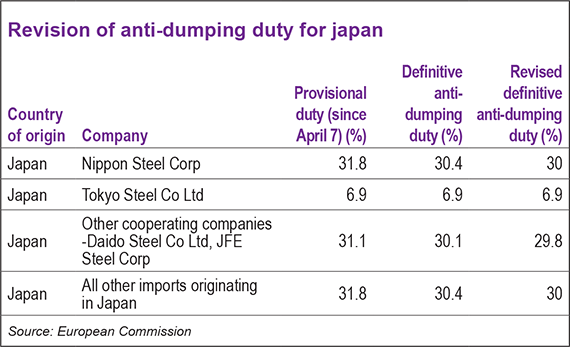
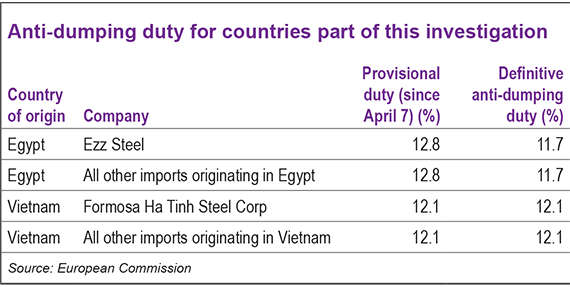
Meanwhile, AD duties for other countries covered in this investigation, including Egypt and Vietnam, were unchanged from the definitive rates announced on July 16, 2025.
While Egypt’s producers will pay 11.7% duty, Vietnamese exports to the EU are subject to a 12.1% AD duty. India, and Vietnamese exporter Hoa Phat, were exempted from any AD duties at the preliminary stage due to insufficient evidence of dumping.
EU buyers unfazed
“The change [in duties] is unlikely to affect buying interest in Europe,” a trade source told Fastmarkets.
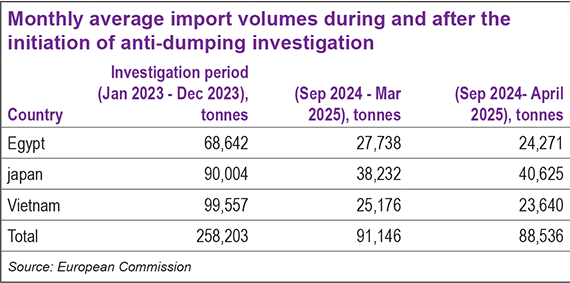
The Commission’s report noted a decline in imports of certain HRFS products into the EU. The monthly average shipments from Japan fell by more than half compared with the investigation period, while Vietnamese exports dropped even further (see table 3). The investigation covered imports from January to December 2023.
Circumvention risks flagged
The Commission warned that any attempts to bypass the duties, such as rerouting shipments through third countries, or flooding the market later, could prompt fresh investigations and expanded penalties.
The anti-dumping probe was initiated on 8 August 2024, following a complaint by European steel industry association Eurofer. The investigation covered imports from January to December 2023.
