


EC opens consultations on CBAM’s technical application
The European Commission launched a series of public consultations surrounding the technical implementation of the Carbon Border Adjustment Mechanism (CBAM) on Thursday (28 August), as a first step in clearing myriad uncertainties presented by the instrument’s upcoming definitive phase.
Such news will be welcomed – though likely also lambasted for its late initiation – by steel market participants, especially given this week’s confirmation that CBAM will not see further delays to its definitive stage. The definitive phase of CBAM, implemented from January next year, introduces fiscal liabilities for the embedded emissions of imports under CBAM-designated product codes, widely applicable to European steel imports.
Split into three consultations, the Commission’s most recent call for evidence proposes three implementing regulations to outline the specific application of CBAM to the bloc’s imports, namely:
- CBAM’s calculation methodology;
- interactions between Emissions Trading System (ETS) free emissions allocations and CBAM liabilities;
- CBAM cost reductions available to accommodate carbon prices already paid on embedded emissions.
The feedback period runs from 28 August to 25 September.
The European Commission has recently concluded a related consultation on the extension of CBAM to downstream products, to further protect against carbon leakage and address circumvention loopholes.
Throughout this series of consultations on CBAM, the Commission has elected not to complete additional impact assessments, deeming its 2021 review as sufficient. The Commission states in its latest briefing document that CBAM’s practical implementations are of “limited, technical scope,” and include “costs/savings of limited magnitude.”
Too close for comfort?
As McCloskey’s steel market sources have cited potential per ton CBAM cost exposure differentials of well over EUR100 on best estimations of different import routes in lieu of actual formula values, it is unlikely that many of Europe’s importers would agree with the Commission’s assessment. Indeed, at European steel distribution association EUROMETAL’s 75th anniversary conference, CBAM was described as everything from a “nightmare,” to a “molotov cocktail for the entire supply chain.”
That said, with further delays ruled out and just over four months to go, the market will likely prefer administrative certainties on CBAM to an administrative report on its impending consequences – though one could question why such matters are being left to industry consultation at the final hour after nearly two years in CBAM’s transitional phase, regardless of the Commission’s reference to “lessons learnt” since 2023.
Methodology uncertainties
CBAM’s calculation methodology has increasingly become the key point of contention in McCloskey’s conversations with steel market sources, as the “benchmark” values operating within the CBAM formula such to derive an importer’s emissions liability have yet to be released by the European Commission – despite the increasing overlap between steel import lead times and CBAM-liable customs clearances.
In effect, importers cannot currently calculate their actual exposure to CBAM import costs, instead resorting to their own estimated values.
The formula defining CBAM emissions exposure is presented below:
Emissions subject to CBAM = embedded emissions – (CBAM product benchmark x CBAM factor)
Imported emissions subject to CBAM must be secured against CBAM certificates, which are priced according to the quarterly average price of equivalent European Union Allowances (EUAs) auctioned under the Emissions Trading System (ETS). Importers can also deduct prior certified carbon payments under parallel international carbon reduction schemes, reducing the number of certificates required. Both CBAM certificates and ETS EUAs represent one ton of CO2 equivalent (CO2e) of embedded emissions in relevant goods.
Averting “carbon leakage”
The “CBAM factor” in the formula represents the inverse relationship between CBAM obligations and existing “free allowances” under the ETS. CBAM’s purpose is to replace these free allowances as a carbon leakage protection mechanism, in ensuring an equitable winding down of the bloc’s net industrial emissions.
Energy-intensive industries deemed at risk of “carbon leakage” – the relocation of polluting industry outside of the EU to escape emissions reduction obligations and costs – have historically been granted free allowances to ensure their continued competitiveness within the EU, in line with their reported productions, and adjusted against the top 10% of competing domestic installations as an ongoing incentive to decarbonise.
The steel industry’s operations have enjoyed widespread and prolonged categorisation as a carbon leakage sector, meaning that for the duration of the ETS’ tenure, steel producers have received the bulk of its emissions allowances for free, without having to secure EUAs via open auction.
This has led to quirks in market cycles, such as in the latter half of 2024, seeing EU steelmakers oversupply the market despite then-subdued demand conditions, in order to preserve maximum emissions allowances for future production.
Goodbye free allowances, hello CBAM
From 2026 however, steelmakers – and other carbon leakage designees – will begin to lose their free allowances at an accelerating rate to ensure the EU meets its decarbonisation targets. This wind-down opens with a 2.5% reduction from January, nearly halving to a 48.5% reduction in 2030, and fully extinguishing free allowances from 2034.
The “CBAM factor” therefore correlates to these reductions to ensure equivalence between domestic and international markets, meaning that importers of CBAM goods can import 97.5% of their embedded emissions duty-free in 2026, though not without caveat.
CBAM’s elusive benchmarks
This caveat is the aforementioned “CBAM product benchmarks”, which operate similarly to the adjustment factor in the ETS free allowance calculation, incentivising importers to look to the lowest emitting suppliers when sourcing international steel. As long as EU importers remain in the dark as to exact benchmark values, they cannot accurately deduce their cost exposure under CBAM – even for material already on the water.
Larger steel trading companies have already been baking CBAM premiums into their sales to end-users, as consumers have been unwilling to adopt variable cost risks into their procurement.
Despite their link and interdependence, respective coverage under the ETS and CBAM are not identical – for example, CBAM operates at the product level, applicable to the emissions embedded under production route-agnostic CN codes; whereas the ETS assesses emissions liabilities for industrial installations at the production stage – meaning the remit of each mechanism cannot be so easily assumed.
Commission confirmations
The “Call for Evidence” briefing document seeks to enlist industry responses to “clarify key technical aspects of [CBAM],” and solidifies many of the Commission’s intentions for the instrument:
- CBAM’s methodology will be revised and simplified (in line with previous resolutions under the Commission’s Competitiveness Compass strategy).
- The calculation process for direct embedded emissions (for which steel imports are liable) and indirect emissions will be clarified in detail.
- CBAM factor methodology will mirror existing free allowance rules under the ETS.
- Mechanisms and “sufficient evidence” for claiming CBAM cost reductions against carbon prices “effectively paid” under parallel carbon systems will be made transparent, supporting international emissions reduction schemes and leaving the door open for the development of a global carbon price.
The review seeks to encourage and better facilitate declarations using actual emissions values for CBAM compliance, but will also make transparent default emission fallbacks.
Benchmark challenges
As for CBAM benchmarks, the Commission confirms that “benchmarks will be derived from the relevant EU ETS benchmarks used to determine the allocation of free allowances within the EU carbon market […] to reflect the relevant amount of free allocation in imported goods.”
The Commission acknowledges the “key challenge” in matching the ETS and CBAM benchmarks, and states it prefers a “simple […] and accurate” approach in order to avoid “a disproportionate administrative burden.”
While previous communications do suggest that CBAM benchmarks will be separately categorized via production route as in the ETS, which bifurcates its benchmarks for electric-arc furnace and blast furnace-produced steel, this is still yet to be explicitly confirmed by the Commission and could be threatened by their preference for simplicity – though a commitment to an accurate reflection of free ETS allowances would surely require a continued split.
The Commission’s indicative timeline schedules Q4 as the deadline for the technical implementing acts, which will presumably be preceded by the synopsis report on the consultations, which is “to be published in due course.”
Benjamin Steven Journalist, Steel

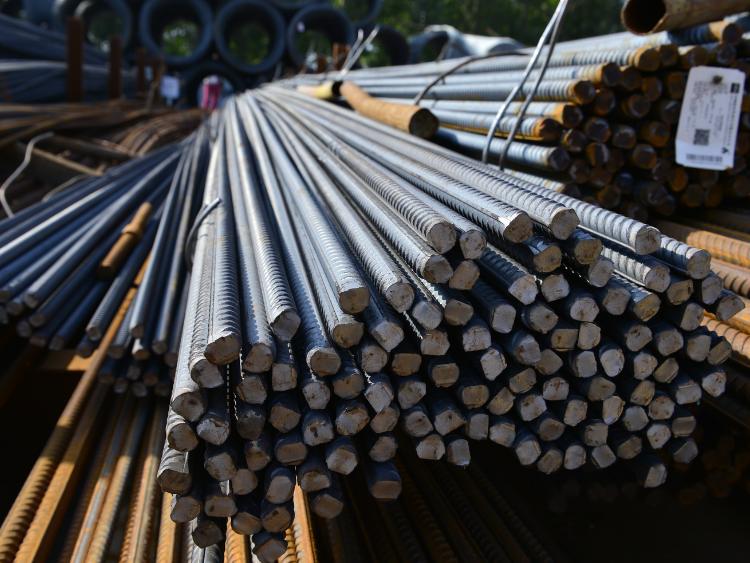
Polish rebar prices drop further on muted demand
Polish rebar prices weakened during the week to Friday August 29 due to sluggish demand, with mills resorting to production cuts to fend off further price drops, sources told Fastmarkets.
Over the week, market participants indicated that prices for rebar hovered around 2,400-2,430 zloty ($656-664) per tonne CPT. The previous week, traders estimated the workable market for rebar at 2,400-2,450 zloty per tonne CPT.
“There isn’t much room for prices to go deeper down – I believe we have reached the bottom,” one distributor source told Fastmarkets, adding that September’s decision on scrap delivery prices might influence the market.
“Scrap is an important cost factor for long steel products, so we might see new price increases in September,” the source said.
Meanwhile, Fastmarkets heard that some mills in Poland have stopped accepting new orders for rebar and reduced their production quotas to keep prices stable.
“We are not making money at current prices, so we’ll have to reduce production for the month of September,” a producer source said.
“We’d rather take a production cut than lower prices,” the producer source added.
Fastmarkets’ weekly price assessment for steel reinforcing bar (rebar) domestic, cpt Poland was 2,400-2,430 zloty per tonne on Friday, narrowing downward by 20 zloty from 2,400-2,450 zloty per tonne the previous week.
Some import prices for rebar from Germany were heard around €580-590 ($676-688) per tonne delivered. Meanwhile, import prices from Ukraine were heard hovering around €540-550 per tonne delivered, for quantities above 1,000 tonnes.
Meanwhile, wire rod prices remained stable this week.
Fastmarkets’ price assessment for steel wire rod (drawing quality), domestic, delivered Poland was 2,580-2,650 zloty per tonne on Friday, unchanged week on week.


EU HRC prices hold ground; buyers continue pushing back on higher offers
European hot-rolled coil prices were holding ground on Friday August 29, with sources expecting more clarity on the direction of prices in the coming weeks, Fastmarkets heard.
Producers in Northern Europe achieved some price rises in recent weeks, with deals rising from rock bottom levels in June and July.
Notably, HRC with October lead times was heard traded at €570-580 ($665.79-667.37) per tonne ex-works recently.
On Friday, most buyer sources estimated achievable prices at €580 per tonne ex-works.
At the same time, target offers of €600-630 per tonne ex-works for October-November lead times were still considered “unrealistic” by local buyers amid a lack of demand.
One Italian supplier was offering October-delivery HRC at €610-620 per tonne delivered to Germany, with no sales reported at these levels so far.
Fastmarkets’ calculation of the daily steel HRC index, domestic, exw Northern Europe was €578.33 per tonne on Friday, down by €1.05 per tonne from €579.38 per tonne the previous day.
The Northern European index was down by €4.58 per tonne week on week and up by €20.00 month on month.
European suppliers maintained higher offers, despite pushback from customers and stable end-user demand.
Sources said the uptrend was mainly backed by expectations of reduced import availability and higher costs of import steel in general due to the introduction of the Carbon Border Adjustment Mechanism (CBAM) and new trade measures to replace safeguards.
“Now mills in Asia are offering October shipment and there is a chance that material will fail to arrive in December, therefore falling under the scope of CBAM in January 2026,” a buyer in the Benelux area told Fastmarkets.
The source estimated that imported coil will be €50-70 per tonne more expensive when CBAM comes into force.
Another source said that mills were also bullish due to looming long-term contracts negotiations with end users.
“The gap between long-term and spot prices is enormous now; it’s over €120. So mills are trying to push spot levels higher to have a better position in negotiations,” a German buyer said.
Meanwhile, Fastmarkets’ daily steel HRC index, domestic, exw Italy was €541.67 per tonne on Friday, stable day on day.
The Italian index was up by €0.84 per tonne week on week and by €13.54 per tonne month on month.
Many stakeholders were still on holiday and expected to return in September.
Integrated mills and re-rollers in Italy were targeting €570-580 per tonne ex-works for October tonnages. Estimates of achievable prices were heard between €540 and €550 per tonne ex-works.
Prices for overseas coil were also largely unmoved.
HRC from Indonesia was on offer to Italy around €470-475 per tonne CFR, sources said, but buying interest was minimal due to regulatory uncertainty.
Meanwhile, offers from Turkey remained at around €520-540 per tonne CFR, including the EU anti-dumping duty.
HRC from India was on offer to Italy at €520-525 per tonne CFR.