

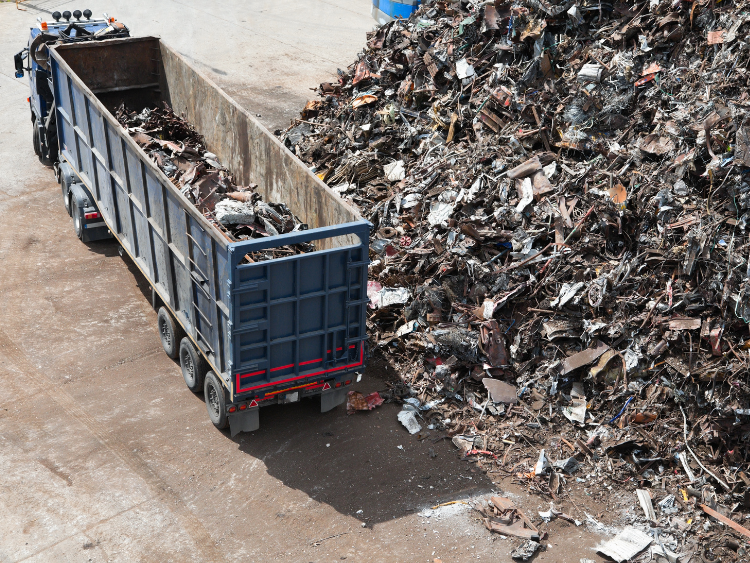
European scrap export ban would hurt steel: associations
The Federal Association of German Steel Recycling and Waste Management Companies (BDSV) and the Association of German Metal Traders and Recyclers (VDM) are against the proposal of the European Steel and Metals Action Plan (SMAP) to potentially restrict the export of scrap, Kallanish notes.
They point to a recently published independent study on the impact of export bans on ferrous scrap, conducted by the Ernst Abbe University of Applied Sciences in Jena (see Kallanish passim).
It concluded that export barriers to recycled steel would distort markets, trigger retaliatory measures, and undermine Europe’s security of supply – without strengthening the EU steel sector. Such measures would undermine both the European steel industry and global climate protection efforts, it noted.
Since scrap trade is very sensitive to cost changes, trade barriers can lead to a shift in trade flows away from Europe. Export barriers pose trade policy risks, including retaliation, the risk of restricting access to high-quality imports and reducing global scrap use, BDSV and VDM conclude,
The study finds that EU policy should address structural challenges such as high energy costs, while accelerating sorting and pre-sorting, standardising quality and certification, and supporting investments that improve the quality of recycled steel and stimulate market demand.
“This document confirms what recycling companies have long been saying: export restrictions on recycled steel are the wrong tool,” says European Recycling Industries’ Confederation (EuRIC) secretary general Julia Ettinger. “The EU should focus on real solutions – reducing energy costs and investing in high-quality recycling – instead of turning to protectionism.”
“The European recycling industry is globally competitive,” says BDSV managing director Guido Lipinski. “Export restrictions would harm this competitiveness, while diverting non-European trade flows would have no positive impact on the supply of European consumers, which is not at risk.”
Svetoslav Abrossimov Bulgaria


ArcelorMittal Hunedoara halts production amid deteriorating market
Romania-based ArcelorMittal Hunedoara will suspend production from 5 September for an indefinite period, parent company ArcelorMittal tells Kallanish.
“This decision, while difficult, reflects the company’s ongoing assessment of the deteriorating market landscape, which continues to be shaped by persistently high electricity costs, limited governmental support, and intensifying competitive pressure from imports,” it says.
“These factors have significantly impacted the site’s ability to remain competitive across domestic, European, and international markets. The order book has seen a sharp decline, with volumes down nearly 60% compared to 2024, further reinforcing the need for this extended pause,” it adds.
In light of these conditions, the company also anticipates prolonging the current economic unemployment measures beyond 30 September, for an indefinite period.
This step is being considered as part of a broader effort to responsibly manage the evolving situation and mitigate the financial impact on employees, the group notes. “ArcelorMittal remains committed to closely monitoring market developments and will reassess its position as conditions evolve,” it adds.
The enterprise is immediately commencing discussions with its social partners.
ArcelorMittal Hunedoara previously suspended production from 14 February until 31 March due to very high electricity prices (see Kallanish passim).
Last December, the plant reduced production due to a lack of orders.
The Romanian firm took similar measures in 2022, also due to a lack of orders. In 2020, it also stopped production temporarily due to the Covid pandemic.
Electric arc furnace-based Hunedoara, part of the ArcelorMittal Europe – Long Products division, produces sections, billet and merchant bar, employing 584 people and some contractors. The firm produces 200,000-300,000 tonnes/year of crude steel.
Hunedoara remained part of ArcelorMittal after the steelmaking group sold its flagship Romanian Galati steelworks to Liberty Steel in 2019.
Svetoslav Abrossimov Bulgaria

Turkey nears exhaustion of EU HRC import quota for Q3
Beginning the last month of the EU quota period from July 1 to September 30, some import quotas for certain steel products allocated for countries like South Korea, Taiwan, Egypt, China and some other countries have already been exhausted, according to the latest data from the European Commission. Turkey’s 402,732 mt HRC (1A) quota usage has reached 99.98 percent, with just 2,740 mt of the quota remaining.
In addition, Turkey, Vietnam and Japan have each exhausted their 21,207 mt quota for metallic coated sheets (4B) allocated under “other countries”.
Turkey’s EU import quota usage by product in Q3

Looking at the other exhausted quotas, Taiwan has used all of its 113,428 mt quota for metallic coated sheets (4A), while it has exceeded its quota of 23,037 mt for organic coated sheets with 2,178 mt waiting for customs clearance. China has exhausted its 141,949 mt quota for merchant bars and light sections and its 17,563 mt quota for rebar allocated under “other countries”. South Korea has used all of its 71,880 mt quota for organic coated sheets, while Egypt has exhausted its 15,255 mt quota for wire rod allocated under “other countries”.
The other quotas near exhaustion can be seen in the table below.
| Product | Country | Amount (mt) | Remaining (mt) | Used (%) |
| HRC (1A) | Australia (under other countries) | 112,716 | 21,209 | 81.18 |
| CRC | South Korea | 95,726 | 6,134 | 94.32 |
| CRC | Vietnam (under other countries) | 43,989 | 1,647 | 96.26 |
| CRC | Taiwan (under other countries) | 43,989 | 4,602 | 91.52 |
| Metallic coated sheets (4A) | India | 54,279 | 9,745 | 82.05 |
| Quarto plate | South Korea (under other countries) | 111,358 | 6,735 | 93.95 |