


Germany’s Feralpi Stahl joins Juwi to develop regional wind farms for green steelmaking
German steelmaker Feralpi Stahl has announced that it is accelerating its transition toward low-carbon steel production through a new cooperation with Germany-based renewable energy developer Juwi.
The two companies have signed a memorandum of understanding to jointly explore the development of regional wind farms capable of supplying renewable electricity to Feralpi Stahl’s rebar production facilities in Riesa. If implemented, the initiative would strengthen regional energy resilience, reduce emissions, and expand local participation in Germany’s clean-energy transition.
The planned collaboration focuses on two upcoming wind energy projects in the Mittelsachsen district. These projects, one with five turbines and the other with six, are expected to begin operation by 2029. Each turbine is designed to generate approximately 20 million kWh per year.
Additionally, Feralpi Stahl has the option to participate through direct investment, provided the economic framework is viable.
Uwe Reinecke, general manager of Feralpi Stahl, emphasized that the company is consistently decarbonizing its production processes and views cooperation with Juwi as a potential step toward producing fully green steel in Riesa. The company has already invested more than €220 million in its German operations.
Feralpi Group’s overarching climate strategy aims for net-zero emissions by 2050.


Regulation alone will not solve problem of steel industry’s lack of competitiveness
SteelOrbis talked to Piotr Ślusarz, president of Polish Metallurgical Chamber of Industry and Commerce, about latest developments in EU steel industry.
How would you describe the current steel demand trends in the EU steel market across major sectors (construction, automotive, machinery, etc.)?
The visible economic slowdown in Europe is negatively impacting demand for steel and, consequently, demand for ferrous scrap. Low steel demand is under pressure from imports of steel products from non-EU sources, including the import of steel products and semi-finished products from Ukraine, which is most damaging to the Polish economy.
How are high energy prices affecting output, investment and competitiveness?
Unfortunately, in Poland we have some of the highest electricity prices in the EU, which results in lower margins and very often in the inability to achieve profitability in industries such as steel production or scrap recycling.
Do you foresee further consolidation or restructuring in the European steel industry?
If the process of restricting the trade in ferrous scrap continues, the only plants processing ferrous scrap in Poland will remain those belonging to steel mills.
What are the effects of geopolitical developments on trade routes?
The restrictions introduced in the WSR will affect the trade routes for ferrous scrap and significantly weaken the scrap industry, which is responsible for achieving recycling and recovery levels for many key sectors in terms of GDP generation for the country.
What are your expectations for steel demand and prices in the short to medium term?
Observing the direction the EU is following, the industry is dismayed by the months-long decline in scrap metal values and the quantitative reduction in demand for ferrous scrap in Europe.
Are you optimistic or cautious about the EU steel sector’s medium-term competitiveness?
The competitiveness of the steel and scrap recycling sectors is burdened with significant costs and struggles with expensive electricity, especially in Poland.
How do you evaluate the latest announcement from the EU regarding the safeguard policy?
The EU should ensure not only support and protection for the steel industry, but also for the recycling sector. Without a scrap metal industry, the steel industry will be unable to meet the requirements and expectations of EU industry.
Are these trade measures effective in ensuring a level playing field, or do they distort competition?
The focus should be on resolving the causes of the lack of competitiveness. Regulation alone will not solve the problem of the steel industry’s lack of competitiveness. Regulation cannot be effective since we are dependent on steel imports from outside the EU, have insufficient production capacity and lack energy infrastructure.
What do you think the main challenges of CBAM are and what effects do you anticipate on trade flows?
I think it will seal off some trade flows, blocking steel products and semi-finished goods entering the EU from the east (Ukraine and Russia) via transit countries.
Do you think current EU funding mechanisms are sufficient to support the green transition in steel?
Support mechanisms apply only to steel mills, and not to all of them, only to those that meet the appropriate criteria. For this mechanism to be effective, this support must cover the entire supply chain, including the scrap industry.
How do you see the balance between environmental targets and global competitiveness?
To achieve environmental goals, it is necessary to create market conditions that provide opportunities for competitiveness. Without these conditions, achieving environmental goals will mean abandoning local industry in the EU.
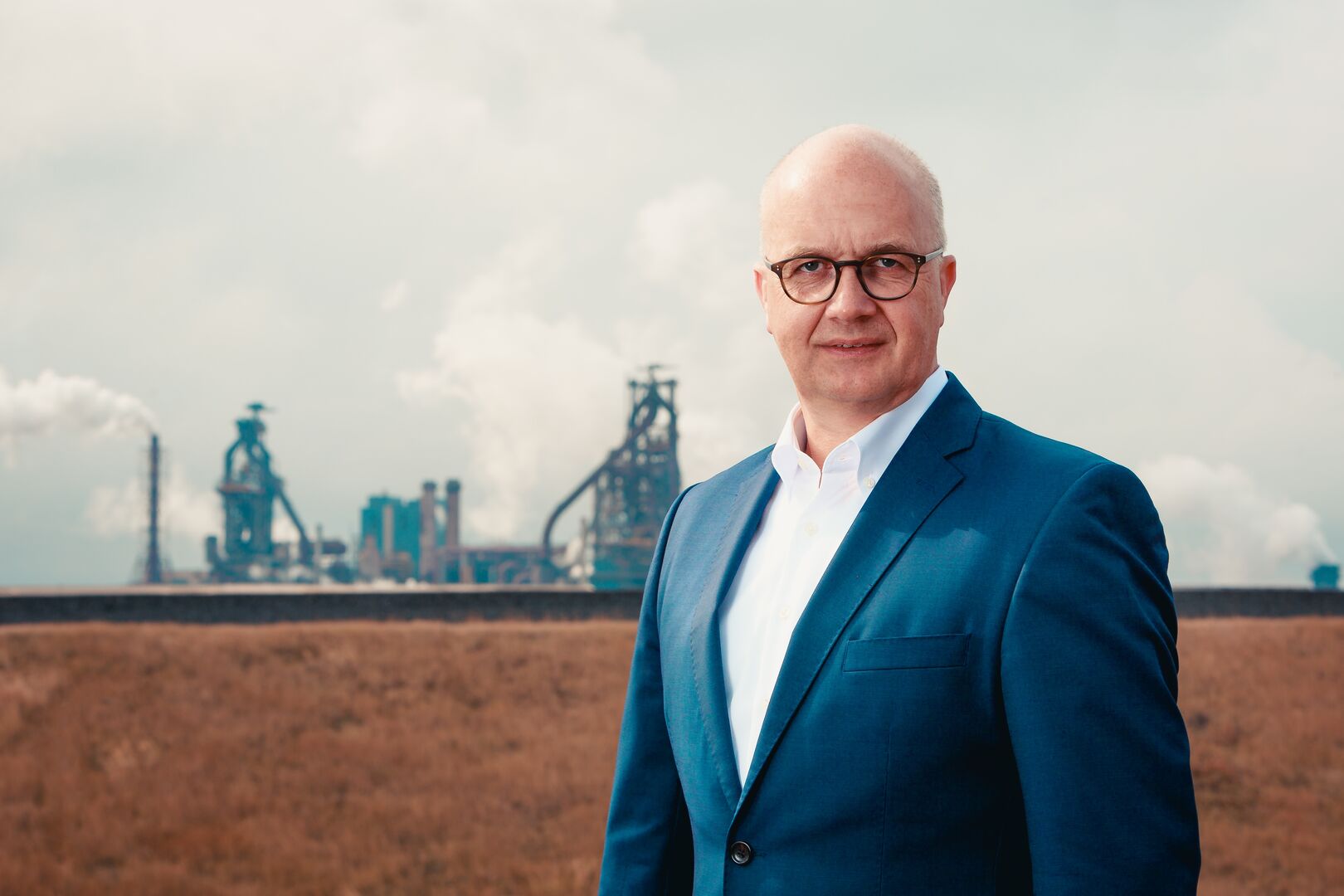
Henrik Adam re-elected EUROFER President
Today the European Steel Association (EUROFER) elected its new Board, President and Vice-Presidents. Henrik Adam was confirmed as President of the organisation for another two-year term.
Dr Henrik Adam currently serves as Executive Chairman of Tata Steel Netherlands Holding BV and as Chairman of the Steel Institute VDEh in Germany. He has been President of EUROFER since November 2023, and previously held the role of Vice-President from 2019. He was also Chairman of WorldAutoSteel. With his extensive background in the steel industry, Adam’s renewed mandate ensures continuity of leadership at a pivotal moment for the future of the sector.
Speaking after his re-election, Dr Adam said: “I am eager to drive forward the crucial work we have started to safeguard our industry’s competitiveness while ensuring the conditions for a successful transition. It’s not just about steel – which sits at the heart of key value chains and clean technologies such as automotive and renewables – but about Europe’s future, its industrial sovereignty and geo-economic resilience”.
“I reaffirm my full commitment to working tirelessly with EUROFER and to pursuing the constructive dialogue initiated with the European Commission to advance all our key priorities: the swift adoption of the steel trade measure addressing global overcapacity; closing the CBAM loopholes to avoid carbon and jobs leakage; cutting sky-high energy prices to restore industrial competitiveness; boosting demand by promoting European green content; and securing ferrous scrap supply and recycling in the EU. Only by following this path can we preserve Europe’s prosperity”, he added.
“I am looking forward to continue close cooperation with Henrik Adam to lead the European steel industry through a challenging transition and one of the most threatening existential crises the sector has ever faced. His ongoing leadership is essential to steer the journey we have begun together with the European Commission, the European Parliament and member states, and to ensure the full, robust and urgent implementation of the Steel and Metals Action Plan and a successful decarbonisation of the sector. This will remain our focus in the coming years: Europe can only be stronger with European steel”, concluded Axel Eggert, Director General of EUROFER.
President and member of the Board
Henrik Adam, Executive Chairman Tata Steel Netherlands Holding BV
Vice-Presidents and members of the board
Geert Van Poelvoorde, CEO ArcelorMittal Europe
Timoteo Di Maulo, CEO Aperam SA
Mario Arvedi Caldonazzo, CEO Arvedi SpA
Jordi Cazorla Pujalte, CEO Celsa
Lorenzo Riva, CEO Riva Stahl GmbH
Gunnar Gröbler, CEO Salzgitter AG
Johnny Sjöström, CEO SSAB
Maria Jaroni, CEO thyssenkrupp Steel Europe AG
Hubert Zajicek, CEO voestalpine steel division
Members of the Board
Stefan Rauber, CEO Dillinger Hüttenwerke/Saarstahl AG
Flavio Bregant, Director General Federacciai
Lucia Freire, CEO Megasa Group
Ben de Vos, CEO NLMK Belgium Holdings SA
Kati ter Horst, CEO Outokumpu Oyj
Roman Heide, CEO Třinecké železárny AS
Bernardo Velazquez Herreros, President of UNESID
Miroslav Kiral’varga, Vice-President U.S. Steel Košice
Kerstin Maria Rippel, Director General Wirtschaftsvereinigung Stahl

CBAM uncertainty clouds stainless steel market at Maastricht expo
CBAM, which enters its definitive phase on January 1, 2026, will require importers to pay for the embedded carbon emissions in goods such as stainless steel, aligning costs with the EU’s Emissions Trading System (ETS).
Despite the leak of key benchmark documents earlier in the week, market participants said the complexity of compliance and the lack of final values were still clouding trade.
“The EU has left it until now to release some of the most crucial numbers that go into the calculation of that tax,” Gabriel Rozenberg, chief executive officer of CBAMBOO, said during a panel discussion at the event. “The lack of certainty has been very frustrating.”
Rozenberg noted that the payment obligation falls on the importer of record, regardless of company size. “If you’re the importer of record, you pay,” he said.
Verification requirements are also a concern.
“If every supplier in the world needs to get themselves verified simultaneously, there are only so many verification auditors on the planet who can do this sort of work,” Christophe Lagrange, secretary general of EURANIMI, said.
The leaked draft regulation distinguishes between actual-data and default-value methods for determining emissions.
“We ran numbers and saw that the default values led to a CBAM tax as high as €540 ($625) per tonne if you use the default value,” Lagrange said.
Tom Lord, head of trading and risk management at Redshaw Advisors, said the CBAM price would be derived from the volatile EU ETS price.
“Your CBAM exposure is based on a fluctuating market price,” he said. “Most analyst projections suggest that prices will be up at the €90-120 range in the next couple of years.”
“Done correctly, CBAM can be an opportunity for European producers and importers alike if they hedge their exposure correctly. Left unhedged, then you’re at the mercy of the market,” Lord added.
According to the leaked draft annex, steel hot-rolled coil carries benchmark values of 1.530 tonnes of carbon dioxide equivalent (tCO2) per tonne for blast furnace/basic oxygen furnace (BF/BOF) production, 1.033 tCO2 per tonne for direct reduced iron/electric-arc furnace (DRI/EAF) and 0.288 tCO2 per tonne for scrap-based EAF routes. But with the final set of default values and benchmarks not expected until March or April 2026, market participants said they were still operating in an “untransparent environment”.
“Even if you don’t have every piece of the jigsaw, we have enough to start estimating and tracking your exposure from the first of January,” Rozenberg said.


Italian rebar market bullish but stable amid limited supply, increased seasonal demand
Fastmarkets’ weekly price assessment for steel reinforcing bar (rebar) domestic, exw Italy was €540-570 per tonne on Wednesday, unchanged week on week.
Upward pressure in the Italian market is being driven by tighter supply and increased competition for material, sources said.
One buyside market participant said there has been an increase in appetite for rebar as “everyone is stockpiling material” ahead of end-of-year holiday production closures, “and they are rushing to steel mills”.
The source added that the EAF shutdown at Pittini Group’s flagship Ferriere Nord long steel plant at Osoppo in northeastern Italy, following a fire in late October, has added to concerns around limited supply amid some low mill inventories.

EU Steel Service Centers record higher shipments amid continued de-stocking in 2025
EUROMETAL’s latest SSC Market Monitoring report shows that European Steel Service Centers (SSCs) experienced a moderate rebound in shipments during the first nine months of 2025, while stocks continued to decline significantly across the continent.
Across the EU27, shipments of strip mill flat products increased by 0.5% year-on-year between January and September 2025, with September alone up 11.1%, signalling improving industrial activity. At the same time, EU27 SSC inventories fell by 6.2% over the nine-month period, reflecting cautious stock management despite strengthening demand .
A stronger performance was recorded in the AT–DE–NL–BE region, where shipments rose 1.4% year-on-year in January–September 2025 and 10.8% in September.
Stocks in this core industrial region were down 10.9% over the nine months, indicating sustained de-stocking across Northern Continental Europe.
Rising shipments combined with disciplined stock levels indicate that European service centers are cautiously adapting to recovering demand.

Leaked CBAM benchmarks provide some clarity, more uncertainty
The European Commission’s long-awaited draft CBAM benchmark values were provided in a leaked document this week, giving EU importers a crucial number they need to calculate steel import cost from 1 January 2026. They remain subject to revision before finalising and have been called into question by some industry sources, Kallanish notes.
The benchmarks are provided in two columns, A for use when applying the actual emissions intensity data provided and verified by a non-EU steelmaker, and B for use with default values when actual data is not available.
In the case of A, one benchmark value is provided per HS code. However, the document stipulates the requirement to select a production route.
If more than 50% of mass of the crude steel produced or used is sourced from scrap, the production route to be selected is scrap/EAF. If more than 50% of mass of the crude steel produced or used is sourced from DRI, the production route to be selected is DRI/EAF. If more than 50% of mass of the crude steel produced or used is sourced from a blast furnace or smelting reduction route, the production route to be selected is BF/BOF.
If neither of the three routes above contribute more than 50% of the final steel, the production route is selected based on the component contributing the highest mass of the steel, the leaked document says.
Column B provides multiple benchmark values per HS code divided by production process – BF-BOF, DRI/EAF and scrap/EAF.
The basic formula to calculate CBAM cost per tonne of steel imported is:
Actual or default embedded emissions – (corresponding emission benchmark x CBAM factor) x EU ETS price – carbon tax paid.
Taking Indian hot rolled coil as an example, when using default emissions data and therefore a default emissions benchmark of 1.53 tonnes CO2/tonne of steel and country-specific default emissions value of 4.27tCO/t, and assuming a €80/tonne ETS price, the CBAM cost comes to €222.26/tonne in 2026. This is with a CBAM factor – or phase-in rate – of 97.5%, which deceases each subsequent year till it reaches zero in 2034, increasing the cost of import.
For many, however, the leak provides more questions than answers. Although the document lays out detailed rules for actual data that determine how the production route should be selected, “column A contains only one value per product – so the rules have no practical function,” Moravia Steel deputy commercial director Daniel Biedrawa points out in a LinkedIn comment.
For default/column B benchmarks, there are multiple values reflecting different production routes, but the document provides no guidance on how the appropriate route should be chosen. “In other words, the rules exist where they are not needed and are missing where they are essential,” he adds.
GTG Consulting managing partner Luigi Villani meanwhile notes: “Column B remains more relevant because it is the only method that can be fully verified with real data. The iterative method would require proving the ‘precursor of the purchased precursor’, which is not possible in practice, so Column B provides the correct and demonstrable outcome.”
Market participants will be hoping for official European Commission notifications in the short term to dispel some of the uncertainty.
Adam Smith Austria


Spanish authorities approve CSN’s takeover of Galvacolor
The Spanish anti-trust commission, Comisión Nacional del Mercado de la Competencia (CNMC), has approved the acquisition of CL Grupo Industrial’s (Cristian Lay) flat steel producer Galvacolor by Companhia Siderúrgica Nacional’s (CSN) on Monday.
“The Commission concluded that the proposed transaction would raise no competition concerns given the minimal horizontal overlaps in Spain in certain markets, and does not give rise to vertical or portfolio effects,” CNMC says in a note monitored by Kallanish.
Located in Jerez de los Caballeros, Galvacolor produces pickled and oiled, cold-rolled, galvanized, and pre-painted flat steel. The company became part of CL Grupo Industrial in 2020 as part of the acquisition of the Gallardo Balboa group (see Kallanish passim).
Todor Kirkov Bulgaria

EU imposes definitive safeguard measures on certain ferroalloys
The European Commission has imposed definitive safeguard measures on imports of certain ferroalloys into the EU for three years, until 17 November 2028, Kallanish notes.
The measures introduce country-specific tariff-rate quotas (TRQs) by product type, allowing set volumes to enter duty-free. Imports above the quota may still enter duty-free if priced above the established threshold; if priced below it, duties will apply to bridge the gap to the threshold.
The safeguards apply to all third countries, including EEA members Norway and Iceland, but are designed to minimise disruption to the EU’s integrated value chain. The Commission will hold tri-monthly consultations with Norway and Iceland and closely monitor the measure’s impact to reinforce supply-chain resilience, it said.
The decision follows a safeguard investigation launched in December 2024, which found that rising imports, driven by global overcapacity, trade restrictions in other markets and higher tariffs, were causing serious injury to EU ferroalloy producers. Imports of the products concerned increased 17% between 2019 and 2024, eroding EU producers’ market share from 38% to 24%.
“The EU cannot afford to let a strategic industry collapse under the weight of rising import pressures. A TRQ-based safeguard – designed in close coordination with our industry – is a necessary and responsible step to defend our industrial resilience,” Maroš Šefčovič, EU commissioner for Trade and Economic Security; Interinstitutional Relations and Transparency said in a press statement.
The measures are to apply to ferro-manganese, ferro-silicon, ferro-silico-manganese and ferro-silico-magnesium, under CN codes 7202 11, 7202 19, 7202 21, 7202 29, 7202 30 and 7202 99 30.
Elina Virchenko UAE