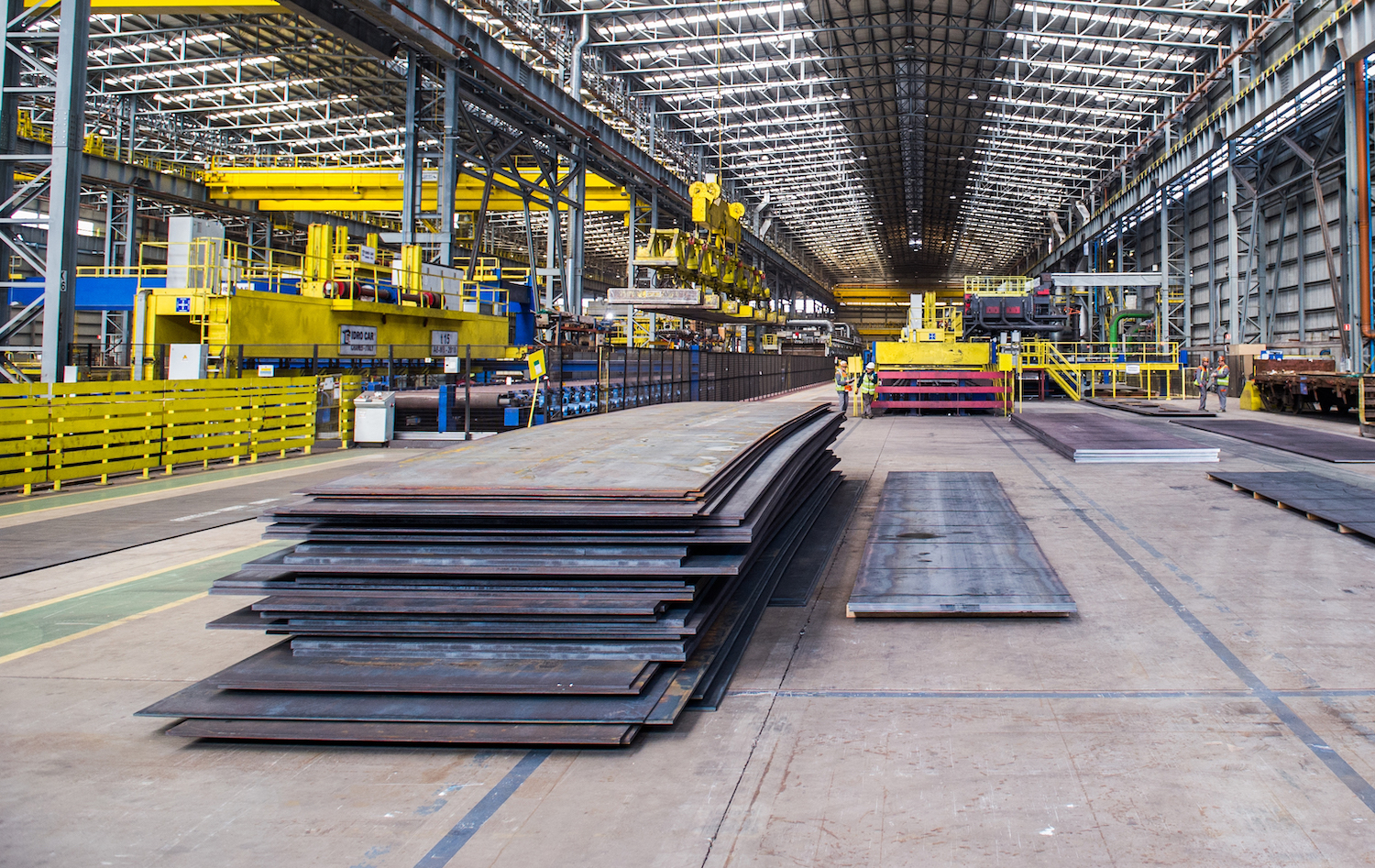
European heavy plate round-up: European plate prices up on CBAM, higher slab costs
European heavy plate prices increased further in the week to 23 January due to effect of the Carbon Border Adjustment Mechanism (CBAM) on costs, higher slab prices and seasonal demand recovery.
Italian re-rollers have been selling s275jr heavy plate at EUR700-730/t ex-works to spot buyers. Offers have been reported at EUR750/t ex-works with some transactions settled at this level with projects. European re-rollers have been offering March shipment plate.
German steelmakers have been firm in their s235jr material offers at EUR750-760/t ex-works. One of the country’s mills has been giving discounts of around EUR20-30/t to special customers, but this had little impact on the market as lower prices were not available to the larger pool of buyers.
A re-roller from the Czech Republic has been offering s235jr plate at EUR720-730/t ex-works.
Offers of s355jr plate from Italy to Germany were reported at EUR780-790/t delivered, and from German mills at EUR800/t delivered.
The introduction of CBAM at the start of the year has made buyers more cautious in their import purchases, often pushing them towards the domestic suppliers due to risks related to the CBAM duties. And while this has helped the domestic plate price recovery, the regulation has also increased production costs for re-rollers, traditionally relying on imported feedstock.
As the actual emissions in slab imports arriving in 2026 and, consequently, CBAM duties will not be certified until 2027, re-rollers have been estimating the duties at around EUR60-80/t. But until exporters obtain the certifications, European re-rollers risk that the duties would be calculated based on default values resulting in substantially higher costs.
Slab exporters from Asia, however, pushed slab offers higher citing good order books and reassuring European buyers that they will get required verifications in time to reduce the CBAM duties. Offers of slab from China and Vietnam have been reported at $530-560/t CFR for April shipment, up from the December deals settled at around $510/t CFR.
The slab costs rise offset the effects the plate price rise had on margins. Market sources said that current plate prices for re-rollers is already close to breakeven with the costs.
“The re-rollers need higher prices as slab prices moved up and with CBAM costs on top the EUR700/t ex-works the prices barely cover the costs,” a mill source said.
| Weekly European heavy plate, slab and green steel | |||||
| Unit | Term | 23-Jan-26 | Change | ||
| Weekly heavy plate | |||||
| Northwest Europe ex-works heavy plate | EUR/t | EX-WORKS | 740.00 | 10.00 | |
| Germany delivered heavy plate (Northwest Europe) | EUR/t | DEL | 785.00 | 10.00 | |
| Italy ex-works heavy plate | EUR/t | EX-WORKS | 715.00 | 15.00 | |
| Weekly steel slab | |||||
| Italy CFR slab | $/t | CFR | 530.00 | 20.00 | |
| Weekly green steel | |||||
| Green heavy plate premium (scopes 1-3 CO2 under 1t) | EUR/t | 25.00 | 0.00 | ||


Leaked IAA draft to harmonize EU industrial framework
The EU’s Industrial Accelerator Act (IAA) – intended to support the competitiveness of the bloc’s industries both globally and in the context of industrial decarbonisation – proposes wide-ranging support mechanisms for the bloc’s core industries, according to a leaked version of the legislation obtained by McCloskey, as it continues through the drafting stage.
Originally scheduled for late December, then late January, and now 25 February, the Commission’s upcoming legislative proposal has generated tensions within industry on several grounds, most prominently relating to low-carbon standardisation methodologies, and made-in-EU content requirements across state-managed procurement and financial support initiatives.
The IAA attempts to protect European industrial competitiveness as part of the Clean Industrial Deal – particularly for the steel and steel-consuming sectors – without unduly diluting the EU’s climate neutrality commitments, seeking a harmonization between climate and competitiveness policy.
Describing the IAA’s purpose, the Commission frames “delayed or insufficient progress on climate action” as a significant economic and social threat, stating that “securing and enhancing the Union’s strategic industries is therefore essential to protecting public order.”
The ‘strategic industries’ prioritised by the IAA are “energy intensive industries” – including the iron and steel sector – “net-zero technologies”, and “downstream industries”. The Commission cites high energy prices, global overcapacities, high capital and operating costs, constrained investment, and burdensome regulatory hurdles as dampening EU competitiveness in these areas.
To combat the downward trend, the IAA proposal introduces a new overarching benchmark for the EU’s industrial manufacturing capacity – assessed in terms of the bloc’s total gross value added – targeting a 20% share for manufacturing sectors by 2030.
In the IAA’s impact assessment – revised multiple times since the initial September report following criticisms from the EU’s Regulatory Scrutiny Board – the Commission acknowledges that downstream industries in particular could suffer net losses from the IAA as a result of “adjustment costs” across their supply chains, but consider that “these losses are largely offset by long-term benefits in terms of job creation, enhanced economic security and resilience of the European strategic industries, which ultimately provide stability and sustainable economic prosperity.”
Steel-consuming industries already feel threatened by potential inflationary effects from rapidly intensifying upstream steel trade protections, largely unshielded from substitutive imports in their own markets. A mandate on purchasing higher-value (and higher cost) low-carbon steel could turn these pressures existential, though the IAA and recent Automotive package provide that financial state support mechanisms will be available, conditional on the adoption of low-carbon domestic steel.
“The Union’s manufacturing industry is the largest sector of the Union’s economy in terms of its contribution to employment and value added.
[…]
There is a risk that the Union’s manufacturing industry may not be able to decarbonise fast enough for the Union to achieve its climate neutrality objective while preserving the Union’s competitiveness. Instead, the latest years have seen greenhouse gas emissions reductions coupled with reduced industrial output. The Union therefore needs to accelerate the decarbonisation of industrial processes and products by strengthening the business case for investment in decarbonisation within a globally competitive environment.”
– European Commission, IAA draft
The IAA in brief
As indicated by the Commission’s statements, a primary thrust of the IAA – aptly named the Industrial Decarbonisation Accelerator Act in its initial formulations – is to better prove this “business case for decarbonisation,” introducing new buy-side measures to incentivise demand for locally produced, low-carbon material in public (and private) procurement, facilitated by the creation of a new low-carbon steel label, and attempts at regulatory streamlining or harmonization.
The Commission considers limited demand for EU low-carbon products; difficulties in scaling industrial decarbonisation projects; and vulnerabilities in strategic supply chains as primary weaknesses in the EU’s industrial framework, presenting a range of measures to streamline regulatory barriers, consolidate and advance industrial decarbonisation, and leverage access to the EU’s Single Market for the benefit of domestic competitiveness.
Also included in the Commission’s recommendations are extensive provisions to control external investment in Union industries, aiming to ensure that the EU sees a reciprocal return for allowing positioning within its industrial sectors.
Overall, the IAA represents an attempt to consolidate regulatory mechanisms across industrial supply chains for the benefit of domestic industries, with measures focused on market pillars of supply; demand; bridged by standardisation provisions to better facilitate and encourage low-carbon liquidity across the EU market.
Detailed analysis of the provisions can be found in the links below – it is important to remember that the legislation exists in a leaked, draft form, and could see significant changes before its official presentation 25 February:
Supply – ‘Symbiotic’ Streamlining
Supply-side initiatives under the IAA largely relate to the clustering of industrial activities within designated zones, the streamlining of regulatory approval processes, and provisions on energy access and critical material stockpiling – most notably relating to steel scrap.
McCloskey has analyzed the specific provisions in this sub-article.
Standardisation – Consolidated Certification
EU green steel standardisation was announced as a priority for the Commission in its Steel and Metals Action Plan (SMAP), now implemented as part of the IAA.
McCloskey has analyzed the specific provisions in this sub-article.
Demand – Principled Procurement
Beyond the implied benefits of methodological standardisation for the liquidity of low-carbon steel on the spot market, the IAA introduces a mandatory preference for low-carbon, domestic steels in the form of minimum content requirements for both public procurement, and state-subsidised private procurement from energy-intensive industries.
McCloskey has analyzed the specific provisions in this sub-article.

European coil and green steel round-up: European coil prices inch up on CBAM, new quotas
The European coil market appears on the precipice of a bullish trend for second quarter deliveries as of 23 January, as market sources report declining availability for cheaper first-quarter material, and firmer offers for post-March lead times.
Market participants are now fairly unanimous that coil prices will rise once mills fully engage sales for Q2, with supply to be increasingly constrained by limitations to import accessibility from the Carbon Border Adjustment Mechanism (CBAM), and the EU’s upcoming replacement to its lapsing steel safeguards.
Hot-rolled coil prices (HRC) in Northwest Europe inched higher on the week, with first-quarter prices considered negotiable to EUR630-650/t ex-works by buyers, confirmed by mill sources. Levels are firmer for the first-quarter, seeing offers at EUR680-700/t delivered for April delivery and beyond.
“At the moment there is at least a 50 euro spread between coil offers, depending on lead time and mill,” said a German distributor, describing the market as “hectic.”
A mill source similarly attributed discrepancies to lead time differentials and a push for higher Q2 prices: “realistically mills are trading at stable prices if they have March material left, and all will claim to be firm on higher prices for the second quarter.”
Buyers are still skeptical in the near-term given poor demand conditions, with a Benelux distributor stating that “the mills really needed to do something to push prices higher as demand isn’t supporting higher rises – activity in the market is just not strong enough.”
Dynamics were similar in the Italian market, particularly on steel sheets, which are reportedly rising in price more rapidly than in North Europe due to additional sensitivity to CBAM costs.
Italian HRC prices were reportedly available between EUR620-640/t ex-works, with imports offered on a DDP Italy basis ex-Saudi Arabia at EUR615/t, and ex-Turkey at EUR620-630/t. CFR Italy offers were available at around EUR500/t CFR ex-India; EUR520-530/t CFR ex-Turkey (without AD duties); ex-Algeria at $670/t (EUR570/t); and ex-Indonesia at $550/t (EUR470/t).
Buyers are almost unanimously deterred from CFR-basis import purchases due to potentially existential CBAM costs if forced to use default emissions values and benchmarks. An Italian trader described how only minimal volumes could be traded CFR, even for larger importers like pipemakers:
“Importing on a CFR basis is still only possible for a small fraction of imports for any company relying on imports, able to dilute high CBAM duties elsewhere in their cashflow – maybe up to 10% of their total imports.”
Italian re-rollers have previously told McCloskey that they have “no choice” but to import under the assumption that requisite verifications for the use of ‘actual values’ for CBAM declarations, as default values otherwise pose too high a cost for continued operations.
Green Steel
While green HRC premiums continue to trade sideways at around EUR70-80/t, the low-carbon market saw its first sign of regulatory stimulus this week following the leak of the European Commission’s upcoming proposal for its Industrial Accelerator Act (IAA) – exclusively detailed by McCloskey in this series of articles.
The IAA introduces the EU’s first official “voluntary low-carbon label” for green steel standardization, and seems to incorporate the controversial ‘sliding scale’ mechanism in its classification thresholds on hot-rolled carbon steel products.
This label is to be incorporated into low-carbon local content mandates for both public and private procurement (where subsidised by state funds) in the EU, and could also assist spot market liquidity for green steel due to greater regulatory certainty as to what is – and is not – considered transparently low-carbon.
The IAA has been delayed again from its January timeline, and is now scheduled for presentation on 25 February.
| Weekly European steel coil | |||||
| EUR/t | Term | 23-Jan-26 | Change | ||
| Weekly Northwest Europe steel coil | |||||
| Northwest Europe ex-works HRC | EX-WORKS | 640.00 | 5.00 | ||
| Northwest Europe ex-works CRC | EX-WORKS | 730.00 | 5.00 | ||
| Northwest Europe ex-works HDG | EX-WORKS | 745.00 | 5.00 | ||
| Weekly South Europe steel coil | |||||
| Italy ex-works HRC | EX-WORKS | 630.00 | 5.00 | ||
| South Europe CIF HRC | CIF | 530.00 | 0.00 | ||
| Source: McCloskey by OPIS. | © 2026 Dow Jones Energy Limited. | ||||
| Weekly green steel | |||
| EUR/t | Term | 23-Jan-26 | Change |
| Green Northwest Europe HRC premium (scopes 1-3 CO2 under 0.8t) | 70.00 | 0.00 | |
| Green Northwest Europe ex-works HRC (scopes 1-3) | EX-WORKS | 710.00 | 5.00 |
| Green HRC premium (scopes 1-2 CO2 under 0.5t) | 70.00 | 0.00 | |
| Green Northwest Europe ex-works HRC (scopes 1-2) | EX-WORKS | 710.00 | 5.00 |
| Green HRC reduced carbon price (scopes 1-3) | 41.67 | -2.56 | |

CBAM spurs coil rises but buyers retreat
Participants are warning the European market may not be ready to accept a large rise in coil prices following the recent announcement of increases by ArcelorMittal, Kallanish learns.
While the hike has likely been encouraged by the Carbon Border Adjustment Mechanism (CBAM) coming into effect since the start of the year, the preceding months saw a slow and gradual increase gaining ground.
“But attempts by steel mills to raise prices more quickly are likely to meet resistance from processors who are not yet able to pass on these costs,” a Dutch manager believes.
He sees recent import offers from Turkey and the Middle East for hot rolled coil at up to €540/tonne ($633) cfr Antwerp. When adding CBAM costs, depending on the case, there would be barely any import arbitrage, with domestic HRC trading at €630-650/t ex-works until last week, he says. ArcelorMittal’s new offers take HRC to €700/t.
The hikes appear bolder for cold rolled coil and hot-dip galvanized coil, with offers now standing for CRC at €830/t and for galvanized material at €820/t. The previous highest quotes were reported in the Netherlands at €750 for CRC and €760 for HDG.
Notably, CRC offer prices have now eclipsed that of HDG. A German observer tells Kallanish that domestic mills have had less interest recently in producing CRC, preferring HRC and HDG, resulting in CRC becoming scarcer on the market.
The Dutch manager also points at EU measures, such as the ongoing anti-dumping investigation into CRC, where higher duties are expected soon. For mills this justifies an extra premium for cold-rolled material, he notes.
One German buyer finds that ArcelorMittal “takes it too far” and that the new prices for CRC and HDG, in particular, “do not fit the market at all; maybe for some special high-grade material”.
He is concerned the new quotes will scare buyers, who will then become even more reserved. “Many will hold back their orders, and a standstill is always bad for the market,” he adds.