


European longs prices tick up, market resistance remains
The recent wave of price increase announcements for longs products across Europe is translating into modest transaction price hikes. However, buyers are widely sceptical about the scope for further rises under current market conditions.
Market sources across western and southern Europe report that, while demand is present, January has been sluggish, largely because many buyers implemented purchases in December ahead of year-end, Kallanish hears.
To compensate for weak domestic demand, European producers are increasingly targeting export sales within Europe. However, logistics constraints are becoming a growing challenge. “Logistics have become extremely expensive,” one longs mill confirms. Barge transport, a cost-effective option, is being disrupted this month by low water levels in Switzerland, Germany and France following a prolonged lack of rainfall. Vessel availability is also tight and some deliveries are being delayed.
Another mill source notes that shipping material to another country now costs almost twice as much as domestic truck transport. Despite this, export activity remains necessary to support order books and avoid production slowdowns, which would otherwise push up fixed costs at a time of high production cost levels.
According to a large European longs producer, demand is broadly stable and in line with what it describes as the “new normal” for Europe. January is traditionally a slow month and the weakness is seen as seasonal. Construction activity is expected to pick up in the coming weeks, having been further constrained in January by adverse weather conditions in several parts of Europe.
Sources say ArcelorMittal raised prices in January by an average of €25-30/tonne ($29.73-35.67/t) versus December across all long products. This is up by around €50/t compared with the lows recorded in October 2025.
While price increases are being implemented gradually, several mill sources stress that January’s upticks remain insufficient to offset rising costs. Electricity prices continue to climb, scrap values rose sharply in January and logistics costs remain high, all of which are weighing heavily on margins. Producers therefore appear determined to continue pushing for higher prices, arguing that current selling levels are close to production costs.
One producer adds that demand is being supported by some eastern European markets, while Spain is currently showing the strongest consumption in western Europe.
Author: Natalia Capra France


Voestalpine sells Böhler Profile to Massachusetts company
Voestalpine has agreed to divest Böhler Profil, a company in its High Performance Metals division, supplier of special profiles for a variety of industrial applications including industrial knives, Kallanish learns.
The buyer is US company Kadant, based in Webford, Massachusetts, with 3,900 employees in 22 countries worldwide. According to voestalpine, Kadant will retain the unit’s staff working at the production site in Bruckbach, Lower Austria.
The Austrian group is divesting the unit for strategic reasons and in line with the streamlining of the High Performance Metals division portfolio. “Kadant had repeatedly expressed interest in the company,” chief executive Herbert Eibensteiner notes on the occasion of the sale agreement.
In the business year 2024/25, Böhler Profil had a workforce of approximately 150 employees and generated revenue of €51.5 million ($61.6m). Over the past 15 years, voestalpine has invested a total of €23m in the Bruckbach site, for purposes including upgrading automation and digitalisation in profile manufacturing, the group highlights.
The spin-off follows the divestment of another unit of High Performance Metals, Buderus Edelstahl in Wetzlar, Germany, as well as site consolidations outside Austria, and capacity adjustments at voestalpine Böhler Bleche. With these measures, the High Performance Metals division has effectively completed the process of restructuring its portfolio, voestalpine states.
Author: Christian Koehl Germany
SSAB highlights minimal US tariff impact
SSAB, which operates production sites in Europe and the USA, has so far seen only a limited direct impact of the US steel tariffs, chief executive Johnny Sjöström said during a conference call this week.
He underlined how SSAB is well-positioned with significant local production in the US. Only a limited volume of special products, especially high-strength steels for the automotive industry, are exported from the Nordics and shipped to North America, and many other overseas locations.
Recently, “we have been selling some more volumes of special steels to the USA, but we don’t have to,” he said. If demand in the USA should go down, the group can divert deliveries to Europe easily, Kallanish heard him say during the call.
SSAB’s US operations at its SSAB Americas division were the main driver behind the group’s improved operating result of SEK 756 million ($86m) in the fourth quarter 2025, up from SEK 486m in Q4 2026. The group notes its strong position in the US heavy plate market was a notable factor that supported the result.
Over the full year, figures saw a year-on-year decline, due to lower steel prices in the group’s main regions. Operating profit fell by SEK 1.7 billion to SEK 6.1 billion, on revenue that dipped by SEK 7.2 billion to SEK 96 billion.
The group’s international setup and the global customer base for its special products are an advantage in principle. However, the nominal figures quoted in a strengthening Swedish krona are affected by a depreciated US dollar, in which most transactions are defined.
Shipments rose slightly at all three divisions, totalling 3.29 million tonnes at SSAB Europe, 1.84mt at SSAB Americas, and 1.24mt at SSAB Special Steels.
For the first quarter this year, the group predicts higher shipments for Europe and Special Steels, and slightly higher sales at Americas, which last year saw the highest volume increase. Prices are expected to climb “somewhat higher” than in Q4, except for Special Steels, which is subject to different market dynamics, and where price hikes will take effect with a delay (see Kallanish 29 January).
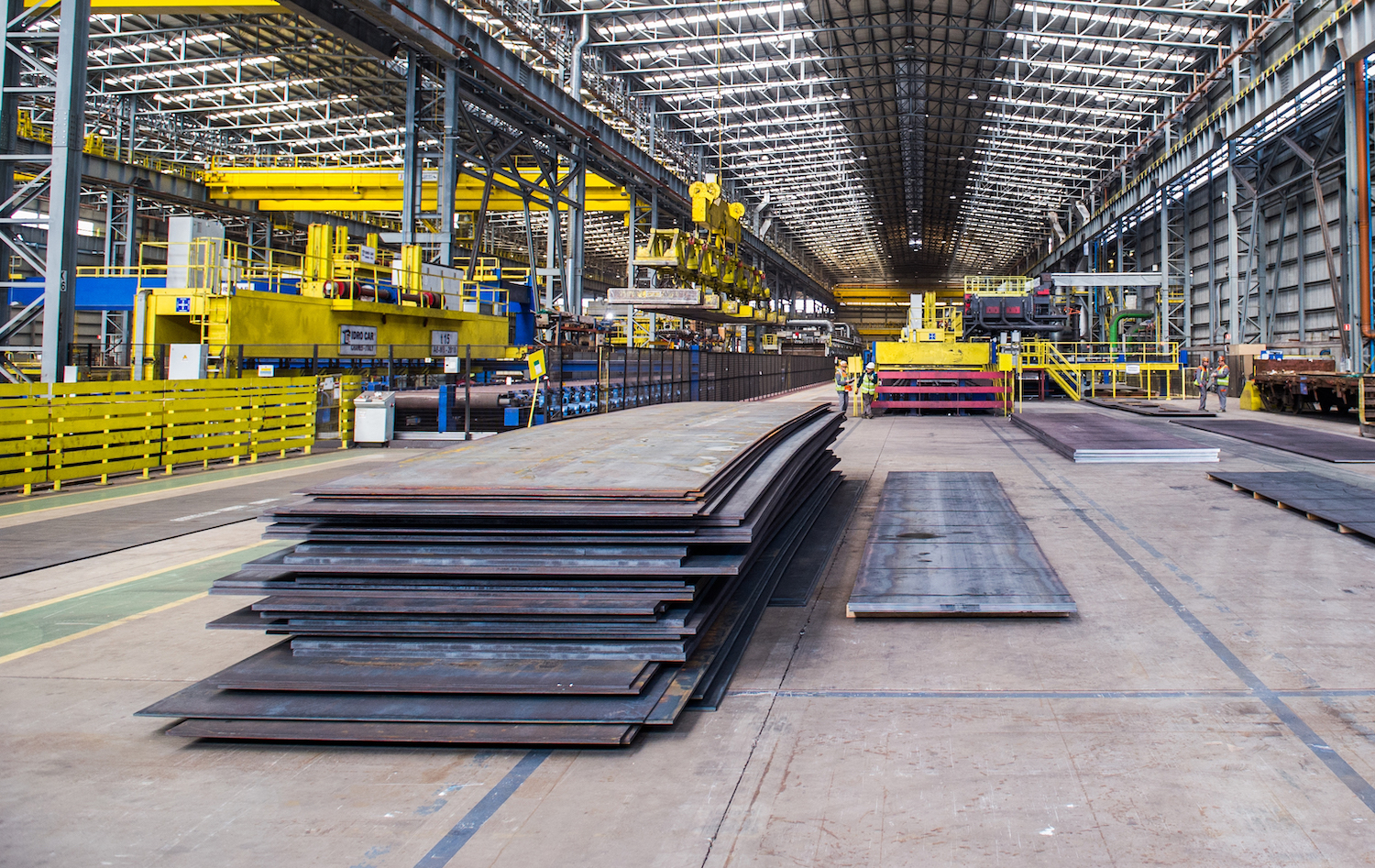
Italian heavy plate rises on CBAM slab costs
Italian heavy plate prices continue to rise, driven by higher imported slab costs linked to CBAM, Kallanish learns.
Market activity has been relatively quiet following the Christmas break, although mills report satisfactory order intakes. Lead-times have now extended into March, while import offers are said to be largely absent or not much below domestic prices.
Producers are also implementing further price increases this month, as CBAM slab costs remain particularly uncertain. One source says there is a possibility that plate prices could move to the €800/tonne ($951.21/t) level as early as February. “The market has to become accustomed to higher prices as protectionist costs take effect. CBAM will be another form of anti-dumping,” a mill source comments.
Mills are continuing to source slabs from their traditional Asian suppliers. Slab values, excluding CBAM costs, are reported at around $520/t cfr southern European ports.
However, prices are expected to rise significantly once CBAM charges are factored in, which sources say are currently difficult to quantify but are expected to be significant.
One slab buyer states that he has been actively working with his suppliers to support the certification of their direct emissions and is confident that, with the assistance of European experts, the certification process will proceed smoothly and costs will be contained. At present, however, CBAM costs appear extremely high when considering default values.
Italian mills are currently quoting around €750/t for S235 plate, with premiums of €30–35/t for S355 and approximately €10–15/t for S275. This represents an increase from around €700/t before to the holiday period. Current contract values before the increases for S325 material remain at €710-720/t ex-works on average.
One distributor says he is currently receiving good volumes of plate orders, but warns that demand could soften if prices reach €800/t, as downstream buyers may reduce tonnages.
Meanwhile, plate price dynamics are diverging between north and south of the Alps, with Italian values rising, while the northwest European market is not yet gaining pace.
Consequently, prices either side of the Alps are equal at present, so ordering Italian material makes little sense for buyers in Austria or southern Germany.
Given that Italian mills have little to no European slab base, they need to follow prices for slab imports, which have risen notably along with the full implementation of the CBAM. Hence, southern prices for S355 plate have reached €730/t in a short time. In northwestern Europe, that has been the desired mark for some two months now, amid limited movement and deals often closing at lower levels (see Kallanish 14 January).
Author: Natalia Capra France
ArcelorMittal rejects €7bn Ilva claim, confirms court summon
ArcelorMittal says there is no legal basis for the €7 billion ($8.32 billion) claim brought by the special commissioners of Acciaierie d’Italia (ADI) in relation to the Taranto steelworks formerly known as Ilva. The global steelmaking group confirms it has been served with a writ to appear before the Court of Milan.
In a note obtained by Kallanish, the steelmaker rejects all allegations contained in the claim. These include the claim that it induced ADI directors and local management to engage in mismanagement as part of a strategy to run down the Italian assets, damage ADI’s business and extract profits from Italy. It denies that its actions caused damages estimated at around €7 billion.
Since 2021, ADI’s holding company, Acciaierie d’Italia Holding (ADIH), has been under joint and equal control with Invitalia, the Italian state investment entity. Invitalia was appointed by the Italian government to implement a public private partnership to relaunch and ultimately acquire the former Ilva assets.
According to ArcelorMittal, it fulfilled all of its contractual obligations, did not exert improper influence over the management and invested around €2 billion in an attempt to turn around what it describes as “a structurally challenged business”.
The steelmaker argues that shortly after acquiring the former Ilva, operations were “affected by an adversarial attitude and wilful acts and omissions on the part of Invitalia and Ilva as well as omissions and illegitimate legislative interventions by the Italian Government”.
“Most notably, in 2019 – less than a year after ArcelorMittal had commenced leasing the business units – the Italian government removed legal protections that were necessary for ArcelorMittal to implement the environmental plan without risk of criminal liability stemming from the status of the plants. This removal, resulting in an unfulfillment of the conditions precedent to the purchase, ultimately led to ArcelorMittal’s withdrawal from the relevant lease agreement,” the group notes.
Invitalia failed to meet its commitments stated in the relaunch plan, despite several proposals put forward by ArcelorMittal. Moreover, measures adopted in February 2024 allowed Invitalia to place ADI under special administration, which resulted in what ArcelorMittal says was “substantially expropriating” its investment.
Blaming ArcelorMittal overlooks Invitalia’s responsibilities and those of the Italian government under the public private partnership, as well as the impact their actions had on ADI’s output, cash flow and planned investments, ArcelorMittal says.
It adds it has filed several claims related to damage to its investment. In June 2025, it launched international arbitration proceedings against the Republic of Italy, alleging unlawful expropriation and discriminatory, unfair and disproportionate measures, which it says caused losses of more than €1.8 billion.
Earlier this month, ADI’s special commissioners lodged a claim with the Milan tribunal against ArcelorMittal, seeking €7 billion in damages linked to the condition in which ArcelorMittal allegedly left the Taranto plant. The amount increased from the level initially contemplated by the Italian government. In December, Italy’s Minister for Enterprises and Made in Italy, Adolfo Urso, told the Chamber of Deputies that the commissioners were preparing a €5 billion claim against ArcelorMittal over the alleged neglect of equipment at ADI’s Taranto plant (see Kallanish passim).