

EU risks steel demand loss ahead of 2028 CBAM extension
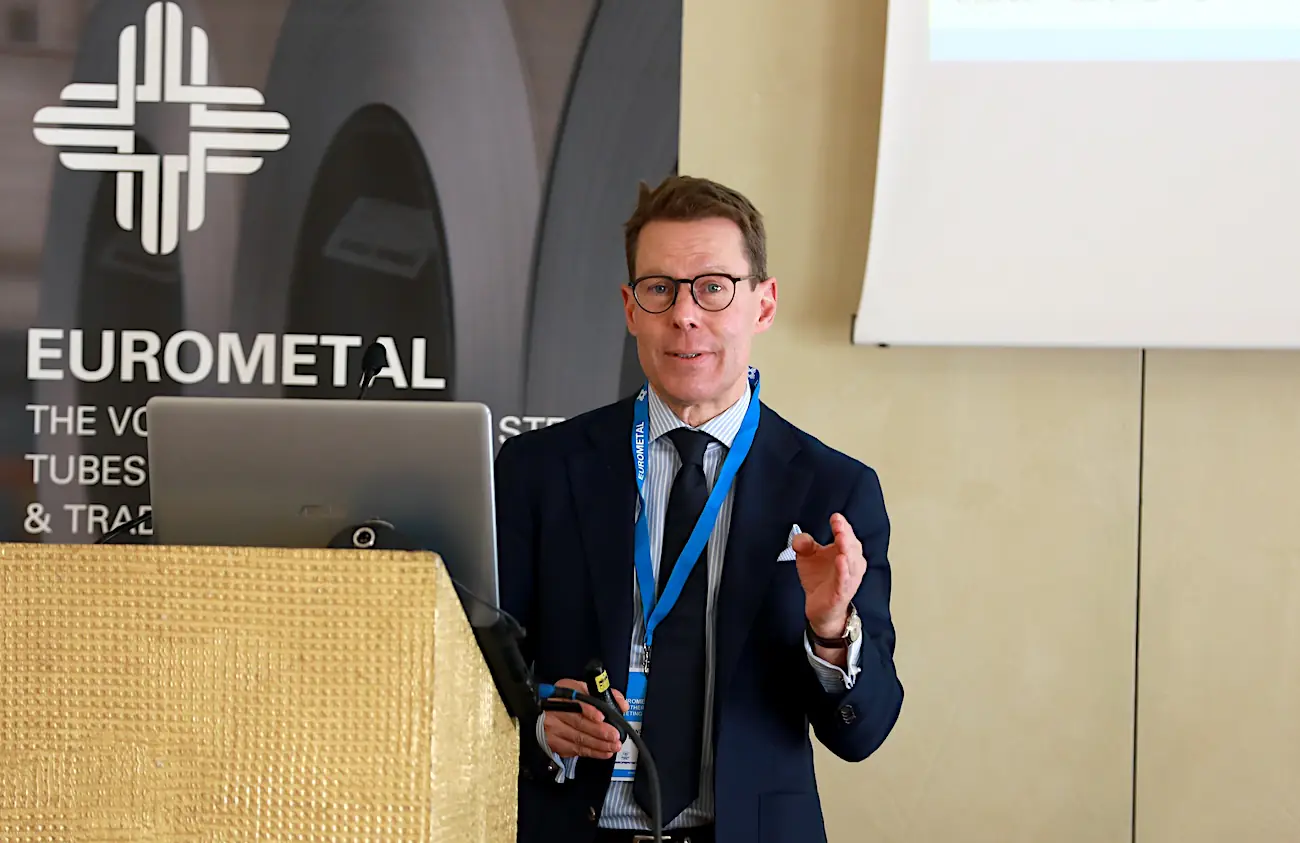
There could be a significant risk to downstream steel demand in 2026-28, prior to the scheduled extension of the carbon border adjustment mechanism (CBAM) to downstream steel-consuming goods, European steel market participants said at the EUROMETAL & Assofermet Southern Europe meeting in Milan today.
Participants suggested that current CBAM costs are being underestimated across the supply chain.
Annual CBAM mark-ups on steel products effectively encourage the import of finished steel derivatives, Polish Union of Steel Distributors president Piotr Sikorski said. While CBAM is expected to expand to downstream products in 2028, the mark-ups on steel will by then be in their third year, potentially continuing to make derivative imports more competitive.
To mitigate the risk of the loss of demand, a list of key HS codes of EU-manufactured products with high steel content has been submitted to the EU by Eurofer, Argus understands. The proposal looks to establish a quota system for downstream products similar to existing steel safeguards.
Key product categories, which have been identified, include car parts and specialised vehicle components, certain home appliances and parts used in machinery and yellow goods. The objective is to implement these safeguards to protect EU manufacturing even before the 2028 CBAM downstream expansion.
Meanwhile, the new version of the steel safeguard measures is still expected to come into effect in July, but attendees warned that there are concerns about the World Trade Organisation compliance of those, at a time of ongoing negotiations on free-trade agreements with several countries on the basis of providing them with specific quotas.
The speed of EU manufacturing deindustrialisation and relocation of production remains a primary concern, market participants said at the event. In response, EUROMETAL is preparing an EU-wide initiative for joint action, president Alexander Julius said, calling for increased co-operation between national federations to present a unified front.
Market sentiment remains subdued, with service centres reporting a weak order intake in February — in some cases 10-20pc lower year on year. Several service centres expect their reliance on imported material to diminish over the course of the year. Imports could fall to about 20pc of their flat steel use, with the remaining 80pc sourced within the EU, according to some estimates. This marks a significant shift from previous years, when as much as 40pc of consumption was covered by imported steel, they said.


Trump’s new 10% temporary tariff takes effect
US President Donald Trump’s new 10% temporary tariff is officially in effect, Kallanish confirms.
The latest tariff, under Section 122, entered force after midnight Tuesday morning, in accordance with the official presidential proclamation issued Friday (see Kallanish 23 February). Later in the weekend, Trump said he would raise the new levy to 15% but that remains unofficial.
The new tariff, in effect for no more than 150 days, follows the US Supreme Court decision striking down the tariffs that the president imposed last year under the International Emergency Economic Powers Act (IEEPA) of 1977.
A press release from US Customs and Border Protection confirms that the Section 122 levy is being collected.
The presidential proclamation offers exemptions, including items that are already subject to the Section 232 tariff on steel and aluminium (see Kallanish 23 February). Specifically, amongst the excluded goods are “articles of iron or steel, derivative articles of iron and steel, articles of aluminum, derivative articles of aluminum, passenger vehicles and light trucks and parts of passenger vehicles and light trucks…heavy duty vehicles and buses.” Imports in compliance with the United States-Mexico-Canada Agreement also are exempted.
A 15% rate under Section 122 would be in violation of some of the trade deals the US has finalised, including higher tariffs than negotiated in deals with the EU, UK, South Korea and Japan, according to a report by Reuters.
Some market participants say the 10% Section 122 duties are buying the administration time to research and determine opportunities to impose tariffs under Section 301. US trade officials have made public statements that Trump may be working on raising it to 15%, but no timelines are given. Some market participants are guessing that the administration may use 10% and 15% subsequently to extend the Section 122 time line.
Trump has made public statements that tariff refunds would be via litigation, meaning those seeking refunds will need to file a lawsuit. Trump suggests that the issue would be fought in courts “for the next five years”.
The Supreme Court ruled, in part, that the IEEPA tariffs would need congressional approval. Unilateral tariffs by the executive branch under IEEPA are unconstitutional, according to the high-court majority opinion.
“The tariff beatings will continue until Congress reclaims some of its constitutional authority over US trade policy and checks the administration’s worst tariff impulses,” says Scott Lincicome, vice president of general economics at Cato Institute.
“Pure tariff chaos from the US administration,” Bernard Lange, chair of the European Parliament’s Committee on International Trade and German member of the European Parliament, writes in a social media post.


Switzerland develops alloy rebar to reinforce bridges
Swiss researchers have developed a strengthening system to retrofit damaged bridges, combining ultra-high-performance fibre-reinforced concrete with memory steel. The latter, alloyed with manganese, silicon, and chromium, among other elements, contracts after being heated, thus prestressing concrete structures.
Researchers at Swiss construction engineering institute Empa have replaced conventional steel reinforcement with iron-based shape memory alloy (Fe-SMA) bars – a “smart” material that can remember its original shape. After installation, the bars are heated to around 200°C. As they attempt to contract but are restrained by the concrete, internal stresses develop. These internal forces can close cracks, lift deformed elements, and extend the service life of a bridge, Kallanish learns.
The Fe-SMA (iron-based shape memory alloy) bars are manufactured like normal ribbed reinforcing bars and are delivered to the construction site in a pre-stretched condition. They are then positioned and anchored in the existing reinforced concrete structure, heated, and then covered with concrete.
The materials used by the Empa team are rather expensive, the researchers note. “The system is therefore particularly suitable for heavily deformed or already damaged bridges – in other words, where conventional reinforcement methods reach their limits.”
ArcelorMittal to shut Belgium-based Tailored Blanks following consultation
The consultation procedure for the planned shutdown of ArcelorMittal Tailored Blanks’ Ghent facility has concluded. Management considered alternative proposals submitted by employee representatives.
In a note obtained by Kallanish, ArcelorMittal describes the dialogue as “transparent and constructive”. The company and social partners negotiated a social plan which guarantees alternative employment within ArcelorMittal Belgium for staff wishing to stay under existing pay conditions. The plan includes a voluntary exit programme, including financial incentives.
On 20 February, 71.11% of the affected workforce voted in favour of the proposed package. The matter will now be submitted to the board of directors for a final ruling on the restructuring plan.
The Ghent facility, which employs 90 workers, has faced a sharp decline in volumes and substantially reduced margins, which have led to accumulated losses over several years. It has been directly impacted by the contraction in Europe’s automotive manufacturing sector. It produces laser-welded blanks, with engineering and manufacturing facilities worldwide.
The company previously stated it remains “the leading supplier of tailored blanks in Europe and is fully committed” to serving automotive sector customers (see Kallanish 12 January).
German annual coil contracts largely finalised
Long-term coil supply contracts in Germany have largely been closed on the upstream end, between mills on the selling side and carmakers and in-between suppliers/distributors as buyers.
Negotiations took longer than in previous years. A year ago, the first deals were closed by early December; others concluded in the course of January. This time around, no deals were reported before year-end 2025. “There were diverse reasons,” a buyer at a processor company explains. “For a long period, we had no master deal signed by mills and OEMs, plus the [targeted] price hikes did not fit the current market.”
The first signals for negotiations are traditionally given during the German sheet fairs in October, Euroblech (Hanover) or Blechexpo (Stuttgart). At Blechexpo last year, mill representatives told Kallanish they were aiming for a three-digit increase compared with the previous year’s contracts.
The was the opposite of the previous year when buyers initially demanded from mills a year-on-year discount of €100 ($117). Eventually, the agreements settled at €50-70 lower. Following the latest talks, prices were settled halfway, at an increase of between €45 and €60, mostly around €50/t, sources report.
“The mills appeared pretty coordinated with their deadlines,” a buyer at a tier supplier believes. He finds that neither side can be too happy with the outcome. The mills had their reasons for demanding a €100 hike against the background of rising costs in a market with unsatisfactory spot prices. Buyers, however, argued perspectives for demand were unclear.
Downstream, negotiations continue between the groups of buyers – the OEMs – and their tier suppliers and steel service centres.

Weak consumption limits Italian longs price increases
Italian longs steel contract prices are largely stable despite producers’ announcing increases at the start of 2026, Kallanish notes.
While certain products, including rebar, are seeing slight declines, others remain steady. Section prices are edging higher, in line with recent hikes implemented by both domestic and European mills.
Agents and distributors report that passing price rises downstream is challenging, particularly in merchant bar, where structural weakness in consumption persists.
Earlier this month, merchant bar makers sought a €50/tonne ($58.94/t) increase, though this has since been reduced to around €20/t.
Buyers had restocked before the announced increases and current consumption at higher prices remains subdued, as buyers are now being delivered material that was booked at old prices. Compared with contract levels at the beginning of the month, contracts show an increase of roughly €10-15/t on average.
Most long steel contracts continue to be agreed at €270-290/t base ex-works equivalent to €690-710/t including size extras, while mills are targeting €300/t ex-works.
Section prices in Italy are moving up by around €30/t. Sustained competition from foreign suppliers, rising energy costs and firmer scrap prices have prompted several European producers to take a stronger pricing stance. Italian first-category sections are trading at approximately €760/t delivered.
The market, however, is uncertain as several payment defaults are emerging. A distributor says maintaining stable month-on-month prices is no longer possible.
“If we try to sell at unchanged prices, we lose orders,” he comments. He adds that recent price increases are further slowing activity, leaving the market out of balance between upstream hikes and downstream price pressure.
Regarding merchant bar, he says he is refraining from new purchases. Material bought in December remains unconsumed due to weak demand, leaving inventories high.