

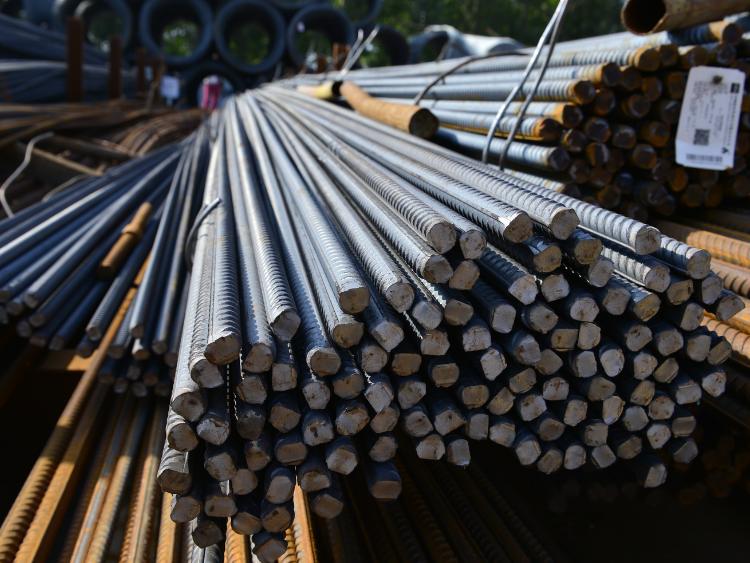
French rebar contracts prices, order volumes increase
French rebar contract values are increasing on-month by €20-30/tonne ($23.28-34.92/t) following the escalation of the US-Iran conflict, Kallanish notes.
European producers have lifted offers due to rising production costs linked to higher gas and electricity prices, as well as increased oil prices for transport. Scrap prices in Western Europe have also edged up this month (see separate article).
Distribution sources say the month started very slowly, with the usual weak order intake, but demand jumped after the conflict escalated last week.
One distributor says his sales volumes have doubled compared with a typical week and points to some signs of “panic buying”. However, another large buyer shows a more cautious view of consumption. “The war is not in Europe. Producers do not pay for energy monthly like households, and consumption in France has not changed, particularly in construction, where activity remains weak,” he says. He, however, concedes that buying has picked up but doubts the recent price increases and higher order levels can be sustained.
French rebar prices have risen from an average of about €610/t delivered last month to €640-650/t delivered in recent days, sources indicate. One distributor in southern France says he has achieved up to €660/t delivered, depending on transport costs, as demand last week and this week has been particularly strong.
Author: Natalia Capra France


Italian rebar makers seek strong increases
Italian rebar producers are raising prices by as much as €70/tonne ($81.48/t) after suspending sales last week amid a sharp rise in production costs linked to the escalation of the Iran-US-Israel conflict, market sources tell Kallanish.
The Italian longs sector is being impacted by the sudden increase in petrol and transport costs, alongside steep rises in gas and electricity prices. Some mills are considering reducing output or cutting shifts to limit production costs which could trigger some shortages, according to sources.
Downstream demand, however, remains weak. Before the conflict, contract values had already declined by a further €10/t amid subdued consumption and slowing construction activity, reaching around €270-280/t base ex-works. Mesh prices had also softened to €340-360/t base ex-works, plus roughly €300/t in extras.
Before the conflict started, including size extras of €260-270/t, effective rebar transaction prices were assessed at around €530-550/t ex-works. This week, producers have returned to the market quoting rebar at €350/t base ex-works, a move that has triggered strong resistance from buyers.
Several market participants say they will not accept the new levels, arguing they cannot pass on the increases downstream. The new asking price for mesh is now €410/t ex-works.
One source at a construction company warns that such a sudden hike in energy and steel prices could delay the start of new building projects, as contractors reassess costs. Another says he will not buy at current prices and can afford to suspend purchasing for three weeks.
Meanwhile, most other European rebar mills are also moving to lift prices. This is in addition to ArcelorMittal and several other producers in Europe seeking higher prices for long products, including rebar, by an average of €15-20/t depending on product. In France rebar prices are rising by €20-30/t (see Kallanish passim).
Author: Natalia Capra France

NW European sections mills return with daily prices
A number of northwestern European mills that had left the market last week appear to have returned with new price offers which are valid for one day only.
Numerous mills last week had stopped making offers, “apparently to get an idea for themselves what they could charge next,” one German manger tells Kallanish.
He suggests that the next target for medium sections S235JR category 1 would be €800/tonne ($932) delivered, a mark suggested by other observers as well.
Those expectations have now materialised with several mills opting for a gross offer price of €800/t, which could still be subject to individual discounts, depending on the deal, a buyer of large volumes says.
He notes that offers that are valid for only one day. “We have not bought yet for that price,” he says, seeing it as realistic. If offers are not accepted within a day, chances are that the next price is higher, he believes.
While this applies to northwestern European mills, he notes that cheaper deals can still be struck with Spanish or Polish mills, at around €770/t. But he also observes a firm determination of the northern mills to assert the new price level.
Another German manager confirms the assessment, and points at the psychological element that goes with such announcements.
He notes that if offer levels must be firm if starting at €800/t. “If they sink back in the €700s, the effort may go up in smoke.”
Meanwhile, ArcelorMittal and British Steel have sent official announcements to their customers in the UK, with hikes of £50/t ($67/t) and £60/t, respectively. This is roughly in line with the increase reported by Continental sources, of €50-70/t, depending on the previous levels.

EU steel safeguard quotas fill up for Q1, with Turkey nearing exhaustion of HRC quota
In the last month of the EU quota period from January 1 to March 31, some of the import quotas for certain steel products allocated for Turkey, Algeria, Vietnam, India, Japan, South Korea and China have already been exhausted, while over 75 percent of quotas for some steel products have been used up, according to the European Commission’s data.
Regarding the other quotas allocated for Turkey, the country has exhausted its 43,033 mt quota for CRC (allocated under “other countries”), its 97,074 mt quota for wire rod and 1,715 mt quota for railway material, and its 37,698 mt quota for other welded pipes. In addition, the country has used 97.59 percent of its 393,977 mt quota for HRC (1A).
Looking at the other exhausted quotas, Algeria has used all of its 110,266 mt quota for HRC (1A), while India has used all of its 77,805 mt quota for organic coated sheets and its 18,833 mt quota for gas pipes. South Korea has exhausted its 5,219 mt quota for angles and sections, while China has used all of its 8,367 mt quota for large welded tubes (25B).
Meanwhile, Vietnam has exhausted its 43,033 mt and 10,608 mt quotas for CRC and organic coated sheets, respectively, while Japan has used all of its 7,347 mt quota for tin mill products. All quotas above are allocated under “other countries”.
In addition, Taiwan has used 98.22 percent and 95.93 percent of its 11,266 mt quota for CRC and its 116,832 mt quota for metallic coated sheets (4A), respectively, both allocated under “other countries”. South Korea has exhausted 78.28 percent, 86.23 percent, 90.23 percent and 97.56 percent of its 38,622 mt quota for electrical sheets (3B), its 37,148 mt quota for metallic coated sheets (4A), its 164,743 mt quota for metallic coated sheets (4B) and its 15,944 mt quota for tin mill products, respectively. China has exhausted 99.79 percent of its 30,628 mt quota for electrical sheets (3B), while the UK has used 90.02 percent of its 35,001 mt quota for metallic coated sheets (4A). Malaysia has used 99.99 percent of its 14,924 mt quota for wire rod, while Macedonia has exhausted 80.07 percent and 88.55 percent of its quotas of 6,955 mt for gas pipes and 25,948 mt for hollow sections, respectively.


European domestic HRC prices see slight uptick amid limited imports
European domestic hot-rolled coil prices edged up slightly on Wednesday March 11 amid challenging market conditions for importers and growing production costs, Fastmarkets heard.
Market sources said concerns persist with imported materials, with import flows affected by the implementation of the EU’s Carbon Border Adjustment Mechanism (CBAM) earlier in the year as well as other trade rules.
In addition, the situation for the market remains unclear after the escalation of the US-Iran conflict, according to sources, which has caused surges in prices for energy and raw materials while also impacting logistics and freight costs.
Meanwhile, a buyer-side source said that while real demand levels remain low in European markets, speculative demand is high as a result of the conflict and shifting geopolitical dynamics.
Fastmarkets’ daily steel hot-rolled coil index domestic, exw Northern Europe was calculated at €705.98 ($816.89) per tonne on March 11, up by €1.60 per tonne from €704.38 per tonne on Tuesday March 10.
Offers were heard around €710-720 per tonne ex-works. Meanwhile, estimates of workable levels were heard around €700-710 per tonne ex-works.
The index was up by €10.41 per tonne week on week and by €53.48 per tonne month on month.
In Italy, offers were heard at €700 per tonne ex-works, while estimates of workable levels were reported around €680-690 per tonne ex-works.
Fastmarkets’ daily steel hot-rolled coil index domestic, exw Italy was calculated at €688.75 per tonne on Wednesday, up by €1.25 per tonne from €687.50 per tonne on March 10.
The index was up by €12.50 per tonne week on week and by €41.58 per tonne month on month.


France’s steel product trade declines in 2025 as exports and imports both fall
According to statistics released by the French Ministry of Economy, Finance and Industry, France’s trade in basic steel products and ferroalloys declined in value terms in 2025 for both exports and imports compared to the previous year.
France’s exports of basic steel products and ferroalloys reached €9.32 billion in 2025, down 3.3 percent year on year. During the same period, exports of steel pipes and tubes amounted to €1.27 billion, decreasing by 0.5 percent compared to 2024. Exports of cold rolled steel bars totaled €428.61 million, remaining stable year on year, while cold rolled steel strip exports reached €652.16 million, falling by 6.6 percent. Cold drawn wire exports stood at €289.36 million, decreasing by 12.2 percent, whereas exports of metal structures and parts increased slightly by 0.5 percent to €908.57 million.
Meanwhile, France’s imports of basic steel products and ferroalloys totaled €8.72 billion in 2025, representing a year-on-year decrease of 8.4 percent. Imports of steel pipes and tubes amounted to €2.03 billion, rising by 1.6 percent compared to the previous year. Cold rolled steel bar imports reached €491.95 million, increasing by 3.1 percent, while imports of cold rolled steel strip totaled €638.29 million, declining by 6.7 percent. Cold drawn wire imports stood at €472.37 million, down by 1.3 percent year on year, and imports of metal structures and parts amounted to €2.5 billion, decreasing by 5.8 percent compared to 2024.

German service centre SSW expands production, storage facilities
German steel service centre Stahl-Service Westerhoff (SSW) is building a new production and storage hall which will triple the size of its operational area.
SSW, located in Ense in the Sauerland region of German state North Rhine-Westphalia, specialises in coated sheet, from basic galvanized to coloured, aluminium-zinc, zinc-magnesium, and other types of layers.
In the zinc-magnesium category, it uses ArvelorMittal’s Magnelis, “which we adopted right when it was launched,” a spokesman says.
The company currently operates a 5,000m² hall with a large cutting facility, a decoiling line, and a precision cutting line by Japanese equipment supplier Amada for bespoke requests. The input material is stored in a 2,500m² hall next door.
The new hall with 15 additional employees will measure 15,000m² to offer a storage and working capacity for 30,000 tonnes of material, a large slitting line and a multi-blanking line.
The start of operations is planned for spring 2027. “A healthy growth over the past years has enabled this investment,” the company says, and adds that it is also streamlining processes, shortening storage and throughput times.
According to the spokesman, this also means a consolidation of contractors it works with. “Our coated strip is normally in thinner gauges, so in case of thicknesses 5mm and up, we have them processed by contractors,” he explains to Kallanish.
SSW handles around 100,000 t/year of sheet. According to local press reports, the investment in the new hall amounts to €35 million ($41m).