

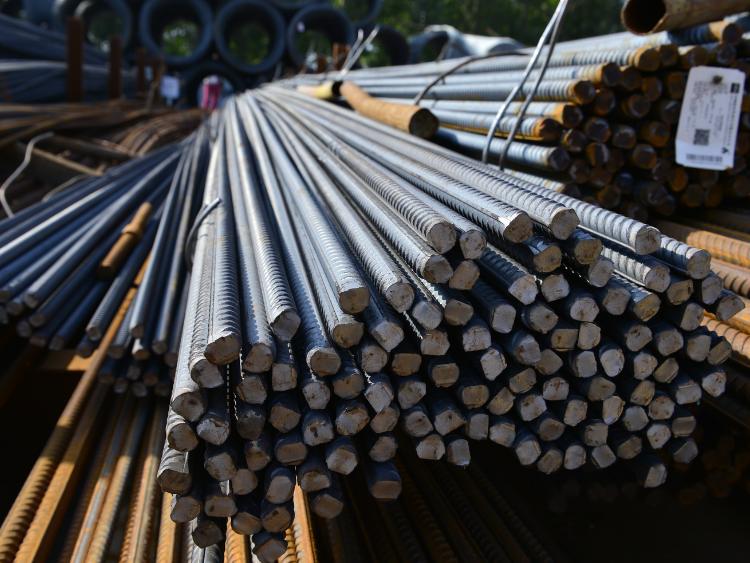
European steel rebar producers continue price push, but regional uptake uneven
European steel rebar producers continued to seek higher prices in the domestic markets amid rising costs and tightening import activity in the week to Wednesday April 15, but regional acceptance was uneven, trade sources told Fastmarkets.
n Germany and France, new rebar offers were heard at €700 ($824) per tonne delivered.
Most recent estimates of workable levels in Northern European market were within the range of €665-680 per tonne delivered when Fastmarkets’ made its weekly price assessment for steel reinforcing bar (rebar), domestic, delivered Northern Europe, on April 15 at €665-680 per tonne, up from €655-665 per tonne on April 8.
After publication, market sources reported that prices closer to €700 per tonne delivered were being gradually accepted in Germany.
“You would see a wide range of prices these days, because the market is exposed to constant change, from rising scrap and electricity costs to more pressure on import material [because of] regulations,” a German producer said, but adding that market sentiment remained positive.
In Southern Europe, customers’ responses were also mixed, with Spanish buyers accepting higher prices but those in Italy mainly taking a wait-and-see stance.
In Spain, suppliers managed to achieve €730 per tonne delivered base in some deals (corresponding to €745 per tonne delivered effective) when the weekly price assessment for steel reinforcing bar (rebar), domestic, delivered Spain, was published on April 15 at €725-745 per tonne, up from €715-725 per tonne on April 8.
Later in the day, information emerged about larger volumes being sold at this price and mills now seeking €750 per tonne delivered base, €765 per tonne delivered effective.
Italian suppliers also announced higher offers at €710-720 per tonne ex-works for the North and €740-750 per tonne ex-works for the South.
These higher prices, however, have not been achieved in deals, with customers postponing the booking of new volumes while seeking more clarity on the situation.
Estimates of workable prices for the North remained at €670-680 per tonne ex-works, while in the South prices are traditionally €20-30 per tonne higher, which would correspond to €690-710 per tonne ex-works.
Fastmarkets’ weekly price assessment for steel reinforcing bar (rebar), domestic, exw Italy, widened upward slightly to €670-710 per tonne ex-works on April 15, compared with €670-700 per tonne on April 8.
Wire rod offers in Southern Europe varied within the wide range of €670-710 per tonne delivered, with the lower end representing Italy and higher end Spain.
Unlike in rebar, mills were more successful in winning deals at the above prices.
Fastmarkets’ weekly price assessment for steel wire rod (mesh quality) domestic, delivered Southern Europe, was €670-710 per tonne on April 15, up from €650-680 per tonne on April 8.


EUROMETAL urges EU to extend steel safeguard measures to downstream products
European steel distributors, processors and manufacturers have called for urgent EU action to extend existing steel safeguard measures to downstream steel-based products, warning that the region risks rapid deindustrialization without immediate policy intervention, SteelOrbis heard at the press conference on April 14 organized by EUROMETAL at the Wire & Tube 2026 fair in Dusseldorf.
Speaking at the press conference, EUROMETAL representatives said a pan-European initiative backed by more than 300 companies and 35 associations will be submitted to EU member states and the European Commission on April 15. The signatories represent over one million direct jobs across the steel value chain.
Rising import pressure and cost disparities weigh on competitiveness
According to industry representatives, European steel processing and manufacturing sectors are facing increasing pressure from lower-cost imports, particularly from Asia, while domestic producers struggle with significantly higher energy, labor and regulatory costs.
Speakers highlighted that the price gap between Europe and third countries has widened to the extent that productivity gains alone are no longer sufficient to restore competitiveness. As a result, insolvency rates in the sector are rising at double-digit levels, while industrial activity is shifting outside Europe.
At the same time, imports of steel products into Europe are estimated to be increasing by around 20 percent annually, while steel consumption within the region continues to decline, indicating a structural shift in industrial activity.
Safeguards seen as insufficient without downstream coverage
While the EU has implemented safeguard measures and is set to introduce a new framework from July 1, industry participants stressed that current policies focus primarily on primary steel products, leaving downstream steel-intensive goods largely unregulated.
This imbalance is seen as creating a “double pressure” effect on European manufacturers: higher input costs due to safeguards and carbon-related measures, combined with unrestricted imports of finished or semi-finished steel-based products.
Industry representatives warned that protecting only one segment of the value chain risks weakening the entire system, as downstream sectors represent a critical link in Europe’s industrial structure.
Industry calls for full value chain protection
As part of the initiative, EUROMETAL and its partners are calling for trade measures to be extended across the entire steel value chain, including tariffs and quotas on steel-based and steel-intensive products under a broader range of customs classifications.
The proposed measures aim to ensure a level playing field by aligning the cost burden between EU producers and imported products, particularly in terms of carbon costs, trade defense measures and regulatory obligations.
In addition, the industry is urging the expansion of the Carbon Border Adjustment Mechanism to cover downstream steel products, arguing that the current scope does not adequately address carbon leakage risks across the full value chain.
Energy costs and regulatory burden add to pressure
High energy prices were also identified as a major factor undermining competitiveness, with calls for an EU-wide industrial electricity price cap of €0.05/kWh to support energy-intensive industries.
At the same time, existing regulatory frameworks, including CBAM, were described as complex and partially flawed, with industry representatives calling for a pause in new regulations until current mechanisms are revised and simplified.
Risks extend to jobs, economy and strategic autonomy
The industry warned that continued inaction could lead to significant job losses across the steel value chain, which employs around 13.5 million people in Europe.
Beyond economic impacts, speakers emphasized potential risks to Europe’s strategic autonomy, noting that increased reliance on imported steel products could affect critical sectors such as defense, energy and infrastructure.
Campaign to intensify pressure on policymakers
The initiative will be supported by the launch of an online platform, steelindustrynow.eu, which will showcase participating companies and provide further evidence of the sector’s challenges.
Industry representatives stressed that the campaign will continue until concrete measures are implemented, highlighting the urgency of the situation and warning that delays could result in irreversible industrial losses.
Author: SteelOrbis Editorial Team


The Eurozone and the EU recorded an increase in industrial production in February


NASS announces closure after 98 years of activity
The National Association of Steel Stockholders (NASS) has announced that it will cease operations in its current format, bringing to a close nearly a century of activity representing the UK steel stockholding and service centre sector.
Founded in 1927, NASS has played a longstanding role in supporting the UK steel distribution and processing industry. However, according to its Director General, Ian Darby, the organisation has faced increasing financial challenges in recent years, compounded by difficult trading conditions in the metals market and declining membership subscriptions.
Despite efforts to stabilise the organisation, it has not been possible to secure its continuation ahead of its 100th anniversary.
To ensure continuity, NASS has transferred the full and exclusive rights to its name—covering both the National Association of Steel Stockholders and the National Association of Steel Service Centres—to the International Steel Trade Association (ISTA).
ISTA has confirmed that it will engage with former NASS members and invite them to join its organisation, with the aim of continuing to represent the downstream steel sector in the UK. The association currently represents a broad range of stakeholders, including traders, service centres, manufacturers, logistics operators, and financial service providers, and maintains ongoing engagement with UK authorities on trade policy matters.
ISTA is actively involved in discussions with the UK Trade Remedies Authority and the Department for Business and Trade on key issues such as steel safeguards, anti-dumping measures, and the future implementation of the Carbon Border Adjustment Mechanism (CBAM).
The closure of NASS marks the end of a historic industry body, while its legacy and representation are expected to continue through ISTA’s activities in the UK steel market.

Re-rollers announce tube price increases at Tube trade show in Düsseldorf
Some re-rollers are using the Tube and Wire trade show in Düsseldorf to implement price increases, as anticipated by sources.
After initial hesitation over new quotes at the start of the week, sources at the event confirm that increases of €50/tonne ($58.93/t) have been announced by some companies.
The tube makers operating on a discount basis, particularly in Italy, have opted to reduce discounts by three percentage points, Kallanish hears.
One re-roller at the show describes a dynamic but uncertain event, with new investments throughout the supply chain being discouraged by geopolitical uncertainty driving up costs.
Multiple steel processors say they are increasingly factoring both CBAM charges and the imminent safeguard into their supply chain and pricing strategies, effectively redesigning their commercial approach to sourcing and selling.
“Demand [for tubes] is in contraction or not particularly different from the previous months but [hot rolled coil] offer is heavily limited and complicated on certain product. The new safeguard will modify the supply chain and the large re-rollers who keep buying globally are taking risks and absorbing cost increases” a source says adding that the financial pressure for steel processors is heavy and forecasting future costs and selling prices to continue to increase.
The current tube price increase is said to be the first of several.
In Italy at present the price of a workhorse squared 40x40x3 welded tube grade is around €790/t or slightly less. Today buyers in Europe are purchasing S235 black HRCs at €735-740/t finished delivered or ex-works depending on order size. They need about €170/t of transformation costs.
Tube prices have not followed the increases of HRC as values have been stagnating since the beginning of March.
In the meantime, several sources report imports of tubes continuing to disrupt the European market. The pressure on the European steel value chain demands faster action than EU decision-making currently affords, with rising volumes of processed products imports a particular concern, says EUROMETAL.
The distributor and processor association has launched a call to action directed at the European Commission and all member countries, supported by 300 signatures representing stakeholders across the entire value chain.
Author: Natalia Capra


Europeans should rethink alliances during challenging times
European steel industry players are being confronted with a multitude of unprecedented risks, and therefore may want to rethink their alliances and the value of trusted partnerships, participants at the Wire & Tube trade fair in Düsseldorf have told Kallanish.
The industry is being shaken by “exogenous shocks”, Ralf Winterfeld of German stainless distributors organisation EHV (Edelstahl-Handelsverband) said in a presentation on the status of the stainless steel economy after Covid.
Following a decline in prices throughout 2025, alloy surcharges for ASTM 304 have risen by 16% since January and stabilised sales prices, he said. By contrast, the slightly positive macroeconomic forecasts issued in February by German economic institutes like IFO have already been nixed, not only by the war in Iran, Winterfeld said.
In response to a question on the impact on traders of CBAM and the proposed new EU steel trade measure, Winterfeld said: “You will have to rethink your sourcing completely.”
He added that “reliability and partnership are the currencies of our times”. Stable and reliable supply partnerships will be the best preparation and defence against erratic politics and incalculable risks from import restrictions, he said.
Along similar lines, Uwe Reinecke of rebar maker Feralpi Stahl recommended that businesses should look for opportunities amid the chaos.
Talking to Kallanish, he said that the unpredictability of US president Donald Trump should spur Europe to find new friends and partners in other parts of the world. The trust in the USA could be shaken into the next presidency, he fears. “Europe needs to use the momentum of the moment for new alliances, or we will die along with our wealth,” he concluded.
Author: Christian Koehl

Trasteel targets Nasdaq listing with Sizzle II merger
Steel trading and processing group Trasteel is going public through a merger with Sizzle Acquisition Corp. II, a Cayman Islands-based special purpose acquisition company listed on Nasdaq under the ticker Szzl, Kallanish notes.
Trasteel and Sizzle II will form a new publicly listed holding company, called Pubco, subject to approval by shareholders of both entities and standard closing conditions.
The new entity is expected to list on the Nasdaq Stock Market under TSTL. Both Trasteel and Sizzle II will become subsidiaries. The transaction is expected to close by end of 2026.
Trasteel intends to use proceeds from this transaction for strategic acquisitions and investments. The transaction values Trasteel at a pre-money equity value of $800 million.
The value of the combined company is expected to be approximately $1.3 billion, assuming no redemptions by public shareholders of Sizzle II. This is based on estimated shares outstanding immediately after closing at $10/share and accounting for estimated net debt of approximately $184m.
Existing Trasteel shareholders will roll 100% of their equity into the new public company.
“The need for additional steel products in Europe and the rest of the world will only continue to accelerate as demand continues to outstrip supply. The funds raised through this transaction, together with gaining access to the public capital markets by listing on Nasdaq, will allow us to achieve our goals in 2027 and beyond,” says Trasteel’s chairman Giuseppe Mannina and ceo Gianfranco Imperato .
Sizzle II forecasts global steel demand to continue to increase. It believes that Trasteel will benefit from this increase in demand.
The company will be able “to weather geo-political risk and macroeconomic headwinds, while generating consistent results,” ceo Steve Salis comments.
Trasteel, which owns 13 facilities in six countries and is currently owned by Giuseppe Mannina, Fratelli Cosulich SpA and Gianfranco Imperato, has transformed from a steel trading company to a trading and steel processing firm each representing approximately half of total sales.
The company operates across more than 60 countries, covering the full steel supply chain, including raw materials, energy trading, non-ferrous metals and industrial transformation.
Author: Natalia Capra

ArcelorMittal seeks full control of Italian CLN
ArcelorMittal is seeking full control of ArcelorMittal CLN Distribuzione Italia (AMCLN), the Italian flat steel service centre joint venture it owns alongside CLN since 2015.
The European Commission has published the merger notification in the Official Journal, opening a period for third-party observations, Kallanish notes.
The transaction would give ArcelorMittal, which currently holds a minority stake in the service centre, full control over AMCLN. This follows a difficult period for CLN, which has faced financial pressure due to deteriorating conditions in the automotive sector.
AMCLN combines several service centre assets in Italy and operates subsidiaries including Delna, active in metal storage and pickling, and Tamagnone, specialising in coil transport and storage. The Commission’s preliminary examination will determine whether the transaction falls within the scope of the EU Merger Regulation.
ArcelorMittal declined to comment when approached by Kallanish.
Author: Natalia Capra

Europe value chain demands swift, ‘Trumpish’ action
The pressure on the European steel value chain demands faster action than EU decision-making currently affords, with rising volumes of processed products imports a particular concern, says EUROMETAL.
The distributor and processor association has launched a call to action directed at the European Commission and all member countries, supported by 300 signatures representing stakeholders across the entire value chain.
Effective and immediately applicable trade measures are needed now, aligned with those already implemented by, for example, the United States and Canada, the association urges.
At a press conference on the sidelines of the Wire + Tube trade fair in Düsseldorf on Tuesday, EUROMETAL president Alexander Julius highlighted the slowness of processes within European politics, whereas the current critical pressure on European companies demands swift action, the “Trumpish” way. “We cannot wait another one or two years,” Kallanish heard him say at the conference.
The initiative was started in March last year with an initial visit to European Commission President Ursula von der Leyen, said Georgios Giovanakis, chief sales officer of thyssenkrupp Steel. He was accompanied on the visit by Heino Buddenberg, chief executive of cold-roller Wälzholz, and Markus Fix of service centre DM Stahl, all of which also sat on Tuesday’s press conference panel.
While measures like CBAM point in the right direction, they are too complicated and slow in taking effect, the panellists warned. The current catalogue of measures also needs to reach further downstream the value chain, to cover all products made of steel. “The chain breaks at the weakest part,” said Fix. “And the chain can be pretty long, reaching over five or six stages.”
One important aspect they pointed out to the Commission was the danger to European independence of not defending its manufacturing industries. Julius referred to recent wars and the associated trade conflicts, warning that Europe becoming dependent on other countries would leave it vulnerable if they decided to restrict supply.
He also pointed out that the old logic of international free trade no longer applies. Economists in former times did not foresee that one nation would produce hundreds of millions of tonnes of steel more than it needs, and would pull down prices internationally in order to find markets, he said.
Author: Christian Koehl

European rebar prices surge at Tube and Wire Düsseldorf
A large European rebar producer describes sentiment in the sector at the Tube and Wire trade show in Düsseldorf as positive, with all producers moving to increase prices across their long products ranges, Kallanish learns.
Some mills are using the event to communicate increases directly to clients, while others have already announced increases since the show opened. The source believes that the general mood is improving alongside recovering margins.
Italian rebar producers are pushing prices up again this week, with offers now at €440/tonne ($518.54/t) base ex-works, a €30/t increase on last week.
Last week mills suspended sales while initially considering increases of €20/tonne, driven by sharply rising costs linked to the US-Iran conflict.
In Italy, despite initial resistance by buyers to a chain of increases over the past month, contract prices have risen significantly since early March, before the conflict started. Transactions last week were being concluded at €400-420/t base ex-works. The €440/t level is described as an asking price currently.
Buyers at the event say that this is a bubble that will burst in time as the increases are driven solely by speculation while demand has remained the same.
“We are writing officially to all our clients” one buyer says, “many of whom buy monthly and are still being delivered at March prices. Some are saying they will pause their building sites. We have demand from infrastructure, but the private sector is consuming very little at the moment.”
While some distributors with high stocks have chosen not to buy in April and can afford to wait, others have already committed at €400-420/t base ex-works. Including size extras of €260-270/t, effective transaction prices for Italian rebar are currently assessed at €660-680/t ex-works.
A French buyer at the event tells Kallanish that all European producers are pushing prices up and in France the level of €700/t delivered will consolidate in the coming week. ArcelorMittal is increasing all its long products by €50/t and Italian and Spanish mills are proving the most aggressive and uncompromising with their increases.
Another trade show participant notes that the price increases are being driven not only by higher input costs but also by CBAM and the incoming safeguard regulations, which are discouraging imports of not only rebar but also cheaper billets from third countries.
Author: Natalia Capra