

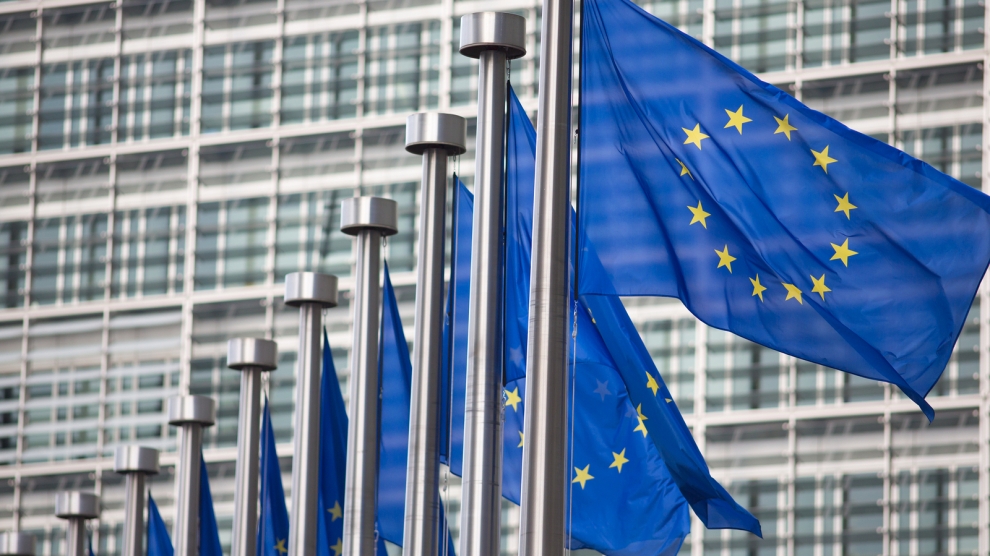
EC publishes new steel trade regime; country quota allocations still pending
The European Commission has officially published Regulation (EU) 2026/1384, establishing the new EU steel trade regime that will apply from 1 July 2026, replacing the current steel safeguard measures which expire on 30 June 2026.
The new framework introduces annual tariff-rate quotas of 18.3 million tonnes and an out-of-quota duty of 50%, alongside new provisions such as the “melt and pour” requirement aimed at strengthening trade enforcement and preventing circumvention.
A key element, however, remains to be finalised. While the Regulation establishes the overall quota volumes, the country-specific allocation of these quotas will be determined through a separate Commission implementing act, which has not yet been published. The Regulation states that this implementing act should apply from 1 July 2026 and will define the distribution of tariff quotas among exporting countries.
Commenting on the publication, trade lawyer Yuriy Rudyuk highlighted that the absence of the implementing act creates uncertainty for importers and supply chains, particularly as negotiations with several FTA partner countries are reportedly still ongoing. Until the country allocations are formally adopted, questions remain regarding the practical operation of the new quota system from day one.

Philippe Mercier elected President of Belmetal
The Board of Directors of Belmetal, the Belgian federation representing steel and metal distributors, has unanimously elected Philippe Mercier, Managing Director of Groupe Aciers Grosjean, as its new President. He succeeds Vanessa Espeel following the federation’s recent General Assembly and the election of a new Board.
Mercier brings nearly four decades of experience across the transport, automotive, logistics and steel distribution sectors. Since 2015, he has served as Managing Director of Groupe Aciers Grosjean in Charleroi and has held a variety of management positions in Belgium and France throughout his career.
He will be supported by two Vice-Presidents: Nicolas Caeymaex of Van Meerbeeck Metalen and Johan Rosseel of Staalhandel Rosseel.
His appointment comes at a challenging time for Belgium’s steel and metals sector, which faces rising costs, increasing regulatory requirements, trade tensions and the need to accelerate decarbonisation efforts. Belmetal represents companies supplying steel and metal products to key industries including construction, manufacturing, energy and infrastructure.
A long-standing Belmetal board member, Mercier is also active within EUROMETAL and serves as a board member of the Chamber of Commerce of Hainaut. As President, he aims to strengthen Belmetal’s role as a representative of the sector, focusing on competitiveness, workforce development and supporting the future of Belgian and European industry.
“The priority is to preserve the conditions that enable companies to invest and create jobs while maintaining the competitiveness of our industrial base in a changing climate and regulatory environment,” Mercier said.

European industry calls for fair competitive conditions for steel-based finished products
Representatives from the steel trade, the steel-processing industry and politics have used a confidential expert exchange with the German Chamber of Commerce and Industry (DIHK) to draw urgent attention to the growing competitive distortions caused by imported steel-based finished products.
The central message was a call for fair and competitive framework conditions to ensure that industrial value creation, employment and technological expertise remain in Europe.
Unfair competition is affecting the entire value chain
The discussion made clear that European companies are not only coming under pressure from traditional steel imports. Increasingly, steel-based finished products and components from third countries are entering the European market under significantly different cost, subsidy, energy and environmental conditions. This creates competitive distortions that affect both European producers and processors.
Participants in the exchange included Alexander M. Julius, President of EUROMETAL and Managing Partner of macroMETAL Handelsges. mbH, Dr Michael Waasner, Managing Partner of Gebr. Waasner GmbH, Domenico Marino, COO of Knauf Interfer SE, Jan Hobert, Head of Metal | Corporate Purchasing at Hettich Management Service GmbH, as well as representatives of the Federal Ministry for Economic Affairs and Energy.
Call to effectively include downstream steel products in trade defence
The participants advocated giving greater trade-policy consideration to imported steel-based finished products where demonstrable market distortions, subsidised overcapacities or circumvention strategies are displacing European suppliers. The objective is not blanket protectionism, but a rules-based, WTO-compatible and targeted framework that restores fair competitive conditions.
Among the issues discussed were clearer rules on origin and traceability, the examination of “melt and pour” approaches, and stronger consideration of downstream steel products in existing and future trade-policy instruments. Concepts such as European value-added shares or “Made with Europe” were also mentioned as potential building blocks.
Safeguarding Europe’s resilience and independence
Steel and steel-based products form the foundation of numerous key industries – from mechanical and plant engineering to automotive supply, energy, infrastructure, defence and security projects. Preserving this industrial base is therefore not only a matter of competitiveness, but also of European resilience and strategic independence.
With the European Steel and Metals Action Plan, the European Commission has highlighted the strategic importance of the sector for competitiveness, decarbonisation and security. From the industry’s perspective, this approach must now be consistently extended to steel-based finished products and downstream stages of the value chain.
Need for action by the Federal Government and the EU
- Give greater consideration to imported steel-based finished products in trade-policy investigations where competitive distortions can be demonstrated.
- Improve rules on origin, traceability and proof in order to prevent circumvention strategies.
- Design existing trade defence instruments to be faster, more practical and more closely aligned with real value chains.
- Better coordinate industrial, climate and trade policy so that European production is not displaced by cumulative burdens.
- Create a shared evidence base involving the Federal Government, EU institutions, associations and companies in order to identify affected product groups in a targeted manner.
Signal from industry
The exchange sends a clear signal: Europe must secure its industrial base through fair competitive conditions, effective rules and strategic capacity to act. Anyone who takes resilience, independence and climate-neutral transformation seriously must prevent steel-based value creation from being permanently displaced from Europe by unfairly priced imports.