


Sülzle adds another regional rebar bender
German rebar distribution group Sülzle Stahlpartner has again expanded its network of sites, taking over Eisen Grader in Weiden, close to the Czech border.
The firm’s existing service portfolio, comprising reinforcing steel, structural steel bending and bored pile production, will be taken over in its entirety, Kallanish hears from Sülzle. The team at Eisen Grader will also remain in place under Christian Dobmann as the branch manager, Sülzle notes.
With the addition in Weiden, Sülzle is strengthening its presence in the northern Bavarian regions of Oberpfalz, Middle Franconia and Upper Franconia. The group is also expanding its capacity for bored piles, now possessing a second site alongside Dessau-Rosslau in Saxony-Anhalt. Sülzle Stahlpartner now has 15 sites all over Germany, predominantly in the southwest.
In June, Sülzle announced its involvement in a plant expansion for signal technology firm Werma Signaltechnik in Rietheim-Weilheim, southwestern Germany. Sülzle Stahlpartner’s main branch in Rosenfeld will supply 550 tonnes of rebar and 90 tonnes of wire mesh for the project in association with construction firm Decker.


Wallenberg Investments takes control at Stegra
Following the recent financing round that generated €1.4 billion ($1.6 billion) for Sweden’s Stegra project, the company has reshuffled its board of directors and its corporate structure, Kallanish learns.
Wallenberg Investments, which has led the consortium in the latest financing round, will assume a leading position in the company.
A new holding company, Stegra Holding AB, owned by the investors in the new financing round, now holds over 90% of the shares and votes in the steelmaker.
The board of directors of Stegra Holding AB is now chaired by Leif Johansson of Wallenberg Investments. He succeeds Shaun Kingsbury of Just Climate, who chaired the board of Stegra for nearly two years, and who remains on the board.
Further representatives from Wallenberg on the board are Håkan Buskhe, Astrid Skarheim Onsum and Erika Söderberg Johnsson. Representatives of further stakeholders are Paal Weberg and Karin Rådström of Altor and Pierre-Etienne Franc of Hy24.
Henrik Henriksson will continue as ceo of Stegra.
The company which holds the investments made prior to the financing round has been renamed from Stegra AB to Green Nexus Investment Holding AB. It has become a minority shareholder of Stegra after the completion of the new financing round.

EU reviews Turkish HR flat steel AD duties
The European Commission has initiated an expiry review of the anti-dumping measures on imports of certain hot-rolled flat products of iron, non-alloy or other alloy steel originating in Türkiye. This follows a request submitted by European steel association Eurofer on behalf of the EU industry on 1 April, Kallanish notes.
The products are currently subject to definitive anti-dumping duties. They cover flat-rolled products of iron, non-alloy steel or other alloy steel, whether or not in coils, including cut-to-length and narrow strip products, not further worked than hot rolled and not clad, plated or coated.
The products currently fall under CN codes 7208 10 00, 7208 25 00, 7208 26 00, 7208 27 00, 7208 36 00, 7208 37 00, 7208 38 00, 7208 39 00, 7208 40 00, 7208 52 10, 7208 52 99, 7208 53 00, 7208 54 00, ex 7211 13 00, ex 7211 14 00, ex 7211 19 00, ex 7225 19 10, 7225 30 90, ex 7225 40 60, 7225 40 90, ex 7226 19 10, ex 7226 91 91 and 7226 91 99.
Excluded from the scope are stainless steel, grain-oriented silicon electrical steel, tool steel, high-speed steel and certain heavy plate dimensions.
Interested parties have 37 days from publication of the notice in the Official Journal on 6 July to submit comments, while producers and unrelated importers wishing to be considered for sampling must provide the requested information within seven days. Sampled parties will then have 30 days to submit completed questionnaires.
The Commission normally expects to conclude the investigation within 12 months, and in any event no later than 15 months from the publication of the notice. Pending the outcome of the review, the existing anti-dumping duties will remain in force.
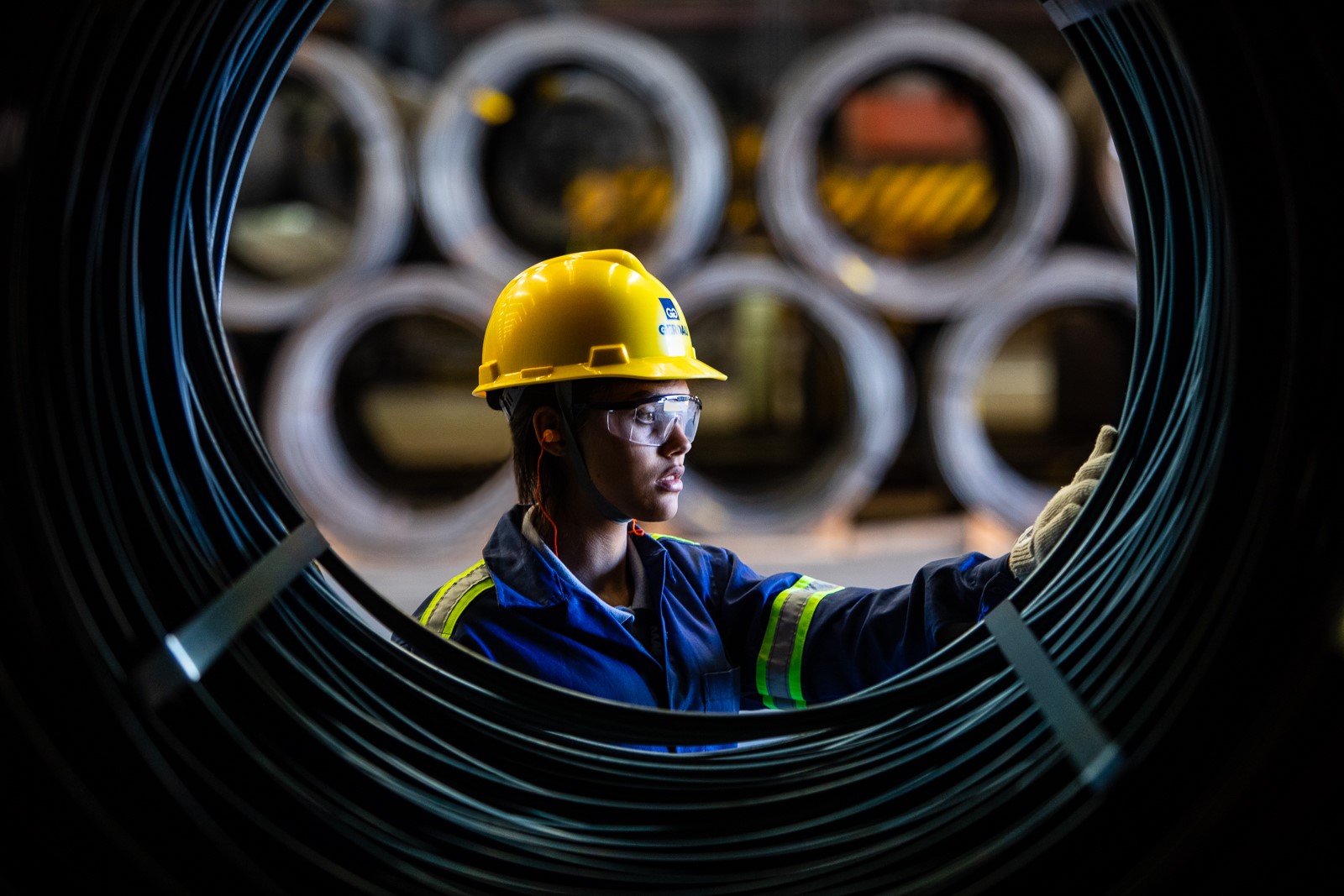
Italian re-rollers increase prices, coil makers prepare hikes
Italian re-rollers are raising prices by around €40/tonne ($45.8/t), with some halting sales altogether while others have already notified clients of the increases which are effective immediately.
The move is the first market reaction to the reduced quota allocations, which also cover welded tubes, Kallanish notes.
Italian coil producers have also suspended sales in the meantime, as steelmakers across Europe consider similar price increases.
The coil market remains slow, with buyers yet to return to purchasing in Europe. They are expected to do so in September when contracts and volumes will inevitably rise given the lack of alternative sourcing origins. New coil price quotes are expected to emerge this week.
June was a particularly difficult month for coil and derivative sales. Tube prices lost around €40/t due to challenging downstream demand and a total absence of apparent consumption, with tube discounts reaching 43-44 points. All re-rollers are now announcing a three point reduction in discounts, equivalent to a €40/t price increase.
One re-roller says the new trade measures “remain something that will strongly change the market.”
Beyond being particularly restrictive on HRC, the regulation severely limits imports of tubes. Ukraine, for example, which had hoped to be exempted, has been allocated a quota of only 6,000 tonnes/quarter, compared to its previous allocation of nearly 20,000t.
The sharp reduction in tube quotas will inevitably push buyers back towards European sourcing, the source adds.
Another re-roller says that with the current discount levels of 44 points a workhorse squared 40x40x3 welded tube grade is around €800/t, which with S235 black HRC at €700/t base delivered, is not sustainable, and that is before considering the HRC price increases expected as early as this week.

Trading remains muted in European domestic HRC market
European domestic hot-rolled coil market was largely quiet on Tuesday July 7, staying in a price-discovery phase, with both sellers and buyers estimating the effect of the recently announced import quotas.
As a result, Fastmarkets indices for Northern European and Italian local hot-rolled coil prices remained largely unchanged in day-on-day comparison.
The daily steel hot-rolled coil index domestic, exw Northern Europe was calculated at €691.25 ($789.98) per tonne on July 7, down by €1.88 per tonne from €693.13 per tonne on July 6.
physical://instrument/MB-STE-0028
The index was up by €8.12 per tonne week on week and down by €0.42 per tonne month on month.
The most recent indications of offers in the region came within the range of €690-715 per tonne ex-works, while estimates of the tradeable level came at €680 per tonne ex-works, which are now more theoretical due to the practical absence of trading activity.
“I spoke to several customers, and they told me that they had the feeling the price downward trend stopped. They think it will stabilize and after the summer break it will go up,” a service center in the Benelux area told Fastmarkets.
Another service center source from the same area shared the same opinion about the price movement expected in September-October rather than immediately.
The Italian market was also quiet, with mills being out of the market since the second half of last week.
Nevertheless, on Monday, information came to light about a booking within the range of €685-690 per tonne ex-works, whereas another source estimated the tradeable range within the range of €660-680 per tonne ex-works.
On Tuesday, no new information was reported. Thus, Fastmarkets’ assessment of the daily steel hot-rolled coil index domestic, exw Italy was €678.75 per tonne on July 7, unchanged day on day.
physical://instrument/MB-STE-0892
The index was up by €11.25 per tonne week on week but down by €0.83 per tonne month on month.
