


German structural steel organisation appoints new president
Germany’s structural steel construction association, Deutscher Stahlbau-Verband (DSTV), has elected Jan Birkemeyer as its new president at its latest members meeting, Kallanish learns.
Birkemeyer sits on the management board of Goldbeck Nord, a construction firm with several branches, mostly in North Rhine Westphalia and northern Germany. He is succeeding Christian Wurst, who held the position for five years, and will remain active as vice president.
According to DSTV’s announcement, Birkemeyer will put a focus of his work on modular and serial construction patterns, which he sees as one solution to bottlenecks in modernisation in Germany.
He will also seek faster procedures for tenders and permissions with public bodies, and to make green steel an element in public tenders.

CBAM price falls on-quarter, Parliament committee amends bill
The price of Carbon Border Adjustment Mechanism (CBAM) certificates for the second quarter of 2026 has been set at €75.28 ($85.93), down €0.08 versus the Q1 price, the European Commission says.
This comes despite EU carbon permit (EUA) prices recovering from their 2026 trough in March and hovering at around €80 since late May. They are yet to return to the recent peak above €90 seen in January, Kallanish notes.
Separately, European Parliament Environment Committee (ENVI) MEPs have backed extending CBAM to around 180 downstream steel- and aluminium-intensive products from 2028, and setting up a temporary decarbonisation fund (TDF) to protect EU producers on export markets.
They deleted the Commission’s proposed safeguard that would have allowed goods to be removed from the scope in the event of price shocks, the so-called “emergency brake”. In its place, MEPs added a mechanism to temporarily redirect CBAM revenues from the goods concerned to the affected sectors. The MEPs want financial support from the TDF to run from 2027 to 2029 and not only from 2028 as proposed by the Commission.
All downstream operators – firms that use CBAM-covered goods as inputs in their production – should be eligible for support from the fund.
MEPs also deleted the option to use international carbon credits for CBAM compliance.
Parliament will adopt its mandate for negotiations with EU member states on the final shape of the bill during the September plenary session.
Eurofer welcomed the ENVI vote, highlighting the exclusion of pre-consumer steel scrap as a precursor from the CBAM scope, stronger “melt and pour” certification improving traceability for imported steel, and the removal of provisions that could weaken CBAM through exemptions or international carbon credits.
“However, further adjustments are required to extend CBAM across more steel-intensive value chains, and to develop an effective and structural solution for European exports,” it adds.

Italian plate prices remain steady in July
Italian heavy plate prices are holding stable this month, with some demand resurfacing and order intake picking up, following a prolonged period of weakness in June, Kallanish hears.
Some mills are said to be reluctant to sell at current prices, which fell in June and are now considered too low. With order books covered until the end of August, they are under no pressure to accept today’s levels and are insisting on increases.
They expect values to rise sharply in September as the new safeguard replacement and CBAM make importing increasingly difficult. An expected coil price acceleration in September is also expected to support plate prices, as buyers resume purchasing in Europe.
Distributors, however, see no near-term recovery in plate, with downstream order volumes remaining persistently low. They too expect demand to return in September, with some price increase driven by the new safeguard measures.
This week prices for S275 grade remain at €720/tonne ($823.2/t) ex-works, with some €740-750/t delivered for S355 grade. Asian slab prices are stable at $600/t cfr Italy, sources say.
Meanwhile, some German plate buyers are taking advantage of the pre-summer dip at Italian re-roller mills, however, these offers do not work for everyone due to high transport costs (see Kallanish 6 July).
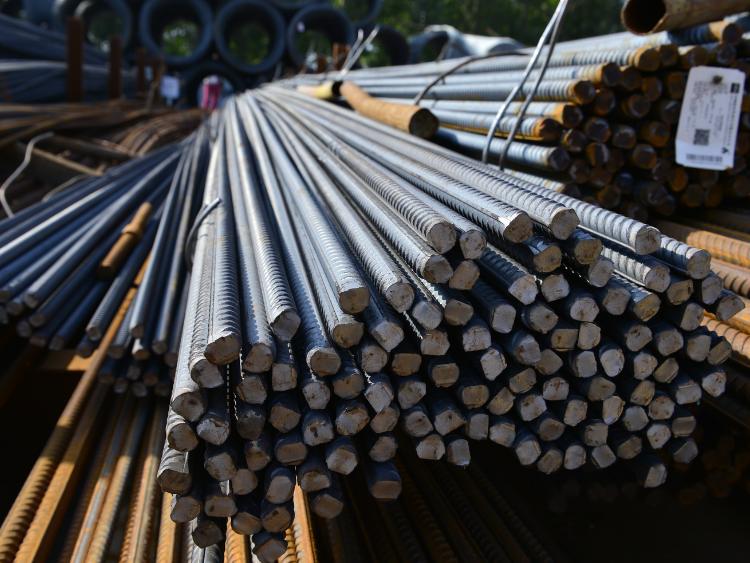
German rebar prices soften from peak levels
German rebar mills saw price declines during June, down from a peak base of €450/tonne ($514) which was reached in May.
Market participants agree that prices are now below that mark, but also note that the drop is not necessarily unsettling.
“It is not unusual in the weeks prior to the summer holiday that prices give in somewhat,” a manager of a Brandenburg bender firm tells Kallanish. He and a source in northern Germany see acceptable offers at €440/t, which with additional standard size extras of €265/t translates to €705/t delivered.
Some buyers for larger distributor chains in western and southern Germany are broadly around €430-435/t but are sure that mills are willing to concede lower for larger volumes deals.
One Ruhr-based manager sees no reason to fear a downward spiral. Ha also attributes the dip to the slowdown of activity in summer, with at least two mills going on breaks next week. He adds he also heard of low offers from Polish mills which has caused some pressure on the German prices.
The manger from Brandenburg, which is on the Polish border, dismisses that Polish mills play much of a role in German pricing, and sees that their offers are not necessarily much lower.
The northern German source says the same of some Czech suppliers, where he occasionally purchases from “mainly for the sake of having my suppliers diversified, not because they are much cheaper”.

European Parliament committee backs downstream CBAM expansion and Temporary Decarbonization Fund
The European Parliament’s Committee on the Environment, Climate and Food Safety (ENVI) has adopted its position on proposed revisions to the Carbon Border Adjustment Mechanism (CBAM), supporting the extension of the mechanism to downstream products and endorsing the creation of a Temporary Decarbonization Fund (TDF) to support the low-carbon transition of European industry.
Under the adopted position, MEPs support extending CBAM beyond basic materials to include a broad range of downstream steel and aluminum products, such as fasteners, wire, springs and household articles, while stressing that the scope extension should be based on transparent and quantitative methodologies. The committee also approved an exemption for electricity imported from non-EU countries by grid operators for the purpose of maintaining electricity network stability.
Committee proposes stronger anti-circumvention measures
The committee proposed strengthening anti-circumvention provisions by clarifying that the prohibition on “slightly modifying” products should also cover slight processing and specifying that the rules should target only arrangements established solely to circumvent CBAM rather than legitimate business decisions aimed at reducing costs. In addition, the committee proposed allowing the European Commission to apply the default emissions values of the true country of origin where circumvention patterns are identified.
MEPs also rejected the Commission’s proposal to remove products from the CBAM scope during price shocks and instead proposed a mechanism allowing CBAM revenues generated from the affected products to be temporarily redirected to the impacted industrial sectors.
To address potential loopholes in online trade, the committee recommended replacing the parcel-by-parcel exemption with a single weight-based threshold covering all shipments from the same seller, accompanied by new reporting obligations and retroactive liability for shipments deliberately split to remain below the threshold. The committee also proposed simplified reporting requirements for least-developed countries together with a technical assistance framework.
At the same time, MEPs removed the Commission’s proposal to allow Paris Agreement Article 6 carbon credits to offset CBAM obligations, arguing that the issue should instead be considered during the forthcoming revision of the EU Emissions Trading System (EU ETS).
MEPs back earlier launch of Temporary Decarbonization Fund
Regarding the Temporary Decarbonization Fund, the committee proposed that financial support should be available from 2027 to 2029, rather than beginning in 2028 as proposed by the Commission. The committee further proposed making all downstream operators using CBAM-covered products eligible for support from the fund. It also suggested that any unused revenues should be allocated to the EU’s international climate finance commitments under the Paris Agreement instead of being returned to member states as originally proposed by the Commission.
The European Parliament is expected to adopt its negotiating mandate for talks with the Council of the European Union during its September plenary session.


European domestic HRC prices increase as mills push September offers after quota changes
Prices for domestic steel hot-rolled coil increased in both Northern Europe and Italy on Wednesday July 8, with trading resuming slightly after the new EU steel import quotas came into force on July 1, but the market was dominated by mills offering material for September delivery, sources told Fastmarkets.
Offers in Italy were reported within the range of €705-735 ($806-840) per tonne ex-works for September delivery, but the prices were discarded due to a lack of buying interest at this level.
Meanwhile, a supplier said workable prices in the market were at €690 per tonne ex-works, but “not below” that level. The same supplier reported offers at €710 per tonne ex-works for September shipment.
The latest deals for HRC in Italy were reported at €685-690 per tonne ex-works on Monday July 6, but a buyer could not confirm this and said there were “no effective deals at this level.”
“Suppliers are not willing to negotiate; no one is willing to buy, because prices are increasing,” the same source said on Wednesday, adding that new transactions happened very rarely. They also said no big volumes were expected to be ordered, as the market needed to pass the holiday time.
The same buyer said they expect prices for HRC will rise further by the end of September, up to €800 per tonne delivered (€785 per tonne ex-works).
As a result, Fastmarkets’ assessment of the daily steel hot-rolled coil index domestic, exw Italy was €688.75 per tonne on July 8, up by €10 per tonne from €678.75 per tonne on July 7.
The index was up by €21.25 per tonne week on week and up by €7.92 per tonne month on month.
In Northern Europe, market activity was slowly picking up, but prices were also reported mainly for September delivery.
Sources said the latest offers were at €740 per tonne ex-works on Wednesday, with deals concluded at €710 per tonne ex-works, all for shipment in September. The offers were discarded in July 8’s index due to a lack of buying interest.
A buyer reported a deal at €685-700 per tonne ex-works for August delivery on the same day, but added that in the new round mills will be offering September delivery.
Fastmarkets’ daily steel hot-rolled coil index domestic, exw Northern Europe was calculated at €701.25 per tonne on July 8, also up by €10 per tonne from €691.25 per tonne on July 7.
The index was up by €19.37 per tonne week on week and up by €9.25 per tonne month on month.
Meanwhile, Turkey has already exceeded its quarterly import quota volume for HRC, just one week after the new quota regime was announced on June 30, according to European Commission data seen by Fastmarkets on July 7.
The data showed that 374,336.06 tonnes of Turkish HRC imports were awaiting allocation against a country-specific quarterly quota volume of 160,573.74 tonnes. That exceeded the available quota volume by 213,762.32 tonnes, or 133.1%, according to Fastmarkets’ calculations.
A market source reported a cargo of Turkish HRC being booked at €565 per tonne CFR Italy this week. Another market participant, however, voiced some doubts, considering the situation with the quota.
Other countries such as India and Indonesia also used more than half of their HRC import quota for the third quarter of the year.
India had used 101,924.69 tonnes of its 149,318.61-tonne quota, leaving 31.7% available, while Indonesia had used 16,318.95 tonnes of its 31,834.46-tonne allocation, leaving 48.7% available, according to Commission data.
A deal from India to Southern Europe was reported at $650-655 per tonne CFR on July 8, while offers from Indonesia came at €530 per tonne CFR on the same day.
Egyptian material was offered at $700 per tonne CFR.
Fastmarkets weekly assessment for steel hot-rolled coil import, cfr main port Southern Europe was €565-610 per tonne on July 8, compared with €570-610 per tonne on July 1.
