European coil and green steel round-up: European HRC prices rise as market digests new fundamentals
Prices jumped in the European hot-rolled coil market in the week to 10 July, as market participants took stock of their new trading reality.
Mills are pushing increased offer levels into the market, but buyer acceptance is limited given high inventory levels purchased in advance of the EU’s new tariff-rate quotas (TRQs), which entered into force 1 July, and the general complexity of the new import regime.
In Northwest Europe, the majority of price indications for HRC were reported at around EUR710/t ex-works, with volumes confirmed traded at that price level, though both buyer and mill sources still report trades in the market below EUR700/t ex-works where orderbook gaps remain in steelmakers’ summer rolling schedules.
Offers in Northwest Europe were heard between EUR700-750/t ex-works, and a leading mill was heard as increasing its offer price to EUR770/t ex-works/delivered toward the end of week. Moving into the quieter summer period, market participants expect prices to slowly increase for September-October delivery, as stock levels wind down and new dependencies on domestic supply become more evident.
In the Italian market, trading dynamics were very similar, though buyers were more pessimistic about the impact of increased domestic market share, given Italy’s traditionally higher dependence on imported volumes. Offers were reported between EUR680-730/t delivered, as well as the revised EUR770/t delivered offer, but sources on both sides of the market reported volumes still trading well below EUR700/t ex-works.
One Italian distributor described the new TRQs as a “turning point” for the European steel market, seeing the implications of the EU’s new import regime as far more significant than most in the market seem to believe.
As the new TRQs allocate volumes across several tiers of access, such as depending on whether an origin holds a Free Trade Agreement (FTA) with the EU, or reached an agreement with the bloc in WTO negotiations, some origins – like Australia – are only workable once sufficient quarterly TRQ volumes have accumulated via the carry-over mechanism. Additionally, as other trade defense instruments (TDIs) like anti-dumping and countervailing duties apply cumulatively with the new TRQ duty of 50%, even more TRQ volumes allocated to trading partners are deemed unworkable by steel market participants, with sources estimating less that than a third of cat 1A HRC imports in 2025 would clear duty-free under the revised framework.
The reduction in eligible duty-free volumes has caught many in the trade on the wrong foot, with reports that some traders are attempting to reroute volumes from Asia now subject to new out-of-quota costs, as well as revise contracted DDP terms with customers that still have impending requirements.
Market participants thus expect that the summer quiet period could end slightly earlier than usual, with some anticipating market activity to ramp-up in August, prior to traditional September restocking cycles. Certainly, the market is now near-unanimous in holding bullish sentiments for the fourth quarter, with a new import clearance period and better visibility of workable trade flows.
Green Steel
Activity in the low-carbon market is stable, largely business as usual, as distributors stick to back-to-back trading with end-consumers, and mills target the highest of premiums for project demand from end-users.
At the end of next week, the European Commission will present its proposal to revise the Emissions Trading System (ETS), which could reduce both domestic and international ‘production’ costs, if free allocation phase-out schedules are relaxed, or pushed beyond the existing 2034 zero-point.
The EU’s steelmakers are positioned in two camps ahead of the review, with three of the bloc’s largest integrated producers – ArcelorMittal, Thyssenkrupp, and Voestalpine – calling for a freeze to ETS costs, while others – including SSAB, Salzgitter, greenfield newcomers, and leading independent EAF steelmakers – want to maintain the ETS in its current form, as a decarbonisation incentive.
| Weekly European steel coil | |||||
| EUR/t | Term | 10-Jul-26 | Change | ||
| Weekly Northwest Europe steel coil | |||||
| Northwest Europe ex-works HRC | EX-WORKS | 710.00 | 20.00 | ||
| Northwest Europe ex-works CRC | EX-WORKS | 800.00 | 0.00 | ||
| Northwest Europe ex-works HDG | EX-WORKS | 810.00 | 0.00 | ||
| Northwest Europe CIF HRC | CIF | 620.00 | 0.00 | ||
| Northwest Europe DDP port HRC | DDP Port | 700.00 | 0.00 | ||
| Show more… | |||||
| Source: McCloskey by OPIS. | © 2026 Dow Jones Energy Limited. | ||||
| Weekly green steel | |||
| EUR/t | Term | 10-Jul-26 | Change |
| Green Northwest Europe HRC premium (scopes 1-3 CO2 under 0.8t) | 80.00 | 0.00 | |
| Green Northwest Europe ex-works HRC (scopes 1-3) | EX-WORKS | 790.00 | 20.00 |
| Green HRC premium (scopes 1-2 CO2 under 0.5t) | 80.00 | 0.00 | |
| Green Northwest Europe ex-works HRC (scopes 1-2) | EX-WORKS | 790.00 | 20.00 |
| Green HRC reduced carbon price (scopes 1-3) | 63.31 | 0.00 | |
| Source: McCloskey by OPIS. | © 2026 Dow Jones Energy | ||
Author: Benjamin Steven

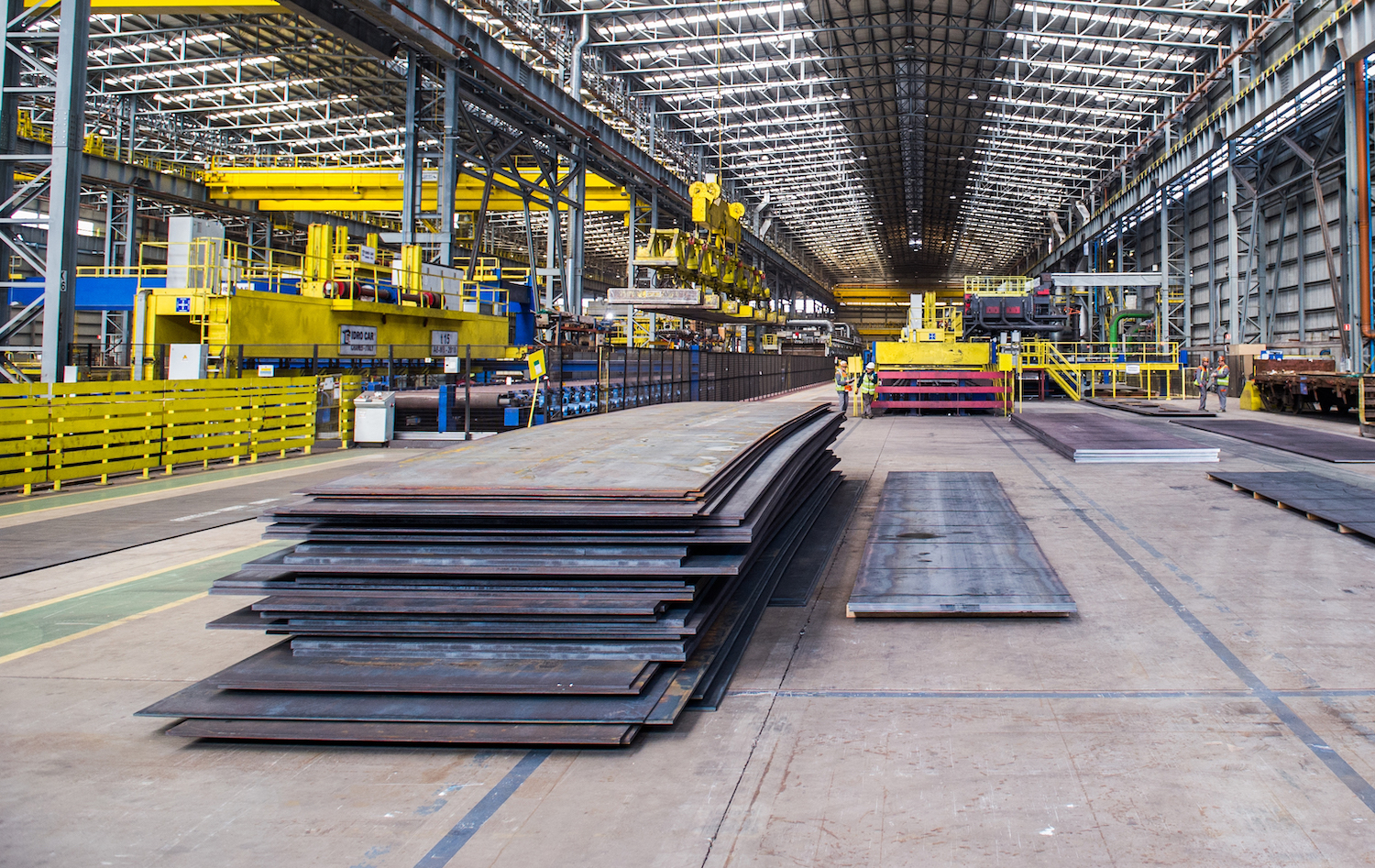
European heavy plate round-up: EU’s heavy plate markets stable as international mills chase slab demand
European heavy plate prices held stable in the week to 10 July, with limited spot exposure maintaining prices at existing levels in Northwest Europe, and visibly declining slab costs subduing bullishness for Italian re-rollers.
Northwest European heavy plate spot price indications were reported stable between EUR800-820/t ex-works for s235 grade, and at a EUR30/t premium for s355 grade.
In the Italian market, prices have increased slightly to EUR720-730/t ex-works, though sources report material as still available at EUR710/t ex-works in negotiation.
Overall, bullishness in the Italian market has arguably been limited, rather than stimulated by the introduction of the EU’s new tariff-rate quota (TRQ) regime for steel imports, as according to one mill source, imports have traditionally only made up around 10% of heavy plate supply, putting pressure on domestic prices at only a few points during the year, now further reduced by the new TRQ restrictions.
However, the TRQ cuts have had a significant negative impact on origin accessibility to the EU on other steel goods, with the result that many exporters have flocked back to advertise semi-finished exports, namely slab for plate production, to European buyers.
“Everyone we’ve been dealing with over the last years is now back at our door with slab offers,” said a mill source. “They are exploring for new demand now that they cannot export their finished goods.”
Slab costs at $600/t CFR are considered as having sustained plate prices of around EUR700/t, so new TRQ effects and tightened import supply in the market, is coming up against visibly lower slab offers – cited at highest at $580/t CFR Italy – in buyer estimations of acceptable plate price levels. Mills have been able to realise an incremental increase on their plate products, but sources now do not expect any further rally of much significance until post-summer, when buyers return from holidays to restock.
| Weekly European heavy plate, slab and green steel | |||||
| Unit | Term | 10-Jul-26 | Change | ||
| Weekly heavy plate | |||||
| Northwest Europe ex-works heavy plate | EUR/t | EX-WORKS | 800.00 | 0.00 | |
| Germany delivered heavy plate (Northwest Europe) | EUR/t | DEL | 830.00 | 0.00 | |
| Italy ex-works heavy plate | EUR/t | EX-WORKS | 715.00 | 5.00 | |
| Weekly steel slab | |||||
| Italy CFR slab | $/t | CFR | 575.00 | -5.00 | |
| Weekly green steel | |||||
| Green heavy plate premium (scopes 1-3 CO2 under 1t) | EUR/t | 25.00 | 0.00 | ||
Author: Benjamin Steven

Future of ETS debate widens with new steelmaker voices
Scrutiny is building against steel sector challengers to the EU ETS, seeing additional steelmakers, and climate interest groups join in support of maintaining the integrity of the EU’s primary climate protection instrument.
As the European Commission’s 17 July deadline to review the ETS approaches, the EU’s steelmakers have formed ‘battle lines’ over their desired outcomes, generally split between larger carbon-intensive integrated steelmakers, and greenfield low-carbon steelmaking projects or those further ahead in their decarbonisation project timelines.
In short, ArcelorMittal Europe, Germany’s Thyssenkrupp, and Austria’s Voestalpine have called for a total freeze to further ETS cost escalation – a fundamental aspect of the system as emissions allowances (EUAs) are iteratively decreased, tightening EUA supply against increasing demand (via free allocation phase-outs) – until the investment case for low-carbon steelmaking is more certain, and supportive infrastructure like green hydrogen supply is fully in place. Against them include steelmakers SSAB, Outukumpu, Stegra, Hydnum – arguing that weakening the ETS would significantly undermine the carbon cost signal upon which their decarbonisation projects and investments are premised, as the ETS would no longer provide the same certainty that green steel will become more competitive than traditional steelmaking as on established carbon market timelines.
Following the launch of this most recent ETS debate, status-quo supporters Outukumpu and SSAB have been joined by German integrated producers Salzgitter and the SHS group, representing their subsidiary steelmakers Saarstahl and Dillinger.
In a renewed call to “defend the integrity of the ETS1”, these “European Steel Leaders” have sent a joint letter to member states backing a preservation of established ETS cost drivers until “at least 2035″; including maintaining the current free allocation phase-out via the inherently linked phase-in of Carbon Border Adjustment Mechanism (CBAM) costs.
Some of the EU’s leading independent secondary electric-arc furnace (EAF) steelmakers have also since signed on to an updated version of the letter sent to EU authorities this week, advocating for the preservation of the existing ETS framework in maintaining (and strengthening) effective CBAM protections.
McCloskey’s market sources were largely critical of the steelmaking trio’s statement, perceiving the ETS challenge more as an alternative and more realistic means of lowering industrial energy costs – what they see as the true driver of industrial non-competitiveness in Europe – amid a lack of visible alternatives to the EU’s ‘merit order’ electricity market design.
The latest version of the letter sent to member states from the ETS-supporting camp makes this point explicit:
“The primary pressure on competitiveness comes from high electricity costs due to fossil fuel dependencies, infrastructure gaps and global steel overcapacity, not from carbon pricing.”
Commentary from climate non-profit Carbon Market Watch (CMW) further suggests that blast furnace relining decisions and schedules – particularly relevant to ArcelorMittal, Thyssenkrupp, and Voestalpine as the EU’s largest integrated steelmakers – also premise the opposition to ETS cost escalation. CMW argues that when taking into account capacity relining completed by the steelmaking trio since 2020, and furnaces due for relining in the next decade; every euro spent on furnace relining risks generating an additional 2-5 euros in operational costs from the ETS on its established trajectory, leading the organisation to conclude that “investing in relining therefore means betting against the ETS.”
In reply to McCloskey’s inquiry on ETS costs and decarbonisation dynamics, a representative from Voestalpine clarified that while its projects were proceeding to schedule, wider steel sector decarbonisation in the EU is lagging behind the 2034 free allocation exhaustion deadline due to a lack of required supporting infrastructure, like affordable green energy, and competitive-at-scale hydrogen supply, as well as insufficient member state investment of ETS revenues back into decarbonisation projects. This chimes with comments from another integrated steelmaking source, arguing that free allocation cannot be seen as a climate benefit, but as fundamental cost support to maintain any degree of competitiveness: “free allocation helps firms to survive – and firms that survive can decarbonise.”
Free Allocation Impacts
For EU steelmakers, the primary lever to freeze their ETS burdens would indeed be to adjust the existing phase-out of free allocation allowances, which sees freely awarded EUAs initially decrease from 100% to 97.5% in 2026, then rapidly accelerate down from 77.5% to 39% 2029-2031, before fully extinguishing at a more gradual pace by 2034.
But softening the impact of the free allocation phase-out, for example by extending freely allocated allowances beyond 2034, or relaxing the intensity of the decline across the phase-out curve (especially between 2029-2031) would not only reduce carbon cost burdens for integrated steelmakers, but also reduce mirrored CBAM costs for those imports competing for EU market share. European steelmakers fairly unanimously attribute their global and domestic non-competitiveness to import pressures: be it the unlevel playing field created by global subsidized overcapacity, or the comparatively high energy and compliance costs of producing steel domestically in the EU, raising questions as to why steelmakers would now seek to weaken CBAM as a balancing mechanism.
Taking an example of Indian hot-rolled coil, the impact of free allocation is plain to see on effective CBAM and (theoretically mirrored) ETS cost liabilities, using McCloskey’s Iron & Steel ‘Actual Values’ CBAM calculator. Using inferred actual emissions data from published Indian steelmaker Environmental Product Declarations (EPDs), the below calculations demonstrate how CBAM costs more than double on the same embedded emissions from 2026 to 2034 via the removal of free allocation adjustments (SEFA).
Carbon cost escalation for traditional steelmaking is even more apparent when accounting for even a conservative EUA price for 2034 – limiting CAMIRO’s 2034 forecast to just below the 200 euro barrier – again more than doubling the CBAM cost to levels approaching the contemporary base price for the underlying steel.


CBAM calculates its costs by taking the specific embedded emissions (SEE) of an in-scope import, and deducting the specific embedded free allocation (SEFA). SEFA represents what deductions a third-country steelmaker would be entitled to from their total embedded emissions liability if they were producing within EU borders, attempting to equalise respective costs under the EU ETS when accounting for free allocation.
One might think, therefore, that those steelmakers opposing the existing ETS trajectory are shooting themselves in the foot somewhat if CBAM costs relax via a reduction of the free allocation phase-out (the ‘CBAM factor’). However, for many steelmaking origins – particularly those offering most aggressively in recent years – CBAM costs on default values are already prohibitively expensive, and can exceed the base cost of the material itself (as with Indonesian HRC) even on 2026’s CBAM factor of 97.5%.

Additionally, general steel import accessibility to the EU has been significantly reduced by the implementation of the bloc’s new steel trade protections, which replaces the existing safeguard system long-term to tighten tariff-rate quotas (TRQs) by an overall 47%, as well as double out-of-quota duties to a potentially very costly 50% tariff rate.
This is particularly impactful for recently destabilizing origins like Indonesia: when comparing its Q3 2025 imports to effective duty-free access under the old and new TRQ frameworks (accounting for origin volume caps, and keeping in mind developing country exemptions), analysis illustrates substantial cuts to Indonesia’s EU market access, with the result that excess cat 1A HRC volumes, for example, could become subject to both a 50% tariff, and additional CBAM costs approaching EUR600/t in order to reach EU demand.

For steelmakers, therefore, CBAM is arguably already doing its job in reducing import competitiveness on default values alone – even at 2026’s existing 97.5% CBAM factor (or free allocation phase-out rate) – giving some insight into why select steelmakers want to “freeze” ETS costs at their current level: even the highest SEFA deductions fundamentally cannot mitigate higher initial default value SEE costs, compounded by additional threat of 50% out-of-quota duties.
Those steelmakers in favour of blocking additional ETS cost escalations, if successful, would then have strengthened trade protections via both CBAM default value effects, and the revised TRQs, as well as limiting increases in their carbon costs. This could create a more stable foundation upon which to realise decarbonisation projects for the EU’s carbon-intensive integrated producers. On the other hand, many, including CMW and fellow climate campaigner Steelwatch, argue that free allocation has not historically acted as a sufficient decarbonisation incentive – especially when considered alongside steelmakers’ other shields from ETS effects, such as indirect cost compensation – and should therefore be phased-out as scheduled to introduce real cost incentives, and protect the business case of greenfield or incumbent steelmaker transformation projects disruptive of the carbon-intensive status quo.
From a domestic industry perspective, it could be argued that market fundamentals have indeed not been sufficiently supportive such to launch low-carbon steelmaking transformations at full scale, especially when considering the long time horizon of steel sector investment cycles, the slow pace of development of supportive low-carbon market infrastructure, pressure from lower-cost imports, and missing demand due to delays in establishing lead markets. After all, the EU is yet to decide what ‘low-carbon’ or ‘green’ steel even is, limiting consumer clarity that said material will effectively contribute toward corporate climate targets, as well as undermining distributor confidence in low-carbon liquidities, and thus what premiums steelmakers can actually achieve to (at least partially) fund the decarbonisation of their operations.
The climate perspective would argue that it is do-or-die time for one of the EU’s most carbon intensive industries – representing around 7% of total ETS emissions – and that the failure of some to account for the additional costs from the phase-out of free allocation, should not be allowed to undermine either those whose investments depend on the ETS in its current form, nor the EU’s climate targets as a whole.
The reality likely lies somewhere in the middle, as steelmakers are arguably justified in resisting being forced into a transition that is not ready for them – at least not without significant support – but are undermined in that position by expanding global blast furnace capacities, or locking in carbon-intensive European production via new blast furnace relining, beyond what is absolutely necessary.
Author: Benjamin Steven

European domestic HRC market quiet as buyers hold back on higher-priced material
Domestic steel hot-rolled coil (HRC) prices in Northern Europe and Italy were steady on Friday July 10. While mills pushed for higher September delivery prices, trading was limited. Recent confirmed deals fell below offer levels, indicating buyers were unwilling to accept the proposed increases, sources told Fastmarkets.
In Northern Europe, trading was quiet throughout the day. Sources reported offers at €730-740 ($835-846) per tonne ex-works for September delivery, but these were generally viewed as unworkable in the current market.
A buyer source indicated achievable levels at €700-710 per tonne ex-works, saying that the increase to €740 per tonne ex-works was “too big.” The source added, however, that HRC import prices had risen rapidly after the reduced EU steel import quotas came into force on July 1.
The same source said they had heard offers for imported HRC into Northern Europe at €640 per tonne CFR but could not confirm the origin. Market participants reported the latest offers for imported material into the region at €610 per tonne CFR from Egypt on Wednesday.
As a result, Fastmarkets’ weekly price assessment for steel hot-rolled coil import, cfr main port Northern Europe was €530-610 per tonne on Wednesday, widening upward by €10 per tonne from €530-600 per tonne a week earlier.
“Customers don’t know what to do because there is still enough material in the market,” the buyer source said regarding local HRC, adding that buyers would still need to replenish stocks for the fourth quarter, but it was still unclear whether demand would improve.
A producer source said that offers at €740 per tonne ex-works “might be high”, but added that they were confident buyers “will be ready to pay more in September-October.”
But the latest deals for September shipment were reported at €710 per tonne ex-works on Thursday, and no activity has been confirmed at higher levels yet. As a result, Fastmarkets did not consider the offers at €730-740 per tonne ex-works in Friday’s index calculation.
Due to a lack of fresh input, price points collected on Thursday were carried over to Friday’s index calculation, in line with Fastmarkets’ methodology.
On Thursday, an indication of the tradeable level for September-delivery HRC was reported at €700 per tonne ex-works. Offers for the same period were heard at €740 per tonne ex-works alongside the mentioned deal at €710 per tonne ex-works, but the offer was zero tonnaged due to the lack of buying interest at that level.
On Thursday, a buyer told Fastmarkets that demand in the market remained limited, there were no urgent purchasing requirements and inventories were sufficient to cover needs through the summer holiday period.
Price points exceeding the delivery timeframe of “up to 6 weeks” stated in Fastmarkets’ methodology were added to the index due to the absence of material with earlier delivery offered in the market.
Fastmarkets’ daily steel hot-rolled coil index domestic, exw Northern Europe was calculated at €705.00 per tonne on Friday, unchanged day on day.
The index was up by €10 per tonne week on week and up by €18.33 per tonne month on month.
Meanwhile, in Italy, no fresh price points were received during the day because market participants were largely inactive. As a result, Thursday prices were carried over to Friday’s index calculation.
On Thursday, sources reported offers in the range of €685-705 per tonne ex-works for September delivery, while indications for achievable levels were heard at €685-690 per tonne ex-works and bids at €670-680 per tonne ex-works.
“We’ve increased offer prices for HRC with September delivery to €700 base [per tonne] exw. Customers’ idea is clearly not there yet; they try to not confirm anything higher than €670-680 base [per tonne] exw. [It] might be that the real picture will take longer to crystallize,” another producer source said on Thursday.
A buyer said on Thursday that if consumers needed to purchase material, they would have to accept higher offers of around €705 per tonne ex-works because there were few alternatives available in the market.
As a result, Fastmarkets’ assessment of the daily steel hot-rolled coil index domestic, exw Italy was €692.81 per tonne on Friday, unchanged day on day.
The index was up by €16.14 per tonne week on week and up by €7.81 per tonne month on month.

Local steel heavy plate prices in Italy, Northern Europe face further downward pressure ahead of summer holidays
Steel heavy plate markets in both Italy and Northern Europe came under further downward pressure in the week to Friday July 10, with increased competition among re-rollers in Italy ahead of the August holiday period, sources told Fastmarkets on Thursday.
Southern Europe
Italy’s plate market remained under pressure during the week, with increased competition among re-rollers for August deliveries, a producer said.
Deals were reported in the range of €710-735 ($831-860) per tonne ex-works, down by €10 per tonne from transactions heard at €720-745 per tonne ex-works on July 2.
Offers were heard at €720-740 per tonne ex-works, down from €740-750 per tonne ex-works a week earlier. Buyer bids were reported at around €700 per tonne ex-works on Thursday.
“There is a fight among re-rollers for August tonnages. Buyers are aware and bid around €700 [per tonne] exw base. We understand that the minimum prices of €710 [per tonne] exw are already confirmed by re-rollers. The pull of lower slab prices is the key factor today, plus the necessity to fill the [order] books,” the producer said.
Steel slab offers to Italy were decreasing during the week amid increased competition among suppliers. Sources also cited the reduction in EU steel import quotas for finished products, including plate, as a potential factor weighing on sentiment.
Fastmarkets’ weekly price assessment for steel slab, import, cif Italy, was $570-590 per tonne on July 9, down by $10 per tonne from $580-600 per tonne a week earlier.
Meanwhile, a trade source said quarto plate re-rollers in Southern Europe were facing “even more difficult times because demand has vanished and stockholders and end-users are only purchasing missing dimensions or grades.”
Fastmarkets’ weekly price assessment for steel domestic plate 8-40mm, exw Southern Europe was €710-735 per tonne on Thursday, down by €10 per tonne from €720-745 per tonne a week earlier.
Offers for plate imports into Southern Europe were reported in the range of €700-720 per tonne CFR during the week, including costs under the Carbon Border Adjustment Mechanism (CBAM) regulations, the same trade source said, adding that there was currently no buying interest for imported material.
As a result, Fastmarkets’ weekly price assessment for steel plate (8-40mm), import, cfr main port Southern Europe was €720-750 per tonne on Thursday, unchanged week on week.
Northern Europe
In Northern Europe, no significant trading activity was reported during the week, while mills were offering commodity-grade plate at €780-830 per tonne ex-works, sources said.
“There is simply no demand and orders are missing,” a trade source told Fastmarkets.
Higher offers were heard at €820-870 per tonne ex-works, but these were excluded from the assessment because, according to a second trade source, such levels were “not relevant for the pure commodity market.”
“Plate producers in Northern and Southern EU are searching for commodity grade orders in the third quarter, despite a dull and shrinking market,” the first trade source said.
Fastmarkets’ weekly price assessment for steel domestic plate 8-40mm, exw Northern Europe was €780-830 per tonne on Thursday, narrowing downward by €10 per tonne from €780-840 per tonne a week earlier.

Belgian distributors express concern over new EU Trade Measures
Belgium steel distributor and trader federation, Belmetal, has voiced its concerns over the country’s particular vulnerability to the new EU trade measures.
Belgium is particularly exposed because of its role as a maritime gateway and distribution hub for steel products, the federation says in a commentary statement on the EU measures. It notes that similar challenges are likely to impact other European markets with major steel-importing ports, including the Netherlands, Germany, France, Italy and Poland.
The Port of Antwerp-Bruges is one of Europe’s principal entry points for steel, while North Sea Port Ghent also plays an important role in international steel trade. Together, these logistics hubs handle substantial volumes that are subsequently distributed across Belgium and neighbouring countries.
As a result, Belgian distributors are often among the first to experience the practical consequences of changes to import quotas, whether in terms of product availability, sourcing options, lead times or pricing. Belmetal finds that the system is considerably more complex than the previous safeguard regime, as several quota categories now coexist depending on origin and trade status.
“Our concern is about supply predictability,” Belmetal director Chetan Corten tells Kallanish. This includes planning certainty and availability of specialised steel grades that are not always produced within the EU. “As a consequence, distributors and their customers may need to plan purchases further in advance, diversify supply chains where possible and carry higher inventories in order to mitigate supply risks.”
Corten underlines that “the revised safeguards are of strategic importance to our members because they directly affect the competitiveness of Belgian steel distributors”.
Author: Christian Koehl