German production rises 9%, but demand remains low
Crude steel production in Germany recovered significantly in the first half of 2026 compared with the same period last year, Kallanish hears from national steel federation WV Stahl.
Output in H1 amounted to 18.6 million tonnes, around 9% higher than the previous year’s level. However, there is no sign of a sustained turnaround yet, the federation warns. Extrapolated over the whole year, crude steel production, at around 37mt, would remain below the 40mt mark required for economically viable capacity utilisation.
Even more serious is the exceptionally low level of steel demand in Germany, the federation points out. The main customer sectors – construction, mechanical and plant engineering, and the automotive industry – have shown only weak growth so far this year.
“Production figures are on the rise, but a genuine recovery will only begin once real demand for steel returns,” says Kerstin Maria Rippel, managing director of WV Stahl. “The increases are primarily a reflection of a technical rebound, such as the replenishment of stock levels.”
Public procurement is a key lever in this regard, the federation states. “Anyone investing billions in taxpayers’ money must not focus solely on the cheapest supplier from the Far East,” says Rippel. Public procurement law must be shaped by Brussels and Berlin in such a way that local industrial value creation is also taken into account.
“A binding ‘Made in the EU’ criterion is of central importance here,” Rippel adds.
The increase of crude steel output at German mills during H1 is more notable in oxygen-route mills, which gained 11.5% to 12.8mt, while the EAF production rose by only 3.5% to 5.9mt. That divergence had equalised by June, when both routes showed a year-on-year increase of around 9%.

Flacks revises ADI bid, plans new company
Flacks Group is revising its bid to acquire troubled Italian steelmaker Acciaierie d’Italia (ADI) and intends to establish a new company, with hopes of the Italian government taking a stake, ceo Michael Flacks confirms to Kallanish.
The new company, named Flacksider, intends to guarantee production continuity at the Taranto steelworks, build a direct reduced iron plant on-site to feed new electric arc furnaces (EAF), and gradually phase out the existing blast furnaces. Flacks expresses frustration at the length of Italian bureaucratic processes and the slow pace of government decision-making.
His intention is to progressively re-employ all direct workers while also relaunching activity for indirect workers and contractors. Flacks says he expects a government response to his proposal but notes that the summer holiday period is slowing the process as the sector approaches its complete August shutdown.
In response to the rival bid by Jindal Steel International, Flacks says the Indian company intends to turn Taranto into a re-rolling facility, with redundancies for the majority of workers and decarbonisation achieved by effectively shutting down the blast furnaces and heavily relying on semi-finished product imports from outside the European Union.
“I am so sorry for all the workers who would effectively lose their job,” he says, adding that his own project would gradually reinstate workers and production, with any workforce reduction being only temporary. Flacks forecasts annual output of 4 million tonnes of green steel at full capacity.
Flacks previously spoke of talks with Metinvest and Italian equipment maker Danieli as possible partners. Danieli confirmed its involvement to Kallanish while Metinvest did not comment publicly. Sources believe both companies could be involved in the new company, Flacksider.
Earlier this year Flacks created a technical committee to update its existing industrial plan for ADI’s relaunch.
Meanwhile, the Italian government is said to be in advanced talks with Jindal Steel for leasing ADI. The proposal submitted by Jindal would focus mainly on downstream re-rolling activity. Taranto’s production would heavily rely on imported slabs, which Jindal would supply from a future green steel complex in Oman. Decarbonisation of the site would be achieved through the shutdown of primary steelmaking (see Kallanish passim).
Weak demand, summer slowdown push European domestic HRC prices lower
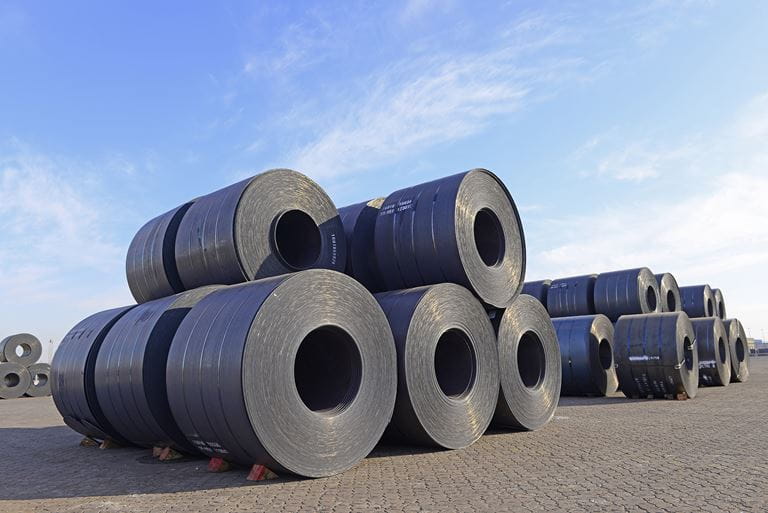
Daily prices for local steel hot-rolled coil edged down in both Northern Europe and Italy on Friday July 24, with slow demand and the summer vacation period weighing on market activity, market sources told Fastmarkets.
In Northern Europe, a buyer indicated workable prices for HRC at €700-710 ($796-808) per tonne ex-works on Friday, saying that the market remained very slow with “extremely weak” demand.
“Also, with the summer holiday time, some companies [are] closing to save some money for workers now,” the buyer said, adding that although producers were trying to increase prices, this was not coming through yet, with consumers continuing to negotiate lower levels.
A supplier source reported offers were at €740-750 per tonne ex-works, but added those levels were not workable in the market yet. The same source said that the latest transaction levels at €710 per tonne ex-works were no longer available.
Due to a lack of fresh inputs on Friday, price points collected on Thursday July 23 were carried over to July 24’s index.
On Thursday, a buyer source reported an indication of achievable levels at €700-710 per tonne ex-works and a transaction at €710 per tonne ex-works.
Fastmarkets’ daily steel hot-rolled coil index domestic, exw Northern Europe was calculated at €706.67 per tonne on July 24, down by €3.55 per tonne from €710.22 per tonne on July 23.
The index was down by €3.33 per tonne week on week but up by €22.50 per tonne month on month.
Meanwhile, the Italian HRC market was also quiet on Friday, with market participants continuing to point to slow demand and limited trading activity ahead of the summer holiday period.
One buyer source said they had purchased a very small volume of HRC, around one truckload, earlier in the week at €680 per tonne ex-works. The deal was not included in the July 24 index because it fell outside the assessment period.
The same buyer indicated workable levels at €700 per tonne delivered (€685 per tonne ex-works), and said that producers were largely absent from the market for the time being. According to the market participant, many mills were expected to pause activity and deliveries between August 1-17 during the summer vacation period.
“Every mill is looking for maximum utilization, [and] with low demand they don’t have it. Italian mills are out of the market because they can’t sell their capacity,” the buyer said.
Meanwhile, a producer said achievable prices for standard commodity-grade HRC were no higher than €720-730 per tonne delivered (€705-715 per tonne ex-works), while mills were continuing to target €740-750 per tonne delivered (€725-735 per tonne ex-works).
“[The increase] might be achieved if decent quality means some exclusive positions in the specifications,” the same source said on Friday.
As a result, Fastmarkets’ daily steel hot-rolled coil index domestic, exw Italy was €704.38 per tonne on July 24, down by €2.50 per tonne from €706.88 per tonne on July 23.
The index was down by €0.62 per tonne week on week but up by €26.88 per tonne month on month.

European heavy plate round-up: Italy’s heavy plate prices move down
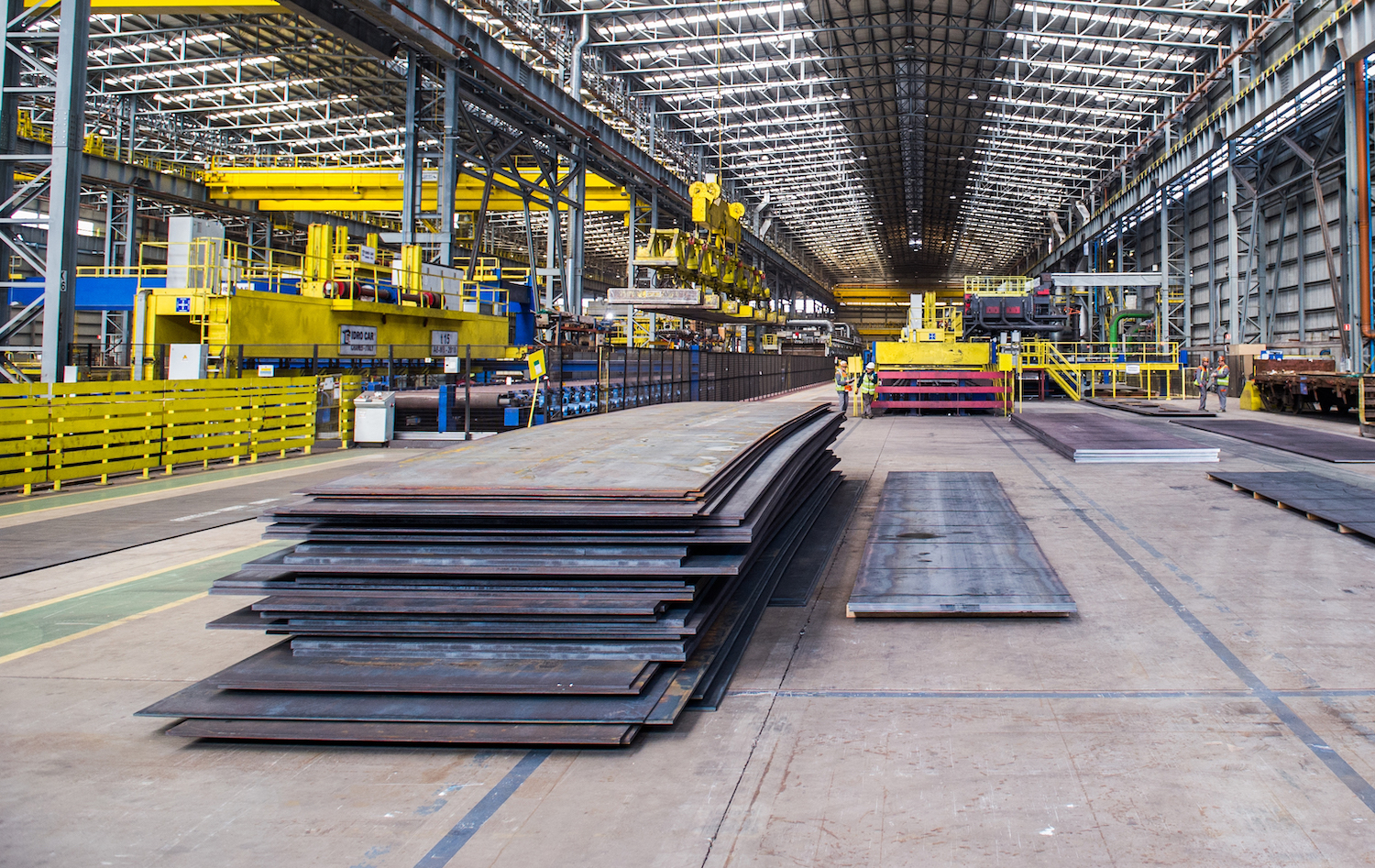
Italian re-rollers accepted lower heavy plate prices in the week to 24 July in order to fill their order books faster, while lower slab prices supported the decline.
Deals for s235jr-grade plate in Italy have been heard at EUR690-720/t ex-works, while offers have been reported at EUR720-730/t ex-works.
“This is self-sabotage by the re-rollers. The demand is fine for this time of the year, yet they chose to cut their prices,” a plate producer said.
While demand has been declining following the summertime market cycle, consumption has remained healthy, sources said. But the re-rollers have been chasing volumes, and lower slab prices allowed them to be more competitive. European re-rollers traditionally rely on imported slab as feedstock for plate.
Import offers for slab from Asia have been heard at $560-570/t CIF Italy, and the mills expect additional discounts of around $10/t.
The re-rollers, however, are likely to attempt to increase offers to follow the recovery in the other flat steel products segment.
“Italians are still flexible on pricing. But they are already covered till mid-September, so I predict a price increase will be announced soon,” a German distributor said.
Despite the new import quotas which came into force on 1 July, a South Korean supplier sold s355jr plate to Spain at EUR770-780/t DDP.
In Northwest Europe, integrated steelmakers have been benefitting from long-term contracts and project deliveries, and they have been asking for higher plate prices.
Domestic s235jr-grade plate prices in Germany have been reported at EUR820-860/t ex-works, with limited volumes available on the spot market.
Re-rollers from Italy, France, and the Czech Republic have been offering s355jr plate to Germany at competitive prices of EUR800-810/t delivered.
| Weekly European heavy plate, slab and green steel | |||||
| Unit | Term | 24-Jul-26 | Change | ||
| Weekly heavy plate | |||||
| Northwest Europe ex-works heavy plate | EUR/t | EX-WORKS | 820.00 | 10.00 | |
| Germany delivered heavy plate (Northwest Europe) | EUR/t | DEL | 810.00 | -20.00 | |
| Italy ex-works heavy plate | EUR/t | EX-WORKS | 700.00 | -10.00 | |
| Weekly steel slab | |||||
| Italy CFR slab | $/t | CFR | 555.00 | -5.00 | |
| Weekly green steel | |||||
| Green heavy plate premium (scopes 1-3 CO2 under 1t) | EUR/t | 25.00 | 0.00 | ||
| Source: McCloskey by OPIS. | © 2026 Dow Jones Energy Limited | ||||
Author: Maria Tanatar


Romanian flats prices soften as buyers push back against recent increases
Romania’s flat steel spot market has lost some momentum this week, as weak purchasing activity and buyers’ resistance to the higher levels tested recently have made it increasingly difficult for traders to sustain their quotations.
Sentiment has also been affected by reports of an aggressively priced sale by a major trader, which has strengthened buyers’ bargaining position and brought discounts back into negotiations. At the same time, persistent liquidity constraints continue to encourage some suppliers to prioritize cash flow, while expectations for August remain cautious amid the seasonal slowdown and limited sales prospects.
Hot rolled sheet prices are currently assessed at €790-815/mt ex-warehouse, compared to €800-830/mt last week. However, a sale by a major trader has been discussed at around €750/mt ex-warehouse, a level considered well below the prevailing market range and therefore not fully representative of general quotations. Nevertheless, the transaction has added pressure to negotiations and contributed to softer price expectations.
Cold rolled sheet prices have also declined, to €890-900/mt ex-warehouse, from €900-925/mt in the previous week. Beyond these headline levels, traders are again showing greater flexibility for serious buyers, with discounts of around 5-8 percent heard depending on the order size, payment terms and the seller’s need to generate liquidity.
Meanwhile, on the sole producer’s side, Liberty Galati’s outlook remains uncertain despite the tolling agreements with UK and Turkey-based companies announced this week. While these arrangements may provide some temporary support and allow limited production to resume, the Romanian authorities also confirmed that salary payments through the state-backed Guarantee Fund will not continue beyond the initial six-month period. The tolling agreements are therefore viewed mainly as a short-term measure, as the expected income is unlikely to cover the plant’s wider financial needs, while efforts to bring in a new investor have yet to deliver a concrete result.
On the other hand, the import market has remained quiet, as Romanian buyers have sufficient stocks and are reluctant to make fresh purchases following the recent increase in import prices. Ukrainian hot rolled sheet prices have increased to €800-820/mt CPT Romania, from €760-770/mt last week, while cold rolled sheet offers have risen to €890-910/mt CPT Romania, compared to €850-860/mt previously. Serbian hot rolled sheet has been heard at around €900/mt CPT Romania, slightly above last week’s €885/mt, although the latest level has not been confirmed. Meanwhile, Turkish HRC indications have edged down to €525-550/mt CFR Romania, from €530-550/mt last week. However, buying interest in Turkish material remains absent due to the lack of available quota and continued uncertainty surrounding CBAM-related costs, with some interest potentially returning in September.
Author: SteelOrbis Editorial Team


Price differential between HRC and CRC widens in Italy