

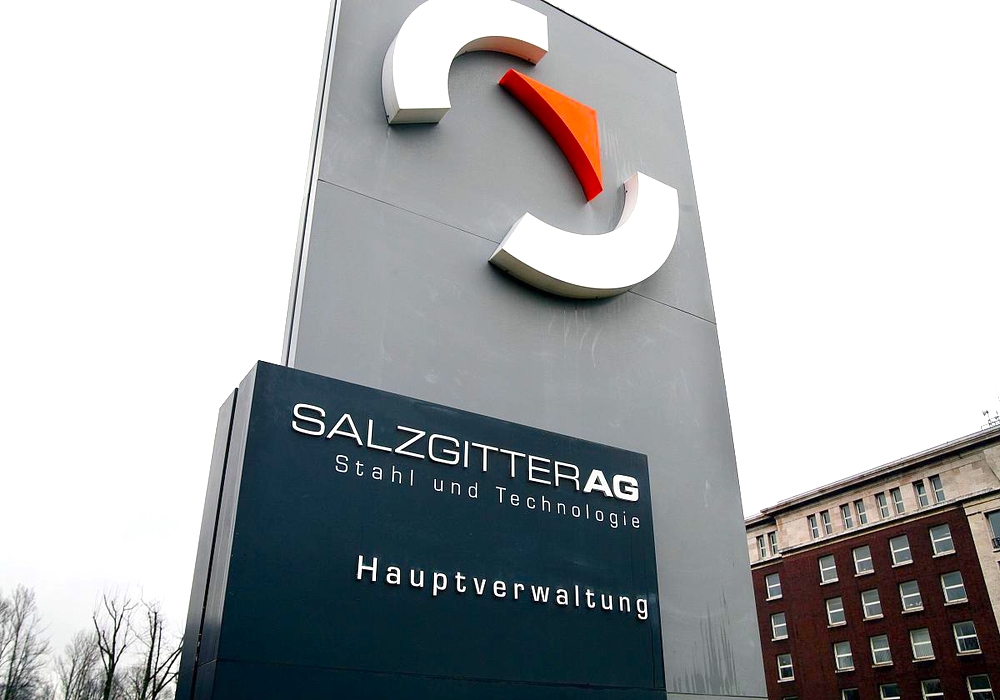
Germany’s Salzgitter returns to net profit in H1 2026 amid geopolitical uncertainties
Germany-based steelmaker Salzgitter Group has stated in its financial report for the first half of this year that the given period was characterized by geopolitical uncertainties, particularly due to the conflict in the Middle East, along with persistently weak demand in key customer industries. The results of its steel production and steel processing units improved despite the challenging market environment.
To future-proof its position, the company noted that it continued to implement its “P28” profit improvement program. The program is designed to improve the performance of its business units in a sustainable way. By 2028, the company expects to see an overall effect of €575 million from efficiency and process improvements in procurement, logistics, sales and technology, including measures taken from the previous Performance 2026 program. In the first half of 2026, the P28 program generated an additional €97 million in earnings, while the company expects to achieve at least €122 million for the full year.
In the first half, the company reported a net profit of €43.5 million, compared to a net loss of €88.9 million in the same period of the previous year, while its sales revenues amounted to €4.59 billion, down by 1.6 percent year on year. Salzgitter’s EBITDA in the given period increased to €277.7 million, compared to €116.8 million in the first half of 2025.
Meanwhile, Salzgitter’s crude steel production totaled 3.03 million mt in the first half, increasing by 3.7 percent year on year.
As for the full year, the company expects its sales revenues to be around €10 billion, and its EBITDA VX to be between €725 million and €825 million.


EU ETS revision could ease CBAM costs for Turkish exporters
The European Commission’s proposed revision of the EU Emissions Trading System (EU ETS) could reduce the future cost pressure created by the Carbon Border Adjustment Mechanism (CBAM) for Turkish exporters by slowing the withdrawal of carbon allowances and extending free allocations, according to Turkish newspaper Ekonomim.
Under the draft announced on July 17, the Commission proposes reducing the annual emissions cap reduction rate from 4.3 percent to 3.7 percent for the 2031-35 period and further to 1.7 percent for 2036-40, as SteelOrbis reported previously. The slower reduction in the supply of emissions allowances could ease upward pressure on EU carbon prices over the longer term.
ETS prices directly influence CBAM costs
The proposed changes are particularly important for Turkish companies exporting CBAM-covered products to the EU because CBAM certificate prices are linked to EU ETS allowance prices.
EU ETS allowances are currently trading at around €82/mt, while the European Commission’s official CBAM certificate price for the second quarter of 2026 stands at €75.28/mt.
Accordingly, a more gradual tightening of the EU ETS could moderate increases in carbon prices and consequently limit the growth of CBAM-related costs for Turkish exporters.
Free allowances could be extended until 2038
Another significant element of the Commission’s proposal concerns the phase-out of free ETS allowances for sectors covered by CBAM. Under the existing framework, free allocations are scheduled to be completely phased out in 2034. The Commission proposes extending this process until 2038, allowing the full carbon cost impact to be introduced more gradually.
The change would be particularly relevant for Turkish exporters of iron and steel, aluminum, cement, fertilizers, electricity and hydrogen, which are covered by the CBAM framework. Exporters of these products to the EU are required to account for their products’ embedded carbon emissions through CBAM certificates.
Sector-specific benchmarks could provide €6 billion in support
The Commission also proposes introducing sector-specific benchmarks for CBAM-covered industries during the 2026-30 period, rather than relying on general criteria. The proposed approach is expected to preserve higher levels of free allocation for affected European industries and provide approximately €6 billion in additional support. For Turkish exporters competing with EU producers, the evolution of these benchmarks and free allocations will be important in determining the effective carbon-cost difference between imported and domestically produced goods.
The proposed EU ETS revision has not yet entered into force. It will be subject to negotiations between the European Parliament and the Council of the EU before the final framework is determined. If adopted in its proposed form, the changes could spread the transition toward full carbon pricing over a longer period and moderate the increase in CBAM-related costs faced by Turkish exporters, particularly those operating in carbon-intensive industries such as steel, aluminum, cement and fertilizers.