


Brussels defends CBAM after US ambassador’s protectionism claim
The European Commission has rejected US Ambassador to the EU, Andrew Puzder’s labeling of its Carbon Border Adjustment Mechanism as protectionism, insisting the measure is a climate tool designed to prevent carbon leakage rather than a disguised tariff.
A commission spokesperson said Aug. 13 that CBAM differs fundamentally from traditional tariffs because it applies equally to all countries based on verified embedded emissions and imposes low or zero obligations on low-carbon goods.
“The commission does not share the characterization of CBAM as a tariff,” the spokesperson told Platts, part of S&P Global Energy, Aug. 13. “It is non-discriminatory, WTO-compatible, and applies equally to all third countries based on verified embedded emissions, irrespective of origin.”
The response follows Puzder’s Aug. 12 opinion piece in The Financial Times, in which he argued CBAM mirrors the trade barriers Brussels criticizes in US measures.
“We therefore do not agree with comparisons with unilateral tariff measures,” the spokesperson said.
Climate measure defense
The commission emphasized that CBAM ensures imported goods face the same carbon price as EU producers under the EU emissions trading system, supporting global decarbonization efforts. Crucially, any carbon price already paid in a third country for embedded emissions can be deducted from the CBAM obligation, preventing double payment for the same emissions.
These remarks highlight growing transatlantic tensions over industrial trade policy even as an EU-US tariff deal entered into force on July 1, making permanent a temporary 15% US import duty on most EU goods.
“Protesting against US national security measures while erecting protectionist barriers reveals a striking double standard,” Puzder had said. “CBAM differs in form but not in substance.”
The definitive phase of CBAM began Jan. 1, 2026, following a transitional reporting period. The mechanism targets imports of goods from the iron and steel, aluminum, cement, hydrogen, fertilizers and electricity sectors, aiming to prevent carbon leakage where companies relocate production to regions with weaker climate policies.
The EU’s CBAM aims to prevent carbon leakage by ensuring imported goods face similar carbon costs to those produced within the EU, potentially affecting trade flows of carbon-intensive products.
Trade tensions
Puzder had drawn direct parallels between CBAM and America’s Section 232 tariffs on steel, aluminum and copper derivatives, calling both measures protectionist despite different framing. His comments highlight escalating transatlantic trade tensions as an EU-US tariff deal that entered force July 1 made permanent a 15% US import duty on most EU goods.
Many developing countries have criticized carbon border taxes in recent years. Russia launched a formal WTO dispute against CBAM and the EU ETS in 2025, calling them “discriminatory.”
China has raised concerns within the WTO but filed no official complaint. BRICS leaders have repeatedly condemned unilateral climate-linked trade measures as discriminatory protectionism. The EU maintains CBAM complies with WTO rules by creating a level playing field without creating trade barriers.
Carbon prices vary significantly because different regions use independent compliance systems, caps and political frameworks with little global alignment.
Carbon permits in Europe are currently almost three times more expensive than compliance prices in parts of the US.
Platts assessed EU Allowances for December 2026 at €81.91/metric ton of carbon dioxide equivalent ($94.49/mtCO2e) on Aug. 12. This compares with the California Carbon Allowance price for December 2026, which was valued at $33.42/mtCO2e on Aug. 12, Platts data showed.
Author: Eklavya Gupte

Thyssenkrupp monitors Rhine levels as steel logistics face strain
Thyssenkrupp said Aug. 13 that blast furnace operations at its Duisburg steelworks remain largely unaffected by low Rhine water levels, though the German steelmaker is monitoring the situation closely as weak navigability continues to strain inland raw-material logistics.
The Rhine, a key transport artery for European industry, has seen its navigable depths decline due to prolonged heat and limited rainfall. The low water levels have forced barges to sail with reduced cargoes and prompted some steel supply chain participants to consider alternative transport, including road freight.
Duisburg is one of Europe’s largest steelmaking hubs and relies heavily on stable inbound logistics for raw materials such as iron ore, coal and other bulk inputs.
Speaking during Thyssenkrupp’s second-quarter earnings call Aug. 13, CFO Axel Hamann said the company had seen no significant impact on blast furnace operations at Duisburg.
His remarks followed Thyssenkrupp’s July 22 statement that it was partially suspending its own barge deliveries of raw materials to the site and would instead charter private ships that could continue operating in the shallower waters.
“We have set up a dedicated task force in the steel division to monitor it [Rhine water levels],” Hamann said during the call. “We have a few options to adjust our production and the operating mode of our facilities to some extent, so that we can work longer with the inventories we have”.
Hamann said Thyssenkrupp was also examining potential road transport options. He said customer supply was not currently at risk, but warned that “if the situation really deteriorates and shipping were to come to a standstill, we could not rule out an impact on our results.”
Water levels at the Kaub chokepoint on the Middle Rhine were about 12 cm late on Aug. 12, with the German water authority WSV forecasting levels to fall below 10 cm starting Aug. 15.
Rhine ships have no legal obligation to transport goods when water levels fall below 80 cm, while 40 cm is generally considered the threshold for a full halt to barge traffic. A small number of modern, lightweight barges can still sail at lower depths with minimal cargoes, but few ships can navigate key pinch points under such conditions.
Platts, part of S&P Global Energy, assessed domestic hot-rolled coil in Northern Europe at €720/mt ex-works Ruhr on Aug. 12, up €5/mt day over day, and in Southern Europe at €710/mt ex-works Italy, stable day over day.
Author: Euan Sadden

Outokumpu starts up biocoke plant in Finland to cut steelmaking emissions
Finnish stainless steel producer Outokumpu has inaugurated a new €30 million biocoke agglomeration plant at its integrated Tornio production site in northern Finland, enabling the company to replace fossil coke in ferrochrome production and reduce direct CO₂ emissions.
In a statement released on Aug. 14, Outokumpu said the plant processes biochar into biocoke, a biomass-based substitute for fossil coke used in ferrochrome smelting. The company said the facility could reduce direct CO₂ emissions by up to 82,000 mt/year when operating at full capacity, equivalent to the annual emissions of about 8,000 Finnish citizens.
The company did not disclose the plant’s biocoke production capacity beyond the stated potential emissions reduction.
“This investment is a concrete step forward in our efforts to reduce the climate impact of our operations,” Juha Erkkilä, head of Outokumpu EvoCarbon, said in a company statement. “Biocoke production has already started in Tornio, and biocoke has been produced both for our own use and for external customers.”
The investment supports Outokumpu’s target to cut CO₂ emissions across its value chain by 42% by 2030 from a 2016 baseline. The company said biocoke is a key tool for reducing the intensity of direct emissions from ferrochrome production, and it linked the Tornio project to its broader strategy to develop lower-carbon stainless steel.
Outokumpu’s Tornio site is an integrated production complex for stainless steel and ferrochrome. The company’s ferrochrome operations are supported by the EU’s only chrome mine in Kemi and an integrated ferrochrome smelter in Tornio, according to a June investor presentation.
Platts, part of S&P Global Energy, assessed Premium Low Vol Hard Coking Coal FOB Australia up $1/metric ton at $224.90/mt Aug. 13, while the CFR China price was also assessed up $1/mt at $244/mt.
Author: Euan Sadden

Bosnia’s Zenica steel plant files for bankruptcy


Marcegaglia: Domestic stainless steel purchases in the UK could ease quota pressure

US announces preliminary dumping margin on welded pipe imports from Greece

Low Rhine levels hurting German steel industry: associations
Record low water levels on the Rhine could trigger a chain reaction in German industry, including the steel sector, according to a statement by industry associations.
The German Steel Recycling and Disposal Association (BDSV), the German Association of Secondary Raw Materials and Waste Management (bvse), and the German Association of Metal Traders and Recyclers (VDM) have issued a joint call for additional support.
“The Rhine’s water level near Kaub has fallen below its 2018 low and in critical sections of the river, inland cargo vessels can only carry a third of their usual volume,” they warn.
“The shutdown of one of the main transport arteries threatens to have a knock-on effect on the country’s entire economy. A threefold reduction in ship cargo capacity requires three times as many voyages. This dramatically increases the cost of transporting a ton of cargo and creates an acute shortage of ships.”
According to BDSV, around 120.7 million tonnes of freight were transported for the industry in 2024, with 49.3% by rail, 31.6% by inland waterway, and only 19.2% by road.
“Overall, more than 81% of the volumes depend on water and rail. Approximately 38mt of metallurgical freight are transported by river annually. Hypothetically, if even half of this volume were rerouted to roads, more than 760,000 additional trucks would be required per year (more than 63,000 per month). This proves that road transport is unable to quickly replace river barges,” it adds.
Rail transport is also on the verge of exhausting its capacity, as steel companies are forced to share available railcars with the chemical, energy, construction, and agricultural industries, the association notes.
“Largest steel-consuming industries like the automotive, mechanical engineering, and construction employ approximately four million people,” it adds. “Delays in raw material or finished metal deliveries threaten production disruptions and investment freezes.”
The situation is complicated by rising steel production in the first half of 2026, when Germany produced 18.6mt of steel, up by 8.9% year-on-year, Kallanish notes.
Plants require an uninterrupted supply of scrap and the removal of products. Logistics disruptions are leading to warehouse overflows at processing plants and raw material shortages at the plants, the associations say.
They are calling on German authorities to immediately coordinate the operation of all modes of transport, expedite the approval of alternative routes, and regulate repairs. They add that in the long term, the country needs more resilient infrastructure like developing waterways, building shallow-draft vessels, expanding railways and multimodal terminals.
German rebar resurges from temporary dip
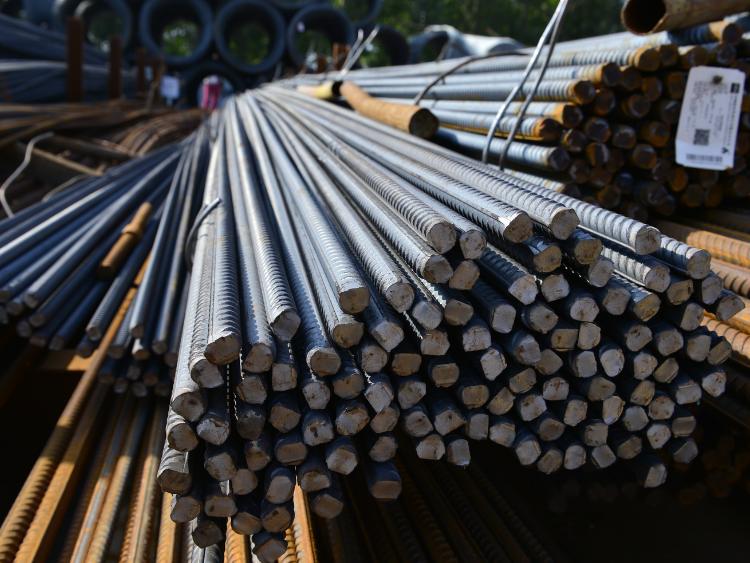
The fall of rebar prices from German mills seen in July has been reversed with current and upcoming orders now again facing base prices above €400/tonne ($462/t).
That was the lower limit seen by most, after a short downturn from the relative stability of around €430/t earlier on.
One buyer of large amounts tells Kallanish of opportunities at €390/t “and even €380/t”.
Most customary buyers would have been happy enough with €400/t, though, and “we have refilled quite a bit, so that I would not know where current offers are,” a Hanover-based manager says.
Mills appear to have collected a good amount of offers, “and in view of this have announced higher prices,” a manager from the Frankfurt area says.
While others confirm the move, the degree of increase remains unconfirmed.
According to the large-volume buyer, mills want to return to €420-430/t, but for the moment are happy to stabilise the €400/t.
Given that books were being well filled in July, fresh transactions are currently rare. “Those who had speculated on even lower prices in July will now have to pay more,” the Lower Saxony manager says, without giving further details.
Market players expressed wide ranging explanations on how the temporary July dip came about. The fall in €25/t scrap prices had been quickly factored in, one source notes. While another notes the ongoing geopolitical challenges, with a brief dip in oil and energy prices on a potential peace deal in the Gulf.
“There was an Italian invasion of cheap offers in southern Germany for a brief period,” the Hanove manager says. “We up north did not get those offers, but still, the domestic mills had to react, and that’s why the waves were felt all over the county.”
Author: Christian Koehl Germany


German steel haulier shifts to electric trucks
Hergarten Stahlspedition, Germany’s largest specialist steel transportation company, intends to convert its fleet to electric vehicles in a move that will reduce road transport CO2 emissions, Kallanish learns.
The company has been considering electrification for some time, and has now launched a transition campaign known as E-Mission 2031, to gradually convert its fleet over the next five years.
The intention of the project is “to contribute sustainably to decarbonisation in logistics,” managing owner Marcel Hergarten has reportedly said in publication Eurotransport.
According to the manager, the transport of steel with its high tonnages is very challenging when going electric.
“It requires careful planning of the itinerary, a selection of adequate vehicles, and a close coordination with the customers,” Hergarten is quoted as saying. He notes that the technical improvement of recent years now allows for higher battery charges and longer ranges.
Beyond the climate ambitions, Hergarten is convinced that the future of road freight transport requires joint efforts with customers, partners, and employees.
The company “wants to start at an early stage with gaining experience in practice to show that climate-friendly logistics can work reliably and profitably in a demanding market segment”.
Hergarten Stahlspedition is located in Cologne and operates a fleet of 200 trucks.
Author: Christian Koehl Germany
State must be pioneer for green steel: Salzgitter
Salzgitter ceo, Gunnar Groebler is calling on the German state to support the uptake of reduced emission steel, Kallanish learns.
“We need politics that actively shapes the markets of tomorrow,” Groebler says in a social media post.
“The acid test here is public procurement. The government need to live up to its role as a pioneer. With smart incentives, like factoring in the use of CO2-reduced steel in the car fleet, it makes regulatory and economic sense for carmakers to use such steel. This would create a pull that can never be achieved with mere subsidies,” Groebler says.
In the first half of its financial year, the German steelmaker delivered “an encouraging performance”, which has prompted the company to lift its earlier profit forecast.
Its revenue of €4.6 billion ($5.3 billion) was slightly below the first half of 2025 compared with €4.7 billion a year earlier. However, Ebitda of €459 million “significantly outperformed” the previous result of €117m.
The main drivers were an exceptionally high earnings contribution from its participating interest in copper maker Aurubis, and the technology business unit.
Meanwhile, the steel focused units of steel production, and trading, also improved their figures, but were more burdened by geopolitical uncertainties, as a consequence of the war in the Middle East.
Crude steel production went up by 100,000 tonnes to 3 million tonnes. Meanwhile, its profit improvement programme made a sustainable contribution of €97m.
Additionally, the group undertook the move to acquire full ownership in Duisburg mill Hüttenwerke Krupp-Mannesmann (HKM) during H1. “The full inclusion of HKM prompted us in mid-July to revise our guidance for the financial year 2026 upward again, says cfo Birgit Potrafki.
In view of the various geopolitical and economic uncertainties, the group anticipates only a moderate improvement in general business conditions.
The group expects revenues of €10 billion for the full year, and Ebitda of €725-825m.