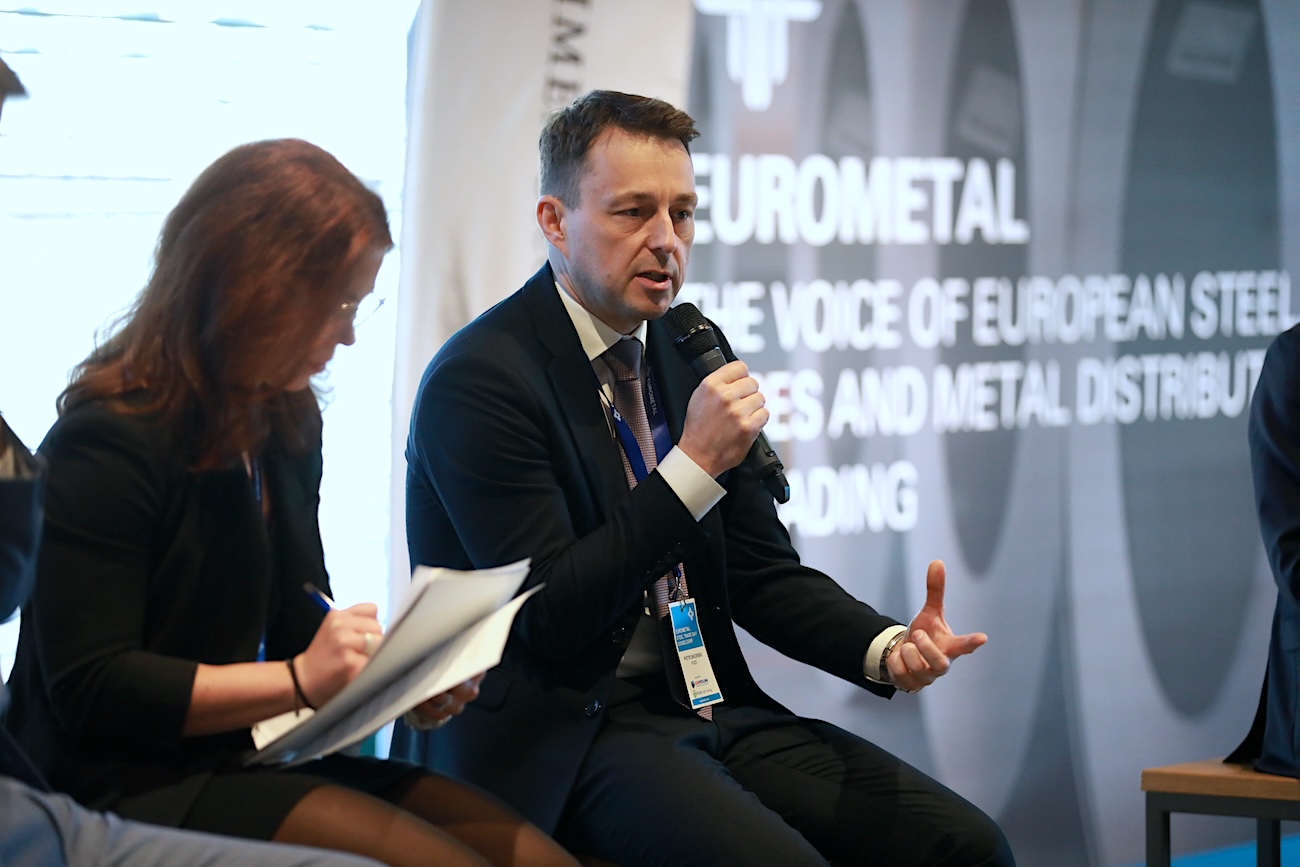
Despite the resilience of the Polish economy and considerable investment potential in infrastructure, energy and defence, the country’s steel consumption remains subdued. The growing disconnect between economic growth and steel demand reflects structural changes in the manufacturing sector rather than a temporary economic downturn, Metal Expert learnt during EUROMETAL Steel Trade Day 2026, held on November 23-24 in Duesseldorf, Germany.
Polish steel consumption is expected to reach 13-13.5 million t in 2026, remaining broadly in line with the previous year’s level and around 2 million t below its historical peak, according to Piotr Sikorski, President of the Polish Union of Steel Distributors and Processors (PUDS). Although Poland remains one of the largest steel-consuming markets in Central Europe, prospects for a meaningful recovery in 2027 remain limited. “It has nothing to do with the economic cycle, because the 13 million t we are dealing with right now has been with us for a very long time,” the source noted.
The changing structure of domestic manufacturing represents one of the major challenges for the Polish steel market. The country’s economic growth and investment needs are no longer translating into a corresponding increase in steel consumption. “Steel demand is a sick patient of our market for a very long time, and we have to finally admit that there is something going on with steel demand, and it is going through a structural change that we haven’t seen before,” the PUDS president pointed out.
Growing imports of steel-containing products, particularly parts and components from Asia, are contributing to the gradual transformation of Poland’s manufacturing sector into an assembly-oriented economy. Although such operations continue to generate employment, tax revenues and economic growth, their contribution to local steel consumption remains limited. “It is a disaster because no steel is being used when we assemble parts imported from Asia,” Piotr Sikorski explained.
Meanwhile, the prospects for a recovery in the European automotive industry, one of the key steel-consuming sectors, remain questionable, especially in view of challenging export. “The share of foreign automotive brands in the Chinese market had reportedly declined from around 60-70% five years ago to approximately 25%, while Chinese vehicle exports were estimated to increase from 7 million units in 2025 to 12 million units in 2026,” he added.
The considerable gap in production costs further complicates the situation for European automotive manufacturers. According to the approximate figures cited by the PUDS president, the average cost of manufacturing an electric vehicle in China stands at around $20,000, compared with more than $30,000 in Europe. Although additional trade protection measures could restrict Chinese suppliers’ access to the European market, they would not necessarily address the underlying competitiveness issues. “But the competitive gap is always there. So we have to dig deeper to change the structure,” Piotr Sikorski stressed.
Moreover, the ongoing debate over extending the production timeline for internal combustion engine vehicles in Europe could give Chinese manufacturers additional time to strengthen their technological advantages and export positions. “I’m not that optimistic as EUROFER when it comes to the automotive industry in 2027,” the PUDS president noted.
The key challenge for the Polish steel market is therefore not necessarily insufficient economic growth or a lack of investment opportunities, but the declining steel intensity of domestic economic activity. Unless European manufacturers retain more value-added production within the region, the Polish steel market could remain stagnant despite relatively favourable macroeconomic fundamentals, Metal Expert understands.
Author: Metal Expert Editorial Team