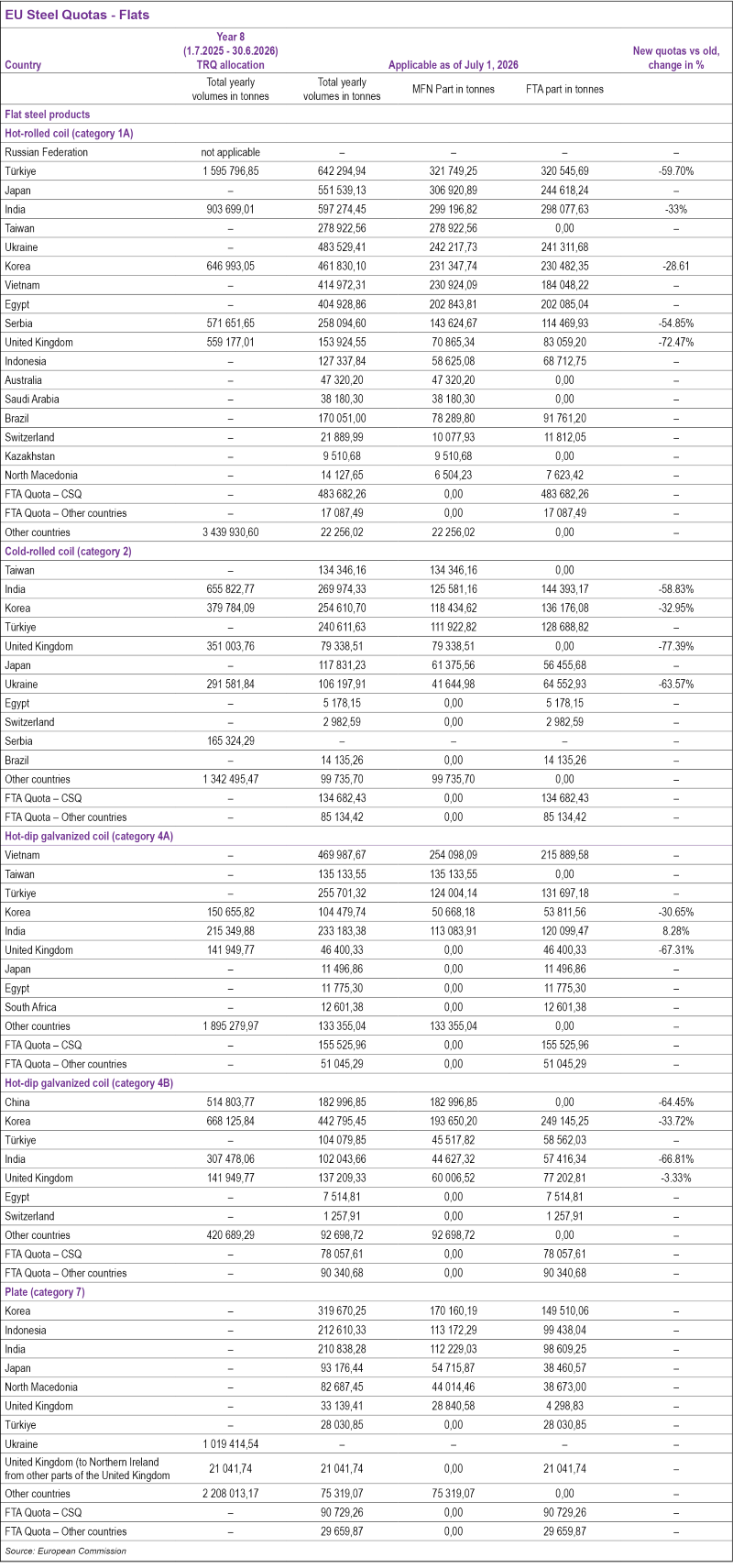
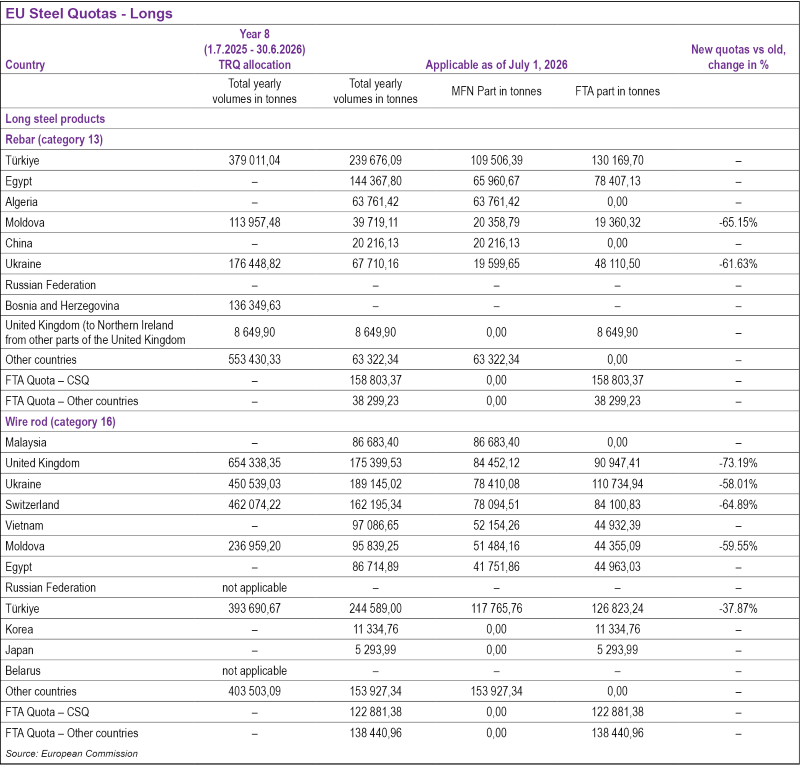
According to a document published in the Official Journal of the EU, seen by Fastmarkets, the new framework will include the expected significant reductions in tariff-free volumes to 18.3 million tonnes.
But it will also introduce a two-tier quota system under which one part will be available only to countries benefiting from an existing or future free-trade agreement with the EU (the FTA Part), while the other part will be available to all third countries on a Most Favoured Nation (MFN) basis (the MFN Part).
MFN quotas were allocated according to each country’s average share of EU imports in each product category during 2022-24. This distinguished many more countries with allocated country-specific quotas compared with the previous safeguard.
For the FTA part, quotas were allocated more flexibly, considering trade agreements, market distortions and the need to diversify supply, as well as special situations affecting certain countries.
As a result, some FTA partners received different levels of access. In particular, Ukraine was given more favorable quotas than other FTA countries.
Both the MFN and the FTA parts of the country-specific quota were accessible simultaneously to economic operators, functioning as a single quota with a single order number.
When a country does not belong to the pool of countries with FTA, economic operators can only access the MFN Part of the country-specific quota.
The regulation also introduced a change to residual quotas, which open at the start of each quarter. Instead of a single residual quota available to “Other countries,” the new system will split residual volumes into “FTA quota – Country-Specific Quota (CSQ),” “FTA Quota – Other countries” and “Other Countries.”
FTA Quota – CSQ will be open to countries with an existing or future free-trade agreement with the EU that have a country-specific quota.
FTA Quota – Other countries will be open to countries with an existing or future free-trade agreement with the EU that do not have a country-specific quota.
This gives FTA countries greater flexibility, and will potentially delay exposure to the 50% tariff compared with non-FTA suppliers, according to the regulation.
The other countries residual quota will be open to all countries except those listed in Section 3 of Annex II of the regulation.
All residual quotas distributed under this regulation will be administered on a first-come, first-served basis.
Any volumes imported outside these quotas will be subject to a 50% tariff.
The measures were intended to protect the bloc’s steel industry from global overcapacity and unfair trade practices.
In 2025, a growing share of the EU’s steel demand was being met by external suppliers rather than domestic producers, prompting the use of tighter trade measures.
EU crude steel production declined by 2.9% year on year in 2025 to 125.8 million tonnes, down from 129.6 million tonnes in 2024. This was the lowest level on record and was around 60 million tonnes below the figures seen before the 2008 global financial crisis, according to European steel industry association EUROFER.
Meanwhile, apparent steel consumption in Europe increased by 4.5% year on year in 2025 to around 130 million tonnes, the first rise after three consecutive years of decline. But this improvement was overshadowed by a sharp surge in imports, particularly in the final quarter, when inbound volumes jumped by more than 50% quarter on quarter.
Import volumes of semi-finished and finished steel products in Europe rose by 14% year on year in 2025, to 40 million tonnes, according EUROFER.
Initial market reaction
The market was digesting the news, with quota cuts for some origins viewed as being extremely punitive.
For instance, allocation of the hot-rolled coil quota (Category 1A) for Turkey, which was traditionally one of the key suppliers of this product to Europe, was reduced by 60% to 642.249 tonnes, versus 1.59 million tonnes under the previous safeguard.
Another trading source said that the regulation was less of protection mechanism and more of a deal to create more complication and to add bureaucratic barriers for business, adding that the current quota distribution would make it “very tough” for new origins to enter the market.
Despite this, he expected no drastic price changes in the European domestic market in the near term, due to the limited demand and spending caused by the caution related to the unstable political situation in the world as well as to the seasonal summer slowdown.
None of the HRC suppliers contacted by Fastmarkets’ on June 30 reported any immediate price rises.
Fastmarkets’ daily steel hot-rolled coil index, domestic, exw Northern Europe, was calculated at €683.13 ($779.92) per tonne on June 30, up by €1.88 per tonne from €681.25 per tonne on June 29.
The index was down by €3.12 per tonne week on week and by €7.79 per tonne month on month.
A source from Ukraine expressed concern that the country was not exempted from the new safeguard in the way it was under the previous regulation, and was now subject to both safeguarding and the EU’s Carbon Border Adjustment Mechanism (CBAM), despite the difficult economic conditions it was facing because of the Russian invasion.