

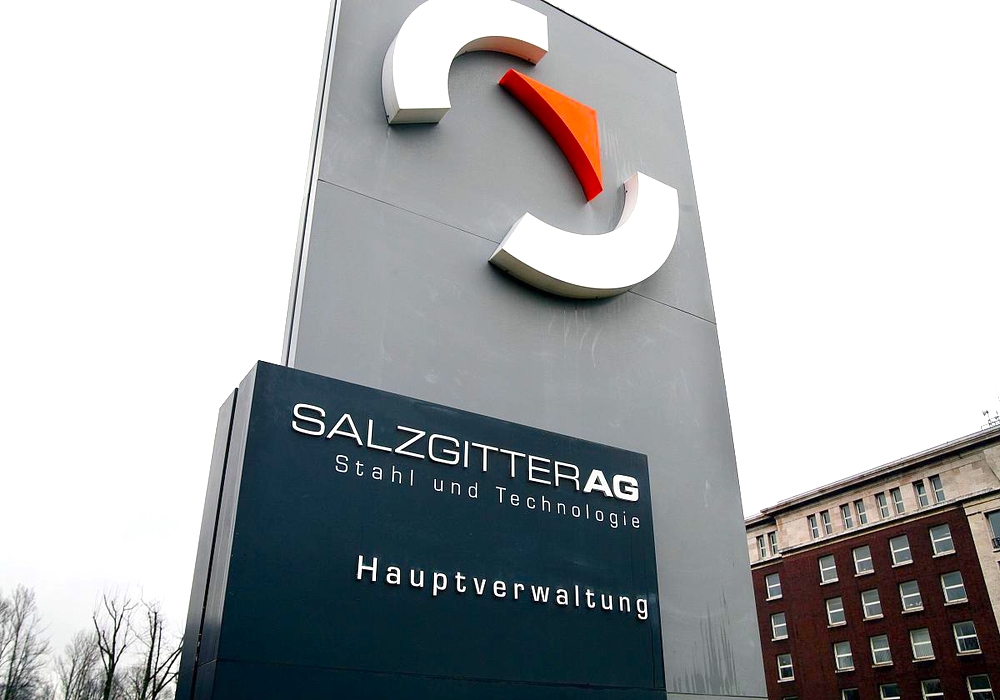
German steelmaker Salzgitter has initiated the decarbonisation of its Hüttenwerke Krupp Mannesmann (HKM) subsidiary, signing a contract with Tenova for the engineering, delivery, and installation of an electric arc furnace at its Duisburg steelworks, Salzgitter said on 29 July.
The new furnace will be Germany’s largest and the second largest within the European Union with an annual capacity of 2.5 mt and a planned production target of 2 mt of green steel. The implementation phase will start in August this year and is scheduled for completion in 2029.
Raw materials, either ferrous scrap or direct-reduced iron (DRI), will be fed into the system continuously via a conveyor belt system, and the exhaust heat will be used to preheat scrap metal, further decreasing emissions compared with conventional EAFs, Salzgitter said.
To learn more about Salzgitter’s decarbonisation initiatives and those of other steelmakers globally, see McCloskey’s Global Green Steel Profile.
Salzgitter acquired 100% of HKM’s shares in the first half of July, having finalised the transfer of ownership from fellow German steelmaker Thyssenkrupp and Vallourec.
The project will receive EUR200m in funding from the federal government and the state of North Rhine-Westphalia as part of the “Federal Funding for Industry and Climate Action” programme.
“With the construction of the electric arc furnace, HKM will be directly integrated into the Salzgitter Group’s transformation strategy towards low-carbon steel production,” Gunnar Groebler, Chairman of the Executive Board of Salzgitter, said. “With the electric arc furnace, we are laying the foundation for sustainable and competitive steel production at HKM and strengthening our position as a leading supplier of green steel for industrial value chains.”
Over the past few years, Salzgitter has signed a number of green steel supply agreements with end users, including companies in the automotive and white goods segments.
Salzgitter has not been active in the spot market for green steel, but has reportedly achieved premiums of around EUR300/t for low-CO2 hot-rolled coil (HRC) from its trial plant.
The latest spot deals for smaller lots of green HRC from other European steelmakers have been concluded at premiums of EUR150-180/t.
New decarbonisation investment and ETS
Salzgitter’s announcement of the EAF investment has come at an important time in light of the European Commission’s recent review of the EU’s Emissions Trading System (ETS).
Under the proposed reforms, free allocation – essentially the emissions allowances granted free of charge to polluting installations to mitigate carbon leakage risks – will be extended beyond the current 2034 phase-out date to 2038, reintroducing 15% of lost free allocation into ETS supply post-2028.
However, unlike the present ETS framework, free allocation would become conditional from 2031, limiting freely awarded EUAs to installations that have firmly committed to transformation projects aimed at decarbonising their processes. Specifically, 80% of eligible allowances for the five-year period from 2031-2035 would be granted annually upon proof of a final investment decision (where invested funds meet or exceed the free allocation requirement), with the remaining 20% released once projects enter the construction or operational phase.
Importantly, steelmakers can group installations under “joint decarbonisation investment agreements,” allowing one or more installations to fulfil the decarbonisation investment requirement for free allocation on behalf of all other installations within the agreement, provided the agreement is concluded prior to the submission of 2031-2035 free allocation applications, or by the end of September 2029. While it is not yet clear whether capital expenditures made before the 2029 deadline will qualify as evidence for post-2030 free allocation, it seems likely that the Commission will reward first movers. Moreover, if Salzgitter’s new EAF at HKM falls within the top 10% of best-performing installations, it may also be exempt from the free allocation evidence requirement for the HKM site (though not for other sites unless they qualify under the aforementioned joint agreement).
Previously jointly owned by Salzgitter, Thyssenkrupp, and Vallourec, HKM could previously have been covered by a joint decarbonisation investment agreement that mitigated investment requirements for all three participating companies. However, following Salzgitter’s full acquisition of the site and its stated plans to incorporate HKM into its SALCOS decarbonisation strategy, it seems less likely that HKM investments would benefit its former owners, which will have to commit to their own decarbonisation projects to qualify for free allocation from 2031.
Author: Benjamin Steven


