


Klöckner lifts earnings, launches e-commerce platform
Germany’s Klöckner & Co raised both its revenues and operating income in the fiscal year 2017, Kallanish hears from the steel distribution group. The increases were especially due to the positive trend in prices as well as to internal optimisation measures, Klöckner says.
For its key markets, the group expects that real steel demand will rise by 1-2% in Europe and by about 3% in the USA in 2018. “If the current trend toward higher steel prices were to persist, this would have an additional positive impact on operating income,” it notes.
2017 saw Klöckner further accelerate its digital transformation. The share of sales generated via digital channels was raised from 13% to 18% as a result. As of the end of last year, the group is expanding its online shops into marketplaces by opening them up to providers of complementary products. The first version of the industry platform, also open to direct competitors, has gone live under the name of XOM.
In September, ceo Gisbert Rühl had announced the launch of XOM as a tool-for-all, to create “… one’s own shop-in-shop,” and in which Klöckner intends to hold only a minority stake in the long run. In that context, he said that digital tools will help to predict demand situations: “Allegedly, Facebook knows two weeks ahead of time if a couple separates,” Rühl said in a presentation monitored by Kallanish.
The distributor raised its revenues by 10% to €6.3 billion ($7.7 billion) year-on-year in fiscal year 2017 on virtually stable shipments of 6.1 million tonnes. Operating income rose by 12% to €220 million and net income improved from €38m to €102m, same basis.

Trump’s threat to EU auto exporters spooks steelmakers
A number of tier-1 European steelmakers are increasingly more concerned about potential tariffs for European cars sold into the US than the direct tariffs on steel under the country’s Section 232 plan, mill sources said Thursday.
The US is the largest export market for an industry that produced 19.2 million vehicles in 2016, according to figures published by the European Automobile Manufacturers Association (ACEA).
US President Donald Trump has been a vocal critic of the trade deficit the US has with European automakers and has warned of a “tax on their cars.” Such a move would be a significant threat to a trade flow that saw the US import 1.17 million EU-made passenger cars in 2016.
A source at a German steel mill said the concern for the automotive sector is far greater than the potential lost steel exports to the US. “Our concern is if this escalates and goes into cars — 25% of German cars go into the US market,” the source said.
The automotive production hub in Europe is in Germany, with numerous service centers almost entirely focused on supplying the sector. In 2016, Germany produced more than 5.5 million passenger cars, with a further 550,000 commercial vehicles. ThyssenKrupp, ArcelorMittal and Salzgitter are major domestic automotive steel suppliers, with significant long-term contracts dependent on the success of the industry.
“If we start a real trade war between Europe, [the] US, China, whoever, this could affect the steel demand and this is a much worse scenario,” another European mill source said, noting that the European Commission has escalated tensions by proposing retaliatory measures for Harley Davison motorcycles and American whiskey.
The European hot-dip galvanized market has been reshaped in recent years to tailor to automotive grades, to the extent that many industrial-grade buyers are concerned by limited supply options. But a trade war with the US would cause significant problems for a key end-user industry that already faces headwinds.
ACEA forecasts new car sales in the EU to slow to 1% growth in 2018, following growth of 3.4% in 2017, when vehicle sales totaled more than 15 million for the first time since 2007.
EU legislation bringing forward CO2 targets for cars and vans, plus the potential disruption from Brexit, have dampened the overall outlook. ACEA Secretary General Erik Jonnaert is keen to avoid further obstacles, calling this week for international trade rules to be respected.
“European manufacturers do not only import vehicles into the US, but that they have a major manufacturing footprint there, providing significant local employment and generating tax revenue. Indeed, some European manufacturers have their biggest plants not in the EU, but in the US,” Jonnaert said.
Peter Brennan, PLATTS
EU exporters expect US trade to continue despite tariff plan
The 25% tariff on European steel exports to the US will have limited impact, as many products cannot be easily replaced domestically, sources said Thursday.
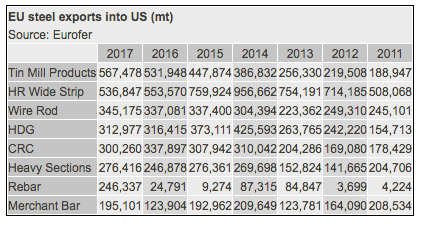
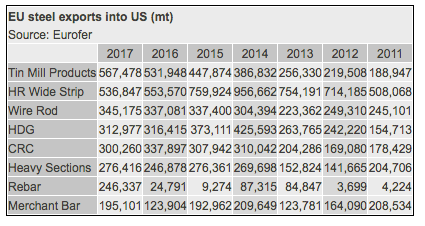
The US imported 3.2 million mt of finished steel products from the European Union in 2017, making it the region’s second-largest export destination after Turkey.
The most exported product was tinplate, a product not easy to replace from local sources in the US as suppliers are limited. Tata Steel is the largest source of foreign tinplate, selling 272,000 mt in 2017 primarily to packaging companies. Sources suggested Tata supplies drawing-quality grades that can save can-makers around five cents per can, while US producers have largely moved out of the product sector in recent years.
Steelmakers also pointed to the US automotive sector, which imports a large proportion of the 1.2 million mt of coils sold into the US last year. “Our customers are realizing that this will be a big problem for auto, indirect auto, engineering high-strength wide steel and packaging steel customers. They are all completely reliant on Europeans,” one mill source said.
Another mill source said that even where the grades are produced in the US, end-users may struggle to acquire the volume they require from the domestic market. “A lot of the US grades they make, they are already at maximum capacity,” the source said.
A third mill source noted the limited impact on European sales to the US after President George W Bush implemented Section 201 tariffs in the early 2000s. “Last time there was a tariff, Europeans just said ‘Sorry, the price is increasing by the tariff,’ and nothing happened,” he said.
The impact is expected to be more serious for long steelmakers, with the likes of Megasa in Portugal sharply increasing their US-bound sales of rebar to 145,000 mt in 2017. Sources said commodity-grade products such as these are likely to be unworkable with a 25% tariff.
But the biggest concern for most is the likely redirection of trade from the US. “It’s plain and simple, only in flat products there is 12 million mt shipped to the US, of which eight million is non NAFTA … that could be coming to Europe from tomorrow,” one mill source said.
Peter Brennan, PLATTS
Trump signs off on steel tariffs; Canada, Mexico excluded
US President Donald Trump on Thursday signed off on two proclamations instituting his administration’s previously announced tariffs on steel and aluminum imports.
As a result, the US will implement a 25% tariff on imports of steel and a 10% tariff on imports of aluminum, which will take effect March 23, 15 days from the date of the signings. Canada and Mexico will be excluded from the initial tariffs and the proclamations include a broader provision which will allow other countries to request an exemption, a senior administration official said Thursday in a media briefing ahead of the signing.
“[The tariffs] will cover all of the countries that ship us steel and aluminum products…however importantly for now, Canada and Mexico will be excluded from the tariffs and we will have ongoing discussions with Canada and Mexico about our security relationship,” the administration official said. “NAFTA discussions will be part of that, only because NAFTA is an important part of the security relationship in the hemisphere.”
No timeline was provided for when Canada and Mexico’s exemptions may lapse.
“All countries will be welcome to discuss with the US alternative ways to address the threat and impairment of the national secretary caused by their imports,” the administration official said.
Discussions with other countries regarding potential exemptions will take place with United States Trade Representative Robert Lighthizer, the administration official said. Should countries secure exemptions, the US will raise tariffs on everyone else modestly, he said.
“Should the president decide there is a satisfactory alternative means to address the threat…this administration has the ability to flexibly modify the order in a way which will preserve our national security,” he said.
The 10% and 25% blanket tariff levels have been set to ensure a healthy steel and aluminum industry that allows US producers to earn reasonable rates of return, the administration official said. In order to do that, steel and aluminum producers have to achieve a sufficient level of capacity utilization, he said. The administration has said its goal is to get steel and aluminum capacity utilization up to 80% each.
Following a nine-month investigation into the effect of steel imports on national security, the Department of Commerce delivered its Section 232 report and recommendations to Trump January 11. A global tariff of at least 24% on all steel imports from all countries was one of three recommendations presented by Commerce in its report, however the administration decided to impose a tariff of 25% on steel based on additional data and analysis by Commerce following delivery of the initial report, the administration official said.
Justine Coyne, PLATTS