


Turkey rebar: EU quota to be filled rapidly
Market participants expect the proposed EU definitive safeguard Turkish rebar quota to be exhausted in a matter of days upon its introduction in early February, they said today after the European Commission (EC) made its plan public.
One Turkish mill has a total of 65,000t of rebar either to be shipped to Europe, en-route or waiting at port, which the producer had earmarked to clear customs once the new quotas come into effect. Another steelmaker was heard to have sold around 70,000t for February arrival.
Some 18,000-30,000t have arrived or are due to arrive in Romania in January and is expected to be cleared by customs in February, according to a market participant. Another continental European source said they expect the 117,231t allocated to Turkey for the period between 2 February and 1 July to be gone within a day.
The question remains when the residual global quota of 217,775t will be made available in the February-July period to exporters with allocated volumes. The EC declined to comment.
But some market participants anticipate a situation similar to what happened in the US post-Section 232 tariffs being implemented, with EU domestic rebar prices set to increase, while buyers continue importing and pay the duty.
The Argus daily rebar assessment fell by $2.50/t to $447.50/t today, as more mills were confirmed to be offering at $450-455/t fob, although market participants agreed $445/t fob would be possible for larger tonnages for some mills. A sale to Germany was heard to have been concluded recently, although details could not be obtained.
Turkish wire rod offers heard were $480-490/t fob.
In the domestic market demand picked up slightly yesterday, with one north Turkey-based mill selling just under 7,000t. Traders were planning to make more purchases today.
The seller offered rebar at 2,466 lira/t ($451/t) ex-works today excluding value-added tax (VAT) — unchanged since mid-December — but lowered its billet offer by TL60/t to TL2310/t on the same basis, although it did not sell much material.
An Iskenderun producer offered at TL2,880/t ex-works including VAT, and a trader said it purchased at TL2,860/t from two mills in the region.
A Marmara mill said it sold around 10,000t of rebar in the local market in the past two weeks at $445-450/t ex-works equivalent excluding VAT to reduce its inventory levels, and is now offering at $450/t ex-works.

EU quotas suggest 5% annual increase until mid-2021
The European Commission has prepared a draft document on the final decision over permanent safeguard measures on imports of a number of steel products into Europe. This indicates that tax-free quotas will rise by 5% annually until mid-2021. Despite this clause, traders are expressing their concerns as the system imposes further limits compared to the temporary measures currently in place, Kallanish understands.
As an example, as anticipated the quotas for HRC will be calculated globally rather than country-based. The draft from the EC indicates that a first quota of some 3.3 million tonnes will be allocated in the February-June 2019 period. After that a quota of 8.6mt will be set for July 2019-June 2020 and one of 9mt for July 2020 – June 2021.
A similar increase over the period is calculated for all other products. The quotas for these however will be allocated to a specific country of origin for the largest importers and a general ‘residual group’ of other countries including all smaller sources.
The division into country of origin could well create new challenges for importers in Europe. A Swiss-based trader, for example, notes that for Chinese metallic coated sheets the EC is setting a 500,000t quota for the July 2019 – June 2020 period. During full-year 2018 over 1mt of such products were imported into Europe from China.
The products mostly under pressure since the temporary quotas were applied have been longs. Over 90% of the quotas set for the period ending February 2019 had already been used in mid December 2018 (see Kallanish passim). The EC is setting an overall 2.1mt quota for the period July 2019- June 2020 for wire rod specifically, while for rebar it will be 1.5mt (both divided into specific countries of origin).
All quotas will be allocated quarterly and unused quotas will be allowed to be transferred to the following quarter. Specific source countries having exhausted their quotas meanwhile will be able to use the unused tonnages included in the ‘residual quota’ group only in the last quarter of the period, Kallanish understands.
Questions arise over proposed EC safeguard measures

European steel market players on Thursday were still analyzing the possible impact of the European Commission’s proposed definitive safeguard measures on steel imports into the European Union.
In a notification document to the WTO, obtained by S&P Global Platts, the EC outlined its planned definitive safeguard measures, which include country-specific quotas on the biggest steel-supplying countries to the EU. However, the EC plans to make an exemption for hot-rolled coil imports which would receive a global tariff-rate quota.
The definitive safeguard measures will be enforced no later than February 4, the EC said.
A mill source said it would be “odd” that HRC received a global quota and that Turkey has not been singled out as it was a major source of material for European buyers in 2018.
According to the EC, a country-specific approach would not be appropriate for HRC as 60% of imports are already covered by anti-dumping measures.
Provisional import quotas, which have been in place since July last year, show that HRC quotas have not yet been filled. Around 37% — 1.56 million mt — can still be imported until February 1 out of an initial quota of 4.27 million mt as of the last update on December 28.
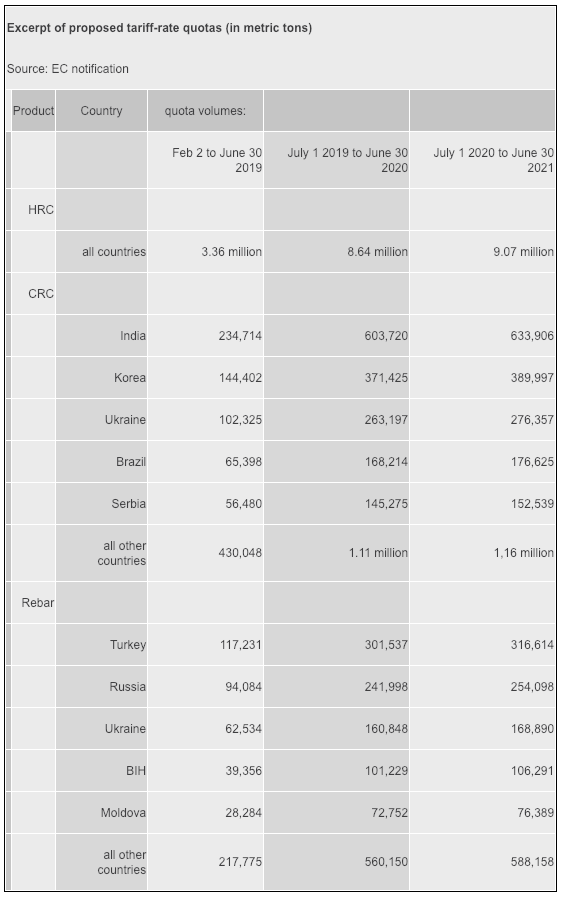
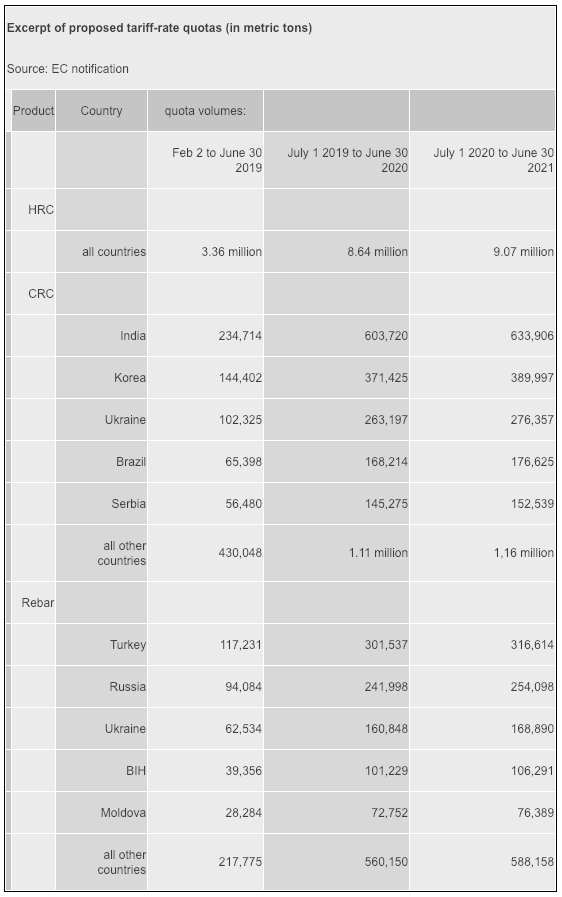
“HRC imports weren’t the big problem, there weren’t massive amounts. CRC and HDG were critical,” said the mill source. He added that singling out India for CRC (see table) would be questionable as India has not been a “distorting” supplier in recent years. However, around 604,000 mt (46% of the initial quota of 1.318 million mt) was still available for import and HDG had a balance of 469,000 mt (22% of the initial quota amount of 2.115 million mt) as of late December.
Most market sources consulted told Platts they are still working out what the proposed safeguards would mean.
“It seems there will be some confusion and I think that traders will hold back until it becomes clearer,” UK-based trader said.
He added that he saw large re-rollers being at an advantage with a global tariff-rate quota for HRC because they will be able to bring in large volumes of cheaper HRC and then process it within the EU to value-add the volumes.
Long products saw the most robust import activity in the past few months, with Turkey a major source for importers. It would receive a country-specific quota under the proposal (see table).
The rebar quota balance came to 9,215 mt as of December 31, only 1.35% of the initial allocated amount of 714,964 mt set in July 2018. At 4,384 mt, the wire rod balance is only 0.4% of the 1.6 million mt allocated.
The safeguard measures are intended to be in place for three years — including the period of provisional safeguards that started in July 2018 — expiring July 16, 2021. Once a quota is filled a 25% tariff would apply.
The level of the tariff-rate quota should be increased by 5% in each year the measures are in force. The EC considers that the quantitative level of the tariff-rate quota should be based on the average imports in the period 2015-2017 plus 5%.
When a country with “significant supplying interest” has exhausted its specific tariff-rate quota, it would be allowed to have access to the quarterly global tariff-rate quota for the specific steel product which would apply to all other countries, but only in the last quarter.
Laura Varriale, Len Griffin, Erica Sesay