

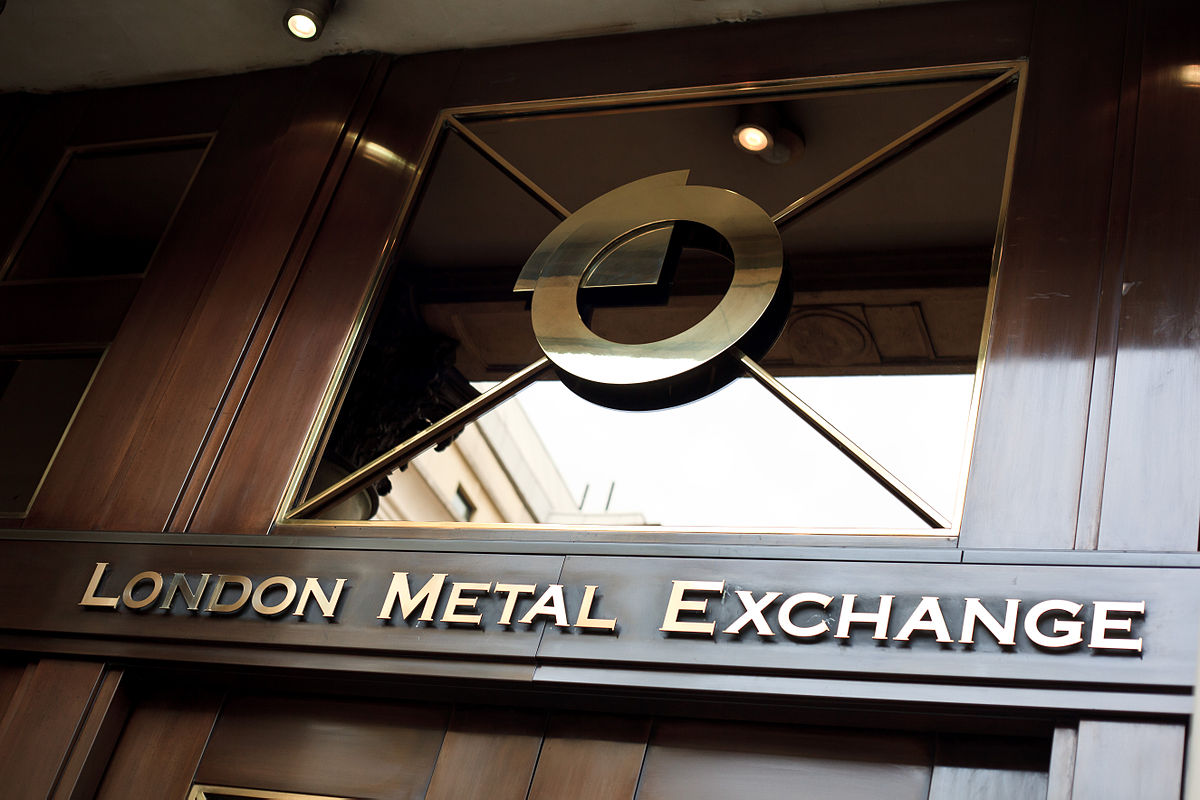
LME joins EUROMETAL as Regular Member

The London Metal Exchange become a member of EUROMETAL as of March 2020.
LME is the world centre for the trading of industrial metals – the majority of all non-ferrous metal futures business is transacted on their platforms. In 2019, 176 million lots were traded at the LME equating to $13.5 trillion and 3.9 billion tonnes notional with a market open interest (MOI) high of 2 million lots.
A member of HKEX Group, the LME brings together participants from the physical industry and the financial community to create a robust and regulated market where there is always a buyer and a seller, where there is always a price and where there is always the opportunity to transfer or take on risk – 24 hours a day.
The London Metal Exchange
10 Finsbury Square
London
EC2A 1AJ +44 (0)20 7113 8888

Baowu overtakes ArcelorMittal as world’s largest steelmaker
China Baowu Group recorded 95.22 million tonnes of crude steel production in 2019, according to the company’s chairman, Chen Derong. This means Baowu has officially become the world’s largest steelmaking group, surpassing ArcelorMittal’s crude steel production of 89.8mt in 2019, Kallanish notes.
In 2019, Baowu Group’s revenue was CNY 556.6 billion ($80.24 billion), with a total profit of CNY 34.52 billion, a year-on-year increase of CNY 690 million, Chen added. It had around 90m t/year of steelmaking capacity directly under its control after merging with Ma’anshan Iron and Steel (Magang) last year. Currently, Baowu is working on gaining direct control of Chongqing Iron & Steel in which it already has a significant stake, giving it 100m t/y of crude steel capacity in total.
Because China accounts for 50% of the world’s steel production capacity, for Baowu to become the world’s largest steel producer is “…reasonable,” Derong says. Baowu aims to better integrate its companies to improve the efficiency of resource allocation. On 3 March, Baowu and Zhejiang’s Shaoxing city also signed a memorandum of cooperation for the development of carbon fibre projects.
China Baowu says it will also vigorously promote “internationalisation” – taking shareholdings in foreign companies – this year, mainly in Europe and the United States and along the “Belt and Road” countries. After Jingye announced the acquisition of British Steel, Baowu’s internal documents indicated the group needed to accelerate its internationalisation.
ArcelorMittal plans temporary layoffs at Genova rolling mill
ArcelorMittal has announced to unions its intention to request the initiation of a temporary layoff scheme for 130 workers each at the rolling plant in Genova and the mill in Novi Ligure, both in north-eastern Italy, Kallanish learns from unions sources.
The announcement comes only one day after the company reached an agreement with the Italian government over the immediate future of the former Ilva group. This gives local authorities an important role in the relaunch of the group.
The layoffs in Genova and Novi Ligure were requested due the weakness in demand and the difficulties experienced by the manufacturing sectors. Unions rapidly expressed their opposition to the plan and called for labour action. The new layoff scheme should last 13 weeks and start at the end of March. Meetings between management and unions are planned for March.
At the same time union sources say ArcelorMittal is also planning to extend by three further months the existing layoff scheme at the Taranto mill of the former Ilva group.
Genova can produce up to 1.5 million tonnes/year of coils, processed using hot rolled coil delivered from other ArcelorMittal plants, including the integrated Taranto site.
EC confirms duties on Chinese steel wheels
The European Commission has confirmed the imposition of definitive anti-dumping duties on imports of Chinese steel wheels as well as the collection of previously imposed temporary measures.
The investigation was started in February 2019 following a complaint from the Association of European Wheel Manufacturers, EUWA. In October preliminary duties were imposed.
The definitive duties, in place for a period of five years, will range from 50.3% to 66.4%, depending on the supplier, Kallanish notes.
During the investigation, “…an importer claimed that measures would have devastating effects on its business.” In the absence of any evidence, nevertheless, the EC “…could not conclude that the alleged negative effects would surpass the need for measures that restore a level playing field.” The Commission adds: “The investigation had shown that there was sufficient supply of the product concerned from other sources so as to retain adequate supply at fair market prices.”
US steel imports fall in February
US steel imports appear to have fallen in February, Kallanish learns from the American Iron and Steel Institute.
Citing data from the US Department of Commerce, the institute puts the number of steel import applications for February at 1.823 million tonnes, which was a decrease of -41.8% from January’s preliminary import total.
The permit tonnage for imports of finished steel to the US was 1.358mt st in Februrary. This is a decrease of -16.8% from January.
Finished steel imports with increases in February permits from January preliminary data include heavy industrial shapes, up 45%, and tin plate, up 20%.
The largest finished steel import permit applications in February by country were South Korea with 155,000t, Turkey with 89,000t, Germany with 51,000t, and Taiwan with 43,000t.
New Ilva agreement lacks clarity, say unions
Italian unions of ArcelorMittal Italia have expressed concern over amendments made to the agreement between ArcelorMittal and Italian authorities on the future of the former Ilva group.
Earlier this week ArcelorMittal agreed with the former Ilva commissioners to amend the existing lease and purchase agreement (see Kallanish 5 March).
A union member tells Kallanish the government’s strategy regarding environmental issues, as well as industrial and workforce perspectives, is not clear. The new industrial plan risks being unsustainable considering it has earmarked less investment than previously into improving vertical integration of tube and re-rolled products output.
Unions have also expressed concern regarding the lack of clarity over the new financial commitment of ArcelorMittal, the role of banks and the public investor, and the mixed BF/EAF production plan. Unions believe the new agreement does not guarantee employment of 12,500 workers.
The amendments are structured around a new industrial plan for Ilva, which involves investment in lower-carbon steelmaking technologies. The core of the new industrial plan is the construction of a direct reduced iron facility to be funded and operated by third-party investors and an EAF to be constructed by AM InvestCo.
In addition, AM InvestCo and Ilva’s commissioners have entered into a separate settlement agreement. AM InvestCo has thereby agreed to revoke its notice to withdraw from the original agreement and Ilva’s commissioners agreed to withdraw their request for an injunction, which was scheduled to be heard in the Civil Court of Milan on 6 March.
In the event the investment agreement is not executed by 30 November 2020, AM InvestCo has a withdrawal right, subject to an agreed payment, ArcelorMittal says.
A new agreement with trade unions has to be signed as a condition to the final closing of the lease and purchase agreement now scheduled by May 2022, the source says.
France considers four offers for British Steel Hayange
French authorities are currently considering other offers for the Hayange rail mill of the former British Steel group. This comes as China’s Jingye confirmed the acquisition of British Steel assets located in the UK and Netherlands, but not in France, Kallanish notes.
In a televised interview, French economy minister Bruno Le Maire confirmed that local authorities are considering four existing bids for the mill, of which three are considered very serious. He also noted that the acquisition of the former British Steel group was done without the French unit, indicating therefore that the mill’s inclusion in the sale to Jingye remains unlikely.
“Hayange produces rail for the local national railway system; it is therefore strategic,” Le Maire said. “The company is very solid and I am not worried for the workers at the plant. We are working to secure that a new owner is found under the best possible conditions.”

Offers for Hayange could see it sold separately from British Steel: sources
There have been four offers for French rail producer Hayange, which could lead to the British Steel unit being sold separately from the rest of the company, sources close to the matter told S&P Global Platts Thursday.
The bidders for Hayange are ArcelorMittal, UK-based industrial group Liberty House, special steel producer Ascoval (through its holding company Olympus), and German steel producer Saarstahl, the sources said.
Saarstahl told Platts it was interested in Hayange, while the other three declined to comment.
The French government, which considers Hayange to be a strategic national asset, put it up for sale last year separately, as a contingency plan in case the deal for Chinese Group Jingye to buy British Steel did not go through.
Hayange produces 250,000-300,000 mt of rails per year, mostly for SNFC, France’s state-owned railway operator. The mill currently rolls blooms produced at British Steel UK in Scunthorpe.
A source close to the matter said that while all four companies submitted their offers independently, it could be possible that Liberty will make an offer in a joint venture with Ascoval.
According to market sources, Hayange would seem to have good synergies with all the possible buyers.
ArcelorMittal Europe is one of the leading producers of rail products, covering the main European and export markets, with mills in Dabrowa Gornicza, Poland, Gijon, Spain and Rodange, Luxembourg. ArcelorMittal produces around 550 000 mt of steel rails per year.
Saarstahl has a continuous cast blooming line in Volklingen, which could supply Hayange as it is close to the French mill.
Ascoval is a client of Hayange and recently won an order to supply 140,000 mt of blooms to Hayange for the manufacture of rails for SNCF from this September for four years.
Ascoval was taken over by Olympus in the spring. Liberty is focused on growing and, for the time being, does not have a rail production capability, so if it were to team up with Ascoval it will have good synergies.
Market sources said the offers for Hayange could make it more difficult for Jingye Group to purchase all British Steel units, but the purchase will go ahead with the Chinese mill expected to complete the deal next Monday.
Two days ago, Jingye Group said it had agreed to proceed towards the completion of its purchase of British Steel next Monday.
Subject to the acceptance of employment offers, Jingye will acquire British Steel’s steelworks at Scunthorpe and UK mills at Teesside Beam Mill and Skinningrove, as well as subsidiary businesses FN Steel and TSP Engineering.
Jingye said the transaction does not include the assets of British Steel France, because “the French government has not yet made a judgment on Jingye’s proposed acquisition of British Steel France nor, at this stage, indicated when it may be in a position to do so”.
A spokesman said Thursday Jingye remained interested in purchasing the Hayange plant, hoped to see a positive decision from the French authorities in the near future, but that it “has agreed with the [UK] Official Receiver’s proposal, they will complete the transaction in stages, first completing on the UK and Netherlands”.
Chinese market sources said that, Hayange to one side, British Steel was a good opportunity for Jingye as China has banned capacity expansion and decreed any capacity swaps must lead to capacity reductions.
Jingye will lose about 1 million mt/year pig iron production capacity and 0.4 million mt/year crude steel capacity in 2021, when iron and steel capacity swaps at its Chinese steelworks are done.
Jingye has been looking for overseas investment opportunities. Market sources said it looked at Myanmar and Malaysia before it decided to acquire British Steel. Sources said it remained to be seen how Jingye could keep British Steel’s running costs down.
Jingye Group operates 18 blast furnaces, producing 15 million mt of steel annually and exports to 80 countries around the world. Based Hebei province in China, Jingye had total sales of Yuan 90 billion ($13 billion) and employs 23,500 people. It also has operations in chemicals, hotels, real estate, and trade.
British Steel, which went into compulsory liquidation on May 22, has about 3 million mt/year of production capacity in the UK, France and the Netherlands.
Completion of the purchase will preserve 3,200 jobs in Scunthorpe, Teesside and elsewhere, securing a future for steelmaking in the region. About 100 jobs will transfer to Barrett Steel following the sale of four British Steel distribution centers.
— Annalisa Villa, Jing Zhang & Laura Varriale