


Trade shows signs of rebound from COVID-19, recovery still uncertain

World trade shows signs of bouncing back from a deep, COVID-19 induced slump, but World Trade Organization economists caution that any recovery could be disrupted by the ongoing pandemic effects.
The WTO now forecasts a 9.2% decline in the volume of world merchandise trade for 2020, followed by a 7.2% rise in 2021 (Chart 1). These estimates are subject to an unusually high degree of uncertainty since they depend on the evolution of the pandemic and government responses to it.
Current data suggests a projected decline for the current year that is less severe than the 12.9% drop foreseen under the more optimistic of two scenarios outlined in the WTO’s April trade forecast. Strong trade performance in June and July have brought some signs of optimism for overall trade growth in 2020. Trade growth in COVID-19 related products was particularly strong in these months, showing trade’s ability to help governments obtain needed supplies. Conversely, the forecast for next year is more pessimistic than the previous estimate of 21.3% growth, leaving merchandise trade well below its pre-pandemic trend in 2021 (Chart 1).
The performance of trade for the year to date exceeded expectations due to a surge in June and July as lockdowns were eased and economic activity accelerated. The pace of expansion could slow sharply once pent up demand is exhausted and business inventories have been replenished. More negative outcomes are possible if there is a resurgence of COVID‑19 in the fourth quarter.
In contrast to trade, GDP fell more than expected in the first half of 2020, causing forecasts for the year to be downgraded. Consensus estimates now put the decline in world market-weighted GDP in 2020 at -4.8% compared to ‑2.5% under the more optimistic scenario outlined in the WTO’s April forecast. GDP growth is expected to pick up to 4.9% in 2021, but this is highly dependent on policy measures and on the severity of the disease (Table 1).
Chart 1 – World merchandise trade volume, 2000‑2021

Source: WTO Secretariat.
Note: Figures for 2020 and 2021 are projections.
As previously noted in the forecast update of 22 June, a weak trade recovery that fails to return trade to the pre-pandemic trend was a distinct possibility. This would result in merchandise trade growth of around 5% next year, rather than 20% in the case of a rapid return to the previous trajectory. The current trade forecast of 7.2% for 2021 appears to be closer to the “weak recovery” scenario than to a “quick return to trend”.
Although the trade decline during the COVID-19 pandemic is similar in magnitude to the global financial crisis of 2008-09, the economic context is very different. The contraction in GDP has been much stronger in the current recession while the fall in trade has been more moderate. As a result, the volume of world merchandise trade is only expected to decline around twice as much as world GDP at market exchange rates, rather than six times as much during the 2009 collapse.
This divergent performance of trade during the COVID-19 outbreak has much to do with the nature of the pandemic and the policies used to combat it. Lockdowns and travel restrictions imposed significant supply-side constraints on national economies, drastically reducing output and employment in sectors that are usually resistant to business cycle fluctuations, particularly non-traded services. At the same time, robust monetary and fiscal policies have propped up incomes, allowing consumption and imports to rebound once lockdowns were eased.
Whether the recovery can be sustained over the medium term will depend on the strength of investment and employment. Both could be undermined if confidence is dented by new outbreaks of COVID-19, which might force governments to impose additional lockdowns. As a result, risks to the forecast are firmly on the downside. There is some limited upside potential if a vaccine or other medical treatments prove to be effective, but their impact would be less immediate.
Ballooning public debt could also weigh on trade and GDP growth over the longer term. Although rich countries are unlikely to face sovereign debt crises as a result of fiscal expansion, poorer ones may find their increased debt burdens extremely onerous. Deficit spending could also influence trade balances, reducing national saving and swelling trade deficits in some countries.
“The incidence of COVID-19 worldwide has fallen from its peak in the spring, but it remains stubbornly high in many areas. Trade has played a critical role in responding to the pandemic, allowing countries to secure access to vital food and medical supplies. Trade has also facilitated new ways of working during the crisis through the provision of traded IT products and services. One of the greatest risks for the global economy in the aftermath of the pandemic would be a descent into protectionism. International cooperation is essential as we move forward, and the WTO is the ideal forum to resolve any outstanding trade issues stemming from the crisis,” Deputy Director-General Yi Xiaozhun said.
Table 1: Merchandise trade volume and real GDP, 2015-2021a

a Figures for 2020 and 2021 are projections.
b Average of exports and imports.
c Other regions comprise Africa, Middle East and Commonwealth of Independent States (CIS), including associate and former member States.
Source: WTO Secretariat for trade, consensus estimates for GDP
As Table 1 shows, all regions are expected to see big percentage increases in export and import volumes in 2021, but it should be noted that this growth will be off of a reduced base. Thus, even large percentage changes may not translate into better material conditions. For example, imports into Asia and South America are both expected to grow by 6.2% and 6.5% respectively next year, but Asia’s rise would follow on a modest 4.4% decline this year while South America’s would be on top of a steep 13.5% plunge in 2020. In this case Asia’s imports would have substantially recovered while South America’s trade would still be deeply depressed.

A carbon border tax could be against the WTO rules: Dalbeler
The European Commission’s plans to put a carbon border adjustment tax on steel could be against the World Trade Organization (WTO) rules, according to Ugur Dalbeler, vice president of the Turkish Exporters’ Association (CIB) and CEO of major Turkish steel producer Colakoglu.
“As the EU’s share in overall Turkish steel exports is around at 35-40%, this kind of an additional [trade] measure will have another negative effect on export volumes,” Dalbeler said, adding that due to the customs union and ECSC free trade agreements between EU and Turkey, Turkey should be exempted.
Veysel Yayan, general secretary of the Turkish Steel Producers’ Association (TCUD), also told Platts Oct. 5 that all measures should be in compliance with WTO rules.
“As Turkish mills’ are already investing in green steel, I don’t think that a carbon border adjustment will have a significant effect on our exports to the EU,” Yayan said, adding that the renewable energy support mechanism (YEKDEM) in Turkey is already notably increasing Turkish mills’ energy costs.
The European Green Deal that was presented by the EC at the end of 2019 aims to make Europe the first continent to be carbon-neutral by mid-century.
EU steel producers have called on the EC to introduce tariffs on imports from steel producers in countries that are not subject to the same types of emissions controls that they are. The EC has already started public consultations about the carbon border adjustment mechanism (CBAM).
A CBAM would ensure that the price of imports reflects more accurately the carbon content of production, the EC said, adding that this measure will be designed to comply with World Trade Organization rules and other international obligations of the EU.
According to a recent report by Turkish Industry and Business Association (TUSIAD), Turkey’s top business association, seen by S&P Global Platts, introduction of carbon border adjustment taxes by the EU, could bring an additional cost of Eur1.08 billion to Turkey’s manufacturing sector, including iron and steel. This cost could be as high as Eur110 million for the Turkish steel sector, the report said.
A carbon border tax could also harm Turkish mills’ competitiveness in the EU market. As of the first seven months of the year, Turkish mills’ steel exports to the EU already declined by 26% on year to 2.8 million mt, amid the pandemic and restrictive trade measures. Quotas, anti-dumping and countervailing duty investigations could deepen this decline in the coming months of the year.
— Cenk Can

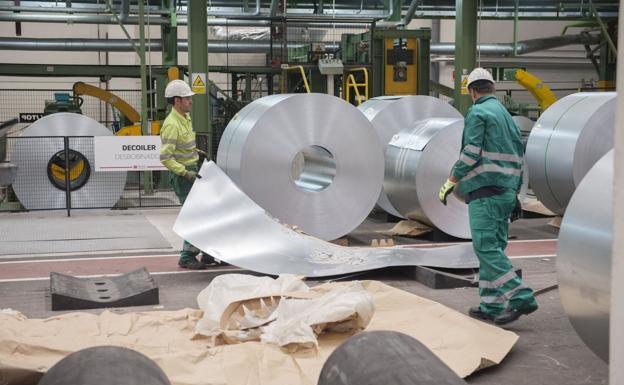
Network Steel processes first coil in Leon
Spanish coil processing company Network Steel officially started production at its new facility in Leon last week, producing the first pickled coil for customers, Kallanish learns from local sources.
The plant initiated tests during the summer and is now operational with the pickling line, while the cold rolling and galvanising lines should be launched in 2021.
Network Steel is targeting 2020 production of some 40,000 tonnes of products from the new Leon facility. Output should then reach 500,000 t/year from 2021 when the plant will be completely operational.
Last month Network Steel announced it reached an agreement with a United Arab Emirates-based company to secure investments in a number of projects in Spain, including the Leon mill (see Kallanish passim).


ArcelorMittal Italia restarts some Taranto rolling lines: unions
ArcelorMittal is restarting a number of rolling lines at the former Ilva site of Taranto, Kallanish learns from trade unions.
According to sources, since the end of last week one zinc-coating line has been restarted. In addition, hot-rolling mill number 2 is also being restarted, after it was stopped in July for market reasons.
In mid-October plate rolling mill number 2 is also expected to return to production; this line was also stopped in July.
Kallanish understands that these new lines restarting will lift the number of active workers at the plant to 4,000. As in many other plants across Europe, ArcelorMittal Italia used temporary layoffs schemes during the last months due to the pandemic.

Russian steel demand to rebound, OECD hears

Russian steel demand is expected to rebound to 2019 levels and slightly above in a V-shape recovery in 2021. So said Dmitriy Kolomytsyn, NLMK’s IR and capital markets director, at the OECD’s 88th Steel Committee session, on behalf of the Russian Steel Association, of which NLMK is a member.
Noting positive Covid-19 containment measures in Russia, which have lead to a stabilisation of cases numbers, further dynamics in Russia will largely depend on the effectiveness of the newly-developed vaccine. But even in the absence of the vaccine, Russian steel output rebounded strongly in July, shaving just -4% on-year, as compared to a -12% drop in April and -17% drop in May, on the back of strong export sales.
The drop in demand was also partially compensated by government stimulus, and high seasonal construction sector demand, which saw July rebar consumption rising 8% on-year, Kolomytsyn said in a presentation monitored by Kallanish.
Despite this, capacity utilisation remained below pre-Covid-19 levels, at around 80% in July, containing oversupply, and subsequently riding on a PMI rise from around 33% in May to 51.1% in August. Additional support came from the lowering by Russia’s Central Bank of a key rate by 200 bps since the start of the year to 4.25%, with further reduction still possible this year, Kolomytsyn observed.
Demand growth is expected to rebound in 2021 by around 15 percentage points to around 5-7% from the fall of around -8-10% in 2020. This will bring it back to roughly in line with 2019 levels. This will be enabled by additional budget expenditure on infrastructure projects, since pandemic-related spending including social expenses and healthcare may decline in the following months, he concluded.