

Dutch service centre Hebels add multi-purpose cutting line
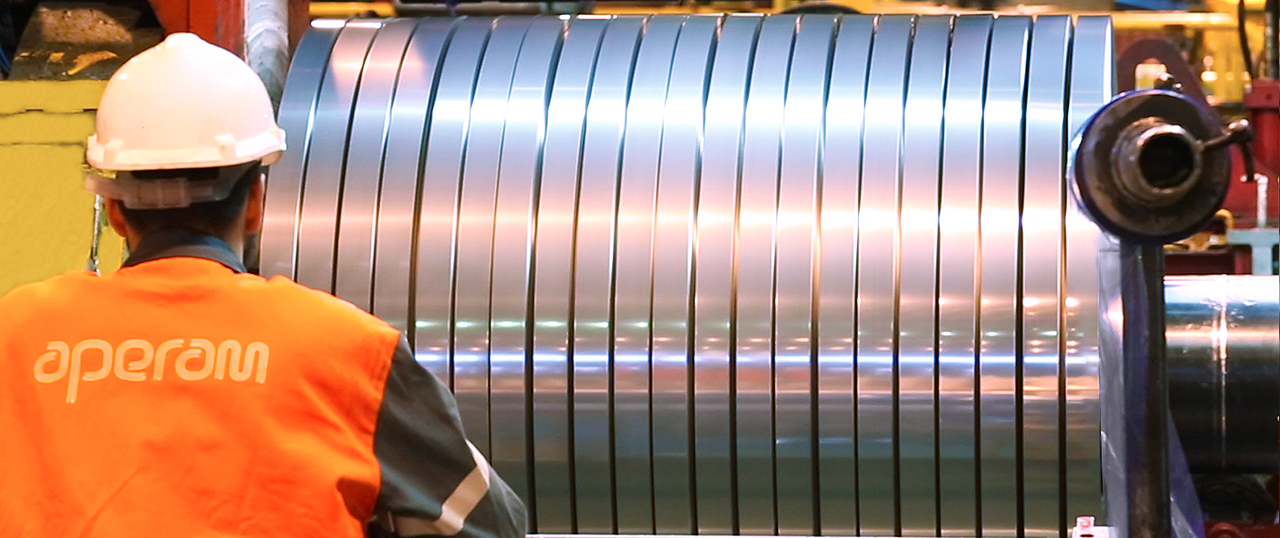
Hebels Steel Service in Oosterhout is expecting the arrival this week of a cutting line for coil in thicknesses up to 10mm, Kallanish learns from the Dutch company.
Hebels describes it as “a monster of a machine” with a length of 70 metres and a total weight of around 600 tonnes. Cement lorries have been driving back and forth in recent months to pour a gigantic foundation, Hebels notes.
The line is considered something like a hybrid because it is able to cut cold as well as hot rolled coil, pickled as well as untreated material. This is unusual because the scale of unpickled material leaves dirt on the machinery.
The line, built by German engineering company Georg, features extra self-cleaning equipment for this purpose. It handles coils of up to 34t with a width of 2,000mm, to cut sheet lengths of up to 8 metres.
The device is a transfer from German service centre Knappstein in Lennestadt, a unit of Carl Spaeter group, where it was installed since 2012. The erection at Oosterhout will take until July, Hebels says. The SSC has been supplying products to the Dutch, Belgian and German steel processing industry since 2004. “Because growing is all about foresight, the management sees plenty of opportunities and is now making an investment of millions to help the company move forward,” it says.
Christian Koehl Germany

Steelmakers need decarbonisation strategies to secure finance: banker
A growing number of investors are demanding sustainability targets be attached to financing, making it risky for steel companies without a zero carbon transition strategy, says Claire Coustar, Global Head of ESG, FIC at Deutsche Bank.
Regulatory and political impetus has driven the shift towards Environmental Social and Governance (ESG) financing instruments over the last decade. What started with green bonds and then social bonds has in the last couple of years moved on to sustainability bonds, where banks provide loans for companies committing to certain ESG performance indicators, Coustar said at a meeting organised by technology supplier Primetals on Tuesday.
Investors are demanding, as part of their due diligence and investment criteria, to know what investees’ carbon transition plans are. At the end of this year, moreover, the European Central Bank will carry out a climate stress test on eurozone banks.
“Investors realise that in certain sectors the technology is not there yet to fully map out the path to carbon zero in 2050,” Coustar observed at the event attended by Kallanish. They are however looking for details of what a company’s decarbonisation plan is for the next five years, followed by the period after that, she added.
Adam Smith Germany

Positive economic cycle to prolong for years: Marcegaglia
The expected reverse of steel pricing uptrend will not happen any time soon, Marcegaglia chief executive Antonio Marcegaglia said during a Siderweb webinar attended by Kallanish.
Despite the current rush to buy, “we do not manage to replenish our stocks as we would like to, because everybody around the world is in the same situation”, Marcegaglia commented. High raw material prices, together with the positive impact of unprecedented fiscal stimulus, will push the sector forward, he added.
He sees the current positive economic cycle as a beginning of an expansive phase that will last a few years. “We initially overestimated the impact of the pandemic on the industry and manufacturing sector,” Marcegaglia observed. “We saw the end of steelmaking, but in fact, we realised that an important part of the world such as Asia and China, in particular, had a positive performance [in 2020] and, overall, we’re seeing a rapid recovery… I believe that some of us in March have achieved figures that had never been achieved before.”
The strong recovery is not being driven by specific regions, such as India or China, but is global, the ceo said.
Marcegaglia believes safeguard duties may be suspended in July due to the serious coil shortages. As a decision from the European Union is needed to extend the measures, it is more probable that that decision is not made with the objective to let the duties terminate upon the expiry date. Even if measures lapse, Europe will not be invaded by coil imports as the supply-demand imbalance involves the entire world, Marcegaglia forecasts.
After mitigating the impact of the first wave of the pandemic in 2020, Marcegaglia SpA registered strong performance in the first quarter. The company saw a 7.5% year-on-year increase in steel shipments and a significant hike of 26.5% in turnover versus Q1 2020 to €1,460 billion ($1,736 billion).
Sales volumes in 2020 increased by 2.7% y-o-y mostly thanks to the integration from December 2019 of plate producer Palini and Bertoli that Marcegaglia bought from Evraz.
Marcegaglia also reiterated his interest to purchase stainless steel producer Acciai Speciali Terni based on industrial synergies between the two companies. Marcegaglia currently buys around 30% of its stainless coil requirement from AST.
Natalia Capra France
Marcegaglia CEO says company firmly interested in buying AST
Marcegaglia, the largest European steel re-roller and largest worldwide tube producer, reconfirmed its firm interest to acquire special steel producer Acciai Speciali Terni, or AST, Marcegaglia CEO Antonio Marcegaglia said, adding that the steel market had entered a supercycle.
“Our interest is serious and solid for Terni, it is based on good industrial synergies between our downstream operations and Terni upstream operations,” Marcegaglia said on April 13 during an online event organized by news portal Siderweb.
Marcegaglia said that the timeline of the sale process was dictated by the seller and that the companies were in the middle of the due diligence.
German steel maker Thyssenkrupp, owner of AST, put the company back in the market for sale in May 2020. In 2018, following a restructuring of Thyssenkrupp Materials, AST became one of the company’s core assets and was withdrawn from sale.
Marcegaglia produces around 550,000 mt/year of stainless-steel products and buys around 30% of its stainless steel feedstock from AST. If Marcegaglia buys AST, the company will not only have a primary production but will also increase its stainless market production.
Marcegaglia is not the only company interested in AST but there are other potential buyers as AST is a good performing mill, according to sources.
Marcegaglia said that overall the demand for coils continued to be strong and that the fundamentals were so good that there were expectations for prices to continue to increase in Europe as supply was low following mills implementing structural cuts in the past.
The margins between still very high raw materials costs and the steel products have “never been so good for years,” the company said.
The first quarter of 2021 for Marcegaglia was positive compared with the same period of last year, when the company still did well as the pandemic made an impact only at the end of March.
The first quarter of 2021 ended for Marcegaglia, which is not a listed company, with a 7.5% year-on-year rise in sales to 1.5 million mt of steel products. The company’s revenues rose 26.5% on the year to Eur1.460 million for the steel units.
European coils are at their historical highest level with the European hot-rolled coil steel and raw materials price spread surging in March to a new record high. This came as the record high spot steel prices outpaced iron ore, scrap and coking coal costs, S&P Global Platts reported earlier.
Northwest European HRC steel averaged Eur477/mt ($560/mt), more than a basket of raw materials costs in March, up from around Eur420/mt in February, according to estimates by Platts on April 1.
According to Platts data, European coils benchmark, Northwest European HRC, since the end of 2020, went up by Eur243/mt to Eur908/mt base ex-works as of April 13.
— Annalisa Villa

Liberty Ostrava unions threaten strike amid concern on steel mill’s future
The main trade union at Liberty Ostrava, the Czech Republic’s biggest steelmaker, threatened strike action April 13 amid concerns surrounding the future of the works, owned by UK-based Liberty Steel Group.
Liberty Steel Group is facing a financing squeeze following the collapse last month of its major financier Greensill Capital.
All labor unions at Liberty Steel Ostrava have now issued strike warnings due to their “increasing concerns” at the situation facing Liberty Steel Group and its parent, the international group GFG Alliance, the OS KOVO Liberty Czech Republic union, the works’ biggest union, announced on its web pages April 13.
Liberty Steel Ostrava has an annual production capacity of 3.6 million mt and employs around 6,000 people.
A GFG Alliance spokesperson said in an emailed statement that GFG is “deeply disappointed by the response of the unions to the current situation at LIBERTY Ostrava, which can only add to the uncertainty following the collapse of Greensill. We are ready to engage with the unions to reduce their concerns over the issue they have raised.
“The improved financial performance at the plant builds on its operational and commercial improvement efforts over the last year as well as the strong recovery of the market and steel prices, which currently stand at their highest levels for thirteen years. These have all led to the Ostrava mill operating at full capacity. The company continues to be fully booked and has secured the material required to run at full capacity. The business is prudently managing its cash flows to maintain a healthy buffer while the group refinances its debt.”
Carbon emissions allowance sales
The unions’ worries focus in particular on suggestions in international media that Liberty management will attempt to lend carbon emission allowances saved up by the Ostrava steelworks to the Romanian Galati Steelworks, also a member of the Liberty Group, which reportedly has no allowances to continue operations.
“We categorically refuse the option of lending emissions allowances from Liberty Ostrava to the Galati Steelworks,” OS KOVO union branch chairman, Petr Slanina, was cited as saying on the website. According to the union official, media reports have suggested the Romanian steelmaker had sold carbon allowances worth Eur100 million ($119 million) last year.
Slanina said that Liberty Ostrava has saved around 5 million carbon allowances, worth around Eur200 million at current prices, over recent years. Liberty Steel promised when taking over the Ostrava steelmaker in 2019 that cash from the sale of the emissions allowances would be used for modernization of the steelworks, including the installation of two new hybrid furnaces by 2023, he added.
“In common with other large industrial companies, LIBERTY Steel Group businesses trade carbon credits as part of the usual course of business,” the GFG Alliance spokesperson countered. “That includes transactions to buy and to sell credits according to their business requirements and according to the market price. We do not comment on our sites’ current balances for commercial reasons but expect them all to surrender the correct number of credits to the EU Registry at the end of April.”
Funds reportedly in Greensill account
The unions also appealed to local management to take all the necessary steps needed to prevent any flow of capital or assets out of the Ostrava steelmaker. The unions said that the Czech steelmaker had been given an operating loan of Koruna 2.0 billion ($92.2 million) by the Czech state-owned bank, EGAP, to help it deal with the coronavirus pandemic but they say these funds had never been drawn on.
The unions said they had information from management that the funds were now in the account of Greensill Capital, which filed for insolvency at the end of March, and could no longer be used by the Ostrava steelmaker.
The unions said that because of the financial problems, the Ostrava steelmaker has lost the trust of some of its business partners and has been forced in recent weeks to pay for raw materials in advance.
— Chris Johnstone and Diana Kinch