


Laurent Noirclerc is the new President of the FFDM
Laurent Noirclerc, Managing Director of Bamesa in France is the new President of the French Federation for the Distribution of Metals (FFDM).
He will succeed Michel Julien-Vauzelle and will represent the federation within EUROMETAL as a member of the presidency.
EUROMETAL takes this opportunity to thank Michel Julien-Vauzelle for all these active years within our federation.

EU market find consensus on HRC offer levels
The EU Northern hot-rolled coil market remained unchanged March 24 as mills and service centers alike noticed little change in prices throughout the week.
Offer levels remained firmly at EUR1,400/mt ex-works Ruhr, while buying interest was evident at a subdued rate.
Two service center sources confirmed their highest HRC workable level at Eur1,400/mt EXW Ruhr, while acknowledging existing higher offers in the market; for project-orientated uses, these were considered unprofitable, however.
A mill source said their offers were beginning at Eur1,400/mt EXW Ruhr, and that they would not accept any bids below it. According to the mill source, agreements for HRC were reaching as high as Eur1,500/mt EXW Ruhr on more urgent requirements, yet the highest he had offered was Eur1,470/mt EXW Ruhr for oiled material.
Customers were looking to fulfil contracts, but a second mill source said he was unsure whether they still could fulfill contracts beyond their minimums. He also did not think customers were looking to build inventory, given current price levels, so spot buying was less favorable.
A third mill source said he was allocating a limited volume of coils per week to spot buyers for May or early June delivery, and that longer lead times were off the table as he expected cost pressures to worsen throughout the rest of the year.
The daily Platts TSI for HRC for North Europe was stable at Eur1,425/mt ex-works Ruhr, while HRC in Italy was assessed up Eur20 at Eur1,400/mt ex-works Italy, according to data from S&P Global Commodity Insights.
Overseas buyers offering HRC to Europe an estimated Eur100-Eur200 lower than domestic prices drew little customer interest. A second service center source believed oversea offers to be largely unreliable, with delivery time and final costs considered.
— Catherine Brown

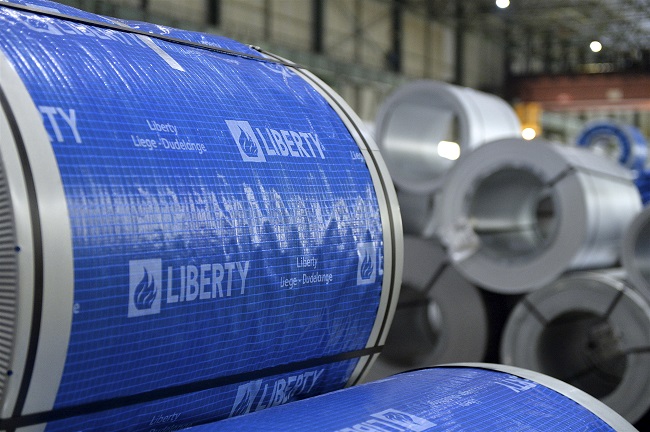
Trade unions paint bleak future for Liberty Dudelange
Trade unions in Luxembourg have this week issued a statement to express their concern over the future of the Liberty Dudelange coil galvanising mill.
Earlier this month, Luxembourg authorities decided against extending state support for the temporary layoff scheme at the plant. From April, therefore, all salaries of the workforce will need to be covered by Liberty Steel even if temporary layoffs are applied, Kallanish notes.
Trade unions add that production levels at the mill in March were very low and visibility for April production remains uncertain.
As a consequence of the uncertainty, unions have reiterated their request to the local government to closely follow developments and plan for a new industrial owner to be found for the mill if need be.
Liberty Dudelange operates in close relation with the group’s coil rolling mills in Liege, Belgium.
Liberty Steel did not respond to request for comment before press deadline.
Emanuele Norsa Italy


Italian steelmakers, merchants clash over scrap exports
Italian steel trade association Assofermet says there is no scrap shortage caused by exports that may impact Italian steelmaking.
Italian scrap exports to countries outside Europe decreased by 12.6% on-year in 2021 to 393,000 tonnes, from 450,000t the previous year, while Italian scrap purchases from European countries reached 5.6 million tonnes, up 15.5%.
“The figures show how irrelevant the export share of scrap from national borders to non-EU countries is, even in a context like the current one with the Russian-Ukrainian conflict, which in a few days has changed the world scenario of raw materials,” Assofermet wrote in a letter to authorities seen by Kallanish.
The letter comes in response to the measure implemented by the economic development ministry (Mise) from 21 March that requires scrap companies to notify authorities of every export sale.
This is seen as yet another attempt, encouraged by the steelmakers’ lobby, to intimidate exporters and keep material available for the domestic steelmaking facilities. In case of failure to declare an export deal, an administrative sanction of 30% will be levied of the value of the transaction, not less than €30,000 ($32,936), for each individual transaction.
Sources close to the subject say the notification has no value in legal terms as an export ban, although scrap is considered a critical material in Italy. Talk of the EU not imposing a scrap export ban seems to have disappointed certain steelmakers, sources say.
Some recycling companies and traders tell Kallanish they responded to the ministry initiative with a lawyer’s letter. They believe the provision is an exercise to keep a record of tonnages sold on the export market and those companies involved in the export business. Italian steelmakers have always been against exporting scrap and have in the past solicited environmental controls on cargoes at ports to slow down trade.
Natalia Capra France

Slab price rise continues, even as Russia re-enters
Global merchant slab supply tightness spurred by the absence of CIS material in the first half of March has eased somewhat amid new sources making themselves available.
As was expected, China obliged, but at prices exceeding those of hot rolled coil, amid buyers’ desperation and still relatively limited availability, Kallanish learns from market participants.
Around two weeks ago, Indonesian and Chinese slab was available at $900/tonne cfr southern Europe, but prices have since gained around $200/t, with latest Chinese offers at a firm $1,000/t fob, according to traders. Some suggest bookings were made at slightly lower levels, at around $1,080/t cfr into Europe, with freight calculated at around $110/t for large, 50,000-tonne lots, but these have not been confirmed. European domestic mills were heard offering at €1,000-1,010/t ($1,100-1,111) ex-works, but no sales were reported at these levels.
It is understood however that some Russian merchant slab suppliers were also able to negotiate sales into Europe. Considering semi-finished steel products have not fallen under sanctions, and some Russian producers are also not under sanctions, sales have been heard in the past ten days. These were made at much-lower-than-Chinese-and-Brazilian-material levels, just below $800/t fob Black Sea, according to sources. They still involve high risk, at least from a lack of certainty. Lead times are also short, due to high risks and the constantly changing environment, sources note.
The same level of interest and pricing is seen in Turkey, with at least one lot heard sold from Russia around a week ago at $900-910/t cfr, but a confirmation could also not be obtained at press time. Chinese slab was booked mid-March at $965/t cfr Turkey for end-May arrival. The overwhelming market majority believes that should Russian sales continue, there is a chance of prices cooling, but forecasts are understandably uncertain.
Meanwhile, in the western hemisphere, prices have been heating up, with Brazilian slab reaching $1,150/t fob for concluded deals and offers at $1,200/t fob to regional producers. These offers are out of reach to Mediterranean buyers, not only due to their value, but also because of much longer lead times, and Brazil’s ongoing concentration on regional and North American sales, sources note.
There were no Russian sales or offers in Southeast Asia. Overall offers of slab appear to have dried up to regional buyers, and this shortage is likely to underpin price increases down the production chain, traders say. Many buyers hope Russian mills will focus on higher slab supply as finished product sales are more restricted, and domestic HRC demand is also expected to soften, at least in the next quarter.
Katya Ourakova UK