

SSAB posts record first-quarter revenue but uncertainty looms
Sweden-headquartered SSAB posted record revenue in the first quarter, but uncertainties connected to the war in Ukraine and high input costs continue to loom in the market.
SSAB’s consolidated revenue surpassed SEK 31 billion ($3.19 billion) in Q1, some SEK 12 billion more in Q1 2021. Higher turnover was mainly supported by significantly higher sales prices across the globe. Shipments also grew on-year at the Europe and Americas units.
“All divisions posted strong results more than offsetting the impact of an unplanned stop in a blast furnace in Raahe, Finland, certain production disruptions in SSAB Americas, as well as higher raw material costs,” says SSAB chief executive Martin Lindqvist. The Raahe blast furnace suffered a stoppage of approximately five weeks between February and March, Kallanish notes.
Operating profit also surpassed SEK 8 billion, compared to almost SEK 7 billion in Q1 2021.
The biggest uncertainty for the future is the impact of the war in Ukraine. “The tragic situation in Ukraine affected the quarter in many ways. SSAB directly ceased sales to Russia and Belarus and discontinued new purchases of ore and coal from Russia until further notice. Several measures have been introduced to ensure access to raw materials, but there is a risk of disruptions related to sanctions and other fallout from the war in Ukraine. The war has driven up both raw material and steel prices. Order intake rose temporarily during the first quarter since our customers wanted to ensure supply of steel,” Lindkqvist adds.
Shipments from the Americas and special steels divisions in Q2 are expected to be higher than in Q1. For SSAB Europe, shipments should be only marginally higher. Realised prices, on the other hand, seem to be close to their peaks as in Q2 in Europe and the Americas they should only be marginally higher.
Emanuele Norsa Italy

Salzgitter, Klöckner report strong first quarter
Two major, stock market-listed German steel companies have performed above their expectations in the first quarter, according to preliminary figures.
Salzgitter generated earnings before taxes of €465 million ($497m) in the first three months of 2022, compared with €117m in the corresponding 2021 period, Kallanish hears from the steelmaker. The performance was attributed mainly to the company’s Steel Production and Trading business units, and notably exceeded current market expectations, it says in an ad-hoc statement. Group revenue rose by around 60% compared on-year to €3.4 billion.
It has therefore lifted guidance for the 2022 financial year and now anticipates pre-tax earnings of between €750m and €900m. The guidance presupposes that raw materials and energy costs as well as steel prices remain at today’s levels, and that availability of natural gas continues.
Distribution group Klöckner & Co meanwhile states it achieved a considerably stronger operating income (Ebitda) in Q1 than originally expected. A renewed supply shortage has led to a significant increase in steel prices in its core markets, Europe and the USA, the group explains.
According to preliminary figures, Ebitda before material special effects amounts to €201m, against the previous expectation of €130-180m. The company also generated positive material special effects from the sale of properties in Switzerland and France amounting to €53m.
Klöckner will announce full figures for the first quarter on 4 May and Salzgitter on 12 May.
Christian Koehl Germany

Vale and Nippon Steel sign MOU to develop decarbonization technologies in steelmaking
Brazilian miner Vale and Japanese steelmaker Nippon Steel have signed a memorandum of understanding to pursue ironmaking solutions focused on carbon-neutral steelmaking processes, the two companies said in separate statements April 26.
Based on this MOU, Nippon Steel and Vale will jointly study and explore the utilization of raw materials which contribute to direct reduced iron, so-called green mold pig iron — in which molten iron produced using carbon neutral carbon materials is cooled and solidified — and green briquettes — raw materials in which iron ore fines are molded using pressure, without the use of heat — as well as other carbon neutral steelmaking processes.
The companies said they expect the initiative to help reduce emissions.
Vale has already announced to target to reduce 15% of its net Scope 3 emissions by 2035.
In addition, the company is seeking to cut its Scope 1 and 2 emissions by 33% by 2030 and achieve net zero by 2050, as within the Paris Agreement. As part of this commitment, the company closed the sale of its coal assets on April 25.
In March 2021, Nippon Steel announced its “Nippon Steel Carbon Neutral Vision 2050” initiative, positioning environmental issues on a global scale.
Nippon Steel is Japan’s largest and one of the world’s leading integrated steel producers. Beyond its six steelworks in Japan, the company makes a wide range of value-added steel products in more than 15 countries.
Vale is a major iron ore, nickel and copper producer.
— Annalisa Villa


Sidenor buys scrap supplier Aguilar Metal Recycling
Spanish special steelmaker Sidenor has acquired Aguilar Metal Recycling (AMR), a Valencian company specialising in industrial scrap, Kallanish understands.
The deal will ensure Sidenor`s supply of quality raw materials and boost its technological and industrial capacity in metal waste treatment.
“This acquisition contributes to the consolidation of the sector, in which the supply security of a key product such as industrial scrap will increase,” Sidenor says.
AMR is located in Sagunto, a significant area in terms of scrap collecting due to the presence of large car production plants, as well as an excellent port and railway logistic location, the steelmaker observes.
The acquisition now awaits approval from Spanish authorities and other closing conditions. The transaction should be completed during the second quarter.
Todor Kirkov Bulgaria
Uncertainty continues at Liberty’s Luxembourg unit
Luxembourg authorities stressed last week that they hope to see a new owner for Liberty Steel’s Dudelange assets, mirroring the concerns expressed by trade unions over recent months.
Liberty Steel controls the hot-dip galvanizing lines of Luxembourg-based Dudelange, which is strongly connected to the group’s Liege units in Belgium. Earlier this month, a Belgian court ordered the Liberty Steel Liege assets to be put into administration. The company said it is appealing this ruling (see Kallanish passim).
In an official release, Liberty Steel confirmed that the issues affecting the Liege plants should not impact the Dudelange unit. In a meeting with trade unions in Luxembourg last week, the management of the company added that they are working to find alternative solutions for the supply of raw materials for the Dudelange lines. This could include Liberty’s plants in Piombino and Skopje, trade unions explain.
Luxembourg economy and labour minister Georges Engel nevertheless confirmed on national television that authorities share the concerns of the trade unions over the future of the Luxembourg plants. He added they are actively working to identify a potential new owner for Liberty Steel Dudelange.
Liberty Steel Dudelange has two electro-galvanising lines and two hot-dipped galvanising lines.
Emanuele Norsa Italy
Swedish steelmaker SSAB sees Q2 demand normalizing after strong Q1
Specialist steel producer SSAB sees demand normalizing in the second quarter, saying it would continue to be a “decent” quarter, after a strong start to the year, Martin Lindqvist President & CEO of the company said during an analyst call April 26.
The Swedish group said the outlook for demand and shipments in Q2 was still characterized by some uncertainty, including further issues with component supplies in the vehicle industry as well as bottlenecks continuing to affect logistics chains. Global demand for high-strength steel is believed to remain at a good level in most markets.
“SSAB’s first quarter was characterized by high steel prices and earnings rose to a record level. All divisions posted strong results more than offsetting the impact of an unplanned stop in a blast furnace in Raahe, Finland, certain production disruptions in SSAB Americas, as well as higher raw material costs,” Lindqvist said.
The blast furnace was temporary halted due to a problem at the so-called chilled heart and had to be stopped for around five weeks.
“The tragic situation with the war in Ukraine is affecting the steel markets and SSAB. We have minor operations in Ukraine through Ruukki Construction and our highest priority is to help our employees and their families,” he said.
SSAB directly ceased sales to Russia and Belarus and discontinued new purchases of ore and coal from Russia, with the company introducing several measures to ensure access to raw materials, “but there is a risk of disruptions related to sanctions and other fallout from the war in Ukraine.”
SSAB’s overall crude steel production during the first quarter of 2022 was down 17% compared with the first quarter of 2021 to 1.75 million mt and up 15% compared with the fourth quarter of 2021. Shipments during the first quarter of 2022 were 1.66 million mt, down 9% on Q1 2021, but up 4% on Q4.
The company, which reported good margins, said EBITDA in Q1 was a record SEK 9.2 billion, compared with SEK 2.9 billion in the same quarter last year and SEK 7.8 billion in Q4 2021.
— Annalisa Villa

Metinvest eyes exports via Poland, Romania
Metinvest is working on new export routes to ship steel products to Europe after the Russian invasion of Ukraine disrupted logistics, the company tells Kallanish.
“There have already been the first attempts to build logistics through the ports of the Baltic and Romania,” the steelmaker’s general director, Yury Ryzhenkov, said during a working trip to the group’s enterprises. “Already in April we are loading a ship in Constanta and Swinoujscie and we will try to develop this further. I hope we will be able to resolve these logistical issues; then the company will be able to utilise the Kryvyi Rih enterprises at 100% versus the current 40%.”
“We are also developing new products and are providing employment for the evacuated Metinvest specialists in order to keep the team together,” he adds.
Metinvest subsidiary Kametstal is currently operating. Two blast furnaces have meanwhile been launched in Zaporizhstal, which are currently operating at 50%, and the company is deciding on how to launch another one in the near future.
Earlier this month, fellow Ukrainian steelmaker ArcelorMittal Kryvyi Rih started negotiations with the Polish government over using Poland’s Baltic Sea ports to export steel produced in Ukraine (see Kallanish passim).
Metinvest representatives said earlier the group’s two main Mariupol plants – Azovstal and Ilyich Steelworks – have been badly damaged due to fighting between Ukrainian and Russian forces. Those assets accounted for about 30-40% of steel capacity in Ukraine. The group also stated that its Mariupol plants would never operate under Russian occupation.
Svetoslav Abrossimov Bulgaria
Acciaierie d’Italia suspends deliveries, draws condemnation
Italian steelmaker Acciaierie d’Italia has suspended some deliveries of already confirmed orders. Italian steel trade association Assofermet has condemned the decision, saying the motivation for it remains unclear and the steelmaker has not communicated how long this suspension will last.
“There is the strong and historical bond that unites the Taranto steelworks to the distribution and national re-rolling sector, which has always placed this supplier at the top position in terms of importance for large-volume procurement … The consequences of the producer’s decision are dramatic as many players will not be able to absorb the price increases on contracts already concluded and will not be able to use, due to the blocking of deliveries, the volumes that were regularly purchased, with heavy repercussions on the downstream market,” Assofermet steel division president Paolo Sangoi says in a note sent to Kallanish.
Orders were suspended without a warning to customers. The move however seems to be unrelated to the energy surcharge implemented by the steelmaker last month on all contracts agreed before 10 March, Sangoi says.
The suspended deliveries are exacerbating the steel shortage caused by the Ukraine war and EU import restrictions. Furthermore, Italian steel production has been reduced drastically due to skyrocketing energy costs, the association points out, adding it has requested an urgent meeting with the management of Acciaierie d’Italia to clarify the situation.
The steelmaker is implementing an energy surcharge on contracts already agreed. The surcharge will be calculated based on the average between the gas price at the time of the order and the gas price at the time of production and shipping. Considering the move unfair, Assofermet asked the producer last month to immediately withdraw the plan. Many service centres decided not to pay the surcharge and have involved lawyers (see Kallanish passim).
Acciaierie d’Italia declined to comment.
Natalia Capra France
EU HRC in waiting game, price softens on muted demand
The EU HRC market softened slightly April 26 as buyers remained in wait-and-see mode, and sources denied expectations of a market correction, seeing prices as largely stable in the near-term.
HRC in Northern Europe was assessed down Eur5 on the day at Eur1,305/mt ex-works Ruhr. HRC in Italy was down Eur10 at Eur1,240/mt ex-works Italy.
Sources reported muted demand, describing the market as waiting for prices to stabilize before restocking.
One distributor source said the situation was a “waiting game,” with mills and buyers standing off on mutually high inventories.
“Everyone has the power to wait just now but it can’t last much longer – stock levels won’t last forever,” the source said. “Some end-users have already waited too long and are having to pay sky-high prices from stock for their project needs. Stockholders are going to see high profits.”
Mill sources reported low demand but expected buyers to return in the coming weeks for third-quarter orders.
“Demand is still much reduced — we’ve seen some cancellations from the automotive sector, so we aren’t struggling with capacity. We aren’t pushing to sell but can answer requests for quotations in comparison to a few weeks ago,” said one mill source.
Another mill source agreed: “Demand is expected to be stronger in the coming weeks when EU customers need to restock.”
A trader source predicted buyers as relenting first due to depleting stock levels.
“Buyers and mills are waiting but distributors have been dealing from stock – I think we’ll see buyers return to the market to restock before mills face the need to drastically reduce prices to bring up demand,” the source said
— Benjamin Steven
Restarted Ukrainian Zaporizhstal steelworks runs at half of capacity
Zaporizhstal iron and steel works, 49.99% owned by Ukrainian mining and steelmaking company Metinvest, has reached 40%-50% of its full capacity since its restart in early April and aims to produce 66,000 mt of steel over the month, a Metinvest spokesperson said April 26.
Located in the southern Ukrainian city of Zaporizhia, the coil producer remained in a standby mode for 33 days from the beginning of March, when it was idled shortly after Russia’s invasion of Ukraine.
After the front line moved away from Zaporizhia, the mill resumed operations, starting with coke and sinter plants and blast furnaces, solving at once logistic problems to supply raw materials and ship finished products.
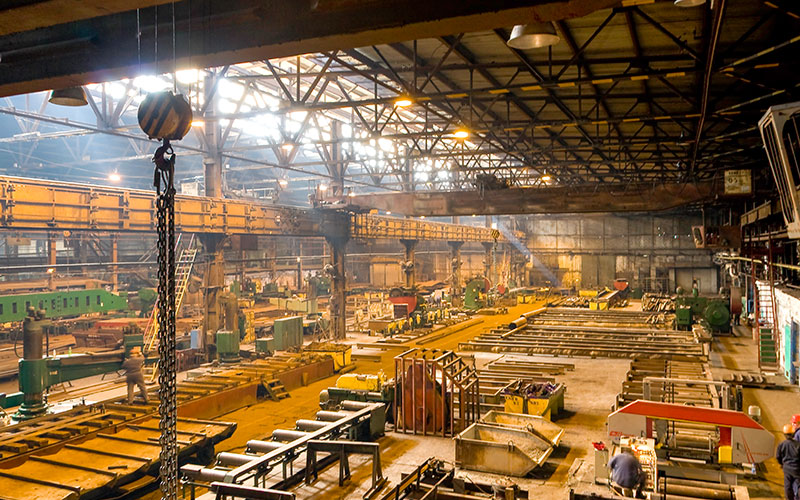
Currently, Zaporizhstal is operating two of its four blast furnaces – Nos. 3 and 4 – and one of its two steelmaking furnaces, all now running flat out.
It also has restarted some of the rolling facilities, with roughly 5,000 employees involved in production processes.
Zaporizhstal in 2021 produced 4.4 million mt of hot metal, of which 3.9 million mt of steel was made and then converted into 3.3 million mt of rolled products.
The bulk of its saleable products normally comprise hot- and cold-rolled coil and sheet, but in addition to trip and coil rolling mills, the plant also has roll-forming shop.
According to Metinvest, three Ukrainian steel companies are currently operating: Zaporizhstal, Metinvest-owned long rolled steel producer Kamet Steel in Kamianske in Ukraine’s Dnipropetrovsk region; and ArcelorMittal Kryvyi Rih in Kryviy Rih, central Ukraine.
Azovstal and Ilyich iron and steel works, both parts of Metinvest, remain idle.
— Ekaterina Bouckley