


Kloeckner to process plate at Nucor Brandenburg
The North American branch of Klöckner & Co is partnering with Nucor to process plate at the company’s Brandenburg, Kentucky, facility, learns Kallanish.
Kloeckner Metals will open the new facility in the third quarter of 2023.
Slated to be fully operational by Q4 2022, Nucor’s Brandenburg location includes a state-of-the-art facility electric arc furnace for recycling scrap metal into new heavy plate steel.
“Due to higher prices in the market, we can look back on an outstanding first half-year. At the same time, we have continued implementing our group strategy, laying the foundation for an even more successful Klöckner & Co in the future. We have strengthened our partnership with Nucor in the USA,” says Klöckner ceo, Guido Kerkhoff, in the parent company’s earnings.
Klöckner aims to be a leader in zero-touch production methods. The company uses digital tools to reduce processing speeds and create efficiencies in the supply chain.
Kristen DiLandro USA


Ryerson achieves strong earnings, debt reduction during Q2
Chicago, Illinois-based US service centre chain Ryerson increased its shareholder’s earnings per share to a record high during the second quarter, while also significantly reducing millions of dollars of the company’s outstanding debts.
Ryerson earned $194.4 million on sales totalling $1.74 billion during the second quarter, which is up on-year from earnings of $112.9m on sales of $1.42 billion in the same period of last year. Shipments by the company during the second quarter reached 524,000 short tons, with sales being conducted at an average selling price of $3,327/st. Year-over-year, the company’s gross profit has increased by over $100/st, up from $777/st to $889/st.
Ryerson has increased both its revenues and income considerably year-over-year in 2022, with the company’s revenue increasing by 36.1% and net income increasing by 160.5%, Kallanish notes.
“We are no longer a high-yield debt company as we redeemed all of our remaining outstanding notes, significantly reduced our cash interest expense, increased our dividend, completed our initial share repurchase authorization 14 months ahead of the two-year expiration, announced a new two year, $75m share repurchase authorization, and amended, extended and upsized our credit facility with improved pricing and terms while making important investments in growth across our service centre network,” explains ceo Eddie Lehner.
The company generated $87.4m in gains on the sales of several properties during the second quarter, including properties located in Delaware, Florida, Illinois, Kentucky, Minnesota, Missouri, Oklahoma, Pennsylvania, Tennessee, Texas, and Virginia.
“We are pleased to have effected numerous capital structure improvements which effectively complete Ryerson’s balance sheet transformation … We now have a capital structure where assets and liabilities are better aligned for growth and through-the-cycle performance,” adds Ryerson cfo Jim Claussen.
Ryerson expects its third quarter revenue to be impacted by falling nickel and steel prices, as well as slowing global economic conditions in many regions. The company’s average selling price for carbon, aluminium and nickel products fell by approximately 25% during Q2.
Zach Johnson USA

Metinvest supplies flats to Ukraine from Italian plants
Metinvest’s trading arm, Metinvest-SMC, has arranged the import into Ukraine of scarce thick plate and hot rolled coil from its assets in Italy, Kallanish notes.
“Due to the difficult situation that has developed with Metinvest’s assets due to the Russian-Ukrainian war, there is a shortage of plate in Ukraine,” the enterprise claims. “To help our clients obtain the desired rolled metal products, specialists from Metinvest-SMC organised the supply of steel products from the Italian assets of Metinvest Group.”
Trametal is a leading European manufacturer of structural steel plate. Ferriera Valsider is an Italian manufacturer of thick plate and HRC.
The total volume of planned deliveries to Ukraine is about 3,500 tonnes, with the first batch already in Ukraine and a second expected soon. “Already now, the first batch of our import delivery from Ferriera Valsider, with a total volume of almost 1,000t of HRC, is available for order and shipment in the Lviv metal centre of Metinvest-SMC,” it adds.
The products in question are HRC 20/30/40/50mm x 2,450mm x 6,000mm, hot-rolled sheet 20/30/50mm x 2,450mm x 9,000mm, hot-rolled sheet 20mm x 2,450mm x 10,000mm, and hot rolled sheet 15/20/30mm x 2,450mm x 12,000mm.
The firm expects the following delivery, from Trametal, to arrive in the near future at the Metinvest-SMC metal centre in Ternopil.
“July turned out to be a productive month for our joint work,” the steelmaker observes. “We are grateful to colleagues from Italian enterprises for their help in the supply of rolled metal products and this is just the beginning of our joint work with foreign partners. In the future, Metinvest-SMC plans to increase the volume of deliveries and the product line by organising imports from other countries.”
Traditionally, before the outbreak of war in Ukraine, Metinvest’s Mariupol-based plants would supply plate and HRC to the Italian market, as well as slab for re-rolling at its Italian plants.
Svetoslav Abrossimov Bulgaria

Steel rebar prices in Italy, Spain stable on maintenance closures, weak demand
Decreasing demand and seasonal steel mill closures resulted in negligible activity in the steel rebar market in Southern Europe in the week to Wednesday August 3, with prices unchanged week-on-week.
Potential rises in energy costs in the fourth quarter continued to create uncertainty among market participants.
Italy
Demand picked up in mid-July, with buyers stocking up small volumes before the August summer holidays, but this activity has since reduced with mills closing for the low season, Fastmarkets heard.
Fastmarkets’ price assessment for steel reinforcing bar (rebar), domestic, exw Italy, was €860-910 ($875-925) per tonne on Wednesday, unchanged week-on-week.
Mills closing for August and sluggish demand resulted in the dearth of trading activity.
One source said that while prices were likely to remain the same throughout August, potential energy cost rises in September could drive up prices sharply.
Some mills, one source said, were selling rebar at prices €30-70 per tonne below the offer price so that they could sell as much as possible before closing for August.
“Producers are telling customers that energy costs will be out of control in September,” the same source said, “so they are warning customers that steel prices will be more expensive at the re-opening.”
Energy rationing, as proposed by the European Commission on July 20, could push up energy prices if it were to go ahead.
Emergency legislation, designed to protect countries from the possibility of Russia using its control of gas supplies to exert political pressure over the coming months, would enable the European Commission to impose 15% binding gas consumption restrictions on EU countries over the next two years.
This legislation, however, was a long way from being passed, and many countries within the EU opposed it. Energy rationing would be a response to Russia cutting off gas supplies, but there was no evidence yet that this would happen.
If such legislation were passed, this would create upward pressure on the price of energy, in turn forcing mills to increase prices, Fastmarkets heard. Some mills had considered extending production cuts into September to manage any upward surge in energy prices, sources said.
Spain
Mills’ maintenance closures and weak demand meant that there was scant trading activity for rebar in Spain, Fastmarkets heard.
Fastmarkets’ price assessment for steel reinforcing bar (rebar), domestic, delivered Spain, was €780-810 per tonne on Wednesday, unchanged week-on-week.
Despite demand increasing in July when customers re-stocked before maintenance stoppages, market activity has since dropped, Fastmarkets heard.
Spanish mills started to raise their prices toward the end of July to compensate for increasing energy costs, sources told Fastmarkets. But with mills closing for the low season, prices were likely to remain stable until September, they said.
Falling international scrap costs since mid-April have been a factor in the decline in the rebar market. Scrap prices jumped in early July but have since corrected.
Fastmarkets’ daily calculation of the index for steel scrap, HMS 1&2 (80:20 mix), North Europe origin, cfr Turkey, was $351.19 per tonne on August 3, unchanged over the past week.
Published by: India-Inés Levy


UK new car sales fall 9% on year in July
New car registrations in the UK totaled 112,162 units in July, down 9% year on year, with supply chain shortages continuing to limit order fulfilment, according to data released Aug. 4 by the Society of Motor Manufacturers and Traders.
“Ongoing global supply chain issues, predominantly the lack of semiconductors, continued to frustrate order fulfilment, exacerbated by COVID lockdowns in key manufacturing and logistics centers in China, plus disruption from the war in Ukraine, all of which restricted production output and thus supply into the UK new car market,” it said.
Due to these factors, the SMMT revised down its industry outlook, forecasting a 2.8% drop in total new vehicles registrations in full-year 2022.
“The automotive sector has had another tough month and is drawing on its fundamental resilience during a third consecutive challenging year as the squeeze on supply bedevils deliveries,” SMMT CEO Mike Hawes said.
“While order books are strong, we need a healthy market to ensure the sector delivers the carbon savings government ambitions demand,” he said, adding that the next prime minister should create conditions for economic growth, restore consumer confidence and support the transition to zero emission mobility.
The UK government plans to ban the sale of new gasoline and diesel cars by 2030.
BEV sales up 9.9%
Battery electric vehicles sales for the month were 12,243 units, up 9.9% year on year, but down 46.2% from June to a five-month low, the data showed.
The BEV market share was 10.9% in July, up from 9% a year ago, but down from June’s 16.1% share.
So far in 2022, 127,965 BEVs have been sold in the UK, up 49.9% year on year and making up 13.9% of total sales, up from 11.9% in January-July 2021.
“Although this is the weakest monthly uplift recorded by BEVs since the pandemic, overall growth in the year has reached 49.9% to deliver a 13.9% market share, illustrating the volatility in the supply chain,” the SMMT said.
Higher EV demand has boosted battery raw material prices. The Platts seaborne lithium carbonate and lithium hydroxide assessments have surged 113% and 136.6% respectively since the start of 2022 to $72,000/mt CIF North Asia and $75,000/mt CIF North Asia as of Aug. 4, according to S&P Global Commodity Insights data.
Sales of plug-in hybrid EVs fell 34% year on year and dropped 15.3% on the month to 6,533 units, which was 5.8% of the total market share, down from 8% a year ago.
The market share of hybrid EVs also fell 6.7% year on year to 13,730 units, which was also down 8.3% month on month and at a market share of 12.2%, up from 11.9% a year ago.
ICE vehicles at 51.3% share
Meanwhile, the market share of petrol and diesel internal combustion engine vehicles moved back above 50% at a combined 51.3% share, up from 49.7% in June, but down from 51.9% a year ago.
Petrol cars continued to hold the largest market share at 45.7% or 51,294 units, which was up from a 44.8% share in July 2021.
The volume of petrol vehicle sales dropped 7.2% on the year in July and fell 36.1% from June, according to the SMMT.
At 6,210 units, diesel vehicles’ market share was 5.5%, down from 7.1% a year ago and a 5.7% share in June.
The diesel volume was down 29.3% year on year and fell 22.4% month on month.
— Jacqueline Holman


Steelmaker Voestalpine sees good demand for high value-added products
Austrian steel and technology company Voestalpine said Aug. 4 there was good demand for its high-quality products in all segments over the April-June quarter despite the difficult environment due to the Russia/Ukraine war, increases in energy prices and ongoing disruptions in logistics.
Looking ahead, demand from rail technology, energy, aerospace and automotive industries should support the steelmaking in the second half of 2022, but other steel end-user industries were a cause for some concerns, with the EU’s general economic outlook largely pinned to natural gas supply issues, Voestalpine said.
The April-June quarter was marked by positive changes in certain steel end-user sectors. The European automotive industry, which has had to contend with supply chain bottlenecks for over a year despite strong order levels, benefited from slight upward trends in the April-June quarter.
The aerospace segment profited from rising passenger numbers in regional air traffic and the resulting increase in demand for single aisle aircraft.
In the oil and natural gas segment, demand rose considerably year on year.
The sharp increases in energy prices are creating incentives to invest in oil and natural gas projects.
The conversion of US Section 232 tariffs into a quota system with effect from Jan. 1, 2022, was positively impacting Voestalpine’s European plants, it said.
Its Railway business division repeatedly posted stable performance. And the reported period saw continued strong demand for storage technology, while the photovoltaics segment, which Voestalpine supplies with substructures, achieved record growth.
All the above helped Voestalpine deliver record strong financial results over April-June, and prepare to dealing with the risks stemmed from economic uncertainty in the remainder of 2022.
Outlook cautious
Voestalpine said it could not assume its earnings will stay at the record level achieved over April-June — the first quarter of its financial year — through the end of March 2023.
Signs were pointing to a significant cooling of the economy from October through March, potentially affecting the company’s cyclical businesses such as flat steel production for the construction, mechanical engineering, consumer and white goods sectors.
The steelmaker said its outlook presupposed that Europe continued to receive sufficient supply of natural gas and that other risks, including raw materials and energy prices, remained manageable.
While Europe had adequate supplies of natural gas, the ‘threat’ scenario of them becoming insufficient as a result of the political tensions arising from the war in Ukraine had recently intensified, the company said.
In the April-June quarter, Voestalpine had revenue of Eur4.6 billion ($4.7 billion), up 38% on the year, while its EBITDA climbed 68.5% to Eur879 million and profit after tax rose 137% to Eur615 million. The company expected full-year EBITDA of Eur2 billion.
— Ekaterina Bouckley

Outokumpu Q2 stainless steel deliveries fall 3.7% on year to 603,000 mt
Stainless steel producer Outokumpu delivered 603,000 mt of stainless steel in the second quarter, down 3.7% quarter on quarter, the company said Aug. 4.
The Nasdaq Helsinki-listed company, the largest stainless steel producer in Europe, also said stainless steel deliveries in the first half of the year rose 1.3% year on year to 1.25 million mt.
IN a results statement released Aug. 4, the company said Q2 ferrochrome production fell 2.3% year on year to 128,000 mt, while output for the six-month period dropped 1.9% year on year to 257,000 mt.
Outokumpu’s Q2 sales rose 58% year on year to Eur2.951 billion ($3.016 billion), the company said, adding that realized prices for stainless steel increased significantly in both Europe and the Americas, while higher ferrochrome sales price boosted profitability.
The company said variable costs in the second quarter rose sharply year on year due to increased cost inflation in energy and consumable prices, while fixed costs also increased and slightly dampened profitability.
Market development
Outokumpu said global apparent consumption of stainless steel flat products in the second quarter rose 1.2% quarter on quarter, due to high seasonal demand in the Americas, which rose by 6.5%, while demand in the Asia-Pacific region increased 1.6% after the Lunar New Year-related drop in the first quarter.
The company said apparent consumption across Europe, the Middle East and Africa in the second quarter fell 2.8% quarter on quarter, showing more hesitant buying behavior, due to uncertainties related to inflation and the war in Ukraine.
Looking ahead to the third quarter, global apparent consumption of stainless steel flat products will likely increase 5.9% quarter on quarter, with the Asia-Pacific region driving the strongest growth of 10.6% for the period due to the recovery of Chinese domestic demand, while the Americas are expected to see a quarterly drop of 1.3% and EMEA a 11.7% drop, Outokumpu said, citing UK consultancy CRU.
In a year-on-year comparison, apparent Q3 demand is expected to increase by 8.5%, driven by 10.6% and 6.0% higher apparent consumption in the Asia-Pacific region and the Americas, respectively, while EMEA demand is expected to fall 1.1%, it said.
Outlook
Outokumpu’s stainless steel deliveries in the third quarter are expected to fall by 10%-20% quarter on quarter, the company said.
Prices for stainless steel have remained high for orders already received, while the European ferrochrome benchmark price fell to $1.80/lb for the third quarter, Outokumpu said.
The company said energy costs are expected to increase in the third quarter and hurt the ferrochrome business area in particular, while planned maintenance costs in the third quarter are expected to increase by about Eur10 million quarter on quarter.
Outokumpu said that with current raw material prices, significant raw material-related inventory and metal derivative losses are expected to be realized in the third quarter.
“The war in Ukraine has led to an energy crisis, with increased energy prices and uncertain availability for next winter. Yet, the realized impacts of the uncertain situation on stainless steel demand or economic growth are difficult to estimate,” Outokumpu CEO Heikki Malinen said in a statement.
“We are living in exceptionally uncertain times both politically and economically.”
— Filip Warwick
TURKEY DATA: HRC imports fall 6% on year in H1
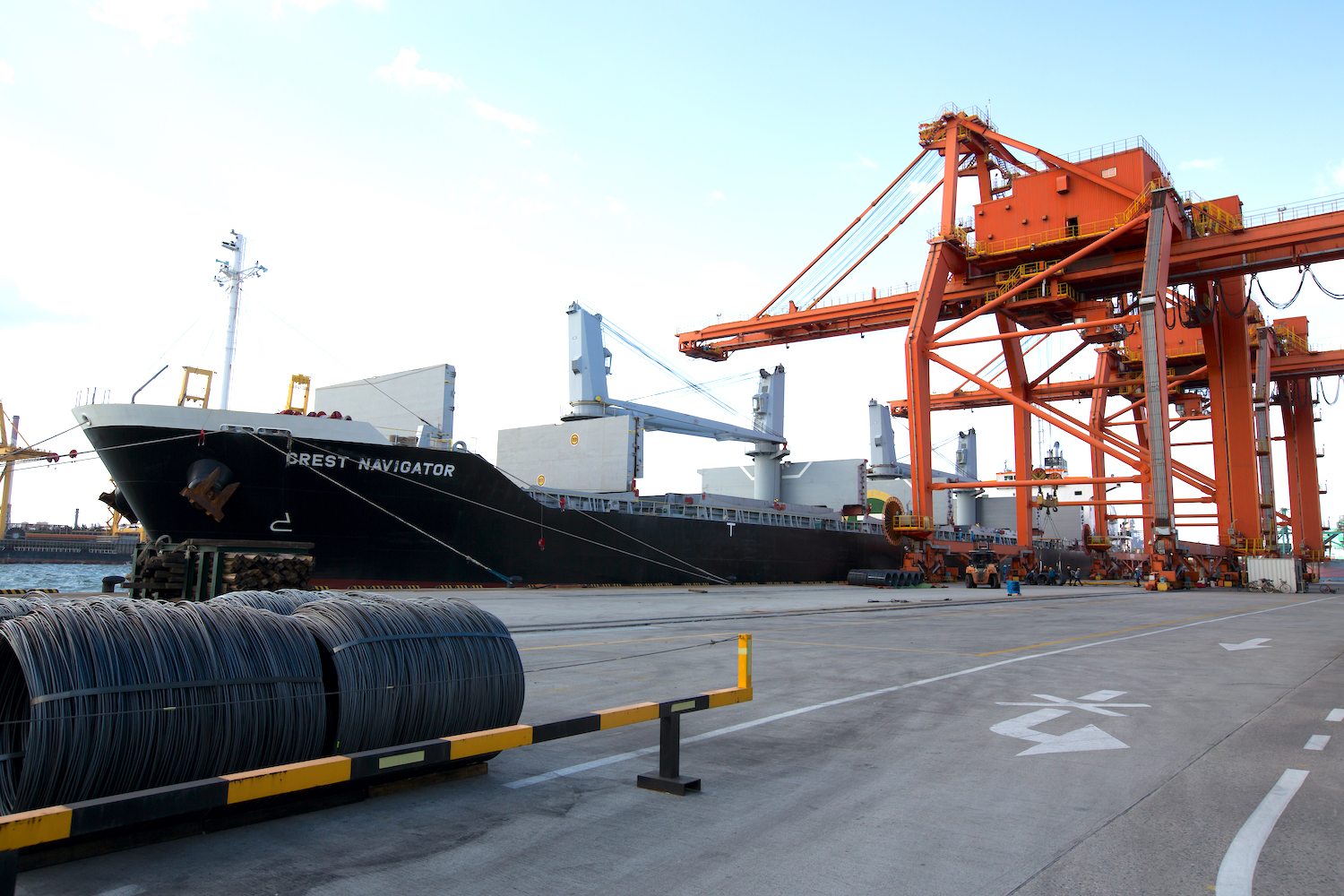
Turkey’s imports of hot-rolled coil fell 6% year on year to 2.58 million mt in the first half of 2022, due to low demand and decline seen in imports from the CIS region and some EU countries, according to the latest Turkish Statistical Institute, or TUIK, data sent to S&P Global Commodity Insights.
However, imports from some Asian suppliers rose in January-June, with India supplying 500,000 mt, up 150% on the year.
South Korea shipped 178,000 mt of HRC to Turkey in H1, up 70,000 mt on the year, while Japan exported 168,500 mt, down 18.5%.
Imports from Russia fell notable to 440,000 mt, down from 1.1 million mt in H1 2021. Imports from Ukraine also dropped to 230,000 mt in H1, down from 666,000 mt a year ago.
Turkish HRC prices topped $1,200/mt in mid-March amid availability issues, but have declined since on slowed demand and low-priced HRC import offers to Turkey.
Turkish domestic HRC was assessed at $670/mt ex-works July 29, according to S&P Global data.
According to the latest TUIK data, France sent 145,000 mt of HRC in H1, relatively stable on the year, while imports from other EU countries remained low. Brazil shipped 135,000 mt to Turkey in H1, compared to none a year ago, while other HRC suppliers were the UK at 123,000 mt and Romania at 96,000 mt.
— Cenk Can

EU HRC prices down, sentiments increasingly negative
Hot-rolled coil prices in Northwest Europe moved lower Aug. 4, as mills offered substantial discounts to secure September volumes.
Northern European HRC was assessed down Eur40/mt on the day at Eur800/mt ex-works Ruhr.
Distribution sources reported deals at Eur800/mt ex-works, though official offer levels remain at Eur840-850/mt ex-works Ruhr.
Poor demand was described as the primary factor motivating discounted sales, with distributor stock levels delaying traditional restocking periods. Some buy-side sources predict that substantial restocking may not kick in until late September-October.
Sentiments in the market are increasingly negative, both in terms of steel market fundamentals and the greater macroeconomic picture.
“There may be cheap prices, but no one has the possibility to buy as stocks are so inflated,” said a service-center source. “Price levels need to increase on rising production costs, but it just isn’t possible on current demand levels and end-user cost-of-living. Even if automotive demand picks up, the average European employee can’t afford to buy a car any time soon.”
Distribution sources said their customers held a wide spread of available offers — enhancing negotiating power — but that even the most competitive of offers would not attract business.
“Customers keep waiting – we’re having the same conversations with them again and again, all that changes is the figures,” said a distributor.
“There are a lot of question marks both now and going forward,” agreed another.
One trader described current market conditions as “catastrophic.”
A German service-center source reported a particular issue with transport, with shipping costs having increased four-fold from Eur20-90/mt. Transporting volumes via truck was posed as an alternative option, declined as unviable due to a shortage of drivers.
“It’s really hard to see signs of recovery, the market has undergone huge pressures this year – and they show no sign of relenting,” the source said.
In Italy, the picture wasn’t much brighter, though the HRC price was stable on day, assessed at Eur770/mt ex-works Italy.
With the region at the outset of August mill shutdowns, very little activity was reported, with only limited back-to-back deals heard between distributors and end-users.
“Honestly speaking, I understand why their cautious to buy,” said a trader source. “Stocks are high, and everyone is having cash flow issues, it makes no sense to do larger deals in these conditions.”
One mill was reported as attempting offers of Eur800/mt ex-works in the market for September rolling, in line with source expectations of a slight price rise in September.
Like the Northern market, however, appetite for an increase was dubious on the recent performance of key industries, like white goods, automotive, and construction.
— Benjamin Steven, Maria Tanatar