


Ekinciler Demir ve Celik joined as member of EUROMETAL
We are pleased to inform you that Ekinciler Demir ve Celik joined as associate member of EUROMETAL.
Ekinciler Iron and Steel Industries, Inc. is the main subsidiary company of Ekinciler Holding. Founded in Iskenderun Bay four decades ago, the company has an annual production capacity of 1.25 million tons. All types of construction steel are manufactured by a highly skilled workforce in the production plant, which is empowered with the state of the art technologies.
EKDEMİR exports products to more than 60 countries all over the world. In 2019, Company’s net sales were USD 326 million and was ranked 78th in 2018 and 114th in 2019 among the Top 500 industrial corporations in Turkey.
Ekinciler Iron and Steel has “ISO 9001 Quality Management Standard Certificate”. The company always puts environmental protection and maintaining a healthy and strong workforce in the forefront of all its production processes and achieved “ISO 14001 Environmental Management Certificate”, “Sustainability Certificate”, and “ISO 45001 Occupational Health and Safety Certificate”. At Ekinciler Iron and Steel Industries, Inc., using energy, water and raw material in the most effective way is an utmost principle. Concerning with the recycling and proper disposal of waste products, the company adopted an approach most beneficial to the national economy.
More information: ekinciler.com
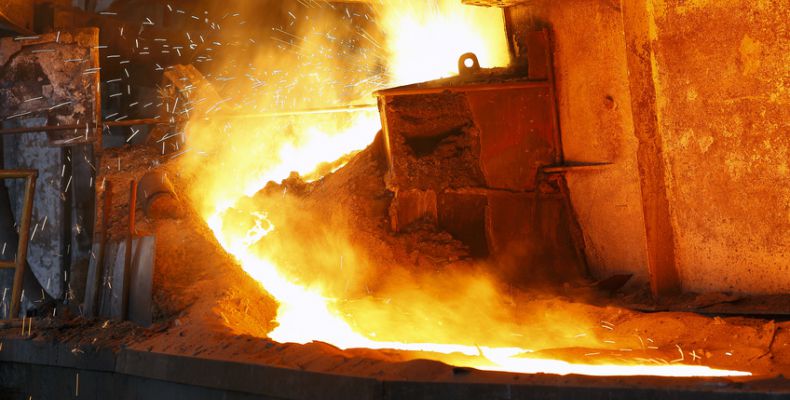
European steelmakers cut production amid weak steel demand
A number of European steelmakers have decided to cut production by idling blast furnaces during the summer period, cutting production as steel demand remains weak.
Automotive manufacturers have consumed less steel because of lower car production rates caused by a shortage of components. Other end-users, including in the white goods segment, were also reported to show lower demand for steel.
A majority of European coil producers have been operating with reduced capacity in recent weeks and have planned longer summer maintenance works in an attempt to balance supply with reduced demand.
European distributors have sufficient inventories and, as a result, they have been avoiding restocking. A negative price trend in the EU flat steel market contributed to a wait-and-see approach among buyers.
Domestic prices for HRC have been declining in Europe since the second half of March because of weak demand. Platts daily assessments for HRC in Northern Europe declined to Eur780/mt ex-works Aug. 9, 15.4% lower than at the start of the year and down from the intra-year high of $1,460/mt reached March 18.
In the short run, output reduction should support price stability, with production to possibly increase if/when restocking starts.
Germany
ArcelorMittal’s Eisenhuettenstadt plant
- Operating at reduced capacity since Aug. 1 due to weak demand.
- ArcelorMittal applied for short-time work for August and September to lower production due to the tense economic situation from weak demand.
- ArcelorMittal has seen a sharp drop in demand for rolled products.
- The plant’s liquid lines are continuing to operate as normal, due to normal demand for slabs.
- The Eisenhuettenstadt plant produced 1.6 million mt of flat steel in 2021.
- ArcelorMittal previously shut blast furnace 5A at Eisenhuettenstadt on May 20 to replace internal cooling plates, among other maintenance, but started ramping it up July 7.
Salzgitter’s blast furnace C
- Delayed the restart of blast furnace C, idled in 2019, due to reduced demand and sufficient semi-finished supply from other sites.
- Blast furnace C has a capacity of 600,000 mt/year. Salzgitter’s total crude steel output exceeds 7 million mt/year.
Italy
Arvedi
- Stopped production at its plant, including its melt shop and rolling mills, for five weeks in August for summer maintenance work.
- Operates two EAFs in Cremona that feed 75% of the finishing operations there.
- EAF No. 1 has a capacity of 1.4 million mt/year of crude steel and furnace No. 2 has an expanded capacity of 2.6 million mt/year.
Acciaierie d’Italia
- Temporarily halted production at its 2 million mt/year blast furnace No. 2 since July 11 for about a month-and-a-half, according to trade union sources.
- Acciaierie d’Italia was also said to have temporarily idled a second blast furnace at the start of August, although it declined to comment.
- Market participants named high production costs (particularly for energy), limited demand and failed attempts to increase coil prices to the targeted level as the likely reasons for the move.
Marcegaglia
- Closed all production for four to five weeks over the regular two to three weeks to realign availability with currently minimal demand, according to market sources.
- The company’s 2022 steel production volume is likely be in line with the overall decrease in demand, with volumes down 3%-5% year o year.
France
ArcelorMittal’s Dunkirk steelworks
- A 1.5 million mt capacity blast furnace was idled July 12, following a run-down of operations.
- The furnace is being shut due to weak market conditions.
- The closure will leave hot metal capacity of 5.7 million mt/year operational at the site.
- The furnace’s expected restart date has not yet been announced.
NLMK Strasbourg
- Closed galvanizing line from early July for relining.
- The NLMK Strasbourg site has a production capacity of 400,000 mt/year of HDG
Czech Republic
Liberty Ostrava plant
- Temporarily idled its blast furnace No. 2 to carry out a Eur9.5 million ($9.7 million) repair and upgrade program.
- Maintenance to increase the stability and reliability of the furnace and reduce the inventory.
- Salamander tapping of the BF took place July 26.
- Maintenance work to include extensive repairs of the coolers and steel structures, as well as an upgrade to the furnace top, including the detection system.
- Plant’s blast furnace No. 3 and rolling mills are continuing to produce to serve customers.
- BF2 was previously idled in April 2020 for four months due to COVID-19, cutting production by 20%, meaning the current shutdown could continue for at least the same period of time, if not longer.
Serbia
HBIS Serbia
- Shut down one of its two blast furnaces by the end of July on unfavorable conditions, reduced demand in the global steel market.
- Blast furnace No. 1 has a maximum capacity of 900,000 mt/year.
- The furnace was previously restarted in August 2021 after HBIS Serbia shut it down in July 2020 because of unfavorable market conditions caused by the coronavirus pandemic.
Slovakia
US Steel Kosice
- Market sources said one of three blast furnaces idled in an attempt to balance supply with low demand and to keep prices from dropping further.
- Company denied this on June 27.
Ukraine
Metinvest
- Operations at Ingulets and Southern iron ore mining and processing plants suspended since July 1.
- Operations at Northern GOK will be suspended from mid-July.
- Shutdowns due to Russia’s invasion of Ukraine.
- Company will switch to using one blast furnace at its Kamet Steel plant in Kamianske.
- Central GOK to continue to operate at reduced capacity utilization levels.
- Central GOK has an iron ore beneficiation capacity of over 6 million mt/year, with 2 million mt/year of pellet capacity, while the group’s iron ore concentrate production hit 30.5 million mt in 2021.
— Maria Tanatar, Benjamin Steven, Jacqueline Holman, Staff


European HRC demand sentiments pessimistic on September revival
Northern European mills continued to offers discounts to secure volumes Aug. 10, struggling in the minimal demand market.
Market participants reported deals settled at Eur760-770/mt ex-works Ruhr, reinforcing lower workable prices.
The Eur760-770/mt ex-works price level was achievable on bids for larger volumes, with the smaller tonnage deals that have represented the bulk of recent trade sitting higher at around Eur800/mt ex-works.
Platts assessed hot-rolled coil in Northwest Europe down Eur10/mt Aug. 10, at Eur770/mt ex-works Ruhr.
Distribution sources again emphasized a need for certainty in the market on price direction and drivers for demand to recover substantially, though expectations for a September revival were heard as increasingly pessimistic on the day.
“The market just needs some certainty before things start moving again,” said a trader source. “Everyone’s banking on a September revival, but it’s looking increasingly likely that we’ll be in this mess for a while.”
Import offers were heard as stable in the Northern market, with another trader reporting tradable levels stable at Eur720/mt CIF Antwerp.
In Italy, the market was silent on capacity reductions and holiday sentiments, bringing stability to the market on muted trading.
HRC in South Europe was assessed stable day on day at Eur770/mt ex-works Italy.
This brings North and South European HRC price levels into parity for the first time since June 10, 2021, assessed at Eur1,145/mt ex-works Ruhr and Italy, respectively.
Platts is part of S&P Global Commodity Insights.
— Benjamin Steven, Maria Tanatar

Ukraine’s Jan-July crude steel output falls 62.1% on year: Ukrmetallurgprom
Ukraine’s crude steel output fell 62.1% on the year to 4.82 million mt in January-July 2022, steelmaking industry association Ukrmetallurgprom reported Aug. 10.
Pig iron output dropped 61.9% on the year to 4.815 million mt and rolled steel production decreased 62.7% to 4.23 million mt, according to preliminary figures.
Output was hit by the Ukraine war, resulting in the destruction of many steelmaking facilities, as well as the disruption of logistic chains, with steel exports out of Black Sea ports barred.
In July, Ukraine produced 280,000 mt of crude steel, down from 1.87 million mt a year ago, while pig iron output was 285,000 mt, down from 1.88 million mt, and rolled steel production was 210,000 mt, down from 1.67 million mt.
Metinvest’s Azovstal and Illych steelworks in Mariupol were both destroyed and captured by the Russian forces, although its Zaporizhstal steelworks, which is running at 50% of its capacity since April, produced 1.01 million mt of steel in January-July, down 56.3% year on year.
Zaporizhstal’s pig iron output dropped 49.9% to 1.27 million mt and rolled metal production decreased 53.9% to 905,700 mt, Metinvest said.
In July, Zaporizhstal produced 137,400 mt of pig iron, down 60.7% on the year, with crude steel production down 72.5% to 89,600 mt and rolled steel output down 71.8% to 78,700 mt.
— Alexander Bor

EU agrees to bring safeguard measures on some steel products in conformity with GATT
The EU and Turkey have agreed that the EU will modify its safeguard measures on certain steel products until Jan. 16, 2023 to comply with the General Agreement on Tariffs and Trade, or GATT, the World Trade Organization announced Aug. 9.
The EU introduced safeguard measures in July 2018 in the form of tariff-rate quotas.
In March 2020, Turkey requested consultations with the EU concerning the provisional and definitive safeguard measures imposed on imports of certain steel products and the investigation that led to the imposition of those measures.
It then requested the establishment of a panel in mid-July 2020, which was deferred by the dispute settlement body on July 29.
In a general WTO panel report released April 29, 2022, the WTO called on the EU to bring its measure into conformity with the agreement on safeguards and the GATT.
The panel said at the time that it found the EU steel safeguard WTO-compatible on most of the points which Turkey had questioned, while it also found, on three points, that the EU safeguard measure lacked sufficient justification.
The EU is traditionally one of Turkey’s largest steel importers and one of its largest steel suppliers.
Turkish exports of hot-rolled coils fell 7% year on year to 1.02 million mt in the first half of 2022 due to lower EU demand, according to the latest Turkish Statistical Institute data.
Turkish exported HRC was assessed at $620/mt FOB Aug. 5, according to S&P Global Commodity Insights data, representing a $600/mt decline from mid-March.
— Cenk Can
Evraz moves to putting North American business on sale
Mining and steel company Evraz, with mines and mills in Russia, the US, Canada, the Czech Republic and Kazakhstan, said Aug. 10 it was launching soliciting of proposals for its North American subsidiaries acquisition.
A sale of the subsidiaries will allow to unlock the stand-alone value of the North America business, the company said, adding it did not intend to provide additional information on the process until it is finalized.
The solicitation process is being conducted under a certain general license issued by UK’s Office of Financial Sanctions Implementation, or OFSI. The transaction will be subject to regulatory and corporate approvals and applicable sanctions laws, and will require approval from relevant sanctions authorities, including OFSI, noted Evraz.
“The simplest answer” about why Evraz is seeking to sell its North American mills is “sanctions,” an analyst who wished to be unnamed told S&P Global Commodity Insights.
“The company is in a difficult position: its business remains registered in the UK (this was confirmed by Evraz), but most of it is in Russia,” said the analyst. “Reregistering in Russia seems to be impossible at this stage. At the same time, something needs to be done with [the company’s] assets around the world. One of the options is to simplify the structure by selling some of them retaining only what is in Russia.
“Additionally, the sale will help the company pay off part of its net debt, which stands at $3 billion [as of end-H1 2022], which would be very handy given its negative cash flow for the period,” the analyst said. “But whether Evraz will be allowed [by OFSI] to sell [its North American mills] is an open question.”
In 2021, Evraz made 1.88 million mt of crude steel and 1.66 million mt of steel products at its mills in North America. Its assets there focusing on the premium markets in the Western US and Canada offering plates, rails, large-diameter and OCTG pipes, comprise Canadian mills Regina, Camrose and Calgary and US mills Pueblo and Portland. The division has technology centers in Portland, Pueblo and Regina.
Evraz is constructing a high-efficiency long product mill at Pueblo, which will produce 100-meter rails using solar power. Last year, it made investments to upgrade equipment and expand production capacity also at Regina, Saskatchewan, and Red Deer, Alberta, the projects that could be completed this year.
Also, Evraz had considered launching this year digital transformation projects focusing on automation and optimization of its North American operations.
Since late February, as a result of Russia’s invasion of Ukraine, it has become one of the most heavily sanctioned metallurgical companies in Russia.
— Ekaterina Bouckley

EU mills’ output reduction could stabilise coil prices
Northwest Europe coil market observers believe mills are putting a break on output, in the legitimate interest of stabilising prices in a market of subdued demand and order activity.
The mills themselves are not very explicit about it. The market leader reduced working hours at the rolling mills of its two German works, but revealed the move only to regional media. Another German mill is refraining from restarting a blast furnace that was meant to be taken back into operation by mid-year. Temporary output interruptions are also being heard in Italy, France, Serbia, and Czech Republic.
“Producers are taking big efforts to seriously reduce output in order to bring back a balance of demand and supply to the market,” one Dutch source tells Kallanish. Looking back, he points out that “during and because of Covid, we had to cope with a back-and-forth of oversupply and shortage.” Russia’s attack on Ukraine then brought panic buying to the market, which “was absolutely unnecessary”, he observes. As it turned out, “the real demand was much lower than the mills foresaw in their budgets.”
A mill source points at high inventories at service centres and distributors. “Once they are in balance, we expect supply/demand to stabilise,” he says.
The working hours reduction at rolling mills could mainly benefit hot rolled coil derivatives. While HRC is seen at €800-850/tonne ($818-869), hot-dip galvanized coil has maintained values above €950. According to another mill source, HDG prices are supported by the increasing costs of natural gas, which is used in the production process. Cold rolled coil is still a good deal lower in price, starting at €910, but sources refrain from pinpointing the value more precisely.
Christian Koehl Germany

Poland’s Weglokoks eyes hot strip mill in 2027
State-owned Polish coal trader and steel re-roller Weglokoks plans to commission in 2027 a new 1 million tonnes/year capacity hot strip mill in Ruda Slaska, next to Katowice, Kallanish notes.
The plant, to be located on the territory of stockist and fabricator subsidiary Huta Pokoj, will allocate half of its production capacity for the needs of the group’s re-rolling lines, with the balance sold on the merchant market.
The PLN 5 billion ($1.1 billion) plant will use electric arc furnaces to melt scrap, of which Poland is a major supplier. Weglokoks forecasts the operation will generate PLN 4.5 billion in annual revenue and provide an average sales margin of 8%.
The aim of the investment is to complete the value chain in Weglokoks’ steel segment, which will result in increased competitiveness and production at its processing lines. This will also result in reduced steel imports into Poland and an improvement in foreign trade balance.
“We are determined that Poland’s steel industry, the part which is in the hands of the state, is rebuilt,” says Polish state assets minister Jacek Sasin.
The state has also released PLN 560 million of funding to Weglokoks for the recapitalisation of its steel subsidiaries.
The group says the main driver behind the investment is the fact the steel industry plays a key role in economic development, and 80% of Polish steel demand is currently covered by imports.
Weglokoks also owns welded pipemaker and mine roadway support producer Huta Labedy, as well as heavy plate producer Walcownia Blach Batory (WBB). The firm had previously planned to consolidate the three steel subsidiaries under a subsidiary called “Weglokoks Stal”.
WBB has suffered from merchant slab procurement issues since it restarted production in late 2017 following an almost two-year stoppage. Huta Pokoj has likewise had issues with billet and hot rolled coil feedstock availability. These have been exacerbated by the disruption in steel supply due to war from Russia, Ukraine and Belarus, which accounted for 25% of Polish steel imports in 2021.
In January-May 2022, Poland imported 1.25 million tonnes of hot rolled flat products under HS code heading 7208, according to Poland’s Central Statistical Office (GUS). HS code 720839 comprised 235,558t, with 76,961t coming from Ukraine and 55,638t from Russia. HS code 720838 accounted for 207,269t, with 58,939t coming from Slovakia and 41,361t from Ukraine.
Despite Poland’s dependence on imports, steel industry participants have said in recent years it is unlikely that Poland will build new crude steelmaking capacity. The new investment is all the more surprising given the current energy crisis Europe is facing. Weglokoks, however, has the backing of the state and said in 2018 that building its own crude steelmaking capacity was an option it was mulling.
Poland’s only current slab and hot strip producer is ArcelorMittal Poland.
Adam Smith Poland