


EUROMETAL Steel Net Forum Iberia: EU steel production growing slower than GDP

Although the forecast for steel production and consumption in the EU is positive for this and the coming years, according to Professor Roland Dohrn from the University of Duisburg-Essen, who shared his presentation at the EUROMETAL Steel Net Forum Iberia, in Porto, Portugal, on March 17, it still has chances for a downward revision. At the same time, the EU GDP forecast for 2023 has been revised downwards compared to last year, while 2024 will see higher results “because after a bad year there is always a catch-up”, according to Professor Dohrn.
More specifically, while steel production worldwide fell by 4.3 percent to 1.83 billion mt, steel production in the EU fell by 10.5 percent year on year, to 136.7 million tons in 2022, according to the WorldSteel Association. Meanwhile, it is worth mentioning that last year the situation in the European steel industry was affected by the high prices for energy, the high volatility of prices and demand, which were mainly caused by the military aggression of the Russian Federation against Ukraine. This year, however, according to representatives of the sector, the challenge from energy prices has lost its power somehow, but the war in Ukraine will continue to affect the world and Europe as well as it has a strong impact on the food sector, and inflation in the EU is highly dependent on this sector. In particular, the inflation rate in Europe is forecast to drop by 5.5 percent in 2023, while in 2024 it may show a two percent recovery.
In 2022, all the leading European steel producers reduced their production last year, including Germany, down by 8.4 percent, Italy down 11.6 percent, France down 13 percent and Spain down by around 19 percent. At the same time, this year, according to EUROFER, production of steel may drop by 0.6 percent and may increase by 1.8 percent in 2024, while EU GDP is likely to increase by 0.1 percent and 1.9 percent, respectively in 2023 and in 2024. “Production of steel mills grows slower than GDP in the EU,” Professor Dohrn said. Meanwhile, following a 4.6 percent drop in apparent steel consumption in 2022, this year it is forecast to decrease by 1.6 percent and to rebound by 1.6 percent next year.
Apparent steel consumption grew slower than production of steel given the lower steel input per produced unit in some sectors like electric vehicles. Besides, the EU has been witnessing changing production patterns within sectors; for example, thermal isolation of existing houses needs less steel than new buildings.
At the same time, in terms of end-user demand, in the construction sector, which has a 35 percent share in total steel consumption, it is expected to drop by 1.6 percent year on year in 2023 but to increase by 1.6 percent next year. End-user demand in the automotive sector, which has an 18 percent share in total steel consumption, is forecast to increase by 1.1 percent compared to last year, but to drop by 0.6 percent in 2024, according to the presentation made by Juan Mañá Herranz from ArcelorMittal Spain.

German scrap exports hit lowest level since 2009
Ferrous scrap exports from Germany decreased significantly in 2022, show data from the German federal statistics office.
In January-December, shipments totalled 7.7 million tonnes, down 14% on 2021, Kallanish notes. This was the lowest export volume since the economic and financial crisis of 2009, say local experts.
In the preceding years, 2016 to 2021, annual exports differed only minimally, between 8.6mt and 8.8mt, Kallanish gathers from an overview issued by steel federation WV Stahl.
Despite the sharply reduced trade volume, the export value of scrap exports increased. According to German Federal Statistical Office (Destatis) data, this amounted to €4.9 billion ($5.2 billion) in 2022, compared to €4.5 billion in the previous year.
The main target country is traditionally the Netherlands, but exports to this destination fell even more significantly, by 17.8% to almost 1.6mt, according to recycling federation BVSE. To Italy, the second-largest buyer country, 12-month exports dropped by 13% to 1.46mt.
Turkey is the most important customer outside the EU. German direct exports here totalled 624,956t, down by 5% on-year in 2022.
However, the surge continued in deliveries to India, which at 198,474t were up 187% on-year.
Scrap imports by the German steel industry also fell last year by 12% on-year to 4.3mt. The value of all scrap imports last year was at €2.2 billion, the same level as the previous year, despite the significant drop in volumes.
The most important trading partner here was also the Netherlands, which provided 931,565t, down by 3.1% on-year.
The second-largest supplier was Czech Republic with 809,542t, down 15.3%, and third-largest was Poland with 648,684t, down by 20.4% on-year.
German scrap prices have increased in March amid higher demand and exports (see Kallanish passim). Local market participants expect this trend to continue in the next few weeks amid restocking from Turkish mills in the aftermath of the devastating earthquake.
Svetoslav Abrossimov Bulgaria


EUROMETAL Steel Net Forum Iberia 2023 gathers 170 participants in Porto


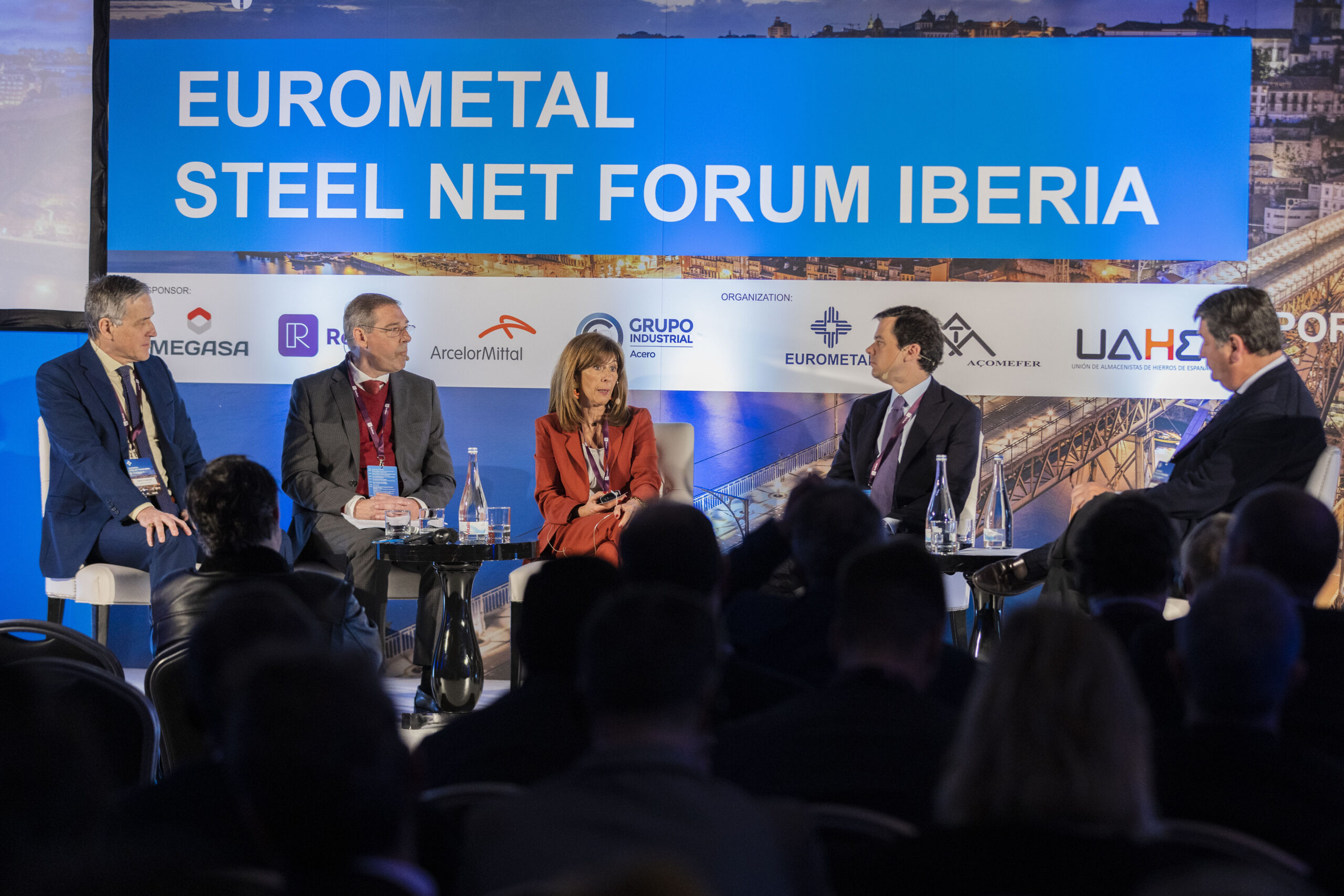
The EUROMETAL Steel Net Forum Iberia 2023 took place last Friday in Porto. More than 170 delegates participated in this event organized in collaboration with Associação Portuguesa dos Grossistas de Aços, Metais e Ferramentas (Açomefer) and Unión de Almacenistas de Hierros de España (UAHE).
We appreciate the great support of sponsors Megasa, Reibus International, Arcelormittal and CL Grupo Industrial that made this event possible.
Here you will find a list of some repercussions of the event in the press:
- EUROMETAL Steel Net Forum Iberia: EU steel production growing slower than GDP March 20, 2023
- Industry expert flags decoupling of European steel user consumption from production: EUROMETAL event March 20, 2023
- Iberian steel stockists expect prices to remain elevated amid ongoing market uncertainty March 20, 2023
- Distributors cautiously positive about 2023 steel price outlook: EUROMETAL forum March 20, 2023
- European sections prices, demand to remain strong: EUROMETAL conference March 20, 2023
- Spanish distributors see challenging scenario in 2023 March 20, 2023
- Iberian distributors embrace ‘new normal’, old concerns persist March 20, 2023
Turkish steel producer Borusan starts talks on acquisition of Europipe US subsidiary
Turkey’s largest steel pipe producer Borusan Mannesmann’s fully owned US subsidiary, Borusan Mannesmann Pipe US Inc., has started negotiations with German steel pipe producer Europipe GmbH on the acquisition of all issued and outstanding shares of capital stock in Europipe’s US subsidiary, Berg Europipe Holding Corp, Borusan said March 16.
According to a regulatory filing March 16 seen by S&P Global Commodity Insights, a non-binding letter of intent was signed between the parties on March 2 and the necessary negotiations for a binding agreement between the parties are ongoing in this context.
“In the meantime, the necessary financial and legal studies within the scope of the process and the required procedures before the regulatory authorities are being carried out,” Borusan said.
Europipe, headquartered in Ruhr, Germany, has production facilities for longitudinal seam-welded large-diameter pipes in Mulheim, Germany and in Panama City, US, named as Berg Pipe Panama.
The company’s second plant in the US, Berg Pipe Mobile, for helically welded pipes, also started production at the end of 2008 in Mobile, Alabama.
Borusan Mannesmann’s ERW pipe mill in Baytown, Texas, has a 300,000 mt/year capacity. The company already started an investment last year to raise its US mill capacity to 400,000 mt/year with new lines.
Borusan Mannesmann’s Turkish mill capacities are 750,000 mt/year of ERW pipes and 300,000 mt/year of spiral pipes. The company’s capacity to produce cold-drawn special pipe at its Vobarno plant in Italy is 28,000 mt/year.
Fluctuations in raw material prices have been putting pressure on steel pipe producers’ pricing, sources said.
Turkish hot-rolled coil prices exceeded $1,200/mt mid-March 2022, but have declined since April, with Platts, part of S&P Global Commodity Insights, last assessed domestic HRC at $845/mt EXW March 10.
— Cenk Can


EU HRC producers to achieve higher prices
European steelmakers are expected to reach higher domestic prices for hot-rolled coil due to short supply, sources said March 17.
The volume of average deals, however, is expected to remain smaller as buyers remain uncertain that the uptrend would sustain in the third quarter. And the European steelmakers have already been offering June-July delivery coil.
Reduced domestic availability and long lead times for import have been supporting coil prices in Europe. Tight supply has been caused by continuing effects from production stoppages last year, technical issues at some mills including Tata Steel in the Netherlands and some automotive steel demand revival. Tata Steel Nederland invoked force majeure due to difficulties following its Cold Mill 21 upgrade, the steelmaker had said Feb. 24.
Earlier this week, ArcelorMittal increased its HRC offers to Eur870/mt ex-works Ruhr, up by about Eur20-30/mt from the previous rates. Other steelmakers have either already been targeting similar prices or expected to return to the market soon with higher offers.
“Prices will continue to rise this month and most likely in April, buyers simply do not have alternatives,” a service center said. “It seems that next month the mills will move offers up to Eur900/mt ex-works.”
The numbers of deals and the volumes traded, however, have remained low as the buyers have been avoiding the bookings of bigger lots.
“Nobody knows what the third quarter would bring – most likely a price decline, as it is usually happens during summer,” a trader said. “Now mills do not feel pressure to sell due to full order books, but when they feel pressure to sell – they will for sure give the discounts.
Platts assessed domestic hot-rolled coil prices in Northwest Europe at Eur850/mt ex-works Italy on March 17, unchanged on day.
Deals have been heard at Eur850/mt ex-works Ruhr, offers – at Eur840-870/mt ex-works Ruhr and tradable values – at Eur840-850/mt ex-works.
One German service center also estimated tradable value for bigger volumes of HRC at Eur820-825/mt ex-works Ruhr.
Platts assessed domestic prices for hot-rolled coil in South Europe at Eur820/mt ex-works Italy on March 17, stable on day.
The assessment was based on deals heard at Eur800-820/mt ex-works Italy and offers reported at Eur850-870/mt ex-works Italy.
Platts is part of S&P Global Commodity Insights.
— Maria Tanatar

Prices remain high in 2023, demand shaky: Moody’s
Steelmakers will still generate historically strong earnings and cash flow in 2023, if not at the record levels of 2021-22. Economic growth and steel demand will likely weaken as the year progresses and higher interest rates mute growth in steel-consuming sectors such as autos and construction, although this will vary by region, says Moody’s.
“Demand improved in early 2023 from a 4.2% decline in 2022, with increased final sales and replenishing inventories at a time of resilient economic growth, reduced supply-chain disruptions, and China ending its Covid restrictions,” Moody’s says in a report seen by Kallanish.
Chinese demand will likely stabilise or slightly increase in 2023 after a low single-digit percentage decline in 2022, mostly based on the government lifting Covid restrictions. China’s manufacturing purchasing managers index returned to expansion mode in January, signifying the end of a contraction in manufacturing.
However, “lingering challenges in China’s economy make it less clear that the recovery will last throughout 2023, based on such risks as weaker export demand, a margin squeeze from higher commodity prices, and ongoing geopolitical tensions,” Moody’s says. Leading producers will continue to consolidate China’s steel industry, giving them additional bargaining power, especially with suppliers of iron ore and met coal.
In India, big infrastructure spending will boost the steel sector by 5-7% through mid-2024, on top of an 8% on-year rise in 2022, based on strong domestic demand and a revival in regional steel prices. Urbanisation and the proliferation of urban housing will keep steel demand solid, while improving semiconductor supplies will fuel demand for cars. However, costly met coal will weigh on steel margins.
“Consolidation and new US government investment in steel-consuming sectors will help steelmakers there maintain their historically high commodity prices and metal spreads despite significant new capacity,” Moody’s observes. “Demand from private-sector construction will ease amid much higher interest rates than in recent years, but easing supply-chain disruptions for the auto sector, significantly stronger aerospace sector demand, and recent legislation supporting economic growth offer some benefits.”
Europe’s steel consumption will contract by around 2% in 2023, which would mark the continent’s fourth drop in steel demand in five years. High energy prices and the continuation of the war in Ukraine and its related disruptions will drag on growth prospects for European steelmakers, especially in the first half of 2023, the credit rating agency concludes.
Adam Smith Poland

German service centre EMW invests in new warehouse
German service centre EMW Stahl Service has acquired the northern part of the former production site of pipemaker EEW Bergrohr in Siegen, North Rhine Westphalia (NRW) state. The property comprises around 23,000 square metres of commercial space, production halls and its own rail connection, Kallanish learns from the company.
EMW plans to build a warehouse with a capacity of 100,000 tonnes of steel sheet on the former production site, with the possibility to extend it in future. The halls will be equipped with state-of-the-art technology, including new crane systems for four handling areas, as well as a sophisticated loading and safety concept, the firm says.
The investment, in the double-digit million range, is part of the company’s aim of concentrating locations. Due to constant growth over the past few years, EMW has built new external warehouses at various locations. By concentrating the warehouses at this new central location, it is possible to reduce their number from 13 to 3, EMW notes.
It highlights the site’s railway connection, which will halve the number of truck journeys that were necessary up to now. “In the future, at least two thirds of incoming goods will be received by rail,” it states. So far, 300,000 t/year of steel are already being transferred from road to rail – the aim for the future is 600,000t.
EMW is a business unit of processor group Schäfer Werke, headquartered in Neunkirchen, also in the Siegerland region.
Christian Koehl Germany

Industry expert flags decoupling of European steel user consumption from production: EUROMETAL event
A leading industry expert has warned that the historical correlation between European steel users’ production and apparent consumption has disappeared, with annual growth in the former significantly outstripping the latter over the past six quarters.
Speaking at the EUROMETAL Steel Net Forum Iberia conference in Porto on March 17, Professor Roland Döhrn of the University of Duisburg-Essen said that the clear correlation between apparent steel consumption and production of users has been negative since the second quarter of 2021
“Production of finished products in the EU declined despite an increase in user production and shrinking imports,” he said.
Utilizing data from Eurostat, Eurofer and the World Steel Association, Döhrn calculates that between Q2 2021 and Q4 2022, European user production generally hovered within a range of 0-5% annual growth while apparent consumption has ranged from zero to minus 20%.
While the reasons for the structural break remain unclear, Döhrn suggested changes in user production patterns as a potential reason for the split.
He pointed to a reduction in steel intensity in the automotive industry as OEMs pivot towards electric vehicles which use more lightweight materials in order to maximize battery performance, and also noted a significant shift the construction sector’s production patterns meaning it requires less steel.
While the disparity between user production and apparent consumption would usually point to an increase in industry destocking, he suggested that the current pattern in user production and apparent consumption is beyond any fluctuations in stock levels.
“This difference goes beyond the stock cycle” he said.
Döhrn said that he expects European steel consumption to record negative growth this year before rebounding in 2024 supported by the recovery of the automotive industry and high construction output.
Platts assessed Northwest Europe hot-rolled coil at Eur903/mt ($961/mt) ex-works Ruhr March 16, up from Eur610/mt Dec. 1, 2022, according to S&P Global Commodity Insights data.
— Euan Sadden

US Steel says European demand has improved
European demand, profitability improves: US Steel
US Steel says European demand has improved and the region returned to positive Ebitda in February. It is also expected to deliver positive Ebitda in March, Kallanish notes.
The European segment’s adjusted Ebitda will still likely be negative in the first quarter but better than forecast in the previous earnings call in February.
“Market prices are improving, reflecting increased demand and lower import activity,” US Steel says of Europe in its Q1 2023 guidance published on Thursday. “Additionally, the warmer winter has reduced energy costs in the region, creating an additional tailwind to the segment’s expected first-quarter performance.”
The firm said last month that US Steel Kosice (USSK) is projected to ship 3.8-4 million net tons of steel in 2023, following its 3.76mnt deliveries in 2022, which were down 13% on-year. Shipments in the fourth quarter alone were down 30% on-year to 715,000nt, as weakening European steel demand forced numerous regional mills, including USSK, to idle blast furnaces.
USSK reduced to operating with two blast furnaces last September, and then to one in December (see Kallanish passim). It returned to three BF operation in January.
Adam Smith Poland

European Commission assesses Marcegaglia’s Severstal Distribution acquisition plan
Marcegaglia plans to acquire Latvia-headquartered Severstal Distribution SIA from Russian steelmaker Severstal, Kallanish notes from a European Commission Directorate-General for Competition notice.
The Italian steel processing group’s Marcegaglia Carbon Steel subsidiary would thereby acquire full control over the Riga-based service centre, as well as its subsidiaries Severstal Distribution Sp.z.o.o. in Poland and Severstal Distribution OOO in Ukraine. The units are active downstream of the supply chain, which includes only the distribution of flat and long products, without any activity in production, points out the EU’s competition authority, which is assessing the potential acquisition.
Since the outbreak of war in Ukraine and consequent EU sanctions against Russia, it has become challenging for Severstal to continue operating its European subsidiary. Severstal said 12 months ago it was seeking to keep the Latvian unit running but this would be possible only for another two months due to EU sanctions on Severstal’s majority shareholder. The unit’s 2021 revenue amounted to €1.53 billion ($1.63 billion).
The Polish arm of Severstal Distribution was sanctioned by the Polish government last April to effectively prohibit cooperation with its parent. The Polish government said over PLN 2 billion ($451.8 million) was transferred from the Polish unit to the Russian parent in 2021.
Italian re-roller Marcegaglia has been busy in the acquisition market recently, completing the takeover in January of the majority of Outokumpu’s long products division (see Kallanish passim).
Adam Smith Poland