

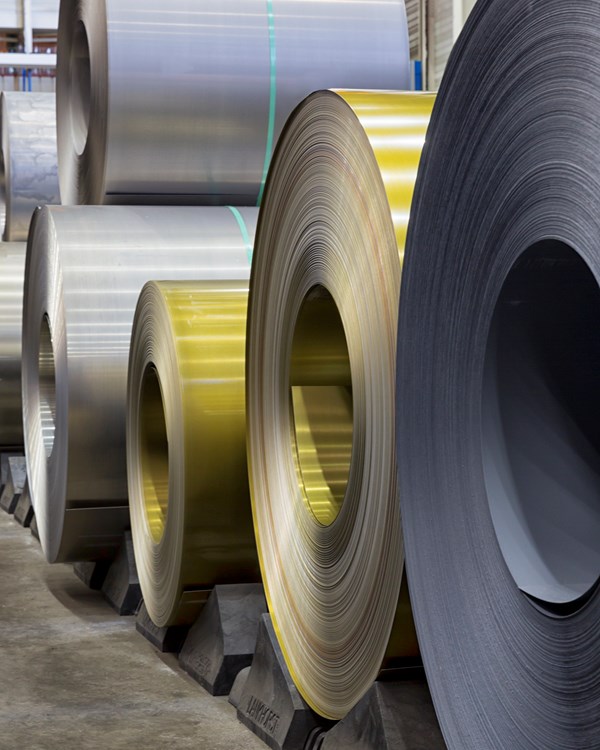
EU HRC prices inch up, demand remains low
Domestic prices for hot-rolled coil have inched up in Europe on July 4, although traded volumes remained limited due to slow demand.
Platts assessed domestic prices for hot-rolled coil in Northwest Europe up Eur5/mt on day to Eur685/mt ex-works Ruhr.
Deals for small lots of coil have been heard at Eur670-700/mt ex-works Ruhr. Market sources estimated achievable prices at Eur680-700/mt ex-works Ruhr.
Majority of the market participants believe that scheduled maintenances at some mills and unplanned production issues at other plants would support the domestic prices. But the availability reduction unlikely to be enough to result in substantial price recovery.
“Demand is quite low and EU mills strategy to motivate customers to buy on spot base with further discounts did not work so now they are trying to get higher prices,” a German service center source said.
European buyers have been showing limited interest in imported coil from Asia due to long lead times. In addition, spread between domestic and imported coil prices has not been wide enough to spur buyers’ interest.
Platts assessed prices for imported hot-rolled coil in Northwest Europe stable on the day at Eur625/mt CIF Antwerp July 4. Offers have been reported at Eur630-650/mt CIF Antwerp for the material from Asia and tradable values at Eur610-630/mt CIF Antwerp.
In South Europe, Italian mills have been aiming for higher prices, but continued to give discounts to secure sales in the slow market.
“Italian mills increased the offers, but it is a nominal rise, as the mills continue to sell at lower prices to generate cash flow,” an Italian trader said.
Platts assessed domestic prices for hot-rolled coil in South Europe at Eur650/mt ex-works Italy on July 4, up Eur5/mt on the day.
Tradable values have been heard at Eur640-650/mt ex-works Italy and unconfirmed deals at Eur680/mt delivered Italy.
Platts assessed prices for imported hot-rolled coil in the region at Eur620/mt CIF Italy on July 4, up Eur5/mt on the day.
Deals for the material from India have been reported at Eur620-625/mt CIF Italy and offers for the coil from Far East have been heard at Eur610-620/mt CIF Italy.
Platts is part of S&P Global Commodity Insights.
Author Maria Tanatar


Nordic developer Blastr, Cargill to work on iron ore pellets, steel sourcing
Norwegian developer Blastr Green Steel AS said July 4 it had signed a strategic framework agreement with US trading group Cargill to jointly develop Blastr’s supply of iron ore and pellets and sell low-carbon steel.
The terms build on Cargill’s support developing Blastr’s projects under an October 2022 memorandum of understanding, with the trader now committing $10 million in Blastr’s planned Series A financing round, the Lysaker-based start-up company said in statement. Blastr was set up in 2021 to pursue low-carbon steel led by a 2.5 million mt/year finished steel project, and backed by shareholder investment fund Vanir Green Industries. A final investment decision for the steel and pellet plants is due by 2025, the company website states.
Cargill and Blastr will finalize definitive agreements covering the areas included in the strategic accord over the next few months, Blastr added.
Cargill’s agreement covers the supply of iron ore feed to Blastr’s pellet plant, along with offtakes and sales of direct reduction pellets, hot briquetted iron (HBI) and low-carbon steel products. Further, Cargill will be involved in ferrous scrap sourcing, low-carbon shipping and logistics, along with supply of working capital and risk management services to Blastr, it said.
Cargill will work with Blastr across the supply chain and enable “the development of transparent certified supply chains,” along with supplying steel customers, growing the low-carbon steel segment, according to Lee Kirk, Cargill Metals’ managing director.
Cargill will support Blastr in developing and commercializing low-carbon steel products for the European market, it added.
Blastr said it is initially developing a 6 million mt/year DR-grade pellet plant in Gildeskal, Norway, and a 2.5 million mt/year direct-reduced iron plant and an electric arc furnace in Inkoo, Finland, with its own green hydrogen production, supporting a major reduction in primary ironmaking emissions compared to using coal-based fuel in blast furnace processes.
Blastr said it targets the potential to deliver more than a 90% reduction of Scope 1-3 C02 emissions per ton of steel.
“Cargill’s access to raw materials and end-customers, combined with innovative trading, shipping, and offtake solutions, bring us a giant leap forward in realizing green steel production at scale”, said Blastr CEO Hans Fredrik Wittusen.
Cargill is expected to consider regional and global sources of iron ore to meet quality requirements and available supply with the project’s timelines. Iron ore mines in Norway and Sweden, along with other sources may have suitable qualities with industry plans to grow high-grade supplies over the next few years. Regional iron ores are already used in several pellet plants. Usage for pelletizing may also depend on grinding capacity and pricing terms.
H2 Green Steel is seeking to develop a green DRI and EAF-based steel plant close to Lulea in northern Sweden, and is projected to start supplying material to markets earlier, with several sales accords with end-users. Cargill in June signed up to a multi-year agreement with H2 Green Steel for the supply of low-carbon steel. H2 Green Steel intends to secure supplies of DR pellets and feedstocks from the markets, with ferrous scrap also planned for usage.
Industry interest to secure low-carbon, or near zero carbon steel has increased in some sectors, with premiums and associated pricing establishing a market for certified steel demonstrating emissions reductions. Auto sector end-users and suppliers across flat and long steel, as well as service centers close to the industry, have signed up to available low-carbon steel supply and future volumes.
However, market observers note that European steel demand is not projected to grow materially to absorb additional supplies, after recent declines in consumption rates. Critics state new greenfield steel projects, including those which have not secured raw materials and energy needed and may be susceptible to volatile pricing risks, may put at risk existing European steel production and employment, as well as accelerating changes in the iron and steel industry. Steel users may increase exposure to plants with renewable energy supplies and utility market prices, as well as depend on growth in related wind and hydro generating capacity to support new DRI and EAF needs.
Author Hector Forster

Italian HRC producers seek higher prices, but buyers hold back
Producers of steel hot-rolled coil in Italy were pushing for higher prices but buyers were reluctant to accept increases, citing slow downstream sales, Fastmarkets heard on Tuesday July 4.Italian producers have increased their offer prices for August-September delivery coil, some of them by as much as by €50 ($55) per tonne, but these increases have not been consolidated in deals so far.
Offers from one integrated mill in the country were heard at €700 per tonne CPT (around €680 per tonne ex-works), while another integrated producer was aiming even higher, asking for €730 per tonne CPT (around €700 per tonne ex-works).
Offers from re-rollers were reported around €680-700 per tonne ex-works. But most buyers estimated a workable value at €640-650 per tonne ex-works, citing slow demand.
“We are trying to increase prices to our customers, but it might take us a couple of weeks to consolidate [these],” a steel-service center source told Fastmarkets. “[HRC] prices have been falling for quite a long time. Until recently, cut-to-length HR sheet was sold at €700 per tonne CPT in Italy.”
Fastmarkets calculated its daily steel hot-rolled coil index, domestic, exw Italy, at €657.92 per tonne on Tuesday, up by €7.92 per tonne from €650.00 per tonne on Monday.
The Italian index was also up by €11.93 per tonne week on week, although it was down by €22.08 per tonne month on month.
Import HRC prices have been stabilizing recently, with some suppliers looking for small rises of about €10-20 per tonne. Interest in overseas bookings has been limited recently due to stretched lead times. August-shipment material was sold out at most mills, while new offers were mainly for September-October shipments, which would mean November-December arrivals.
An HRC offer from Japan was reported at €630 per tonne CFR for September shipment, while smaller-volume transactions were reported at €620 per tonne CFR to Italy.
October-shipment HRC of Indian origin was offered to Italy at €600 per tonne. And a Vietnamese mill was offering €610 per tonne CFR for September-shipment HRC to Italy.
South Korean suppliers were out of the market. According to market participants, suppliers might have exceeded their quota volumes for the next quarter and therefore were not active.
Meanwhile, Fastmarkets’ daily steel hot-rolled coil index, domestic, exw Northern Europe, was calculated at €681.46 per tonne on Tuesday, up by €1.46 per tonne from €680.00 per tonne on Monday.
The latest calculation of the Northern European index was also up by €9.46 per tonne week on week but was down by €55.62 per tonne month on month.
Firm offers were rare in the region, with most integrated mills taking a “case by case” approach.
Buyers’ estimates of tradeable values were heard between €670 and €700 per tonne ex-works, with transactions for smaller tonnages reported at €670-680 per tonne ex-works.
Some sources suggested that producers would follow the Italian mills and try to increase prices in the spot market, especially given the outcome of long-term contract negotiations.
“Contracts [for the second half of the year] with automotive [manufacturers] were settled at €800 per tonne, similar to first-half levels. But this is significantly above the current spot market, so a logical step for the mills would be to push for a rise,” a distributor said.
But buyers doubted the likely success of such a move, given the slow demand from end-users.
“It would make sense for mills to take small steps [in terms of price rises],” a second steel-service center source said. “Market conditions are not good for a massive price rise. Maybe some upward correction would be possible during July restocking, but that’s all.”
Most sources agreed, however, that HRC prices were unlikely to decline, so a rollover or an upward correction were equally possible for July.
Published by: Julia Bolotova


Niedax sources CO2-reduced steel from Tata UK
Niedax, a producer of cable protection systems, has started sourcing and processing certified Optemis Carbon Lite steel from Tata Steel UK.
This week, the first coil was delivered to the steel centre in Schwerte, Germany operated by Niedax subsidiary Boecker Stahl-Service GmbH, Kallanish learns from Niedax. The maker of cable tray systems from steel sheet received hot-dip galvanized coils of 22 tonnes. It informs that CO2 emissions in the production of material were reduced by 85% in the course of an independently certified in-setting process.
The CO2-emission-reduced steel enables Niedax to manufacture cable management systems for large infrastructure projects in its own steel service centre with a significantly more favourable carbon footprint, it says. In the coming weeks, the Niedax Group expects further deliveries of Optemis Carbon Lite steel.
Anil Jhanji, chief commercial officer of Tata Steel UK, calls the partnership “with a leading international company like Niedax an important step on our journey to carbon-neutral steel”. Niedax chief executive Bruno Reufels adds: “We are already registering initial interest from consumer-related sectors such as the construction and automotive industries.”
Christian Koehl Germany

Schäfer Werke acquires service centre OKS
German service centre Schäfer Werke, headquartered in Neunkirchen in North Rhine Westphalia’s Siegerland region, has acquired OKS Otto Knauf GmbH in Iserlohn from Fidelium Partners.
OKS Otto Knauf is an independently operating steel service company with over 100 employees. Founded in 1952, the business gradually developed into a modern steel service centre, Kallanish learns from the new owners. OKS operates high-performance slitting lines, processing several hundred tonnes of steel annually into precise dimensions, achieving a turnover of approximately €95 million ($104m).
After its acquisition by Fidelium from Stemcor in 2017, OKS was able to reposition itself and return to profitable growth. After the OKS takeover, Fidelium introduced an extensive series of successful optimisation measures.
The 100% family-owned Schäfer Werke operates globally with diversified business areas: EMW Steel Service Centre, perforated sheets, container systems and IBCs, as well as IT and interior systems.
As one of Europe’s largest independent steel service centres, EMW works coils, slit strip, cut-to-size and circular blanks at its two locations, in Neunkirchen (North Rhine-Westphalia) and Treuen (Saxony). It has more than 220,000 tonnes of thin steel sheet permanently in stock.
The takeover will expand Schäfer’s service portfolio, as OKS has an extensive range of machinery, as well as a highly skilled and experienced workforce, Schäfer notes. It processes carbon and stainless steels as well as aluminium in thicknesses from 0.25-16mm. For EMW, the takeover brings additional storage capacities. The coil warehouse holds 60,000t and the finished material warehouse can store 15,000t of slit strip.
Christian Koehl Germany

H2GS signs €1.5 billion deal with ZF
H2 Green Steel (H2GS) has signed a seven-year binding agreement with ZF to deliver zero-emissions steel to one of the biggest suppliers to the automotive industry globally starting from 2026.
ZF directly and indirectly processes around 2.5 million tonnes/year of steel. This agreement covers a significant share of ZF’s yearly steel volumes, making it strategically important in the company’s efforts to decarbonise its operations, H2GS says.
ZF aims to be climate neutral by 2040, including value chain emissions. The agreement, valued at €1.5 billion ($1.63 billion), is expected to reduce CO2 emissions by close to 2.3mt compared to traditional steelmaking processes.
“No one can fight climate change alone, but teaming up with partners, we can achieve a lot. H2 Green Steel is a good example of startups working together with established players to drive change faster than the incumbent industry has managed. For ZF, this is a strategic agreement in our significant efforts to reduce CO2 emissions from our supply chain,” ZF board member Stephan von Schuckmann says in a note seen by Kallanish.
“This is a true milestone contract for H2 Green Steel, not the least because of its size. ZF’s role in the automotive ecosystem is undeniable and they are a true partner to us where we also see potential to move into other regions, like North America,” says H2 Green Steel chief executive Henrik Henriksson.
ZF, with 165,000 staff across 32 countries, is a global technology company supplying mobility technology for passenger cars, commercial vehicles and other industrial applications.
Adam Smith Poland

Trial for Celsa control begins in Spain
The Celsa ownership saga has entered its final phase. The restructuring plan for the Spanish steelmaking group’s debt of €2.8 billion ($3.05 billion) presented by some creditors was submitted to court in Barcelona on Monday, Kallanish notes. The hearings will last until next Tuesday.
During the first day of the trial, the creditors, who represent 90% of the jumbo debt and 89% of the convertible debt, contended that their restructuring plan is based on creating an independent board of directors and a new financial scheme. This includes investment funds taking over 100% ownership of the Rubiralta family-owned steelmaker due to the progressive loss of confidence in the current shareholders.
“Our plan provides a comprehensive solution to Celsa’s financial situation, reducing its indebtedness by €1.29 billion [$1.4 billion] through the capitalisation of the convertible debt and part of the jumbo debt,” Álvaro Fabián, representative of Celsa creditor SVP Global, explained to the judge. The proposal also foresees a five-year extension of the maturity date for the remainder of the liabilities, as well as maintaining Celsa’s operations centres in Spain and employment across the entire group.
Celsa, meanwhile, maintains that the creditors do not ensure the viability of the company. “The business project of the creditors would not ensure the continuity of Celsa, and the restructuring would plunge the company into uncertainty that can lead to disaster since the intention of the funds is to sell some assets when they can,” said Celsa vice president Francesc Mesegué. “Their proposal goes against the vision of the current Celsa Board, which is managing a ten-year transformation plan.”
Celsa is the largest private industrial group in Spain, with its main steelmaking activities near Barcelona and in the north of the country. Outside Spain, the group produces steel in France, the UK, Norway and Poland.
Todor Kirkov Bulgaria