

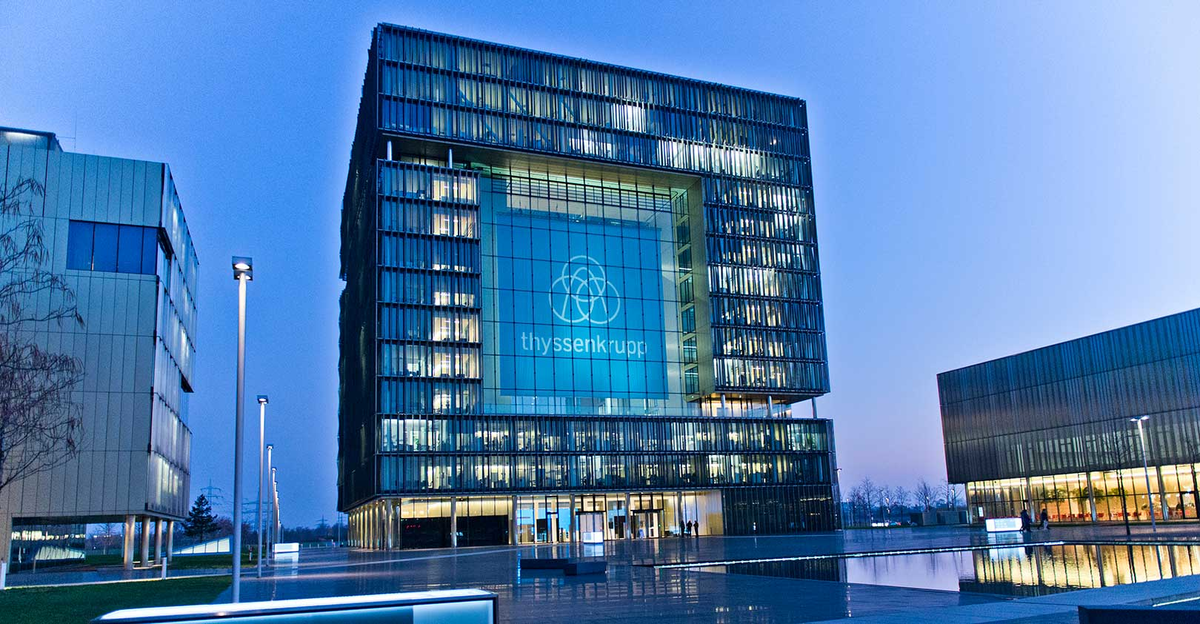
Thyssenkrupp invests in Rotterdam terminal operations
Thyssenkrupp Steel says it has lined up a mid-double-digit million euro sum to be invested in modernising terminal operations at Ertsoverslagbedrijf Europoort C.V. (EECV) at the Port of Rotterdam.
An old ship unloader will be replaced by a new state-of-the-art unit, strengthening the future of EECV and thyssenkrupp Veerhaven, Kallanish learns. The new unloader is expected to be operational by the end of 2025.
Tk Steel says the investment is underlining its commitment to a modern infrastructure in the Port of Rotterdam, and sustainable supplies to tk Steel’s mills and Hüttenwerke Krupp Mannesmann (HKM) in Duisburg.
“The project sends a strong signal for the future of EECV and thyssenkrupp Veerhaven, the two Dutch logistics subsidiaries of thyssenkrupp Steel,” the company states. The two companies will ensure the unloading of seagoing vessels and the interim storage and transport of around 24 million tonnes of iron ore and coal for steelmaking in Duisburg.
Like its predecessor, the new ship unloader weighs around 2,000 tonnes, stands a good 60 metres high, 30m wide and has a crane boom length of around 100m. With these crane dimensions, EECV will be able to unload the largest bulk freighters in the world at a highly productive rate of up to 2,600t of iron ore per hour.
Christian Koehl Germany


Polish steel wire rod prices slightly down amid lack of activity; rebar slightly up on restocking
Wire rod
Polish mills continued pushing for higher prices in the assessment week. Thus, the offers for domestic steel wire rod (drawing quality) varied between 2,900 and 3,000 zloty ($659-682) per tonne CPT. According to market sources, those levels were not workable, and no major trading at such levels was heard.
“Consumption remained comparatively weak, and market activity was low,” a trading source told Fastmarkets. According to that source, deals were concluded at about 2,850 zloty per tonne CPT, but only for small tonnages.
A producer source estimated achievable prices for wire rod in Poland at 2,800-2,850 zloty per tonne CPT. The source confirmed that sales were comparatively slow this week after the more active restocking in mid-September.
“New restocking can be expected in October, and then slowdown in November again. This, combined with [a Polish local producer’s] decision to stop for maintenance in October, will stabilize prices [for wire rod],” the mill source said.
As a result, Fastmarkets’ weekly price assessment for steel wire rod (drawing quality), domestic, delivered Poland was 2,800-2,900 zloty per tonne on Friday, widening downward by 50 zloty per tonne from 2,850-2,900 zloty per tonne in the previous week.
The assessment was based on deals, the lower end of offers and market participants’ estimations of achievable values.
Drawing-quality wire rod offers from Germany to Poland were heard at about €610 ($643) per tonne CPT.
One Ukrainian mill was offering mesh-quality wire rod to Poland at about €590 per tonne CPT.
Rebar
Polish domestic rebar was offered by local mills at about 2,850 zloty per tonne CPT, which equates to about 2,830 zloty per tonne ex-works, in the week to Friday September 29.
However, according to a distributor source, the bids for at least few hundred tonnes of rebar were seen between 2,750 and 2,770 zloty per tonne CPT, which nets back to about 2,730-2,750 zloty per tonne ex-works.
“After [mid-September] there was a spur of buying — now it can be seen it was mainly restocking. Demand from construction is better than a month ago, but it’s not enough to hold the current [rebar] prices on the market for long,” a trading source said.
A consumer source said during the assessment week that deals for rebar in Poland were concluded at about 2,780 zloty per tonne CPT, or about 2,760 zloty per tonne ex-works.
As a result, Fastmarkets’ weekly price assessment for steel reinforcing bar (rebar) domestic, exw Poland was 2,730-2,830 zloty per tonne on Friday, up by 10-20 zloty per tonne from 2,710-2,820 zloty per tonne the week before.
Despite improved buying, the availability of rebar in the domestic market was expected to be reduced in October due to a one-month maintenance stoppage at one of the key producers in Poland.
Therefore, sources expected rebar prices in Poland to flatten in October, although the downtrend could resume in November, with end-user demand unlikely to rebound due to seasonality.
Import offers for rebar to Poland were reported at about €610 per tonne from Moldova and Italy.
According to market sources, the high euro exchange rate versus the Polish zloty was making rebar imports uncompetitive for Polish buyers. Notably, €1 was traded at 4.63 zloty on September 29, according to the online currency converter Oanda.com. The Polish zloty was traded at 4.62 zloty to €1 on September 22, compared with 4.48 zloty to €1 on September 1.
Published by: Julia Bolotova, Darina Kahramanova


Acciaierie d’Italia launches low-carbon steel brand
Italian steelmaker Acciaierie d’Italia (ADI), the joint venture between state company Invitalia and ArcelorMittal, has launched its own low-carbon steel brand called “Penisola Steel”. The steelmaker held last week a commercial roadshow called “Steel Commitment, Primary” in Taranto, attended by 500 companies, to get closer to its clients and gain market share.
The new brand defines the low-carbon steel produced at the Taranto steelworks thanks to the completion of the 2018-2023 environmental plan supported by the government and its private sector partner, Kallanish learns from ADI.
According to a study conducted by research institute SWG, 74% of companies interviewed in Italy believe that paying attention to sustainability is key, a higher figure than that of some other countries. 40% of consumers prefer sustainable steel products while 30% are ready to pay a premium for certified low-carbon products.
As for the next steps, “the main pillars are the environmental optimisation of the hot-end area, the electrification of the area itself – with the introduction of DRI technologies – and the development of a series of new energy plants, including a regasification and desalination plant, facilities for the synthesis of industrial gases, offshore wind farm and photovoltaic parks,” environmental director Alessandro Labile said during last week’s event.
He added that Taranto’s most important asset is the new research and development centre, which benefits from €12.5 million ($13.1m) investment with the support of 15 laboratories and 40 employees including researchers and technicians.
In collaboration with engineering and certification entity RINA, ADI has started a constant monitoring and certification platform for the capillary analysis of water, soil and other equipment.
Natalia Capra France
Macquarie cuts EU forecast amid recession, manufacturing deterioration
Macquarie has cut its EU crude steel production forecast for 2023 to a 2.3% on-year decline, followed by a 5% on-year rebound in 2024.
A eurozone recession likely commenced in the third quarter, with the downturn in the manufacturing sector having broadened, plus consumer services activity slowing, the financial services firm observes.
The manufacturing PMI has fallen below the levels seen during the euro crisis in 2011/12 and indicates there is still further for manufacturing gross value added to fall in the months ahead, negatively impacting steel demand, Macquarie says in a report sent to Kallanish.
Import arrivals into Europe have also picked up, especially from Asia, putting pressure on domestic prices. In July, EU hot rolled coil imports were up 88% on-year.
Interest among EU buyers in making new import orders has however fallen in recent weeks due to uncompetitive offers, as well as expectations that new safeguard quota availability will be very limited in the fourth quarter of 2023 and Q1 2024 (see Kallanish passim).
Macquarie expects European steelmaking margins to remain weak into next year. Its forecast of a lower iron ore price should help margins of blast furnace/oxygen converter-based steel producers to an extent. However, the firm expects coking coal to fall from spot but average higher in Q4 than in Q3, and scrap prices to average flat from spot levels in Q4. Scrap is now cheap relative to hot metal, but a fall in iron ore prices should bring them back in line, Macquarie points out.
Adam Smith Poland

Křetínský seeks 50% thyssenkrupp Steel stake: reports
Thyssenkrupp is about to sell a stake of 50% in its tk Steel unit to Czech billionaire Daniel Křetínský, German media reports.
Over recent months, Křetínský was heard to have emerged as an investor candidate in tk Steel (see Kallanish passim). Only some weeks ago, thyssenkrupp steel chief executive Bernhard Osburg was quoted as saying he is open to any investor who contributes to the strength of a major stakeholder. He said he especially welcomes investors with expertise in industries like steel or energy.
According to business daily Handelsblatt, talks have matured to the point that the size of a stake – 50% – has been revealed by people familiar with the matter. The new ceo of thyssenkrup AG, Miguel Lopez is pressing on with the negotiations, and a deal could reportedly still be finalised this year.
Another daily, WAZ, writes that the rumour has been received with dismay by union IG Metall, which called the plan a sell-out driven by Lopez.
When contacted by Kallanish, thyssenkrupp declined to comment on the rumours, but confirmed its efforts for the deconsolidation of the steel business.
Christian Koehl Germany