

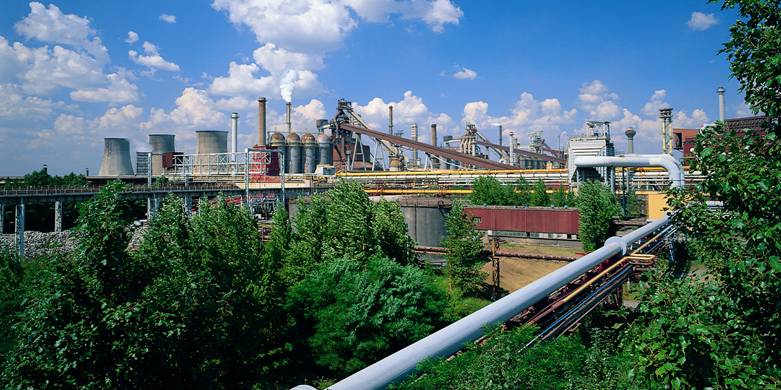
ArcelorMittal Poland closes coke production for good
ArcelorMittal Poland (AMP) has decided to close the remaining coke battery at its Krakow plant after the hoped-for rebound in steel demand did not materialise.
The firm idled the coke battery last November due mainly to weak demand, but also the narrowed differential between coke and coking coal prices (see Kallanish passim).
The hot idling allowed for the battery to be restarted once market conditions improve, but “unfortunately, that didn’t happen”, says AMP chief executive Wojciech Koszuta. “Keeping a battery hot idled is very costly, mainly due to the cost of the natural gas that we use to fuel the facility. The continued hot idling of the battery in the hope the situation will improve is economically unviable.”
Moreover, decarbonisation plans in various sectors in the coming years will result in the gradual decline of coke demand, the firm adds.
The firm found work at other AMP units for 230 of the affected coke plant employees during the hot idling. The remaining 70 workers that have maintained the coke plant since then will receive offers to transfer to other units.
AMP’s crude steel production sunk to just 3.1 million tonnes in 2023, down 9% on-year. This represents a drop exceeding 2mt over the last five years. Production has been gradually declining following the closure of AMP’s Krakow blast furnace in 2020, weakening European steel demand, imports’ increased share in consumption, and uncompetitive production costs in Europe.
The Krakow plant sources slab from AMP’s flagship Dabrowa Gornicza works to feed its hot and cold rolled coil mills, as well as galvanizing and coil painting lines. It also plans to commission a line for zinc, aluminium and magnesium (ZAM) coil coating in 2025.
Adam Smith Poland


Italian rebar prices remain unchanged, activity slow
Italian rebar prices showed little change last week after experiencing a decrease earlier in July. The low end of the transaction price range has nevertheless once again decreased, by €10/tonne ($10.8), due to low consumption downstream, Kallanish notes.
Activity is decreasing as the August break approaches. Sources indicate July sales volumes have been disappointing.
Transaction values in the domestic market fall within the range of €320-340/t base ex-works, or €580-600/t ex-works effective. This includes an average of €260/t for additional size extras.
Domestic mesh is also hovering at around €420-440/t base ex-works. When considering their purchases, buyers should take into account costs for transport and an extra €300/t for size extras.
Meanwhile, scrap prices in Italy have seen an average decrease of €25/t in July. According to sources, the railway and warehouse construction sector is currently driving rebar demand.
Natalia Capra France

Post-summer price direction unclear for European HRC market: sources
Fastmarkets calculated its daily steel hot-rolled coil index domestic, exw Northern Europe at €628.58 ($686.37) per tonne on Friday, up by €0.45 per tonne from €628.13 per tonne on Thursday July 18.
The index was down by €3.55 per tonne week on week and by €2.30 per tonne month on month.
Integrated mills in the region were reportedly selling HRC with lead times of four to five weeks at €620-640 per tonne ex-works, while offers were in the range of €625-650 per tonne ex-works for such material.
A German integrated mill was selling HRC with lead times of four weeks at €625 per tonne ex-works, sources said.
For HRC with lead times in October, a supplier in the Benelux area voiced offers at €660 per tonne ex-works, compared with €640-650 per tonne ex-works for August to September delivery coil.
Another major European mill was looking to achieve €670 per tonne ex-works for HRC with September-October lead times.
Higher offers have not yet turned into deals, sources said.
“That is [a typical] tactic of the European mills — to push offers up, expecting trading to pick up after summer break. However, it doesn’t seem likely that the market will be ready for higher prices, since consumption doesn’t show any signs of a rebound,” a German buyer said.
In Southern Europe, Fastmarkets calculated its daily steel hot-rolled coil index domestic, exw Italy at €620.42 per tonne on Friday, stable day on day.
The index was down by €5.58 per tonne week on week and by €7.71 per tonne month on month.
The Italian market was also seasonally quiet, and prices were largely unmoved, but sources said that local integrated mills were also aiming for post-summer price rises.
“All activities are muted — it’s a holiday season in Europe,” an Italian buyer said. “There is talk of a €20 per tonne price rise [for HRC] from [a local supplier] for September, but it’s too early to say what market would look like after the holidays.”
In the week to Friday, HRC with lead times of four to five weeks was still being offered by a local supplier at €640-650 per tonne delivered, which corresponds to €630-640 per tonne ex-works.
Buyer sources estimated achievable prices at no higher than €610-620 per tonne ex-works, with sporadic trades reported at €620 per tonne ex-works in the week to Friday.
Offers of HRC from Turkey were available at €600-610 per tonne CFR, including the anti-dumping duty.
Published by: Julia Bolotova


European HRC prices hold largely stable amid continued demand slump
The domestic prices for European hot-rolled coil were largely stable July 19, as demand for the summer ahead remained weak and supply levels high. Opinion on price recovery continued to be mixed.
“Ever since March, things got very bad,” a service center source said. “There is no optimism [in the market].”
“I don’t think prices will go down anymore,” another service center source said. “If mills fail to raise prices, then the year will be lost.”
Sources said that most of the service centers and stockholders currently operating in the market are well-stocked, and therefore do not need to buy any material in the near term.
Market sources also noted that, due to the new safeguard measures and the potential prolonged holiday period for mills, lead times for delivery might increase, adding to overall concerns around the European flat steel industry.
“I am worried about the industrial situation in Europe,” a service center source said. “We are not competitive any longer.”
Platts assessed Northwest European HRC at Eur625/mt ex-works Ruhr July 19, up Eur5 on the day. Tradable values were reported at Eur620-630/mt EXW Ruhr.
Meanwhile, Platts assessed domestic HRC prices in Southern Europe stable on the day at Eur625/mt EXW Italy July 19. Tradable values were reported at Eur620-630/mt EXW Italy, and offers were reported at Eur630-640/mt EXW Italy.
Geraint Moody | Devbrat Saha


EU car sales rise in June, but construction activity dips
EU June auto registrations up 4.3% on year
New passenger car registrations in the European Union in June increased 4.3% year on year to 1.1 million units, largely driven by gains in Germany, Italy and Spain, European Automobile Manufacturers Association (ACEA) data showed.
Italy, Germany and Spain recorded respective year-on-year growth of 15.1% to 159,982 units, 6.1% to 297,329 units, and 2.2% to 103,357 units, while France was the only major market that saw a decline, of 4.8% to 181,709 units.
That meant new car registrations in the first half of 2024 were up 4.5% to 5.7 million units, the ACEA said, but remained 18% below pre-pandemic levels.
EU construction dips
In the EU, seasonally adjusted production in construction decreased by 1.0% in May from April, according to first estimates from Eurostat, the statistical office of the EU.
Among member states for which data was available, the largest monthly decreases in production in construction were recorded in Czechia (-5.1%), Romania (-4.1%) and Hungary (-3.8%).
On the other hand, the highest increases were observed in Finland (+1.9%), Bulgaria (+1.1%) and Belgium and Spain (both +0.3%).