

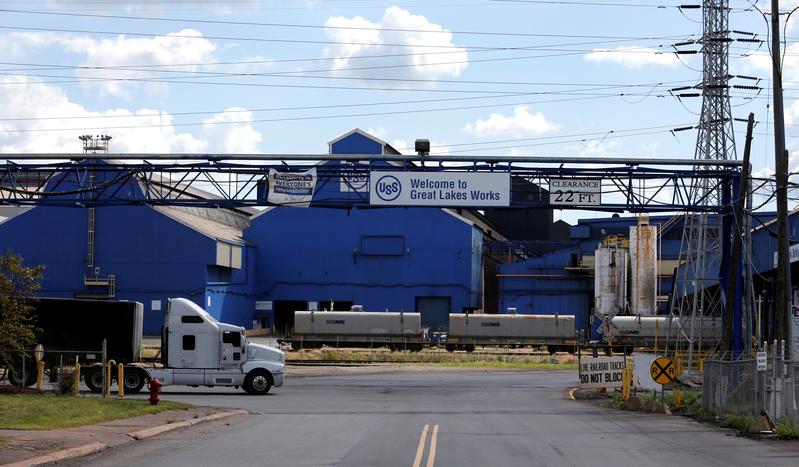
Nippon Steel to ‘heavily invest’ in US Steel rather than acquire it: Donald Trump
Trump said the agreement will preserve American ownership of US Steel and will help the iconic company benefit from Japan’s steelmaking expertise.
“US Steel is a very important company to us. It was the greatest company in the world… 80 years ago, and we don’t want to see that leave. It wouldn’t actually leave, but the concept, psychologically, not good,” Trump said.
“They’ve agreed to invest heavily in US Steel as opposed to own it, and that’s very exciting,” he added.
Prime Minister Ishiba said Japan will invest $1 trillion in the US but provided no indication of how much Nippon Steel might invest in US Steel.
“They’re doing it as an investment, no longer a purchase. I didn’t want it bought, but investment I love,” Trump said.
“And we’ll meet with the head of [Nippon Steel] next week, a very great company, and they’ll work out the details and I’ll be there to help mediate and arbitrate,” Trump said.
LNG shipments
As part of the agreement between the US and Japan, President Trump pledged to begin shipments of liquefied natural gas (LNG) via a new pipeline in Alaska, a move he touted for also being able to bring trade between the two nations closer to an equal balance and away from Japan’s long-standing trade surplus.
The 807-mile proposed pipeline Alaska LNG would connect natural gas reserves in Northern Alaska to Nikiski for export, according to project developer Alaska Gasline Development Corporation (AGDC).
Assuming a standard 0.5-inch wall for the 42-inch line pipe specified for the 807-mile line, that means the line would consume about 472,577 short tons of steel.
Fastmarkets last assessed equivalent product steel ERW line pipe (X52), fob mill US at $1,250-1,300 per short ton on January 8.
The total steel value of the line, then, could range around $590 million-614 million.
Trump issued an executive order on January 20 requiring the federal government to prioritize the development of the Alaska LNG pipeline.
“Alaska LNG will annually strengthen the US balance of trade by approximately $10 billion, create thousands of jobs, and eliminate up to 2.3 billion tons of carbon emissions over the project’s 30-year authorization,” AGDC president Frank Richards said after the order was issued.
Market chatter
A steel distributor supported Nippon Steel’s potential investment as a positive for the company and the US.
“I have no doubt that Nippon is committed to making US Steel a success. They definitely need all that Nippon has to offer,” the distributor said.
“It’s unfortunate that a foreign entity needs to be the one that [invests in] US Steel, but if that’s the only offer, it needs to be allowed so they can be a continuing company,” they added.
Nippon Steel’s investment in US Steel is by no means a sure thing, the distributor said.
“Trump being the businessman and dealmaker, he may be able to get a couple [American] steel companies interested and broker a deal to have them buy US Steel instead,” they said.
United Steelworkers (USW) union president David McCall issued a statement reiterating opposition to any Nippon Steel investment in US Steel.
“While we await the details of the proposed investment, we encourage President Trump to continue safeguarding the long-term future of the domestic steel industry by instead seeking American alternatives,” USW stated.
Nippon Steel’s proposed $15 billion acquisition of US Steel was blocked by former President Joe Biden due to national security concerns in January, and the Committee on Foreign Investment in the United States ruled that the order blocking the deal would not be effective until June 18 to give Japan a chance to appeal it in court.
Alesha Alkaff in Boulder, Colorado, contributed to this story.

EU industry cautious over rebound, awaits policy rescue
Big European steel industry names have offered a glimmer of hope for the demand outlook in recent days, but tempered expectations for 2025, Kallanish notes. In any case, the industry’s health will depend heavily on anticipated European Commission measures.
ArcelorMittal said it expects higher apparent demand on-year in 2025 amid low inventory levels, especially in Europe. The group’s expectation of restocking throughout 2024 did not materialise, however. Chief executive Aditya Mittal also cautioned that EU measures to support industry will be critical this year. The European Commission is due to publish its Clean Industrial Deal later in February. A specific action plan for the steel industry is also eagerly being awaited.
European steelmakers’ association Eurofer said the Commission initiatives “will determine the future of the EU steel industry”.
ArcelorMittal’s European operations saw sales and Ebitda drop 5% and 18% respectively on-year in 2024 to $29.95 billion and $1.62 billion, despite a 4% rise in steel shipments to 28.66 million tonnes, driven by flat products.
Eurofer said EU apparent steel demand should recover 2.2% in 2025 but only provided the industrial outlook improves and global tensions ease. This is also down from its forecast in October of a 3.8% rebound this year. The firm steadily revised down its 2024 demand growth projection throughout last year.
Economic uncertainty will continue to take its toll in the coming quarters despite monetary easing by the European Central Bank, it added. Energy prices, weak manufacturing and geopolitical tensions continue to weigh on activity.
US Steel, which owns the major flat steelworks in Kosice, said it expects slightly improved results in Europe in the first quarter, but pressure will remain from challenging pricing and demand conditions.
Tata Steel, which owns the IJmuiden and Port Talbot steelworks, pointed out that despite the European Central Bank reducing interest rates significantly, concerns persist about inflation and energy costs in Europe.
Adam Smith Poland


Steel becomes object of politics in Germany
Chancellor Olaf Scholz of the Social Democrats (SPD) has paid a visit to thyssenkrupp Steel in Duisburg, shortly before German voters are called upon to elect a new national government.
The visit is seen as a reaction to earlier remarks by Scholz’s adversary, Friedrich Merz, which were interpreted as a dismissal of the idea of “green” steel. Merz, the Christian Democrats (CDU)’s candidate for chancellor, questioned the economic feasibility of the energy transition in view of a lack of affordable energy. He was attacked by several political commentators and subsequently clarified he was not questioning the transition in general.
“Following the doubts expressed by Friedrich Merz … Olaf Scholz found clear words in Duisburg for the future of steel in Germany,” an SPD press release reads. Scholz was cited as saying that “the transition must be enforced, [so that the industry is enabled] to deliver [a new steel product] in time.”
While most of Scholz’s statements were foreseeable, reiterating positions expressed earlier, one tangible detail concerned framework conditions that must be improved. Scholz declared that electricity grid fees – the factor most hurting manufacturing industries in Germany – must be capped, and that this is part of SPD’s programme. The party notes that the visit took place following an invitation from tk Steel’s works council – a detail not mentioned in the company’s official press release about the visit.
In subsequent commentaries in the German press, the visit was largely seen as business as usual in the run-up to elections. One commentator quipped that Scholz “is positioning himself as a steel chancellor, although he was not much of one during his years in office.”
Christian Koehl Germany

Trump will impose 25% tariffs on Steel and Aluminum
The US president said he planned sweeping tariffs on all steel and aluminum imports on Monday and would take other action to even out tariff rates with the rest of the world later this week.
Donald Trump has said he will announce new 25% tariffs on all steel and aluminum imports into the US on Monday that would affect “everybody’, including its largest trading partners Canada and Mexico, in another major escalation of his trade policy overhaul.
Trump’s pre-announcement came as China’s retaliatory tariffs, announced last week, came into effect. The measures target $14bn worth of products with a 15% tariff on coal and LNG, and 10% on crude oil, farm equipment and some vehicles.
The US president, speaking to reporters on Air Force One on Sunday, also said he would announce reciprocal tariffs – raising US tariff rates to match those of trading partners – on Tuesday or Wednesday, which would take effect “almost immediately”. “And very simply, it’s, if they charge us, we charge them,” Trump said of the reciprocal tariff plan.
The move on steel and aluminum brought a swift reaction from Doug Ford, the premier of the Canadian province of Ontario, who accused the US president of “shifting goalposts and constant chaos” that would put the economy at risk.
Monday’s tariffs would come on top of existing metals duties.
Amid wider pushback against Trump’s economic heavy-handedness, French President Emmanuel Macron warned in an interview broadcast on Sunday that he was willing to go “head-to-head” on tariffs with the US president. “I already did so, and I will did (sic) it again.”
Macron told CNN that the EU should not be a “top priority” for the US, saying: “Is the European Union your first problem? No, I don’t think so. Your first problem is China, so you should focus on the first problem.”
Macron said tariffs would harm European economies but also the US, given the level of economic ties. “It means if you put tariffs on a lot of sectors, it will increase the costs and create inflation in the US. Is it what your people want? I’m not so sure,” he said.
He said the EU must be ready to react to US actions, but stressed that the 27-nation bloc should mainly “act for ourselves”. “This is why, for me, the top priority of Europe is competitiveness agenda, is defence and security agenda, is AI ambition, and let’s go fast for ourselves.
“If in the meanwhile, we have [a] tariff issue, we will discuss them and we will fix it.”
Trump has long complained about the EU’s 10% tariffs on auto imports being much higher than the US car rate of 2.5%. He frequently states that Europe “won’t take our cars” but ships millions west across the Atlantic every year.


Flat steel spot prices in Romania stable but trade slow
Despite the weakness that has been present in the market for some time, Romanian flat steel traders have kept prices stable week on week.
On the other hand, according to reports, the sole domestic flat steel producer has yet to begin production, although offers and sales are still heard for March shipment. However, according to market speculation, the sole flat steel producer is still facing economic challenges and delays in completing deliveries despite receiving government assistance.
Currently, prices for domestic origin hot rolled coil (HRC) in Romania have remained stable week on week at €590-600/mt CPT. Likewise, traders’ prices for hot rolled sheets (HRS) and cold rolled sheets (CRS) have remained unchanged week on week at €725-750/mt ex-warehouse and €835-850/mt ex-warehouse, respectively.
Meanwhile, while no new import deals have been announced, HRS and CRS offers from Ukrainian suppliers have remained stable week on week at €650-660/mt DAP and €740-750/mt DAP, respectively. Turkish mills, on the other hand, have raised their offers somewhat compared to last week, with FOB prices ranging from $530 to 540/mt, freight costs of roughly €25/mt, coming to Romania at around €535-545/mt CFR.
