


Challenges remain in European steel market as tariffs can put further pressure: thyssenkrupp
The second largest European steel producer, thyssenkrupp, said on Feb. 13 during its Q1 of the fiscal year 2024-2025 (period from October to December) that the market environment remains challenging due to uncertainties about future global economic growth and US new steel tariffs imposed by President Trump adding potential further headwinds.
In today’s press call CFO thyssenkrupp Jens Schulte, said that there could be secondary effects if, as a result of the US tariffs, cheap steel from other countries, such as China, were to be pushed onto the European market. “This would further increase price pressure in Europe. However, a reliable estimate of this effect is not yet possible, as the newly announced tariffs have not yet come into effect,” Schulte said.
As things stand at present, the tariffs announced on imports to the US would have only a very limited impact on thyssenkrupp’s business. This applies in particular to the announced tariffs on steel, which the company confirmed to S&P Global Commodity Insights in a separate e-mail reiterating what was said in the analyst’s call.
“Europe is the main market for thyssenkrupp’s steel. The export of steel products from thyssenkrupp Steel Europe to the USA is negligible and mainly concerns high-quality products with a good market position. The majority of thyssenkrupp’s sales in the US come from the trading business (tk Materials Services) and the automotive supply business (tk Automotive Technology). In principle, thyssenkrupp is well positioned in these businesses in the US with a significant share of local manufacturing for the local market. Much of the production for US customers takes place within the US. This focus on local production minimizes the risk of possible tariff risks and similar regulatory changes,” the company said adding that it continues to monitor developments very closely and is constantly analyzing possible scenarios of import tariffs and their impact on our businesses.
In Q1 the steel division reported a decline in sales by 11%, attributed primarily to lower spot-market price levels across all customer segments. Shipments decreased significantly, particularly in the automotive and industrial sectors, although there was some offsetting demand in packaging steel and grain-oriented electrical steel. The overall topline was negatively impacted, yet the division benefitted from significant positive effects, including compensation for electricity prices and further cost advantages, particularly in raw materials.
the company did not disclose the shipment and the crude steel tonnages in details when asked. In the fiscal year 2023-24 thyssenkrupp produced 9 million mt of crude steel, sightly below the 9.4 million mt produced in FY2022/2023.
The company is finalizing its business plan for Steel Europe and sees a 50/50 JV with EPCG as the logical next steel to the independence of Steel Europe.
Green transformation is being implemented with the 2.5 milion a year DRI plant under construction and with the company that signed a MoU with Volkswagen for the supply of CO2-reduced bluemint Steel from the planned DRI plant.
During the call with analysts, the Ceo underlined again the current company view which is the need to start production of the DRI using natural gas. “For the time being, the cost of green hydrogen is not competitive so there is a clear indication that we need to start the whole thing, as I said, with gas,” he said. “Of course, we are very committed to this project. But of course, it needs to be also monetized, and it will be then effective if we are using gas in the beginning as long as we have not competitive pricing for the green hydrogen,” the Ceo said.
Platts, part of Commodity Insights, assessed hot-rolled coil in Northwest Europe at Eur600/mt ex-works Ruhr February 12, up Eur5 on the day, since the beginning of the year HRC prices moved up by Eur40/mt. In the last quarter of 2024, HRC prices moved sideways to Eur550-560/mt base ex-works to the lower level of 2024.

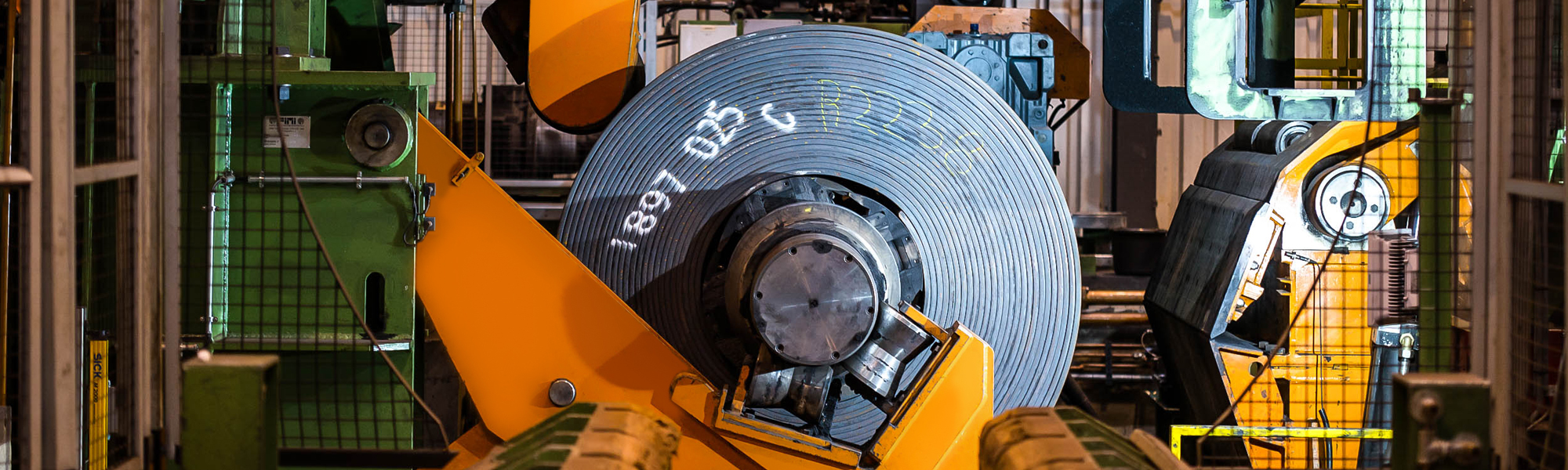
Italian re-rollers increase prices on expensive coils
Italian re-rollers are cutting back their discounts and planning to halt sales in response to recent price hike announcements from European hot rolled coil producers, according to industry sources.
In Italy, tube discounts are starting to decline. According to one re-roller, he is at 45 points and unwilling to go below this level. Nonetheless, the level of 47 points is still available in the market. A number of tube suppliers, steelmakers and service centres who spoke to Kallanish agree that HRC, tubes, and sheets will see significant price increases in the near future.
Europe is anticipated to strengthen its defences by granting some of the most recent safeguard review requests from Eurofer following the recent US tariff announcement.
“Now, a new phase is beginning,” a re-roller source remarks, “we must embrace it and learn to control the new macrotrend that will involve higher steel prices and a new management of the supply chain that will be strongly impacted by the additional protectionism.”
Ports will be filled with material starting on 1 April. In order to avoid paying duties, some re-rollers and service centres confirm they will continue to leave material in consignment at the port. Because there will be fewer coils available in Europe, prices will rise and businesses should be prepared to handle their supply chains in a different way in order to adjust to increased pricing and decreased volumes, the source comments.
Prices for European HRC are predicted to rise to €650/tonne ($676.3/t) base delivered in the upcoming weeks.
In light of the present high cost of coils and related processing expenses tube discounts are set to drop to 40 points in the coming weeks. According to another tube seller, “40 points will not even suffice to return to profitability. With the prices we have today, nobody can afford to buy coils at €650/t.” He adds that the commodity grade tube of 40x40x3mm should reach 37–38 points, exceeding €800/t when HRC prices hit €650/t.
Despite the anticipated price rises for all flat products, projections indicate that demand and consumption will likely remain constrained, resulting in subdued volumes for the year.
Natalia Capra France


Poland declares Huta Czestochowa a strategic asset
The Polish cabinet has approved the classification of Huta Czestochowa as a strategic company, which means its acquisition will not be possible without the approval of the Polish government.
Bankrupt plate producer Huta Czestochowa, formerly owned by Liberty Steel, is being leased by state-owned Weglokoks. The tender for its sale will take place on 17 February, with the starting price set at PLN 226.95 million ($54.7m). Right of first refusal will go to Weglokoks. According to media reports, Metinvest and a Middle Eastern firm will also take part in the tender.
The mill is of great importance to Polish national security as it is the only unit in the country capable of producing hardened plate for the defence sector, the government points out. It also has one of the largest production halls in the EU, which allows for the renovation of military equipment, it adds. Following the cabinet decision, the mill will come under the control of Poland’s defence ministry.
The firm’s EAF has a 700,000 tonnes/year crude steel capacity, while the plate mill is 1.2 million t/y design capacity. However, after a year of being idle and with current staff numbers, plate production capability is currently at around 40,000 t/month. Besides defence, the mill is expected to supply plate to the growing wind power industry.
Adam Smith Poland

EU unites over US tariffs: Polish minister Krzysztof Paszyk
EU countries are united and determined to protect the European steel sector from potential market destabilisation after the US announced blanket steel tariffs, says Polish development and technology minister Krzysztof Paszyk. However, the bloc should negotiate a deal with the US to remove transatlantic trade barriers.
This was the conclusion of a video conference call this week between EU trade ministers, with the participation of Commissioner for Trade and Economic Security Maroš Šefčovič. Poland is heading the EU’s rotating presidency in the first half of 2025.
“Although the EU-US partnership is of strategic importance, Poland will support the European Commission to be active in such cases and to react proportionately and responsibly if necessary. At the same time, we want to maintain the offer of positive cooperation with the US – so as to jointly remove barriers on the transatlantic market or take care of economic security.”
European Commission President Ursula von der Leyen said earlier this week the US tariffs will “trigger firm and proportionate countermeasures” from the EU. However, there have since been calls from within the EU to negotiate a trade deal with the US, rather than retaliate.
European steelmakers’ association Eurofer meanwhile said it expects the EU to urgently revise the existing safeguard regime in response to the US tariffs. The EU could lose up to 3.7 million tonnes/year of steel exports to the US, it added.
Adam Smith Poland

European green steel premiums edge higher in recent deals; traded volumes limited
Across Europe, green steel produced in electric-arc furnaces (EAFs), with Scope 1, Scope 2 and upstream Scope 3 greenhouse gas emissions below 0.8 tonnes of CO2 per 1 tonne of steel, was offered at premiums of €200-300 ($207-311) per tonne during the assessment week.
Bids for such material were reported at €80-150 per tonne. However, several sources pointed out that mills were firmly insisting on prices above €150 per tonne for such specs, considering the costs of production.
“To produce green steel, we have to buy green energy, pay for environmental declarations,” a mill source said. “What’s the point of selling it [green steel] below cost?”
Transactions for such material were reported at €150-170 per tonne over the past seven days.
One large-size deal was also reported within the range of €150-170 per tonne for April-shipment material.
As a result, the green steel premium for flat steel in Europe was stable, with Fastmarkets’ weekly assessment of the green steel domestic, flat-rolled, differential to HRC index, exw Northern Europe set at €150-170 per tonne on Thursday, narrowing upward from €100-170 per tonne a week earlier.
Even though overall traded volumes for green steel were low across Europe, sources pointed out that there was a positive tendency over the past two years.
“In 2021-2022, traded volumes [for green steel] were zero or close to zero. Now we have a market — small, but evolving rapidly,” a buyer in Northern Europe said.
Besides, demand for green steel remained highly regionalized across Europe, with Nordic countries leading the race, sources said.
“In Norway, Denmark and Sweden, there are state-funded projects requiring green steel procurement. Not mass-balanced, but real physically produced green steel,” a second buyer source in Europe said. “At the same time, in Southern and Central Europe, interest in green steel is very low,” they added.
Sources said that, in addition to the high premiums, the lack of public projects across Europe — projects that could insist on green steel procurement — and the lack of stimulus measures to encourage “going green” were limiting demand for green steel.
“Buying steel with reduced carbon content is great for the environment — it’s a step in the right direction. It’s just not affordable when many companies are fighting for survival in a tough market,” a third buyer source told Fastmarkets.
Despite the looming challenges, however, European steelmakers were committed to the green steel transition and expected the market for green steel to grow exponentially in the upcoming years, supported by regulations.
“It’s a very small market so far, but with big potential. We have already seen an exponential rise in booked volumes [of green steel] year on year, and these volumes are only set to grow in the future, supported by the EU’s decarbonization plans,” a second mill source said.


Trump sets roadmap to establish reciprocal tariff regime
The President said in a post on Truth Social ahead of an Oval Office press conference that he had instructed Secretary of Commerce Howard Lutnick, Secretary of the Treasury Scott Bessent, US Trade Representative Jamieson Greer and Senior Counselor to the President for Trade and Manufacturing Peter Navarro to do all the work necessary to deliver reciprocity to the US’ system of trade.
The named officials have until April 1 to create the new reciprocal tariff regime Trump has dubbed the “Fair and Reciprocal Plan,” after which the US will begin imposing reciprocal tariffs.
The senior officials will be examining non-reciprocal trading arrangements and determining an appropriate US tariff for each foreign trading partner.
“For many years, the US has been treated unfairly by other countries, both friend and foe. This system will immediately bring fairness and prosperity back into the previously complex and unfair system of trade. America has helped many countries throughout the years, at great financial cost,” Trump said in his Truth Social post.
“It is now time that these countries remember this and treat us fairly — a level playing field for American workers,” the President said.
A White House official told reporters in a conference call that US officials will look first at “the most egregious” examples of non-reciprocal trading arrangements, with a special focus on India, the EU and Japan.
After new tariffs are established, if any nations subsequently reduce their tariffs, the US will respond by reducing its reciprocal tariffs against that same nation, Trump said.
In his Truth Social post, the President explained how he views non-tariff costs and barriers.
“For purposes of this United States Policy, we will consider countries that use the VAT system, which is far more punitive than a tariff, to be similar to that of a tariff,” Trump said.
“Sending merchandise, product, or anything by any other name through another country, for purposes of unfairly harming America, will not be accepted,” he said. “In addition, we will make provision for subsidies provided by countries in order to take economic advantage of the United States.”
“Likewise, provisions will be made for nonmonetary tariffs and trade barriers that some countries charge in order to keep our product out of their domain or, if they do not even let US businesses operate,” Trump said.
“We are able to accurately determine the cost of these nonmonetary trade barriers. It is fair to all, no other country can complain,” he added.
Manufacturers also have the option of relocating to the US, where they would face no tariffs, the President said.
Trump also said he will be imposing tariffs on imported automobiles, pharmaceuticals and semiconductors in the coming months.
The President defended the Section 232 tariffs he imposed on steel and aluminium imports in his first administration and his recent move to restore 25% tariffs on Canada and Mexico.
“If I didn’t do the tariffs in my first term, you wouldn’t have one steel company here — they’re going to be thriving. You’re going to want to buy those steel companies like crazy,” he said.
“The tariffs have given US Steel a new lease on life,” and now the company can do well on its own without needing to be acquired by Nippon Steel or any other buyer, Trump said during the press conference.

Limited imports support European HRC price recovery
However, according to market participants, the current positive trend in the European HRC market is not so much demand-driven but related to the lack of strong competition from imports.
The latest steel safeguard review of the European Commission, launched in December, sparked uncertainty among local buyers, decreasing their appetite to purchase imported HRC. Thus, European customers started to rely more on domestic production.
Fastmarkets calculated its daily steel hot-rolled coil index domestic, exw Northern Europe at €603.33 ($625.74) per tonne on Thursday, up by €0.83 per tonne from €602.50 per tonne on Wednesday.
The Northern European index was up by €3.33 per tonne week on week and by €30.83 per tonne month on month.
One leading European mill has started offering April-May delivery HRC at €660 per tonne ex-works or delivered, depending on the destination, since last week, Fastmarkets understands.
Other mills in Northern Europe were heard offering HRC for delivery in the second quarter of the year at €610-630 per tonne ex-works.
Some transactions were reported at €600 per tonne ex-works, industry sources told Fastmarkets.
Buyers estimated the workable market level for HRC in Northern Europe at €595-605 per tonne ex-works.
Meanwhile, in Southern Europe, Fastmarkets’ corresponding daily steel hot-rolled coil index domestic, exw Italy was calculated at €593.57 per tonne on Thursday, up by €0.24 per tonne from €593.33 per tonne on Wednesday.
The index was down by €0.18 per tonne week on week and up by €28.57 per tonne month on month.
Local suppliers were heard offering April-delivery HRC at €600-630 per tonne delivered, which would net back to €590-620 per tonne ex-works.
One European supplier was offering HRC with second-quarter lead times to Italy at €660 per tonne delivered, which would be equivalent to €650 per tonne ex-works, Fastmarkets understands. According to industry sources, discounts of €10-20 per tonne were possible.
Buyers’ estimates for the workable market level for HRC in Italy were at €590-600 per tonne ex-works, with the upper end of the price range considered challenging for local customers.
“[Levels at] € 600 per tonne ex-works [are still] a problem for the buyers at this stage because the downstream market is not [performing] great, but apparently there are no alternatives,” a buyer source based in Italy told Fastmarkets.
In terms of imports, no fresh offers or deals were heard in the European market.

China’s steel, aluminum markets remain unfazed by Trump’s tariffs
China’s steel and aluminum markets have shown resilience in the face of the 25% tariffs imposed by US President Donald Trump, indicating that such a move is not expected to adversely impact the two industries in the short term.
China already faces a 25% tariff on its steel exports, which has blocked most Chinese steel from the US market. Broader trade investigations into China’s aluminum exports have also reduced shipments to the US since 2018.

China’s steel exports are likely to remain strong, at least in the first half of 2025, market participants said during the week of Feb. 11.
Any tariff escalation typically would create greater uncertainty in global trade policies, pressuring the growth of China’s manufactured goods.
Infrastructure
China’s steel markets are more prone to trade barriers as domestic consumption remains under pressure due to property sector woes since 2021. Robust exports were the crucial driver behind the manufacturing growth.

China exported about 892,000 mt of finished steel to the US in 2024, up 5.5% year over year, but accounting for only 0.8% of China’s total steel exports, data from research firm CEIC showed.
In 2024, the total retail sales of China’s consumer goods increased 3.5% year over year to Yuan 48.79 trillion ($6.72 billion), slowing from a 7.2% growth in 2023, NBS data showed.
China’s steel consumption by key sectors such as machinery and vehicles rose 2.3% year over year to 309 million mt in 2024, according to S&P Global Commodity Insights data.
China’s exports of manufactured goods are seen strong in the first quarter of 2025, market sources said.
Exports of aluminum products are expected to see limited impact, as shipments to the US have significantly declined since 2018 due to trade investigations, market sources said.
Trade flows
Over January-November 2024, China exported about 812,786 mt of finished steel to the US, up 5.1% year over year, according to the customs data
The export value in dollar terms of China’s mechanical and electrical products, the most steel-intensive manufacturing sector, increased 7.5% year over year to $2.125 trillion in 2024, customs data showed.
In December alone, the export value in dollar terms of China’s mechanical and electrical products increased 12.3% year over year to $119.107 billion, led by a rush to ship goods before tariffs hit China.
The US was China’s largest export destination for aluminum products in 2017, according to customs data.
China exported 259,412 mt of aluminum products to the US in 2024, accounting for 4.1% of China’s total aluminum products exports, according to state-owned research agency Antaike.
Prices
As China’s steel demand slowed faster than its output in 2024, the domestic hot-rolled coil and rebar prices averaged Yuan 3,648/mt ($502/mt) and Yuan 3,519/mt in 2024, down 8.9% and 10.8% year over year, respectively, according to Commodity Insights data.
A robust demand from the electric vehicle and photovoltaic sectors, slower output growth and support from production costs kept China’s aluminum prices elevated in 2024.
The closing price of the most active aluminum contract on the Shanghai Futures Exchange averaged Yuan 19,909/mt ($2,724/mt) in 2024, up 6.5% from a year earlier, exchange data showed.