


UK proposes slashing provisional steel TRQ volumes
Provisional tariff rate quota levels for the UK’s replacement of its steel safeguard system, seen by McCloskey 20 March, propose massive cuts to UK steel import accessibility from 1 July, reducing total quota volumes by around 60% and doubling the tariff rate to 50%.
The UK government published its Steel Strategy on 19 March, pledging to cut steel tariff quota levels “substantially” for implementation on 1 July, when the existing safeguard lapses.
The officially published Strategy document does not detail the proposed TRQ cuts beyond the stated goal of increasing the market share for domestic steelmakers to 40-50%, up from 2024 levels cited at around 30%, but a confidential document titled “Steel Trade Measure – Further Industry Detail” circulated to stakeholders by the Department of Business and Trade (DBT) alongside the Steel Strategy offers insight into the government’s provisional breakdown of steel quota allocations.
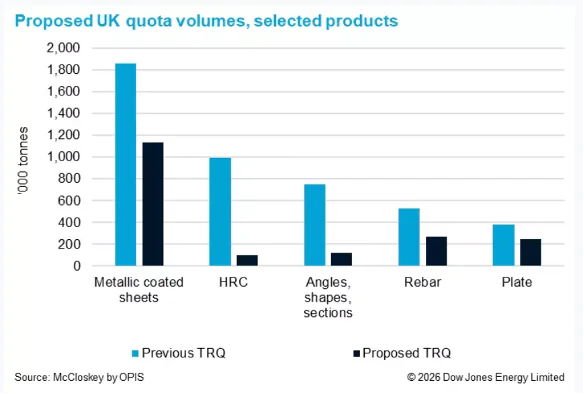
As illustrated in the above graph, and the product category table appendices below, the cuts to steel quota levels are far beyond industry expectations, especially on category 1 hot-rolled steel. Despite the lack of reference to Product Category 1B in the confidential document – which currently allows material to enter the UK duty-free where it is to be used for downstream processing – sources tell McCloskey that this carve-out will very likely be sustained in the UK’s new quota framework, at least until Tata Steel UK’s new electric arc furnace at Port Talbot is operational. Tata Steel UK currently imports HRC from their affilitated operations in India and the Netherlands, following the closure of the blast furnace at Port Talbot in 2024.
Overall, the current proposal would reduce total steel import quota volumes in the UK by around 60% across all product categories, with some categories, such as “12B: Non-alloy merchant bars and light sections,” hit by reductions as high as 97%. Other product categories like “4: Metallic coated sheets” have comparatively lesser reductions (39%).
Market participants have highlighted references in the UK Steel Strategy to private investment as a core stimulus for the revitalisation of the UK’s domestic steelmaking, and have drawn comparisons between the level of quota reductions and potential portfolios of domestic steelmakers like Speciality Steel UK, which the government is supporting financially through its administration process to facilitate future sale of the assets to new buyers.
As stated in the confidential document, quotas will still roll over between quarters “to smooth trade flows across the year,” with volumes allocated on a “first come first served basis.” The new quota year will begin on 1 July, with subsequent quarters confirmed to start on 1 October; 1 January; and 1 April.
The new trade measure proposal also extends steel tariff protections to four new product categories: category 14 – “stainless bars and light sections”; category 15 – “stainless wire rod”; category 27 – “non-alloy and other alloy cold finished bars”; and category 28 – “non-alloy wire”.
Detailed below, it is important to remember that the presented quota levels are “provisional and subject to change,” and have not yet been officially released by the UK government.
Category 1 – Non-alloy and other alloy hot-rolled sheets and strips
| Previous Quota Holders | Previous Quota Levels (t) | New Quota Holders | New Quota Levels (t) | % Change |
| EU | 744565 | EU | 68226 | -91 |
| Turkey | 97760 | India | 12405 | |
| Taiwan, China | 54426 | South Korea | 3258 | |
| Residual | 93673 | Residual | 18452 | -80 |
| Total | 990424 | Total | 102341 | -90 |
| Global quota *1B (40% cap) | 2297785 | N/A | N/A |
Category 4 – Metallic coated sheets
| Previous Quota Holders | Previous Quota Levels (t) | New Quota Holders | New Quota Levels (t) | % Change |
| EU | 1286045 | EU | 634773 | -51 |
| India | 98199 | India | 125796 | +28 |
| Taiwan, China | 132960 | South Korea | 100753 | |
| Vietnam | 174367 | |||
| Residual (15% cap) | 339590 | Residual | 100116 | -71 |
| Total | 1856794 | Total | 1135805 | -39 |
Category 5 – Organic Coated Sheets
| Previous Quota Holders | Previous Quota Levels (t) | New Quota Holders | New Quota Levels (t) | % Change |
| EU | 145538 | EU | 29836 | -79 |
| South Korea | 59142 | South Korea | 19694 | -67 |
| Residual | 8840 | Residual | 5993 | -32 |
| Total | 213520 | Total | 55523 | -74 |
Category 6 – Tin mill products
| Previous Quota Holders | Previous Quota Levels (t) | New Quota Holders | New Quota Levels (t) | % Change |
| EU | 126900 | EU | 4740 | -96 |
| China | 32218 | Japan | 74 | |
| South Korea | 9987 | South Korea | 596 | -94 |
| Taiwan, China | 10522 | |||
| Residual | 4305 | Residual | 6385 | +48 |
| Total | 183932 | Total | 11795 | -94 |
Category 7 – Non-alloy and other alloy quarto plates
| Previous Quota Holders | Previous Quota Levels (t) | New Quota Holders | New Quota Levels (t) | % Change |
| EU | 282391 | EU | 200868 | -29 |
| South Korea | 33795 | |||
| USA | 766 | |||
| Residual (20% cap) | 100776 | Residual | 14415 | -86 |
| Total | 383167 | Total | 249844 | -35 |
Category 12A – Alloy merchant bars and light sections
| Previous Quota Holders | Previous Quota Levels (t) | New Quota Holders | New Quota Levels (t) | % Change |
| EU | 117107 | EU | 83558 | -29 |
| Residual | 16845 | Residual | 9082 | -46 |
| Total | 133952 | Total | 92640 | -31 |
Category 12B – Non-alloy merchant bars and light sections
| Previous Quota Holders | Previous Quota Levels (t) | New Quota Holders | New Quota Levels (t) | % Change |
| EU | 140677 | EU | 4454 | -97 |
| Turkey | 52949 | Turkey | 1788 | -97 |
| Residual | 30090 | Residual | 468 | -98 |
| Total | 223716 | Total | 6710 | -97 |
Category 13 – Rebars
| Previous Quota Holders | Previous Quota Levels (t) | New Quota Holders | New Quota Levels (t) | % Change |
| EU | 295656 | EU | 149024 | -50 |
| Turkey | 140067 | Turkey | 50582 | -64 |
| Residual | 95364 | Residual | 68374 | -28 |
| Total | 531087 | Total | 267980 | -50 |
Category 14 – Stainless Bars and Light Sections
| Previous Quota Holders | Previous Quota Levels (t) | New Quota Holders | New Quota Levels (t) | % Change |
| N/A | N/A | EU | 11,532 | |
| USA | 1,782 | |||
| Residual | 2,360 | |||
| Total | 15,674 |
Category 15 – Stainless Wire Rod
| Previous Quota Holders | Previous Quota Levels (t) | New Quota Holders | New Quota Levels (t) | % Change |
| N/A | N/A | EU | 570 | |
| South Korea | 135 | |||
| Residual | 237 | |||
| Total | 942 |
Category 16 – Non-alloy and other alloy wire rod
| Previous Quota Holders | Previous Quota Levels (t) | New Quota Holders | New Quota Levels (t) | % Change |
| EU | 297,636 | EU | 168,471 | -43 |
| Residual | 12,994 | Residual | 10,504 | -19 |
| Total | 310,630 | Total | 178,975 | -42 |
Category 17 – Angles, shapes, and sections of iron or non-alloy steel
| Previous Quota Holders | Previous Quota Levels (t) | New Quota Holders | New Quota Levels (t) | % Change |
| EU | 677,693 | EU | 106,106 | -84 |
| South Korea | 3,002 | |||
| USA | 852 | |||
| Residual | 70,432 | Residual | 13,230 | -81 |
| Total | 748,125 | Total | 123,190 | -84 |
Category 19 – Railway material
| Previous Quota Holders | Previous Quota Levels (t) | New Quota Holders | New Quota Levels (t) | % Change |
| EU | 19,032 | EU | 7,254 | -62 |
| Residual | 559 | Residual | 46 | -92 |
| Total | 19,591 | Total | 7,300 | -63 |
Category 20 – Gas pipes
| Previous Quota Holders | Previous Quota Levels (t) | New Quota Holders | New Quota Levels (t) | % Change |
| EU | 28,085 | EU | 15,792 | -44 |
| India | 14,441 | India | 8,777 | -39 |
| Turkey | 62,400 | Turkey | 29,917 | -52 |
| Residual | 2,936 | Residual | 5,008 | +71 |
| Total | 107,862 | Total | 59,494 | -45 |
Category 21 – Hollow sections
| Previous Quota Holders | Previous Quota Levels (t) | New Quota Holders | New Quota Levels (t) | % Change |
| EU | 44,959 | EU | 15,792 | -65 |
| Turkey | 148,124 | Turkey | 29,917 | -80 |
| India | 8,777 | |||
| Residual | 13,667 | Residual | 5,008 | -63 |
| Total | 206,750 | Total | 59,494 | -71 |
Category 25A – Large welded tubes
| Previous Quota Holders | Previous Quota Levels (t) | New Quota Holders | New Quota Levels (t) | % Change |
| EU | 25,125 | EU | 7,067 | -72 |
| South Korea | 5,018 | South Korea | 659 | -87 |
| Japan | 32,835 | Japan | 413 | -99 |
| USA | 495 | |||
| Residual | 8,856 | Residual | 1,538 | -82 |
| Total | 71,834 | Total | 10,172 | -86 |
Category 25B – Large welded tubes
| Previous Quota Holders | Previous Quota Levels (t) | New Quota Holders | New Quota Levels (t) | % Change |
| EU | 64,629 | EU | 25,219 | -61 |
| Japan | 8,138 | Japan | 267 | -97 |
| South Korea | 18,575 | South Korea | 3,493 | -81 |
| Turkey | 5,110 | |||
| Residual | 19,592 | Residual | 3,202 | -84 |
| Total | 110,934 | Total | 37,291 | -66 |
Category 26 – Other welded tubes
| Previous Quota Holders | Previous Quota Levels (t) | New Quota Holders | New Quota Levels (t) | % Change |
| EU | 90,535 | EU | 19,666 | -78 |
| Turkey | 44,197 | Turkey | 9,597 | -78 |
| UAE | 60,841 | UAE | 7,114 | -88 |
| China | 23,250 | USA | 3,649 | |
| Switzerland | 721 | |||
| Residual | 40,142 | Residual | 10,809 | -73 |
Category 27 – Non-alloy and other alloy cold finished bars
| Previous Quota Holders | Previous Quota Levels (t) | New Quota Holders | New Quota Levels (t) | % Change |
| N/A | N/A | EU | 14,442 | |
| Turkey | 3,916 | |||
| Residual | 3,172 | |||
| Total | 21,530 |
Category 28 – Non-alloy wire
| Previous Quota Holders | Previous Quota Levels (t) | New Quota Holders | New Quota Levels (t) | % Change |
| N/A | N/A | EU | 47,859 | |
| Japan | 415 | |||
| USA | 6,076 | |||
| Residual | 25,875 |


Automotive suppliers urge EU to preserve production capacity
European Association of Automotive Suppliers (CLEPA) is calling on the European Union to implement targeted measures to preserve production capacity, address structural cost disadvantages, and support investment in domestic manufacturing.
Without decisive action, thousands of jobs will be lost, and European companies will face the relocation of production outside the region, Kallanish learns from the association.
According to CLEPA, for decades, the European automotive supply industry has sustained a robust trade surplus, being an undisputed engine of global value creation, but today the engine is stalling.
“The most striking shift is in production value after China has expanded its capacity at such a pace that it now produces roughly twice as much in value-added terms as the EU. This surge, alongside rising imports from lower-cost hubs is actively cutting the trade surplus that once underpinned Europe’s industrial strength. Simultaneously, exports to key, traditional markets like the United Kingdom and the United States have begun to decline,” it adds.
Taken together, these trends point to a rapid erosion of Europe’s role as a global powerhouse in traditional automotive components, the suppliers say.
“China’s automotive supply industry is growing faster than ever, increasingly challenging Europe’s suppliers,” says CLEPA’s general secretary Benjamin Krieger.
“If Europe wants to remain a major manufacturing hub, we need policies that strengthen our competitiveness and ensure that suppliers can compete on a true level playing field. Balancing the protection of European industrial strengths with the promotion of employment and investment must be the core goal of the Industrial Accelerator Act,” he adds.
The association note that imports from China continue to dominate the EU market for traditional automotive components, growing in 2025 by 12% year-on-year. Chinese imports now exceed €8 billion ($9.2 billion), representing around 30% of total EU imports in this category.
At the same time, imports from Turkey have doubled over the past five years, now reaching approximately €5 billion. Imports from the United Kingdom, Japan and South Korea remain broadly similar in scale, each supplying around €2.5 billion worth of components to the EU market in 2025.


Kirchoff signs MoU for Arvedi’s Arvzero steel
Italian steelmaker Arvedi is joining forces with German component maker Kirchoff automotive to boost the presence of carbon-neutral steel in the automotive sector’s supply chain, Kallanish learns from a statement.
The Memorandum of Understanding, signed by the two firms in Cremona, will see Kirchoff integrate Arvedi ‘s sustainably produced steel brand, Arvzero, into its portfolio with the aim of reducing Scope 3 emissions across its value chain.
Kirchoff’s ceo J. Wolfgang Kirchhoff and global EVP of procurement, Michael Rank, recently visited Arvedi’s electric arc furnace (EAF) steelmaking plant in Cremona, observing the full production cycle from liquid steel to rolled coil within less than 200 metres.
According to Kirchoff, the setup highlights the efficiency of Arvedi’s integrated process. The company says the visit underlines what the partnership stands for: a clear roadmap for CO2‑reduced and ZeroCO2 steel and a strong partnership with a decarbonisation pioneer.
In 2023, Arvedi’s Cremona plant obtained its carbon neutrality certificate after drastically reducing Scope 1 and 2 emissions by investing in a new EAF supplied by Tenova and cutting the use of pig iron and other polluting raw materials. The first carbon neutral certificate for Arvedi’s coils, Arvzero, was issued for a large contract supply with Mercedes Benz during the same year. (see Kallanish passim).

Europe too slow supporting its industries: conference
EU steel industry representatives bemoaned slow bureaucracy in the bloc delaying critical industrial projects during the Handelsblatt “Zukunft Stahl” conference in Essen this week.
SSAB chief executive Johnny Sjöström, who previously worked in the USA as well as in China, remarked that in those countries, it takes only six months to lay a new power line, “whereas in Öxelesund we needed nine years to get it approved”. This involved decisions, reversals and appellations at various instances in the political approval process. “This is a bureaucracy we need to overcome,” Kallanish heard him demand at the event.
Former Salzgitter ceo Hansjörg Fuhrmann, who participated at the conference as an attendee, pointed at the “very different timeline they have in India”, compared with “man-made regulations” slowing down decisions in Europe.
This was confirmed by voestalpine Steel Division head Hubert Zajicek, who told of impressions he has gained of different countries from his experience as worldsteel executive committee member. “It is nonsense to believe that we Europeans can detach our economic ecosystem [with its numerous regulations] from the rest of the world,” he said.
To a lesser extent, Europe also lags behind on pace of business processes such as consolidation, said Guido Kerkhoff, ceo of Klöckner & Co, which has expanded vastly in the USA. Stateside, the process for making acquisitions and expansions entails one third to one half the effort required in Europe. “After all, you are considered the good guy when you come investing,” he stated.
Sjöström also pointed out a particularly uneasy case in which speed can be crucial. European armed forces standardising and approving the construction of tanks is a lengthy process, meaning Europe’s total production of tanks does not exceed 50 units per year – versus 500 made in Russia in the same time.

French longs prices continue to rise
French longs transaction prices have moved higher since early March as mills implement increases following the escalation of the US-Iran conflict, Kallanish notes.
After an initial pause, with buyers adopting a wait-and-see stance, order intake increased soon after the conflict and price rises have been at least partially accepted.
Buyers and distributors report average increases of €20-30/tonne ($23.02-34.53/t) compared to pre-conflict levels. Activity has improved across the value chain, though without signs of panic buying. Apparent demand has returned modestly, with buyers securing volumes and expecting further increases.
A large buyer and a distributor in both northern and southern France, as well as a large European steelmaker, expect further increases, potentially in April, depending on how the conflict evolves.
However, one source notes that real demand has not improved and warns that excessive price hikes could stall activity.
Demand picked up sharply in the days following the outbreak of the war but appears to be easing again this week.
Across the value chain, logistics costs are rising due to higher fuel prices, while energy costs and modest scrap increases in March are also supporting increased prices.
Scrap merchants expect material values to rise again in April, as suppliers in France, Belgium and Germany face the same cost pressures, although it remains too early to confirm. One source adds that the recent uptick in apparent demand is increasing scrap requirements by mills, which could lead to price increases for the raw material.
For the first time, European producers seem to be putting up a united front on price increases. Spanish longs producers active in France, along with Italian rebar suppliers present in the south, are also pushing up prices. Lower-priced import offers from either origin are not currently available. ArcelorMittal is also implementing significant increases across rebar and other long products.
First-category section prices are now moving towards €780/t delivered, with European suppliers, including Spanish mills, targeting around €800/t delivered into France. Rebar is rising to approximately €640-650/t delivered with more orders throughout the value chain. Merchant bar prices are also increasing, up from €240–250/t last month to €260–270/t delivered, with other European producers maintaining firm positions on further hikes.
NW European coil prices reach target levels
The price target set by the market leading mill of €720/tonne ($829/t) delivered for hot-rolled coil appears to be largely accepted now, despite demand from steel users not significantly reviving from its ongoing lull.
“You won’t get any HRC from European integrated mills below €700/t ex-works anymore,” one observer tells Kallanish. He concedes that €690/t is possible at one re-roller mill, which could still be an option, mainly in Benelux.
Lower levels could be available from traders with inventories of Asian material bought earlier at prices around $500/t, with CBAM fees considered, on a ddp-basis to the buyer’s warehouse.
A Nordic source notes that there could be other existing stocks, at mills or distributors, where offers could still be under €720/t.
One mill source confirms that price level for continental Europe, and notes offers can be higher rather than lower, especially in Scandinavia. He cites a recent spot deal concluded with a large European distributor last week for May delivery with a price that is €200/t higher than in November 2025.
This gap is wide compared to Kallanish’s published price series, which on 1 November saw HRC at €600/t after three months of increases, a rise of €105/t.
In another comparison, one manager points out that currently the price is now at its highest in two years since March 2024, when it had come down from a brief peak to €720/t.
Further hikes have not been announced and could be difficult to assert if material is still available from stocks. Many sources point out that inventories are quite high downstream at warehouses and fabricators, with little appetite to go for more than light replenishment.
“Customers have enough in stock and they do not see their order books improving,” a Swiss buyer says. While a Dutch service centre manager adds that he has reason to believe that “stock levels remain relatively high compared to historic averages”.