UK Steel, Tata seek improvements to EU quotas
UK Steel and Tata Steel are seeking further improvements to the newly published EU import quotas, Kallanish learns from their respective statements.
The producers’ association says it recognises the progress made by the UK government but adds that negotiations must continue between the UK and EU for further improvement in volumes as the two regions continue their reset talks. 70% of UK steel exports go to the bloc, making it a crucial market.
The UK’s country specific EU quotas amount to 1 million tonnes, while access to Free Trade Agreement pools and residuals takes the total UK access for tariff-free steel exports to 2.14mt. UK Steel warns these pools are likely to be quickly filled by countries with larger production, with the UK “likely” to lose a significant chunk of the 1.7mt of finished steel it exported to the EU under the previous safeguards.
It blames overproduction on “rampant global subsidisation” which has distorted international market prices, and forced the two regions to significantly restrict import access.
“Unfortunately, broad trade measures have unintended consequences and outdated multilateral trading rules make it difficult to single out bad actors who distort the market for all,” it adds.
UK Steel director-general Gareth Stace says: “Securing wider export access for certain high value steel products will be critical for the long-term viability and profitability of the UK steel sector. The UK and EU are interdependent markets, and we hope both sides will take a reasonable view of each other’s needs as discussions take place over the coming months.”
Meanwhile, in a separate statement, Rajesh Nair, chief executive of Tata Steel UK, says: “While we recognise the UK Government’s efforts in these negotiations, the overall reduction of 60% in guaranteed tariff-free EU quotas, combined with the recent UK steel import measures, is likely to have a significant impact on our UK business.”
“We will need some time to analyse the specific details of the announcement with respect to different product categories, but given the importance of the EU market to British steel producers, fair and workable market access remains critical if we are to achieve a sustainable steel industry here in the UK,” he adds.
Last week, Tata said it was disappointed in the UK’s import quotas and expressed concerns on allowances for metallic coated steels (Category 4), packaging steels (Category 6) and hollow sections (Category 21).
Author: Carrie Bone


EU quota allocations stun Italian coil buyers, importers
The recently published European Commission quota allocations under the new trade measure regulation are being described as a bombshell by Italian coil buyers and end-users.
Market participants tell Kallanish they did not expect the regulations to be this harsh, and say the move is completely reshaping the supply chain landscape, which will need to be rethought. They add that the new regulation is seen as a huge gift to EU producers.
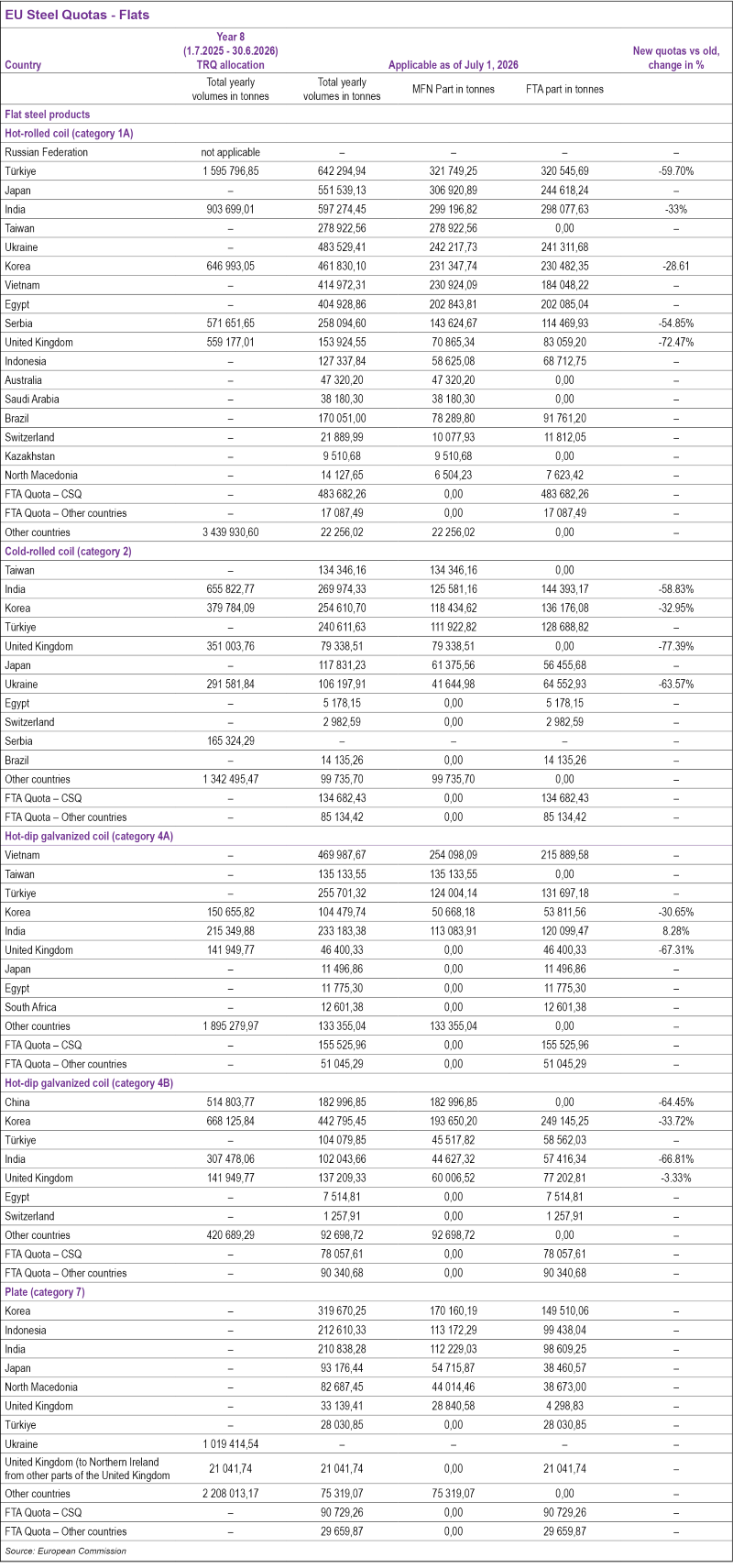
The architecture of the regulation is notably fragmented, with some countries allocated minimal quotas, such as Australia at 11,000 tonnes for hot rolled coil for the quarter, while Turkey, a long-standing EU supplier, has seen its allocations slashed from 390,000 t/quarter to just 160,000 t/q.
“From Australia you can’t even buy a single vessel. Other countries such as Japan have been heavily penalised too, with 551,000 t/year [for HRC] and anti-dumping duties of 30%. It’s a strong message,” one buyer comments.
Another buyer expects the reduced quotas to be exhausted within hours by large trading companies and European steel processors, making it increasingly difficult to source from Asia.
Another large buyer describes the impact on HRC imports as severe, with an immediate effect on prices. Some Asian producers have responded to the publication of the document by raising HRC offers to €680-700/tonne ($775-798/t) cfr.
A trading company describes the mechanism as particularly complex, with buyers left with little alternative but to purchase in Europe. “There will be very little room to manoeuvre. Prices will increase significantly, but the rest of the supply chain will suffer,” a trader says.
All sources agree the downstream sector will not be able to absorb the expected sharp price increases or maintain volumes. Many end-users, including white goods makers and the automotive sector, have been implementing production stoppages to balance supply and demand.
Another large buyer believes the need to rethink the supply chain will only become a pressing issue in the fourth quarter. HRC stocks remain high, he explains, including his own, with enough material to cover demand until around December.
Any price increases announced this month in Europe for September delivery are unlikely to translate into contracts, as all sources confirm they currently have no need to buy.
In Q4, however, European coil prices are expected to rise to €750/t base delivered, up from the current €700/t base delivered.
Half of the 18.3 million tonne annual quota has been allocated to Free Trade Agreement partners, with the other half accessible for all countries, including FTA partners. FTA partners will therefore retain a higher share of EU market access than the average quota volume reduction of 47%.
A significant number of partners have provisionally agreed to their allocated quotas following negotiations, the Commission says.
However, it adds it will continue engaging with trading partners at the WTO under the ongoing Article XXVIII GATT negotiations. Because the regulation is being adopted by urgency procedure, it is initially valid until end-2026 (see separate article).
Author: Natalia Capra

Belmetal highlights impact of new EU steel import quota system
The European Commission has published the final country-specific tariff quota allocations implementing the EU’s new steel import regime, which entered into force on 1 July 2026. The measures complete the transition from the previous safeguard system to the new framework established under Regulation (EU) 2026/1384.
In an analysis published by EUROMETAL member Belmetal, the Belgian federation highlights the practical implications of the new quota system for steel distributors and traders. The new regime reduces the annual volume of duty-free steel imports into the European Union to 18.3 million tonnes, with imports exceeding available quotas becoming subject to a 50% duty.
Belmetal notes that the European Commission concluded negotiations with twelve Free Trade Agreement (FTA) partners before finalising the allocation, allowing countries including the United Kingdom, Ukraine, Switzerland, Serbia, North Macedonia, South Korea and Türkiye to retain dedicated access reflecting historical trade flows, security of supply considerations and existing trade commitments.
For steel distributors, the introduction of country-specific quotas, separate allocations for FTA partners, residual quotas for other exporting countries and additional FTA volumes creates a significantly more complex import management system. Importers will need to monitor quota utilisation closely and adapt their sourcing strategies to avoid quota exhaustion and the application of additional duties.
As one of Europe’s major steel distribution and processing hubs, Belgium is expected to be directly affected by the new arrangements, particularly regarding product availability, sourcing decisions, pricing and delivery lead times.
Belmetal concludes that while the new framework provides greater predictability than the previous safeguard mechanism, its successful implementation will depend on careful monitoring of quota utilisation and effective planning by market participants during the coming quarters.
Read Belmetal’s full article here: belmetal.be

European steel market participants expect unchanged fundamentals in July
European steel market participants expect prices, inventories and production levels are to remain stable in July, Platts European Steel Sentiment Survey data showed July 30.
Price index
Participants’ price expectations were mostly steady for July, with the overall index for July standing at 47.50 points, down from 64.29 in June and now the third month in a row where expectations have fallen.
Trader, stockholder and service center sentiment on price was measured at around 45 points, while producers were neutral on 50 points.
Buyers’ have largely adopted a wait-and-see approach in recent weeks in anticipation of the final country-specific quotas for the new safeguard mechanism, which were published June 30, leaving activity on a subdued level. Market reaction has remained limited, but participants expect the situation to develop over the next few weeks and months when the safeguards effect truly kicks in.
“I think safeguards will have some positive effect on prices, maybe not up like a rocket, but I think by September there will be increases,” one Germany-based distributor said.
Platts, part of S&P Global Energy, assessed domestic hot-rolled coil in Northern Europe at Eur680/mt ex-works Ruhr, steady month over month.
Platts last assessed rebar in Northwest Europe June 24 at Eur675/mt ex-works, also stable across the same time period.
| Month: | Feb 2026 | March 2026 | April 2026 | May 2026 | June 2026 | July 2026 |
| Index: | 76.88 | 91.67 | 92.50 | 75 | 64.29 | 47.50 |
Production index
The overall index for production stood neutral at 50 points, down from the 57.14 points observed in June, suggesting the market feels production will remain steady in July.
Trader, stockholder, and service center sentiment increased over the month from 39.3 points in June to 50 in July. Producer sentiment decreased from 75 points to 50.
The market usually enters a quieter stage in the summer months as participants take holidays and producers conduct maintenance in their plants, as reflected in current sentiment.
| Month: | Feb 2026 | March 2026 | April 2026 | May 2026 | June 2026 | July 2026 |
| Index: | 68.75 | 58.33 | 61.25 | 47.50 | 57.14 | 50 |
Inventory index
The overall index for inventory was measured at 48.33 points, a marginal uptick from the 46.43 points seen in June.
This was made up of around 55 points from traders, service centers and stockholders, and around 42 points from producers.
Sources have continued to note throughout June that inventory levels are high after another month of low activity and weak demand, with the index suggesting this will be the case in July too.
| Month: | Feb 2026 | March 2026 | April 2026 | May 2026 | June 2026 | July 2026 |
| Index: | 53.75 | 33.33 | 52.50 | 50.83 | 46.43 | 48.33 |
Author: Riley Waters


Construction to remain key support for EU steel demand in 2026
According to the Economic and Steel Market Outlook 2026-2027/Q2 2026 Report from the Economic Committee of the European Steel Association (EUROFER), the construction sector is expected to remain the main source of resilience for EU steel demand in 2026, supported by infrastructure spending, NextGenerationEU funding and the delayed effects of monetary easing.
EUROFER stated that construction, the EU’s largest steel-consuming sector, accounts for 37 percent of apparent steel consumption. After contracting by 3.3 percent in 2024, the sector recorded a modest recovery in 2025, with output increasing by 1.3 percent, supported by public construction schemes at EU and national levels.
According to EUROFER, construction output increased for three consecutive quarters in 2025, rising by two percent year on year in the third quarter and by 3.1 percent in the fourth quarter. The association noted that this growth provided important support for overall demand from steel-using sectors, particularly as automotive output remained weak.
Looking ahead, EUROFER expects construction output in the EU to rise by 1.5 percent in 2026, despite higher interest rates linked to renewed inflationary pressures. In 2027, construction output is forecast to increase by 2.9 percent, supported by a recovery in housing demand and a further pick-up in infrastructure spending.
Author: SteelOrbis Editorial Team


EU sets CSQ allocations under post-safeguard regime
The European Commission has announced that it has set out the detailed country allocation of tariff quotas under the EU’s new steel trade regime. The total annual tariff quota volume of 18.35 million mt will be distributed across 26 steel product categories, replacing the previous safeguard quota administration. Each quota is divided equally into four quarterly volumes.
Half of the import quotas have been allocated exclusively to free trade agreement (FTA) partners, while the remaining half will be available to all exporting countries, including FTA partners.
Three different quota access mechanisms established
The regulation establishes three different quota access mechanisms depending on the exporting country’s status.
Countries receiving a country-specific quota (CSQ) may use their allocated quota immediately. Once exhausted, eligible FTA partners may continue exporting under an additional FTA Quota – CSQ, which is administered on a first-come, first-served basis.
Countries without country-specific quotas may instead access:
- “Other countries” quota: accessible for the exporting countries which are not FTA partners.
- FTA Quota – Other countries quota: accessible for the exporting countries which are FTA partners.
The countries that are able to access these three type of quotas may vary depending on the products.
HRC represents almost one-third of total tariff quota volume
The Commission highlights Category 1A (non-alloy and other alloy hot rolled sheets and strips) represents almost one-third of the total tariff quota volume. Total Category 1A quota volume is now almost 5.2 million mt, compared to 7.7 million mt in the previous quota year (July 1, 2025-June 30, 2026).
For category 1A, Turkey receives the largest annual country-specific quota of 642,295 mt, followed by India (597,274 mt), Japan (551,539 mt), Ukraine (483,529 mt), South Korea (461,830 mt), Vietnam (414,972 mt), Egypt (404,929 mt), Taiwan (278,923 mt) and Serbia (258,095 mt). These countries can use FTA Quota – CSQ once their CSQs are exhausted, as mentioned above.
Looking at the other high-volume quotas, in the new system the quotas allocated for CRC and metallic coated sheets (4A) are at 1.5 million mt and 1.6 million mt, respectively, compared to 3.9 million mt and 2.4 million mt, respectively, in the previous quota year.
Author: SteelOrbis Editorial Team

EU cuts Türkiye’s steel quotas, except CR, tinplate
A preliminary comparison of the EU’s new quarterly country-specific tariff-rate quotas with the final quarterly allocations under the previous EU safeguard regime indicates that Türkiye faces lower quotas across most product categories, Kallanish notes.
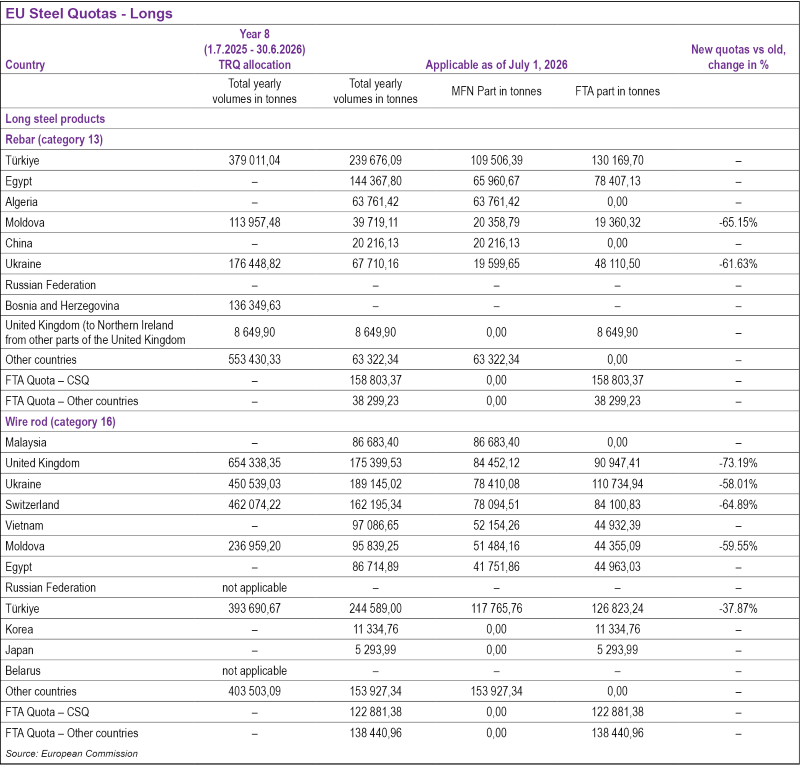
Cold rolled sheets (category 2) is one of the few product groups where Türkiye’s quarterly quota has increased, rising 38% to 60,153 tonnes, from 43,512t under the previous safeguard system. An even larger increase was recorded for tin mill products (category 6), where the allocation almost doubled, climbing 92% to 14,279t from 7,429t.
The largest reduction was recorded for hot rolled sheets and strips (category 1A), where Türkiye’s quarterly allocation fell by almost 60% to 160,574t from 398,355t previously.
Significant reductions were also introduced for metallic coated sheets (category 4A), down 46% to 63,925t; merchant bars (category 12), down 43% to 60,496t; wire rod (category 16), down 38% to 61,147t; rebar (category 13), down 37% to 59,919t; and hollow sections (category 21), down 29% to 59,850t (see table for more details).
Türkiye has also obtained new product allocations in several categories, including electrical sheets (category 3A), metallic coated sheets (category 4B), quarto plates (category 7), stainless hot rolled sheets and strips (category 8), large welded tubes (category 25A), cold finished bars (category 27) and wire (category 28).
The new regime also allows eligible FTA partners such as Türkiye to compete for the additional FTA quota pool once their country-specific allocation is exhausted.
| Product category | Product | Q3 (New measures) |
Q2 (Old measures) |
% change |
| 1.A | HR sheets, strips | 160,574 | 398,355 | -60 |
| 2 | CR sheets | 60,153 | 43,512 | +38 |
| 3.A | Electrical sheets (other than GOES) | 9 | – | – |
| 4.A | Metallic coated sheets | 63,925 | 118,130 | -46 |
| 4.B | Metallic coated sheets | 26,020 | – | – |
| 5 | Organic coated sheets | 11,569 | 15,732 | -26 |
| 6 | Tin mill products | 14,279 | 7,429 | +92 |
| 7 | Quarto plates | 7,008 | – | – |
| 8 | Stainless HR sheets, trips | 3,432 | – | – |
| 9 | Stainless CR sheets, strips | 17,260 | 20,849 | -17 |
| 12 | Merchant bars, light section | 60,496 | 106,082 | -43 |
| 13 | Rebars | 59,919 | 94,493 | -37 |
| 16 | Wire rod | 61,147 | 98,153 | -38 |
| 17 | Angles, shapes, sections | 13,456 | 22,643 | -41 |
| 19 | Railway material | 1,280 | 1,558 | -18 |
| 20 | Gas pipes | 28,163 | 49,482 | -43 |
| 21 | Hollow sections | 59,850 | 84,033 | -29 |
| 25.A | Large welded tubes | 1,947 | – | – |
| 25.B | Large welded tubes | 10,936 | 14,947 | -27 |
| 26 | Other welded pipes | 22,453 | 38,117 | -41 |
| 27 | Cold finished bars | 7,045 | – | – |
| 28 | Wire | 24,235 | – | – |
*Preliminary comparison by Kallanish
Author: Elina Virchenko

Federacciai elects new president
Italian steel producers’ association Federacciai has elected Alessandro Banzato, chairman and chief executive of Acciaierie Venete, as the next president for the 2026-2028 term, Kallanish notes.
The designation will be submitted for approval to the assembly of steel entrepreneurs, which is scheduled for October.
Banzato, who will replace president of Duferco Antonio Gozzi, has held several senior roles within the association and has been vice-president since 2016. He was previously elected president in 2018, a role he held until 2022, Federacciai says in a note.
Author: Natalia Capra

EU unveils tighter steel import quotas, new allocation structure
According to a document published in the Official Journal of the EU, seen by Fastmarkets, the new framework will include the expected significant reductions in tariff-free volumes to 18.3 million tonnes.
But it will also introduce a two-tier quota system under which one part will be available only to countries benefiting from an existing or future free-trade agreement with the EU (the FTA Part), while the other part will be available to all third countries on a Most Favoured Nation (MFN) basis (the MFN Part).
MFN quotas were allocated according to each country’s average share of EU imports in each product category during 2022-24. This distinguished many more countries with allocated country-specific quotas compared with the previous safeguard.
For the FTA part, quotas were allocated more flexibly, considering trade agreements, market distortions and the need to diversify supply, as well as special situations affecting certain countries.
As a result, some FTA partners received different levels of access. In particular, Ukraine was given more favorable quotas than other FTA countries.
Both the MFN and the FTA parts of the country-specific quota were accessible simultaneously to economic operators, functioning as a single quota with a single order number.
When a country does not belong to the pool of countries with FTA, economic operators can only access the MFN Part of the country-specific quota.
The regulation also introduced a change to residual quotas, which open at the start of each quarter. Instead of a single residual quota available to “Other countries,” the new system will split residual volumes into “FTA quota – Country-Specific Quota (CSQ),” “FTA Quota – Other countries” and “Other Countries.”
FTA Quota – CSQ will be open to countries with an existing or future free-trade agreement with the EU that have a country-specific quota.
FTA Quota – Other countries will be open to countries with an existing or future free-trade agreement with the EU that do not have a country-specific quota.
This gives FTA countries greater flexibility, and will potentially delay exposure to the 50% tariff compared with non-FTA suppliers, according to the regulation.
The other countries residual quota will be open to all countries except those listed in Section 3 of Annex II of the regulation.
All residual quotas distributed under this regulation will be administered on a first-come, first-served basis.
Any volumes imported outside these quotas will be subject to a 50% tariff.
The measures were intended to protect the bloc’s steel industry from global overcapacity and unfair trade practices.
In 2025, a growing share of the EU’s steel demand was being met by external suppliers rather than domestic producers, prompting the use of tighter trade measures.
EU crude steel production declined by 2.9% year on year in 2025 to 125.8 million tonnes, down from 129.6 million tonnes in 2024. This was the lowest level on record and was around 60 million tonnes below the figures seen before the 2008 global financial crisis, according to European steel industry association EUROFER.
Meanwhile, apparent steel consumption in Europe increased by 4.5% year on year in 2025 to around 130 million tonnes, the first rise after three consecutive years of decline. But this improvement was overshadowed by a sharp surge in imports, particularly in the final quarter, when inbound volumes jumped by more than 50% quarter on quarter.
Import volumes of semi-finished and finished steel products in Europe rose by 14% year on year in 2025, to 40 million tonnes, according EUROFER.
Initial market reaction
The market was digesting the news, with quota cuts for some origins viewed as being extremely punitive.
For instance, allocation of the hot-rolled coil quota (Category 1A) for Turkey, which was traditionally one of the key suppliers of this product to Europe, was reduced by 60% to 642.249 tonnes, versus 1.59 million tonnes under the previous safeguard.
Another trading source said that the regulation was less of protection mechanism and more of a deal to create more complication and to add bureaucratic barriers for business, adding that the current quota distribution would make it “very tough” for new origins to enter the market.
Despite this, he expected no drastic price changes in the European domestic market in the near term, due to the limited demand and spending caused by the caution related to the unstable political situation in the world as well as to the seasonal summer slowdown.
None of the HRC suppliers contacted by Fastmarkets’ on June 30 reported any immediate price rises.
Fastmarkets’ daily steel hot-rolled coil index, domestic, exw Northern Europe, was calculated at €683.13 ($779.92) per tonne on June 30, up by €1.88 per tonne from €681.25 per tonne on June 29.
The index was down by €3.12 per tonne week on week and by €7.79 per tonne month on month.
A source from Ukraine expressed concern that the country was not exempted from the new safeguard in the way it was under the previous regulation, and was now subject to both safeguarding and the EU’s Carbon Border Adjustment Mechanism (CBAM), despite the difficult economic conditions it was facing because of the Russian invasion.