


Trasteel targets acquisition opportunities ahead of Nasdaq listing
Steel trading and processing group Trasteel is growing through selective acquisitions as part of the group’s opportunistic strategy and low-risk trading model, chief executive Gianfranco Imperato has said.
During a podcast by investment analysis firm SPACInsider, monitored by Kallanish, Imperato describes Trasteel as sitting in the middle of the steel supply chain, acting as a customer to producers and supplier to end-users.
Despite being considered a mature market, steel in reality is imperfect, with price differences existing not only over time but also geographically, while industrial assets can at times become available at undervalued prices.
“Therefore, there is a significant possibility to make capital gains out of buying and selling companies, not only buying and selling products,” he says.
On acquisitions, Imperato says the group targets specific opportunities as they arise rather than following a fixed strategy. He points to three recurring scenarios: European companies in a succession phase where founders have no heirs involved in the business, companies struggling to finance their working capital, and companies where partners are in dispute.
He notes that the steel sector’s high working capital intensity makes it unattractive to private equity and financial institutions, creating an opening for operators with the right management skills. When evaluating targets, the group prioritises cost efficiency and management quality.
“Obviously revenues are necessary, but you are a winner if your costs are under control. And this is the key two points of the cost efficiency and the management skills that we are searching before entering into a deal,” Imperato adds.
He is also keen to remain independent from steel production. “Steel production is very cyclical. It takes much more capital, it takes a totally different approach. In reality, we manage a spread between a semi product and the product and we manage a service to many customers that are populating our market.”
Additionally, he argues that the return of trade barriers and supply chain disruptions has restored the value of skilled intermediaries after years of disintermediation during the globalisation era. He highlights when a small entrepreneur from Milan could fly to Vietnam and source coils directly.
“Complications in the world are generating the need [for] operators like us, believed to be able to run around the obstacles that are put in by the politics or geopolitics or by the international trade complications,” he says.
Imperato is clear that Trasteel does not speculate on prices and points to the Iran crisis as an example. Some orders coming from Oman had to be sourced from a different mill when the original supply was disrupted at short notice without taking direct price exposure. “We believe it’s better to have a small but constant margin rather than running risks on speculations which are by definition not always right,” he says.
During the podcast Jamie Carson, vice chairman of Sizzle Acquisition Corp 2, says Trasteel’s hedged business model, global customer base and low inventory risk approach were the key attractions of the deal.
Trasteel is going public through a merger with Sizzle Acquisition Corp. II, a Cayman Islands-based special purpose acquisition company listed on Nasdaq under the ticker Szzl. It will list on Nasdaq through a $1.3 billion ($1.5 billion) business combination.


NW European sections price stabilisation accepted by market
Players on the northwestern European sections market find the latest price hike announcement from the market leader to be fair and believe that it will take root in the market.
The announcement, intended to cover a variety of long products, will mean less of a resurge but rather a stabilisation after shaky pricing over the summer.
Prices in some cases have softened to €800/tonne ($930/t) for Category 1, S235 sections delivered. The €20/t target should bring the level back to €820/t where it was previous, which observers say is “absolutely realistic”.
In July, the market leader had tried for a bigger hike of €40-45/t, but in vain. “So now they are trying more moderately and will be satisfied if it works. That’s often their approach,” one observer tells Kallanish.
Some players are now preparing for prices to head towards €840/t, others say the mills will be happy if they can secure €820/t across the board. One mill manager points at the continuously high power costs in EAF production, which he says, “will not get better going forward”. And he is sure that scrap prices will resurge following the drop in the last two months.
The price will differ slightly by region, he says. And he warns that southern European mills could intervene with lower offers. “They are a factor that’s prone to disturb the prices every now and then,” he says.
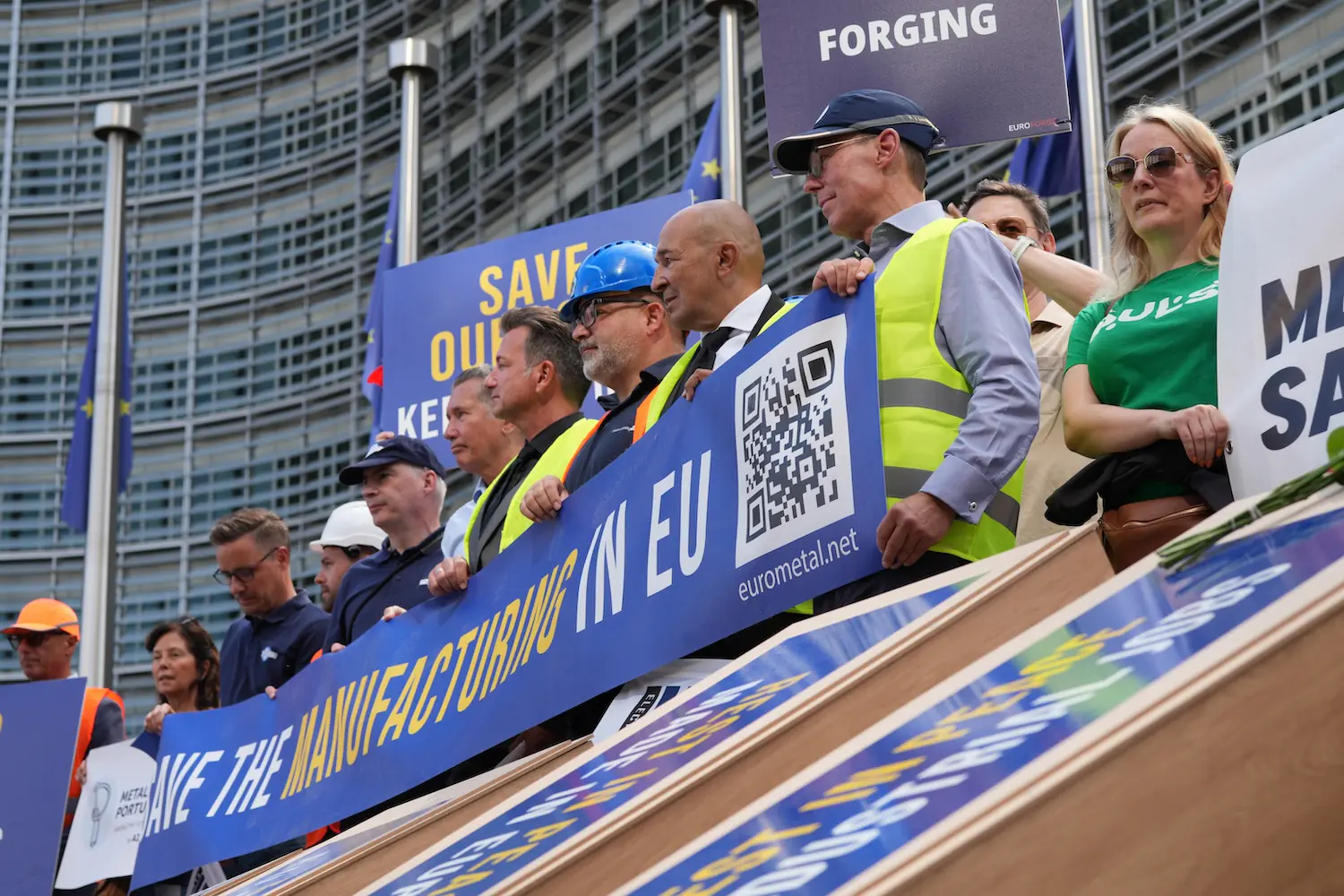
European convoy brings industry’s call for competitiveness to Brussels
More than 200 representatives of Europe’s steel, metals distribution, processing, logistics and manufacturing industries took part in the European Convoy for Industrial Competitiveness in Brussels on 7 September.
Organised by EUROMETAL, the initiative brought 15 trucks and 10 symbolic industrial coffins to the European Quarter to highlight the growing pressures facing European industry and the urgent need to restore competitiveness throughout Europe’s manufacturing value chains.
Participants travelled from across Europe with one clear message: KEEP MANUFACTURING IN EUROPE.
A symbolic warning for European industry
While the truck convoy travelled through Brussels, a parallel procession carried 10 symbolic industrial coffins to the European Commission’s headquarters at the Berlay Sta. The convoy and procession arrived together, and the coffins were laid down to create a symbolic “graveyard of European industry”.
The installation represented companies, jobs, investments and manufacturing facilities threatened by the competitive imbalance between European producers and imported steel-intensive products. It reflected the industry’s concern that current policies risk accelerating industrial decline, investment leakage and the loss of highly skilled employment across Europe.
No representative of the European Commission met the delegation at the Berlaymont. A member of the Commission’s security staff received EUROMETAL’s position paper and Call to Action on behalf of the institution.
EUROMETAL now calls on the Commission to consider the industry’s proposals and engage in a substantive dialogue with the affected sectors.
Fair competition across the entire value chain
The convoy was neither a protest against Europe nor a rejection of its climate ambitions. It was a constructive appeal for policies that protect competitiveness, encourage investment, safeguard employment and strengthen Europe’s industrial resilience.
Steel produced in Europe—or imported directly into the European Union—is subject to extensive trade-defence measures, carbon costs and regulatory requirements. However, many imported steel-intensive manufactured products are not subject to equivalent obligations.
This imbalance creates a growing risk of downstream carbon leakage, production relocation and job losses throughout Europe’s industrial value chains.
Participants called for:
- Fair competition throughout the European steel and manufacturing value chain.
- Effective measures to prevent downstream carbon leakage.
- Trade and climate instruments that address steel-intensive manufactured goods where appropriate.
- Enhanced traceability and origin requirements.
- Stronger support for “Made in Europe” industrial value chains and strategic projects.
- Reduced unnecessary administrative burdens while maintaining Europe’s environmental ambitions.
“There can be no Green Deal without industry”
Alexander M. Julius, President of EUROMETAL, said: “The message of the convoy was simple: Europe cannot achieve its climate ambitions, strategic autonomy or economic resilience if it allows its industrial base to disappear. European manufacturers support decarbonisation and fair competition, but the regulatory framework must apply consistently across the entire value chain.
Today, too many steel-intensive products enter the European market without being subject to equivalent trade, carbon and regulatory obligations.
The result is investment leaving Europe, production moving abroad and skilled industrial jobs being lost.The trucks and coffins that arrived together at the Berlaymont symbolise a choice for Europe: either preserve and strengthen its manufacturing foundations or watch more factories become part of industrial history. There can be no Green Deal without industry, no strategic autonomy without manufacturing and no resilient Europe without strong European steel and metal value chains.”
Continuing the discussion at the European Parliament
Following the demonstration, participants were welcomed at the European Parliament by Elena Donazzan, Vice-Chair of the Committee on Industry, Research and Energy (ITRE), who supported the initiative and hosted a dedicated discussion on the future of European industrial competitiveness.
The exchange brought together industry representatives, policymakers and stakeholders to consider the legislative and regulatory changes needed to restore the competitiveness of Europe’s steel-using industries, retain investment within the European Union and preserve high-quality manufacturing employment.
EUROMETAL will continue to advocate for an industrial, trade and climate policy framework that supports strong, sustainable and resilient European value chains.
Europe’s industrial future can still be secured—but decisive action is needed to keep investment, innovation, production and employment in Europe.
EUROMETAL Brussels Convoy Press Release – 9 September 2026 EN
EUROMETAL Brussels Convoy Press Release – 9 September 2026 DE

Renew MEP Canfin calls to make ETS an ‘investment tool’
Reform of the EU’s carbon market will be judged a success if it speeds up investment in European decarbonisation, Pascal Canfin, Renew coordinator in the environment committee ENVI, told Contexte.
That would need to be matched by stronger demand for products such as green steel and cement, he said, with flanking measures such as the Commission’s proposed Industrial Accelerator Act helping to create that demand.
Canfin said he was “not completely at ease” with the Commission’s 17 July proposal to use ETS allowances to buy international carbon credits and fund investment outside Europe.
But he said quality could be assured by looking at standards developed by big development banks such as Germany’s KfW.
French readers can see the full interview transcript here.


Parliament rapporteurs seek to tighten ’Made in EU’ rules
According to a near-final version of the Parliament’s report on the Industrial Accelerator Act (IAA), obtained by Contexte, lead rapporteurs are seeking to narrow the conditions under which third countries can benefit from a status equivalent to ‘Made in Europe’ in public support schemes and public procurement.
The Commission proposed in March that all countries with a public procurement or trade agreement with the EU could be granted equivalent status, subject to exclusions for countries that do not offer EU producers the same treatment as domestic ones.
Pierre Jouvet (S&D), Anna Cavazzini (Greens) and Christophe Grudler (Renew) instead want the Commission to draw up a list of countries eligible for ‘Made in Europe’-equivalent status.
These countries would have to meet seven conditions, including equal treatment for EU products and compliance with the Paris climate agreement. In key sectors such as steel and electric cars, public procurement contracts and 90% of public aid would also have to include a minimum share of European content.
European preference could be waived if it increases the cost of a project by more than 40%, compared with 25% under the Commission’s proposal. Their report is due to be finalised on 9 September.