

EU steel sector holds funeral for industry in Brussels
“Do we want to leave European defense, research and development, the future of our kids, the green transformation – in the hands of non-European countries?” – Alexander Julius, President of European steel trade and distribution association, EUROMETAL.
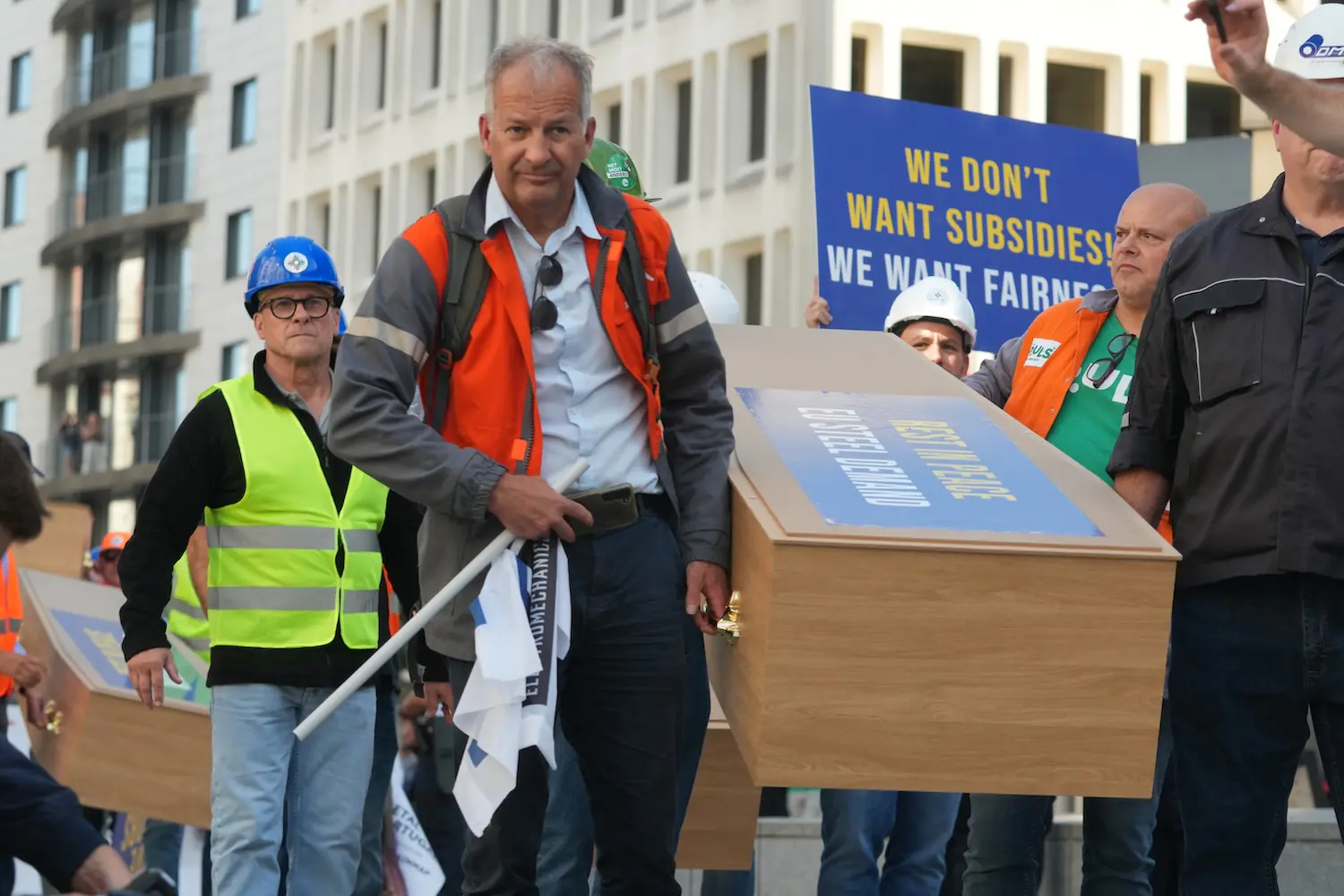
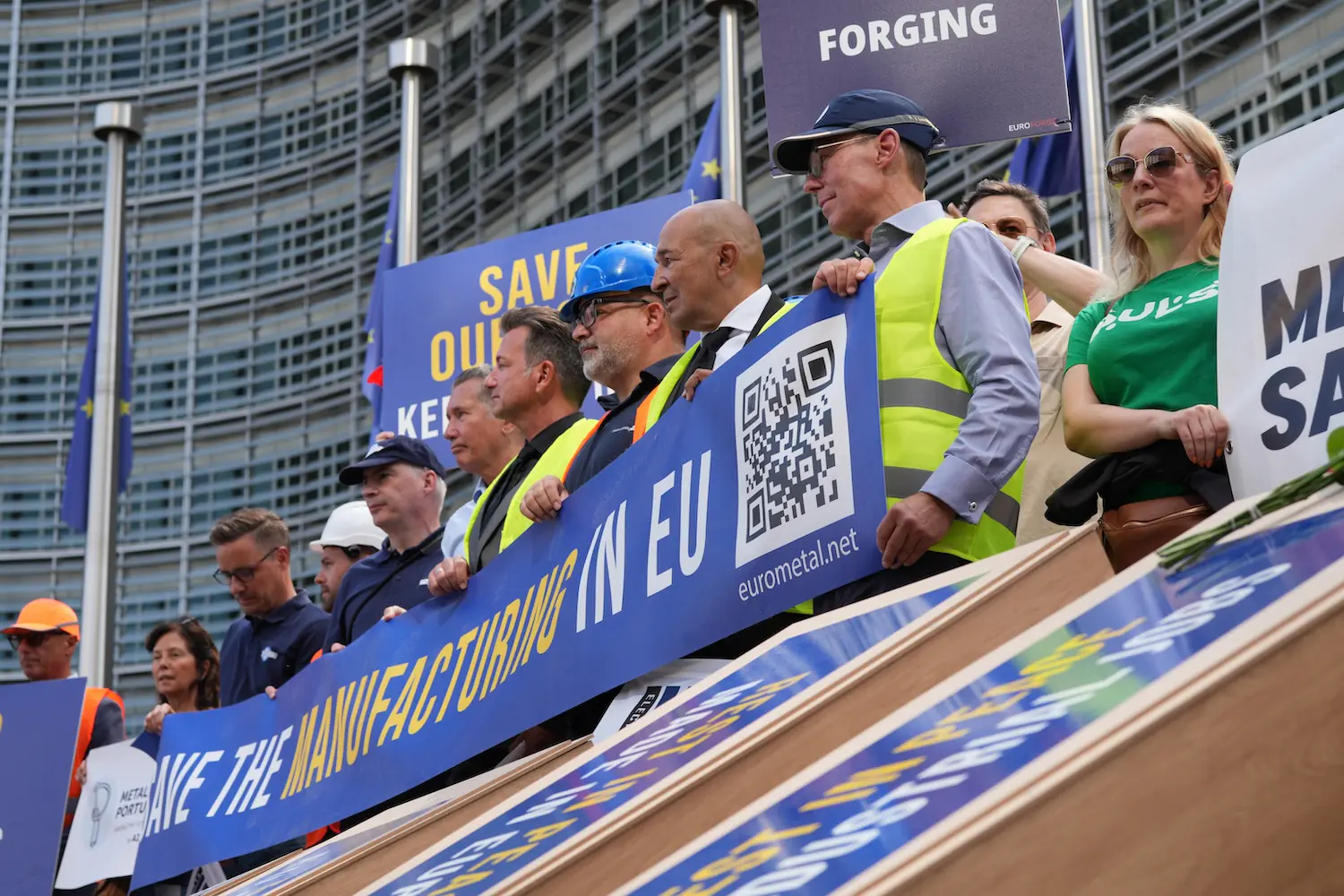
Representatives from across the EU’s steel sector held a symbolic funeral for European industry in Brussels on 7 September, laying ten coffins at the European Commission’s doorstep as part of EUROMETAL’s European Convoy for Industrial Competitiveness.
Reminiscent of similar efforts by Europe’s agricultural sector, the steel sector demonstrators were joined in their procession by a convoy of trucks, sounding their horns in concert as the coffins were laid in front of the Berlaymont, headquarters of the European Commission.
Conveying a symbolic death, the coffins were displayed with individual banners of “Industrial Jobs;” “Made in Europe;” “EU competitiveness;” “EU supply chains;” “Green Deal;” “Fair Competition;” “European Defence”; “European Factories;” “Industrial Independence;” and “EU Steel Demand” – commonly featuring a foreboding “Rest in Peace.”
McCloskey was on the ground in Brussels for the demonstration, well-attended by senior executives from companies across Europe’s steel value chain, and its representing associations.
The problem
Few would disagree that Europe’s industries are being put to the test: competitiveness concerns have grown to existential levels for European manufacturing, as domestic production costs are increasingly undercut by international exporters with cost advantages unavailable to European operators.
For industries such as steel, the potential loss of these capacities is likely to have real consequences: how can Europe retain global influence and attract competitive advantages in an increasingly fraught geopolitical context, if dependent on potentially volatile trading partners to facilitate its industrial survival, military capacity, and low-carbon transformation?
Seeing the danger, the European Commission has moved in the last year to mitigate some of these competitiveness pressures for its domestic steelmakers, attempting to ensure a future for steel production in the bloc to preserve its industrial backbone.
Two primary protective policy pillars have been constructed to hold the steel sector above water, on climate and trade grounds. Firstly, the Carbon Border Adjustment Mechanism (CBAM) entered into its ‘definitive’ stage in January 2026, mirroring domestic carbon costs to equivalent imports at the border; followed by reform of the EU’s long-standing steel safeguard system in July, doubling the EU’s steel tariff rate to 50%, while halving accessible duty-free volumes.
The effect on domestic steel prices has been significant, with European hot-rolled coil prices seeing a year-on-year gain of nearly 30% (EUR170/t) leading into September (McCloskey’s Northwest European hot-rolled coil price marker), with current prices 20% higher than when CBAM liabilities activated in January.
Additionally, as these protective pillars are intended to not only ensure the survival of the EU’s steel sector, but also facilitate its low-carbon transformation, the addition of a low-carbon premium to traditional steel pricing dynamics is likely to see end-consumers paying even more for their steel-containing inputs – especially if the EU forces low-carbon demand via green procurement mandates, already under legislative consideration.
The issue – with sirens now blaring broadly across Europe’s steel value chain, from steelmakers to manufacturers – lies downstream, as domestic manufacturing has not been afforded the same treatment in the European Commission’s protective efforts, and remains as of yet unshielded by both CBAM and the EU’s core steel tariff-rate quota (TRQ) trade measure.
As described by EUROMETAL President Alexander Julius, addressing the demonstrators, while upstream steelmaking enjoys new these protections, manufacturers downstream are being left to fight for global competitiveness “only on price,” despite many of its cost burdens coming from its own jurisdiction’s regulatory efforts – old and new – and the historical lack of effective EU-level movement to mitigate the bloc’s sky-high energy costs. Comparatively, the most aggressive international exporters have received subsidisations in their own jurisdictions, creating a significant policy cost gap that EU manufacturers are struggling to survive.
This creates a real risk that further cost inflation in upstream manufacturing inputs – and the consequent attempts of manufacturers to pass on these costs – sees buyers of the EU’s manufactured goods look abroad to lower-cost substitutive imports, resorting to skipping the European steel value chain entirely to preserve competitiveness in their own markets, or deliver maximum returns to shareholders.
EUROMETAL have already outlined the scale of the danger in their policy briefing “Steel Derivatives: The hidden threat driving Europe’s deindustrialisation”, finding that “Europe’s core industrial sectors – those most dependent on steel inputs – have been losing ground for over a decade” resulting in “a stealth mechanism of deindustrialisation, undermining Europe’s ability to retain value creation, climate responsibility, and strategic autonomy.”
How then to reverse this injury, or at least prevent its worsening, without overly abandoning core EU principles or values? In the absence of dealing with energy cost fundamentals, attendees at the Industrial Convoy for European Competitiveness would suggest politicians start with what they already have.
The solution?
There were scarce few demonstrators calling for the total abandonment of the EU’s climate ambition, or even for the individual scrapping of CBAM or upstream steel TRQ protections, despite the headache these developing regulations (often at last-minute) have caused European steel market participants over the last year. Be it faith in the importance of the EU’s climate leadership and trade protectionism, or political pragmatism, no demonstrators expected any significant reversals in the EU’s developing steel regulatory framework.
Instead, steel sector representatives across the value chain were near-unanimous in calling for a rapid extension of these new steel trade and climate protections to their downstream partners, seeing little point in protecting vital domestic supply, or distribution outlets, without also ensuring that European steel goods actually have a place to go.
While the European Commission is actively legislating to extend CBAM downstream, and has a similar consultation running for a limited first-step extension of the steel TRQs, there is still no decision from Brussels as to how far this extension should go, with different committee positions on CBAM’s extension alone still representing a lack of agreement on hundreds of downstream CN codes, and more substantive scope extensions to steel TRQs not scheduled for consideration until mid-2027.
Speaking to representatives at the demonstration, part of the solution may be to acknowledge that no best-fit extension strategy exists, instead implementing wide-ranging protections as a first step, then potentially weakening them, or exempting certain products where protections are deemed unnecessary, or ultimately do more harm than good (via a lack of EU supply availability, or export competitiveness factors).
“Shotgun-style”, “protectionist”, “Trumpian” – however demonstrators described their desired protections, the goal was a common one: to convince the European Commission of the urgent need to forgo its slower-paced administrative tendencies and prioritise rapid industrial protections, less the EU’s industrial capacities face irreversible injury.
Producers in the EU steel value chain – while not overly represented at the distribution and manufacturing-focused demonstration – have separately voiced support for EUROMETAL’s efforts, including steelmaking association Eurofer, ferroalloy producers’ association Euroalliages, forging association Euroforge, as well as other producing associations like those for the EU’s copper and aluminium segments.
“Once European industrial capacity and good jobs disappear, rebuilding it is far harder than preserving it,” European steel association, Eurofer, stated in a press release relating to the demonstration.
However, end-consumers that require a range of steel-containing manufactured goods, such as the automotive sector, have largely resisted further regulatory cost drivers in their supply chains, fearing for their own competitiveness should they have to sustain competitiveness in markets at home and abroad amid compounding inflationary pressures from the extension of upstream policy protections.
The risk is real: German automaker Volkswagen announced an additional 50,000 job cuts across its global operations earlier this week, citing excess capacities in Europe, as well as poor demand, and competition burdens as factors.
Earlier this year, industrial resistance downstream contributed to the Commission’s delay of the EU’s first official low-carbon steel label under the Industrial Accelerator Act to the Ecodesign for Sustainable Products Regulation, after member states were unable to reach a compromise between “Made in EU” and low-carbon content specifics in a demonstration of how regulatory ambitions can be tempered by competing national industry interests.
But for participants in the European Convoy for Industrial Competitiveness, their own industrial reality is telling them that time is up, and that the EU must move now if it wants its newly protected steel industry to have anyone left to sell to.
Author: Benjamin Steven

EU steel value chain warns Brussels over widening downstream competitiveness gap
European steel distributors, processors and manufacturers have stepped up pressure on EU policymakers to address what they see as a widening competitive imbalance between steel produced in or imported into the European Union and steel-intensive manufactured goods entering the bloc from third countries.
More than 200 representatives from the European steel, metals distribution, processing, logistics and manufacturing sectors gathered in Brussels on September 7 for the European Convoy for Industrial Competitiveness, organised by EUROMETAL.
The initiative brought 15 trucks and ten symbolic industrial coffins to the European Quarter, but the industry’s message went beyond the demonstration itself: EU trade and climate policies risk protecting steel at the border while leaving important parts of the downstream manufacturing chain exposed to lower-cost imports.
According to EUROMETAL, steel produced in Europe or imported directly into the EU is increasingly subject to trade defence measures, carbon costs and regulatory requirements, while many finished steel-intensive products manufactured outside the bloc can still enter the European market without equivalent obligations.
This creates a potential competitive distortion for European steel users. Manufacturers inside the EU face the cost of sourcing steel subject to European environmental and regulatory standards, while competing finished products may be produced abroad using steel that has not faced comparable costs. The concern is that tighter controls on direct steel imports could therefore shift rather than eliminate import pressure. Instead of importing steel and processing it in Europe, European buyers could increasingly turn to finished components, machinery, structures or other steel-containing goods produced outside the EU.
EUROMETAL has identified this as a growing risk of downstream carbon leakage, potentially resulting in manufacturing investment and employment moving outside Europe.
The issue has already been recognised at EU level. The European Commission proposed in December 2025 to extend CBAM from 2028 to around 180 additional steel- and aluminium-intensive downstream products, including machinery and appliances. The Council adopted its position on the proposal in June 2026, while the European Parliament’s Environment Committee subsequently backed an extension to downstream steel and aluminium products.
For EUROMETAL, however, the timing and scope of these measures remain critical. The federation has called for fair competition throughout the steel value chain, stronger protection against downstream carbon leakage, improved traceability and origin requirements and the inclusion of steel-intensive manufactured goods in EU trade and climate instruments where appropriate.
EUROMETAL president Alexander M. Julius said Europe could not achieve its climate, strategic autonomy and economic resilience objectives while allowing its manufacturing base to weaken.
“Today, too many steel-intensive products enter the European market without being subject to equivalent trade, carbon and regulatory obligations,” Julius said, warning that the imbalance could lead to investment leaving Europe, production moving abroad and skilled industrial jobs being lost.
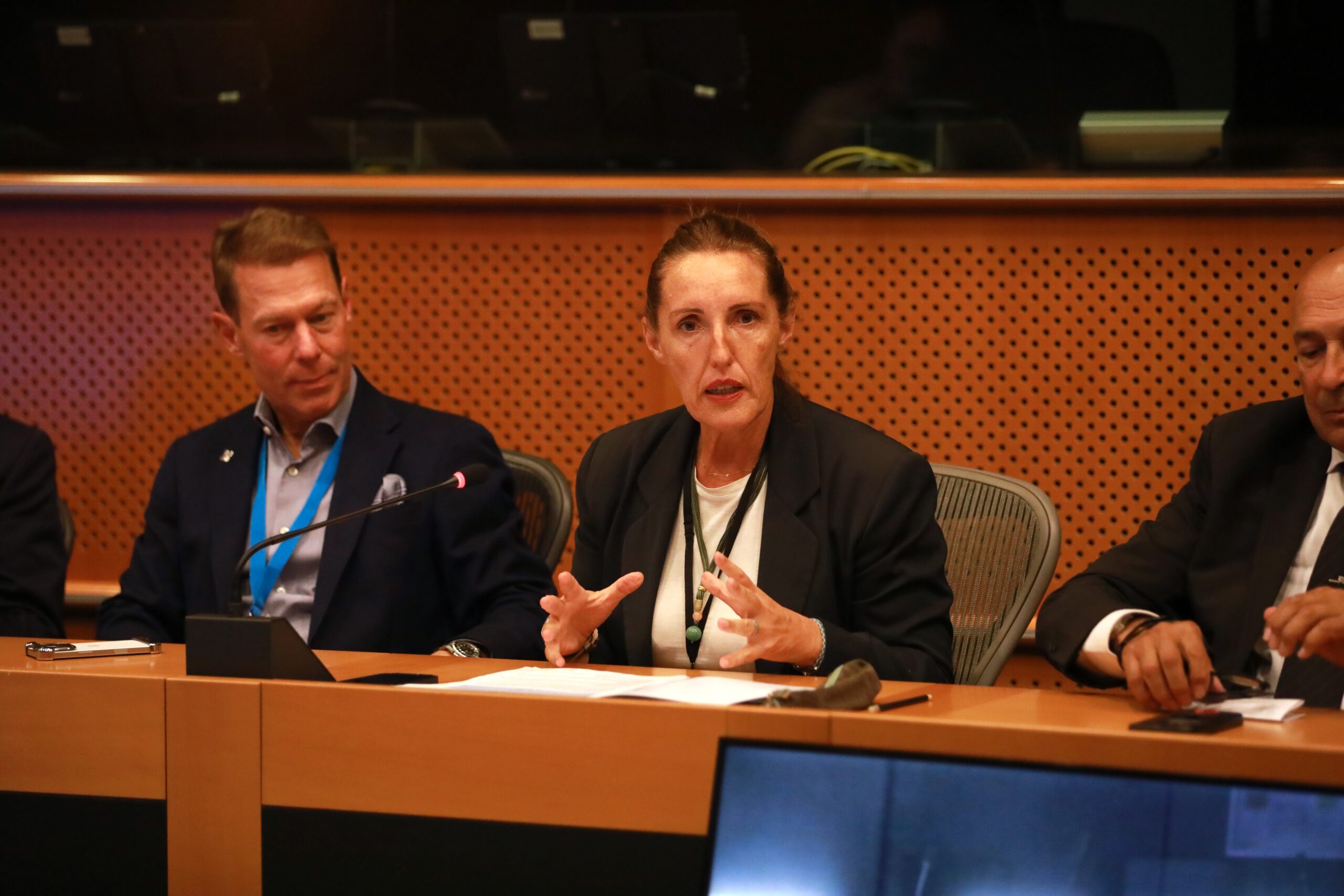
No European Commission representative met the delegation when it reached the Berlaymont, according to EUROMETAL. The federation’s position paper and Call to Action were instead handed to Commission security staff. Later in the day, participants were received at the European Parliament by Elena Donazzan, vice-chair of the Committee on Industry, Research and Energy, for discussions on industrial competitiveness, investment and the future of Europe’s steel-using sectors.
The debate highlights an increasingly important challenge for European industrial policy: how to decarbonise and protect domestic steel production without weakening the competitiveness of the manufacturers that consume it.
For Europe’s downstream industry, the question is therefore no longer only how much steel should be imported into the EU, but increasingly where the steel consumed by the European economy will ultimately be transformed into finished products – in Europe or abroad.


Volkswagen approves major layoffs, some plants could close
Volkswagen’s supervisory board has approved a restructuring programme that includes the elimination of approximately 50,000 jobs worldwide.
The decision was made unanimously after lengthy discussions last week. Its “Future Plan 2030″ calls for large-scale “personnel optimisation”, which the company explains is necessary to implement its transformation strategy.
The approved plan is the most extensive restructuring in the company’s 89-year history, Kallanish notes.
Four VW plants in Emden, Zwickau, Hanover, and Neckarsulm may cease operations because the company cannot guarantee competitive capacity utilisation for them from 2031 to 2034. Alternative uses for these sites will be considered, the enterprise claims.
A sustainable production structure concept for European companies must also be developed by the end of June 2027. The plan also calls for a near-half reduction in product lineups. Restructuring costs are estimated at up to €10 billion ($11.6 billion).
According to VW, the new programme will create conditions for improving the group’s efficiency and competitiveness. “The core automotive business takes centre stage and as market conditions evolve, the group plans for annual sales of nine million vehicles. The primary financial target is an operating margin of 9% by 2030. This corresponds to an operating result of approximately €31 billion, with €37 billion in overhead costs and a target of €135 billion for capital expenditure and research and development in the planning period 2027 to 2031,” it adds.
“This is a strong sign for the future of the Volkswagen Group and we are taking responsibility for our entire team, for our partners and for industrial jobs worldwide,” says the company’s chief executive, Oliver Blume. “Over the coming years, we will invest a three-figure billion sum to make our iconic brands even more attractive, stronger and more competitive.”
Union IG Metall and the works council note that some decisions prevented an escalation of new labour conflict, according to German media reports. They state that the issue of spinning off the core Volkswagen brand and the VW-Komponente division into separate entities has been removed from the agenda.
Author: Svetoslav Abrossimov

Salzgitter starts new straightening machine for plate
Salzgitter Mannesmann Grobblech in Mülheim has ramped up a new hot plate straightening machine, which enables material qualities suitable for the energy infrastructure sector, Kallanish hears.
The all-new facility is one of the largest single investments committed in over 20 years at the site, and marks an important step for future developments, the company underlines. The hot straightening machine was developed in collaboration with the Austrian partner Buma Engineering & Anlagenbau to meet special and specific requirements. It enables the production of high strength, thick plates to be used in the foundations and support structures of offshore wind turbines.
According to Salzgitter, a double digit million euro amount was invested in Mülheim to dismantle the old machine and install the new, more powerful system, weighing 1,100 tonnes.
The company highlights that implementing the project required many years of detailed planning. Special tracks were installed over the cooling beds to lay the foundation, and for the installation of the new system, while also facilitating the demolition of the old machine. Sill, only a brief shutdown was required in Mülheim for dismantling, installation, and commissioning, Salzgitter notes.
Salzgitter owns two of Germany’s three production mills for heavy plate: Salzgitter Mannesmann Grobblech in Mülheim and Ilsenburger Grobblech in Ilsenburg. According to plate buyers, the Ilsenburg mill focuses more on sophisticated grades, while Mülheim currently produces more commodity grades.
Author: Christian Koehl

SSAB’s Luleå steel transformation project takes new step

Germany’s crude steel production declined in July
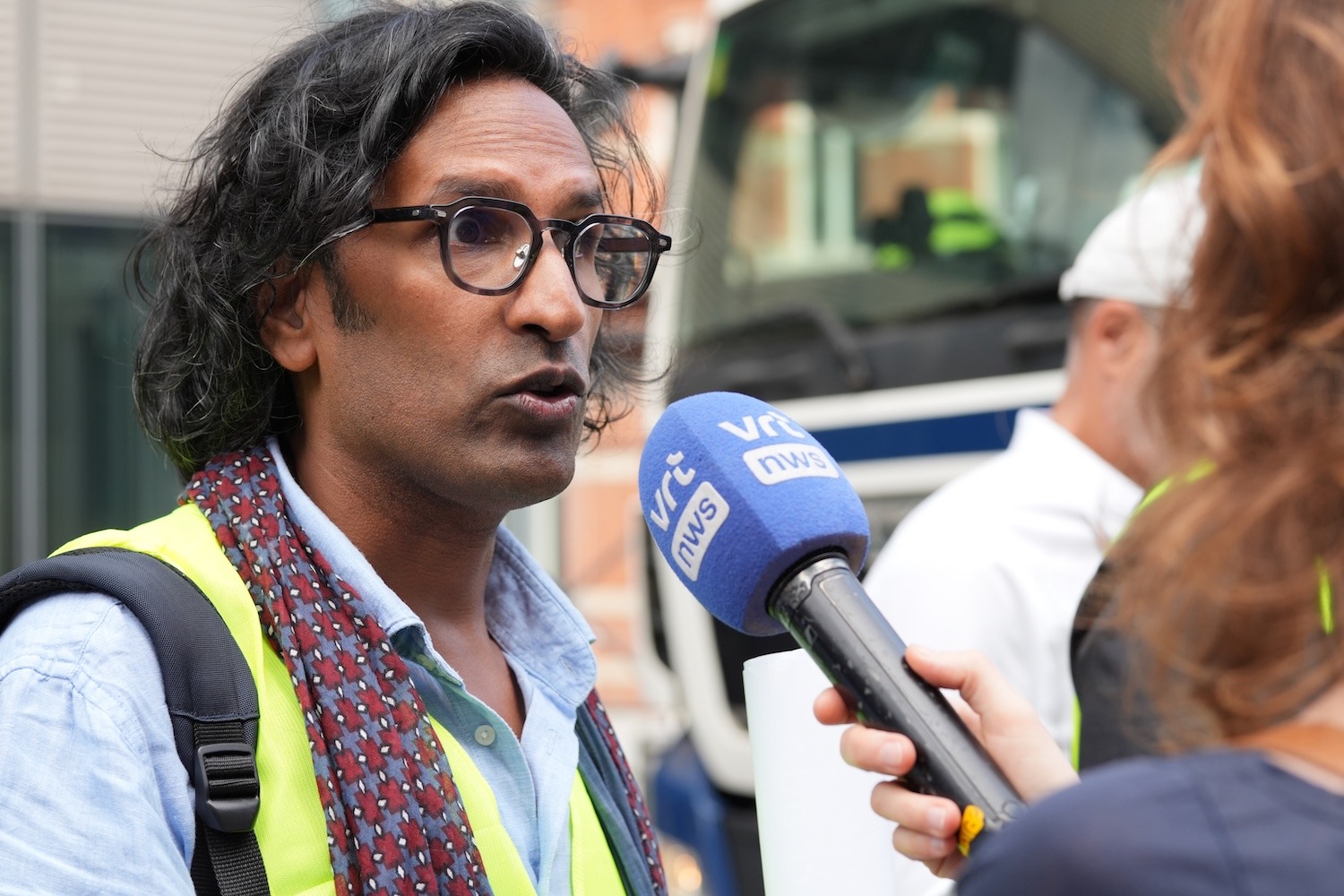
Belmetal: If European measures target only primary steel, competitive pressure could shift to processed products


Germany’s Moselstahlwerk puts 560,000 mt EAF steelmaking facility up for sale
German steelmaker MSW Moselstahlwerk GmbH has announced that it has appointed Amsterdam-based industrial asset management company KRUDO Industrial to manage the international marketing and sale of its electric arc furnace-based steelmaking facility in Trier, Germany, as part of its ongoing reorganization.
The facility includes a 60 mt Tenova Consteel electric arc furnace melt shop, secondary metallurgy equipment and a Danieli Centro Met three-strand continuous billet caster. According to KRUDO Industrial, the melt shop has an annual production capacity of approximately 560,000 mt and covers the production process from scrap charging and melting through refining and casting of 160 x 160 mm billets.
€80 million invested in facility modernization
Moselstahlwerk invested approximately €80 million in the modernization and technological upgrading of the facility in 2008, aimed at improving its steelmaking capabilities and production efficiency. The plant is capable of producing steel grades for a range of downstream applications, including wire rod, spring steel, cold-heading products, welding wire, free-cutting steel, prestressed steel and rebar.
KRUDO Industrial will market the facility globally, with a particular focus on potential buyers and investors in India, the Middle East, Africa, Asia and the Americas. The melt shop is being offered for sale by private treaty and can be inspected by qualified interested parties. According to KRUDO Industrial, the sale is aimed at steel producers seeking to expand existing electric steelmaking capacity or establish new operations through the acquisition and relocation of an existing facility.
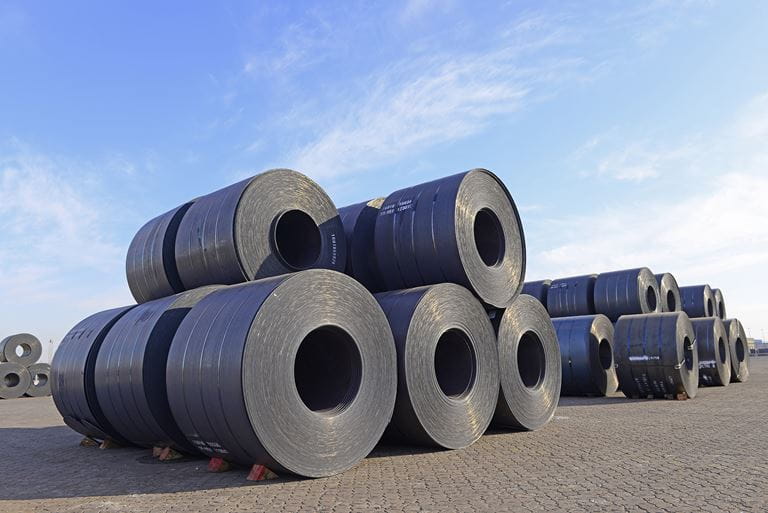
European HRC trading subdued as buyers resist higher mill offers
Trading activity in the European steel hot-rolled coil (HRC) market was quiet on Tuesday September 8, with buyers showing continued resistance to higher mill asking prices and limiting purchases to small volumes.
The Northern European market was relatively slow, with demand described as subdued and restocking ahead of the first quarter yet to materialize.
Small-volume deals were heard concluded at €750 ($862.82) per tonne ex-works.
“Demand remains very dull for the moment. Restocking for Q1 has not yet started,” a buyer told Fastmarkets.
A second buyer said tradable levels were within the range of €730-740 per tonne ex-works.
“The market is very slow and there is no demand, but small quantities on the market can be sold between €730 and €740 per tonne ex-works,” they told Fastmarkets. “€740 is the maximum, and it’s not possible to increase the price further.”
Buyers rejected suppliers’ higher asking prices of €770 per tonne ex-works as unworkable, and those levels were excluded from the daily pricing index.
Regional supply remained constrained, with major producer thyssenkrupp still absent from the market due to ongoing maintenance works.
Fastmarkets’ daily steel hot-rolled coil index domestic, exw Northern Europe, was calculated at €742.50 per tonne on September 8, unchanged from September 7. The index was down by €5.83 per tonne week on week and up by €25.00 per tonne month on month.
In Italy, trading activity remained limited amid persistent domestic supply constraints. While Metinvest’s Ferriera Valsider has restarted operations following a previous engine failure, it has yet to return to making offers.
Compounding availability concerns, Acciaierie d’Italia (ADI) faces a potential halt to its steelmaking operations by October following an August 27 Milan Court of Appeal ruling, which threatens to leave the domestic market with just a single operational HRC supplier.
Against this backdrop, workable price levels in Italy held firm at €720-730 per tonne ex-works on Tuesday.
“Higher offers sound in the market, but real deals are still flat,” an Italian-based buyer said. “I do expect more strength in price increases from EU producers in the next few weeks. The market is in trouble importing steel,” they added.
Fastmarkets’ daily steel hot-rolled coil index domestic, exw Italy, was calculated at €726.25 per tonne ex-works on September 8, down by €1.25 from €727.50 per tonne on September 7. The index was up by €13.75 per tonne week on week and up by €17.50 per tonne month on month.


Subdued buying weighs on European stainless CR sheet prices
Transaction prices for stainless steel cold-rolled sheet in Northern Europe edged lower over the past month amid persistently sluggish demand, sources told Fastmarkets.
Fastmarkets’ monthly price assessment for stainless steel cold-rolled sheet, 2mm, grade 304 transaction domestic, delivered North Europe fell to €2,740-2,800 ($3,186-3,256) per tonne on Monday September 7, down by €10-50 per tonne from €2,750-2,850 per tonne on Friday August 7.
Two distributor sources said that buying activity remained largely subdued.
“We are purchasing at a level between €2,740 and €2,755 per tonne at the moment, and we expect this level to be representative for the region,” a major distributor source told Fastmarkets. “As we are already approaching the end-of-year stock targets for distributors and service centers, we expect no restocking before year-end; on the contrary, we anticipate destocking behavior.”
A producer source said that trading remained quiet, adding that “the market is very weak.”
Meanwhile, European stainless steel mills announced modest increases in their alloy surcharges for September following the sharp declines seen in August.
Fastmarkets’ monthly assessment for stainless steel cold-rolled sheet, 2mm, grade 304 alloy surcharge, domestic Europe rose to €2,178-2,235 per tonne from €2,152-2,228 per tonne in August.
However, market participants noted that the small uptick in raw material surcharges failed to lift final transaction prices, as weak consumption continued to dominate price dynamics.
Fastmarkets’ monthly price assessment for stainless steel cold-rolled sheet, 2mm, grade 316 transaction domestic, delivered North Europe narrowed downward to €4,150-4,300 per tonne, compared with €4,150-4,350 per tonne on August 7.
Logistical issues reported along inland European waterways – notably low water levels on the Rhine – continue to be monitored by market participants, though actual disruptions to finished product deliveries remain limited given the overall low trading volumes.
Meanwhile, appetite for import material from Asia remains constrained. Buyers continue to point to trade defense measures and regulatory uncertainties – particularly safeguard quotas and the Carbon Border Adjustment Mechanism (CBAM) – as key deterrents against placing overseas orders.