EU steel TRQs fluid with trade, decarbonisation trends
The EU’s steel protections will continue to evolve subject to both domestic and global industry trends, according to Eurofer Deputy Director General Karl Tachelet, describing the steel tariff-rate quota (TRQ) framework as a “living instrument.”
Tachelet, responsible for International Affairs at EU steelmaking association Eurofer, discussed possible developments for the mechanism at the EUROMETAL Regional Meeting Central Europe 2026 in Warsaw on 16 September, as part of the panel on ‘Industrial Competitiveness and Regulation.’
According to Tachelet, while the EU’s steel protections have traditionally been time-limited (e.g the 5-year terms for anti-dumping protections), July’s overhaul of the TRQ framework has the potential to be permanent, though still remains a “living instrument.”
This dynamic nature of the TRQ regulation will not only be subject to developments in the international steel markets – after all, combating overcapacity-related import pressure is its core purpose – but also the decarbonisation of the EU’s domestic steel sector, Tachelet said, suggesting that the Commission would see no reason to keep the TRQs if its steelmakers failed to modernise their operations at pace with the bloc’s climate ambitions.
Against the doom-and-gloom sentiments more commonly associated with the European steelmaking sector, Tachelet was notably more positive, stating that in some ways, Europe represents something of an “investment hotspot” in global steelmaking, if interpreted more broadly as incorporating decarbonisation projects, rather than just capacity expansion.
The traditional model of integrated steelmaking “is not sustainable” in the context of the EU’s climate ambitions, said Tachelet, seeing the future of the European steel industry as belonging to “a new type of competitiveness, beyond price.”
EU advantages
The Eurofer Deputy Director General highlighted the EU’s significant advantages for the low-carbon transition: its abundant high-quality scrap reserves, its technological competencies and expertise, and its large manufacturing sector – i.e. “demand” – seeing a need to shield these competencies as the EU defines and realises its new competitive advantages.
Tachelet stressed that some of Europe’s decarbonisation barriers would be very difficult to overcome, but that Europe’s industries nevertheless have to “find a new competitiveness,” and questioned the long-term viability of new blast furnace assets and capacities in, for example, India, in “20-30 years”.
Dow Jones Energy tracks steel decarbonisation projects globally and by region, as detailed in our Global Green Steel Profile.
The European Commission does appear to be taking a harder stance on the inevitability of the industrial transition, with July’s reform proposal for the EU Emissions Trading System (ETS) introducing new conditionality mechanisms for producers to emit portions of their production free-of-charge via ‘free allocation’.
Dismantling the TRQs due to a lack of decarbonisation progress would represent a massive relaxation of the EU’s new import restrictions, but as discussed on the panel, the inverse is much more likely: that the Commission moves to further intensify protections by changing the basis of volume allocations to the TRQs from traditional origin determinants, to the country of “melt and pour” (MnP).
Melt and Pour, and its complications
Under the new TRQ regulation, the Commission must assess whether to change the allocation rules to MnP by the end of June 2028, which could then be backed with a legislative proposal. That deadline falls after the review to assess whether to extend the TRQs scope downstream to steel-containing goods, scheduled for the end of June 2027.
As the steel TRQ rules currently stand, the MnP clause operates as a traceability mechanism, with importers required to declare the country of MnP for in-scope products from 1 October, to be evidenced with Mill Test Certificates.
As described by EUROMETAL President Alexander Julius, switching allocations to the country of MnP would be an extreme change for steel imports, with the panelists commonly considering potential interactions between MnP allocations, and the extension to downstream steel-containing goods, as highly complex. Julius was also against the inclusion of scrap content and sourcing reporting requirements in the MnP rules, considering that level of international traceability to be “completely unworkable.”
Tachelet suggested that Eurofer was in support of MnP allocations, but also recognises that downstream MnP provisions could become very complicated.
The ‘value chain’ perspective
The Warsaw conference took a unique approach, focusing entirely on the urgent need to extend the EU’s new steelmaking protections downstream to steel-containing manufactured goods, without which the European value chain risks existential erosion from substitutive downstream imports.
Dow Jones Energy was in attendance for the sessions, and later moderated the steel production panel alongside panelists Tomasz Plaskura, CMO East Europe for ArcelorMittal Europe Flat Products; Jiří Mravec, Head of Innovation and Transformation at Czech steelmaker Třinecké železárny; and Radek Strouhal, CEO of Czech steelmaker NOVÁ HUŤ.
The sessions demonstrated unanimous agreement among steel sector representatives – including steelmakers – that downstream protections are indeed urgently necessary to preserve Europe’s industrial base, with a scope extension of both the newly intensified TRQ framework, and the Carbon Border Adjustment Mechanism (CBAM), considered the most appropriate strategy.
Distribution representatives emphasised that these extensions should not be seen as “support,” but rather a “level playing field,” allowing downstream industries to pass on upstream steelmaking’s inherently inflationary policy effects without losing competitiveness to substitutive imports, via the extension of those same policy protections.
Jiří Mravec stated that concerns over export competitiveness could no longer be allowed to delay the extension of trade protections across the entire steel value chain, emphasising the need to ensure the survival of steel demand within the EU. Alexander Julius expressed a similar position, considering the EU’s export markets as already “lost” to Chinese industrial overcapacity, requiring a much more defensive approach from regulators to halt the same trend at home.
Tomasz Plaskura of ArcelorMittal spoke of the importance – and opportunity – of consolidating the voice of the EU’s downstream steel sector representatives on the panel, saying that European authorities had never before been so responsive and willing to protect its industries, in recognition of its longstanding competitiveness burdens.
Earlier in September, EUROMETAL organised the ‘European Convoy for Industrial Competitiveness’, with Dow Jones Energy in attendance, seeking to bring visibility of the threat to European manufacturing and industry to the European Commission’s doorstep.
Author: Benjamin Steven


Nippon Steel decides to build new EAF in Slovakia
Nippon Steel, Japan’s largest integrated steelmaker, plans to build a 1.6 mt/y electric-arc furnace (EAF) at U.S. Steel Košice (USSK) in Slovakia to strengthen the mill’s long-term competitiveness and support stable supply of green steel in Europe, the company said on 16 September.
The new EAF is scheduled to start operating in 2030. Nippon Steel also plans to add an air separation unit (ASU) to support stable steelworks operations, improve energy efficiency and reduce CO2 emissions, with the ASU scheduled to start operating in 2029.
Total investment will be around EUR0.9bn ($1.04bn), including EUR3.5m from the EU Modernization Fund.
USSK currently has around 4.5 mt/y of crude steel production capacity, with two of its three blast furnaces operating. Actual crude steel output was 3.22 mt in 2025. Its key finished steel products are flat steel products.
A Nippon Steel official said the company had not yet decided whether any existing blast furnaces would be halted after the new EAF starts operating. The company will consider and determine an optimised production structure, the official said.
The official said a production base in Europe was needed as Nippon Steel expands its global production footprint in regions with growing demand. The company also expects increased EU trade measures on imported steel to make local production more suitable.
EAF production will increase the share of green steel in Nippon Steel’s output and allow the company to meet growing demand for lower-emissions steel in the region, the official added.
In May, Nippon Steel announced plans to separate USSK from U.S. Steel and make it a wholly owned subsidiary of Nippon Steel, effective 1 October. The company plans to rename the mill Nippon Steel Slovakia (NSSK) from the same date, positioning it as Nippon Steel’s key operating base in Europe.
Author: Benjamin Steven
Growing CEE manufacturing input imports threaten value chain
Central and Eastern European (CEE) steel production has plummeted in the last decade, but manufacturing continues, increasingly fed by imported inputs. This raises the question of how much of the steel value chain is generating value within Europe, says Polish Union of Steel Distributors (PUDS) president Piotr Sikorski.
CEE crude steel production dropped over 40% between 2015 and 2025 to 14.1 million tonnes, but regional end-user activity did not contract by the same amount – automotive, machinery and construction sector output continues.
The region’s array of mills once owned by Liberty Group have now been rescued or are awaiting rescue. “Who is willing to own, produce, finance, and modernise the capacity that has remained?” Sikorski asked during his presentation at last week’s EUROMETAL Regional Meeting Central Europe in Warsaw, attended by Kallanish. Alternatively, “where does the steel come from instead?”
Taking Poland, Czech Republic, Slovakia, Hungary and Romania into account, the deficit of finished carbon steel, including pipe, imports rose almost 9mt in the decade to 2025, to 14.2mt. The region has become substantially more dependent on steel imports. However, rather than imports from outside the bloc, intra-EU trade accounted for 60% of that deficit growth.
Going forward, “if the production is dropping, if the steel consumption is dropping, and we have effectively narrowed the import, how we keep on manufacturing?” Sikorski asked. Looking at the automotive sector across those five countries, imports of seven groups of automotive components rose 17.5% between 2015 and 2025, with intake from outside the EU doubling. Regional automotive output grew some 7% in the period to 4.11 million units.
“We were occupied with steel imports to EU, but we seemed to forget that the threat might be somewhere else,” Sikorski noted. “The industrial base remains but the way steel and components enter its value chains is changing.”
“The declining domestic steelmaking does not necessarily mean declining final manufacturing … The picture is much more complicated as European manufacturing is becoming more and more complex with external inputs. Part of the industrial value chain can move across borders, while the final factory remains exactly where it was,” he continued.
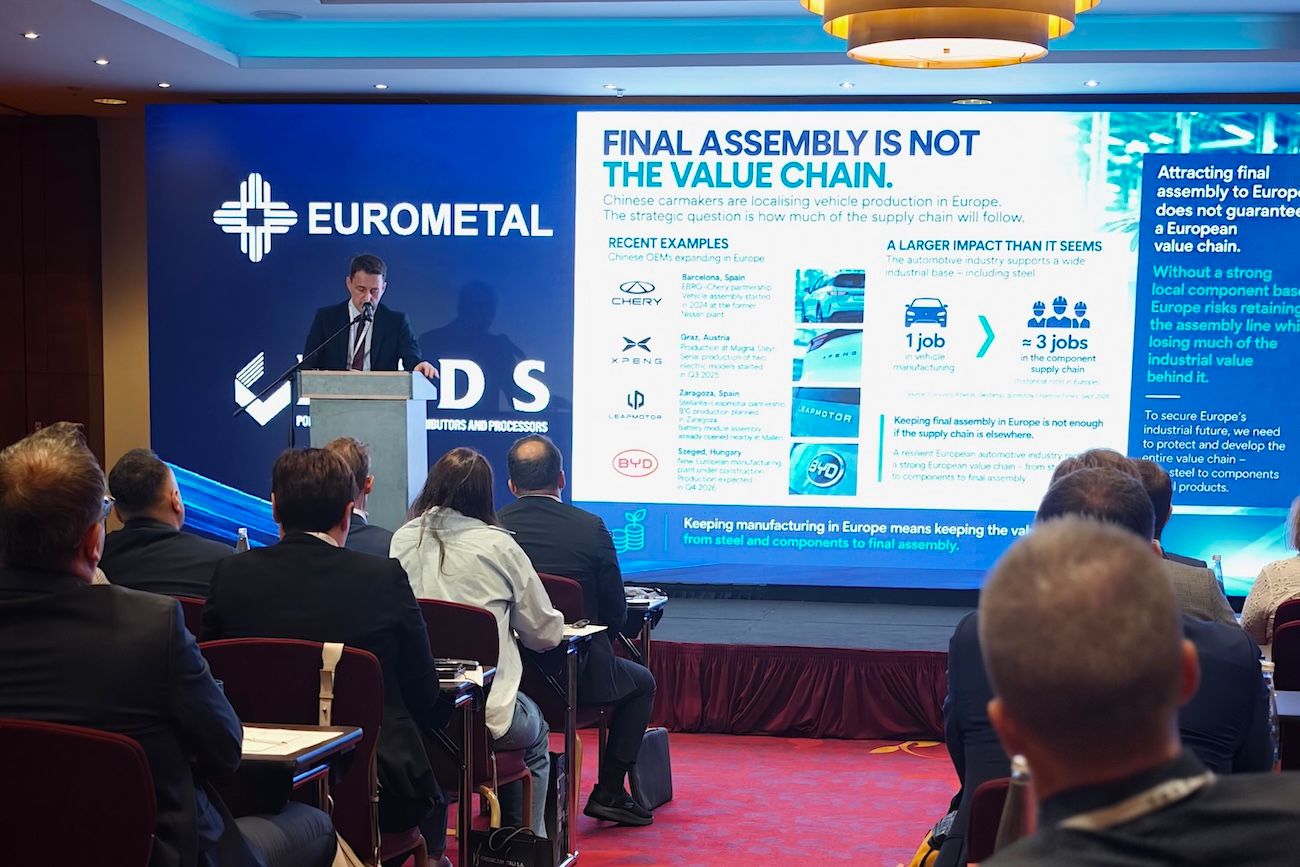
“We already see Chinese carmakers localising production in Europe. In our region, for example, BYD in Hungary, and of course investments in production coming to Europe are always welcome. But the real question is, how much of the supply chain will follow?” Sikorski noted.
He referred to the recent Financial Times interview with Gestamp executive chairman Francisco Riberas, who said he supports Chinese automotive investment in Europe but argued that Asian manufacturers should increasingly source components locally rather than importing them. Otherwise, Europe risks becoming no more than an assembly base.
“We should not ask, is this car made in Europe? We should also ask how much of the value behind this car is created in Europe, because the steel is hidden in the value chain,” Sikorski said.
“Europe cannot remain an industrial power if it retains only the final stage of the value chain,” he concluded.
Author: Adam Smith