Central and Eastern European (CEE) steel production has plummeted in the last decade, but manufacturing continues, increasingly fed by imported inputs. This raises the question of how much of the steel value chain is generating value within Europe, says Polish Union of Steel Distributors (PUDS) president Piotr Sikorski.
CEE crude steel production dropped over 40% between 2015 and 2025 to 14.1 million tonnes, but regional end-user activity did not contract by the same amount – automotive, machinery and construction sector output continues.
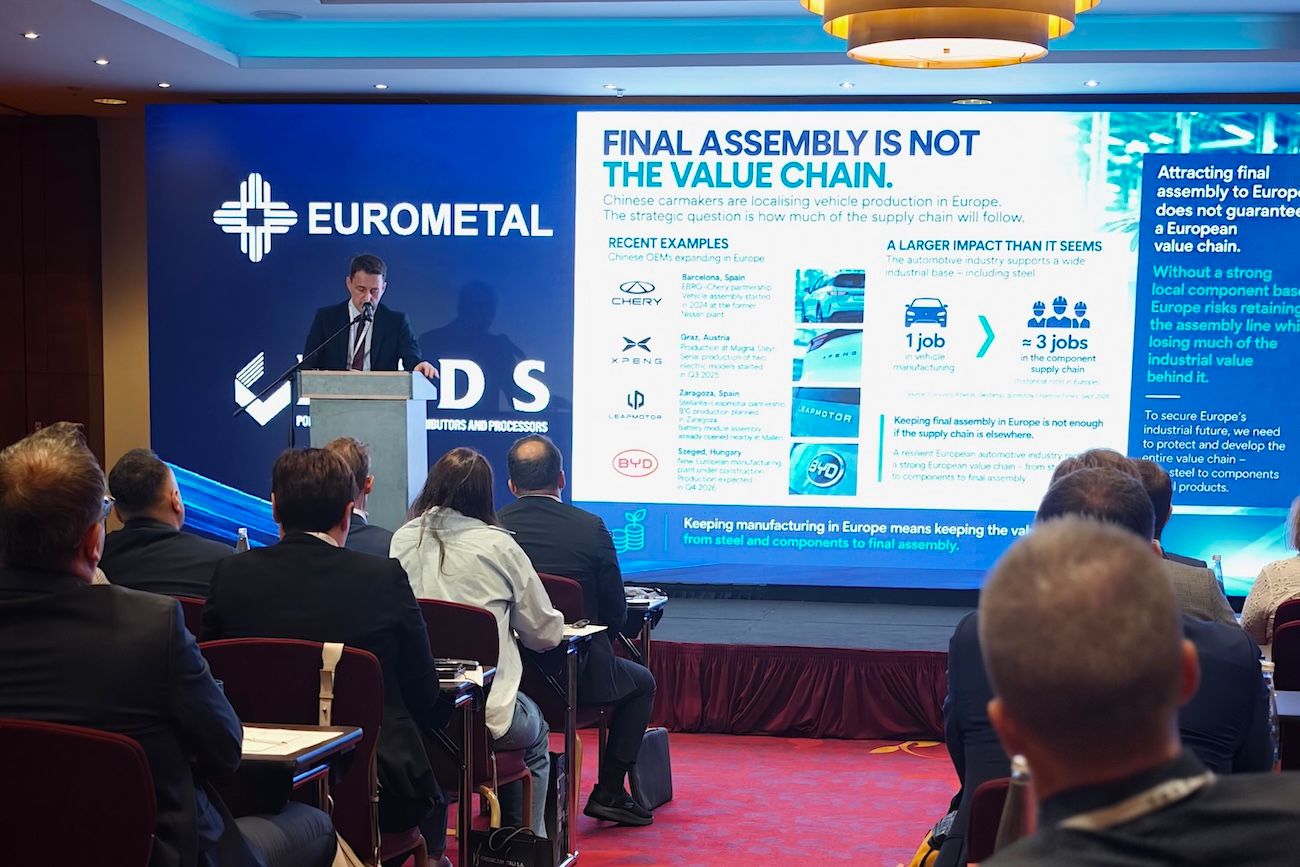
The region’s array of mills once owned by Liberty Group have now been rescued or are awaiting rescue. “Who is willing to own, produce, finance, and modernise the capacity that has remained?” Sikorski asked during his presentation at last week’s EUROMETAL Regional Meeting Central Europe in Warsaw, attended by Kallanish. Alternatively, “where does the steel come from instead?”
Taking Poland, Czech Republic, Slovakia, Hungary and Romania into account, the deficit of finished carbon steel, including pipe, imports rose almost 9mt in the decade to 2025, to 14.2mt. The region has become substantially more dependent on steel imports. However, rather than imports from outside the bloc, intra-EU trade accounted for 60% of that deficit growth.
Going forward, “if the production is dropping, if the steel consumption is dropping, and we have effectively narrowed the import, how we keep on manufacturing?” Sikorski asked. Looking at the automotive sector across those five countries, imports of seven groups of automotive components rose 17.5% between 2015 and 2025, with intake from outside the EU doubling. Regional automotive output grew some 7% in the period to 4.11 million units.
“We were occupied with steel imports to EU, but we seemed to forget that the threat might be somewhere else,” Sikorski noted. “The industrial base remains but the way steel and components enter its value chains is changing.”
“The declining domestic steelmaking does not necessarily mean declining final manufacturing … The picture is much more complicated as European manufacturing is becoming more and more complex with external inputs. Part of the industrial value chain can move across borders, while the final factory remains exactly where it was,” he continued.
“We already see Chinese carmakers localising production in Europe. In our region, for example, BYD in Hungary, and of course investments in production coming to Europe are always welcome. But the real question is, how much of the supply chain will follow?” Sikorski noted.
He referred to the recent Financial Times interview with Gestamp executive chairman Francisco Riberas, who said he supports Chinese automotive investment in Europe but argued that Asian manufacturers should increasingly source components locally rather than importing them. Otherwise, Europe risks becoming no more than an assembly base.
“We should not ask, is this car made in Europe? We should also ask how much of the value behind this car is created in Europe, because the steel is hidden in the value chain,” Sikorski said.
“Europe cannot remain an industrial power if it retains only the final stage of the value chain,” he concluded.
Author: Adam Smith