


New car registrations in EU up 5.7 percent in Jan-Sep 2026
In September this year, new passenger car registrations in the EU increased by 9.3 percent year on year to 971,048 units, according to the European Automobile Manufacturers’ Association (ACEA).
In the given month, France (+11.6%), Spain (+10.2%), Italy (+9.8%) and Germany (+9.0%) reported positive results.
In the January-September period of this year, new car registrations in the EU rose by 5.7 percent year on year to 8.52 million units. Italy (+8.6%), Spain (+6.7%), Germany (+5.3%) and France (+4.1%) posted increases.

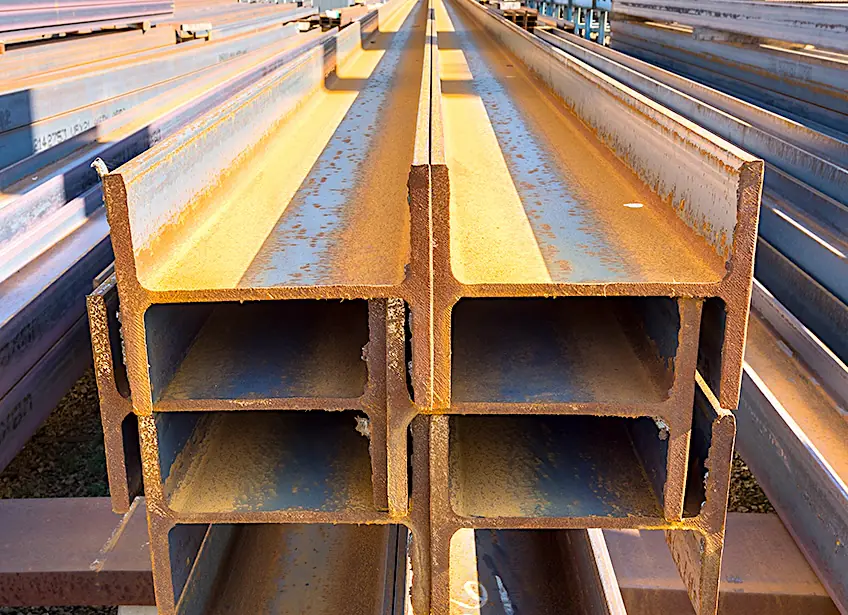
European longs producers firmer on prices, but demand remains selective
The European long steel market has continued to show differing trends this week. Higher energy and logistics costs are prompting some producers to take a firmer stance, while distributors and end-users continue to limit purchases to immediate requirements.
In the Italian rebar market, producers’ price requests have remained unchanged compared to the previous week, €720/mt including regular extras.
In Poland, market feedback indicates new offers at around €660/mt (PLN 2,900/mt) delivered, compared to the latest sales reported at €640-645/mt (PLN 2,800-2,830/mt) delivered, up by €5/mt compared to last week’s level. Stronger demand from Ukraine for Polish material is fueling expectations of further increases, although it is still too early to identify a uniform change across the market. Meanwhile, the leading European steel producer has stated that it will seek increases of €30/mt for November sales.
In central Europe, particularly Germany, rebar prices have also been reported at €650/mt delivered, up by €10/mt compared to SteelOrbis’ latest indications. Logistics are having the greatest impact in this market, as water levels on the Rhine remain significantly below reference levels.
In the export segment, in addition to Italian offers, Spanish rebar offers have been reported at €645-650/mt FOB, stable overall compared to the previous levels. Moreover, sources have reported that the shipping situation in the Black Sea is becoming more complex because of the higher insurance and freight costs linked to the ongoing conflict.
In the import segment, Turkey continues to show signs of softening. Official Turkish rebar offers for shipment in November stand at €585-595/mt CFR, down on US dollar basis but stable in euro terms compared to last week. Some Turkish mills are reportedly willing to consider €575-580/mt CFR for large tonnages, although no deals have been confirmed at these levels. Turkish wire rod offers have meanwhile declined by $5/mt week on week, with the upper end of the range also falling by €5/mt compared to the previous levels, to €595-600/mt CFR for the same shipment period. Offers from Egypt, instead, have been reported at €580-585/mt CFR for rebar and €595-600/mt CFR for wire rod, respectively lower by €5/mt on the higher end of the range and higher on the lower end of the range by the same amount. Both variations are on weekly basis.
Overall, European producers are seeking to pass on at least part of the higher energy costs to finished steel prices, while stable scrap prices provide only limited support for their price requests. Sentiment therefore remains cautious: while high energy and transportation costs may strengthen suppliers’ price requests, weak end-user demand continues to limit increases in long steel prices.
€1 = $1.12

European steel plate prices unchanged on limited trading; Italian mills continue targeting higher levels for 2027
European steel heavy plate prices were stable in the week to Thursday October 22, with limited trading activity heard across Italy and Northern Europe, as producers were already targeting higher 2027 levels, sources said.
Italy
In Italy, most indications for steel plate prices were reported by sources within €740-750 ($830-842) per tonne ex-works, unchanged from the previous week.
Market participants said producers were targeting levels at €770-780 per tonne ex-works for delivery in January 2027, while a trade source said deals were already achieved at the higher end of the range for the same delivery period. Some sources, however, expressed uncertainty about such high levels done in the market.
This price range at €770-780 per tonne ex-works was not considered in the final assessment due to delivery time exceeding Fastmarkets’ methodology window of up to six weeks.
“Plate [is] stuck at €740-750 [per tonne] base ex-works Italy, even if most re-rollers push for at least plus €30 [per tonne] to these levels for January delivery,” a producer said.
As a result, Fastmarkets’ weekly price assessment for steel domestic plate 8-40mm, exw Southern Europe was €740-750 per tonne on Thursday October 22, stable week on week.
Meanwhile, steel slab import prices in Italy edged lower amid weaker Asian prices, while uncertainty over Carbon Border Adjustment Mechanism (CBAM) costs and emissions verification complicated buying decisions and the assessment of alternative origins, sources said during the week.
Fastmarkets’ weekly price assessment for steel slab import, cif Italy was $580-590 per tonne on October 22, narrowed downward by $5 per tonne from $580-595 per tonne a week earlier.
Market sources did not report any fresh prices regarding imported plate material, citing higher CBAM-related risks.
Thus, Fastmarkets’ weekly price assessment for steel plate (8-40mm), import, cfr main port Southern Europe, was stable at €710-750 per tonne on Thursday.
Northern Europe
In Northern Europe, the market was quiet during the week, with some participants attending the Euroblech fair in Hanover on October 20-23, limiting the availability of pricing data.
A trade source reported an indication of workable levels for commodity plate in Germany at €850-880 per tonne ex-works during the week, mostly unchanged from previous levels. No other prices were received during the assessment period.
For this reason, Fastmarkets’ latest weekly price assessment for steel domestic plate 8-40mm, exw Northern Europe remained stable at €840-880 per tonne on October 22.
No fresh information was heard about plate imports into the region, as sources said there was a lack of buying interest.
“Imports are nothing to be considered at this moment, at least not for Antwerp,” the same trade source said.
Fastmarkets’ weekly price assessment for steel plate (8-40mm), import, cfr main port Northern Europe, was €710-750 per tonne on Thursday, unchanged from the previous week.


European coil and green steel round-up
European hot-rolled coil (HRC) prices increased in the week to 23 October, although liquidity remains limited due to weak apparent demand.
European distributors hold significant stocks of flat steel, having customs-cleared excessive volumes in June ahead of the introduction of stricter post-July quotas. As underlying demand has yet to improve, destocking is taking longer than usual.
Buyers are limiting purchasing volumes to only those needed to fill portfolio gaps, market sources said.
Despite this limited trading activity, market sentiments are bullish, as the combination of tariff-rate quotas (TRQs) and the Carbon Border Adjustment Mechanism (CBAM) has made imports more costly and restrictive, pushing European steelmakers to a larger market share.
In Northwest Europe, deals for domestic HRC have been settled at EUR750-770/t ex-works. Offers for HRC for first-quarter delivery have reached EUR790-800/t delivered. Some steelmakers claimed to be sold out on HRC for first-quarter deliveries.
The region’s mills have also started to negotiate contracts for the first half of next year, and for the whole of 2027, seeking increases of EUR100-150/t compared with the latter half of 2026. Market participants believe that contracts will ultimately be settled with increases of around EUR50-80/t.
In Italy, domestic HRC prices have been reported at EUR740-750/t ex-works and EUR740-770/t delivered. A few transactions were still being concluded at lower rates, at EUR730/t delivered.
Prices for imported HRC are comparable to those offered by European mills, ranging from EUR740/t DDP at Italian ports for material already available there to EUR800/t DDP for new orders. Additionally, buyers face the risk of exceeding available quota limits and paying costly 50% duties, though Dow Jones Energy’s analysis shows that ‘effective’ duties could be lower than expected.
On a CIF basis, HRC from the Far East, India and Turkey has been offered at EUR740-750/t, including anti-dumping duties where applicable.
To tackle limited import availability, some traditional HRC importers have switched to purchases of non-EU steel slab for use as rolling feedstock for European capacities.
Green steel market
Demand for green steel coil in the spot market remains limited, with transactions largely settled for small trial volumes. Automotive companies and construction projects continue to be the main sources of demand for low-emissions steel, while most buyers remain focused on adapting to new trade restrictions and securing supplies of conventional material.
Green HRC premiums vary depending on the producer, buyer and type of contract. Premiums of around EUR200/t have been reported for project-based sales and long-term contracts, while a South European producer has indicated premiums of EUR200/t for material from its electric-arc furnace (EAF)-based plant. Spot premiums for EAF-produced green HRC are generally around EUR100/t, in line with buyers’ idea of workable premiums.
Some mills claim green steel premiums of up to EUR300/t, although confirmed levels are lower. Project-related sales have been concluded at around EUR200/t, while trial sales by other producers have been reported at approximately EUR150/t.
Distributors continue to show limited willingness to hold low-CO2 steel in stock, typically purchasing it on a back-to-back basis against confirmed end-user orders. Buyers’ indications for green steel premiums are generally around EUR100/t in the spot market, reflecting subdued demand and a cautious approach to paying extra for lower-emissions material.
| Weekly European steel coil | |||||
| EUR/t | Term | 23-Oct-26 | Change | ||
| Weekly Northwest Europe steel coil | |||||
| Northwest Europe ex-works HRC | EX-WORKS | 760.00 | 10.00 | ||
| Northwest Europe ex-works CRC | EX-WORKS | 865.00 | 0.00 | ||
| Northwest Europe ex-works HDG | EX-WORKS | 855.00 | 5.00 | ||
| Northwest Europe CIF HRC | CIF | 640.00 | 0.00 | ||
| Northwest Europe DDP port HRC | DDP Port | 780.00 | 30.00 | ||
| Weekly South Europe steel coil | |||||
| Italy ex-works HRC | EX-WORKS | 740.00 | 10.00 | ||
| South Europe CIF HRC | CIF | 640.00 | 0.00 | ||
| South Europe DDP port HRC | DDP Port | 775.00 | 25.00 | ||
| South Europe CIF CRC | CIF | 720.00 | 0.00 | ||
| South Europe DDP port CRC | DDP Port | 865.00 | 25.00 | ||
| Source: McCloskey by OPIS. | © 2026 Dow Jones Energy Limited. | ||||
| Weekly green steel | |||
| EUR/t | Term | 23-Oct-26 | Change |
| Green Northwest Europe HRC premium (scopes 1-3 CO2 under 0.8t) | 100.00 | 0.00 | |
| Green Northwest Europe ex-works HRC (scopes 1-3) | EX-WORKS | 860.00 | 10.00 |
| Green HRC premium (scopes 1-2 CO2 under 0.5t) | 100.00 | 0.00 | |
| Green Northwest Europe ex-works HRC (scopes 1-2) | EX-WORKS | 860.00 | 10.00 |
| Green HRC reduced carbon price (scopes 1-3) | 74.06 | 11.44 | |
Author: Benjamin Steven & Maria Tanatar


European heavy plate round-up
European s235jr-grade heavy plate prices remained unchanged in the week to 23 October, with sentiment turning more bullish due to restocking and higher slab costs.
“Real demand did not improve, but cutting centres and stockists need to buy,” a German distributor said.”Lead times are getting longer,”
Italian re-rollers concluded transactions for s235jr plate with spot buyers at EUR740-750/t ex-works, with the majority of indications reported at the upper end of the range. Offers were heard at EUR770-800/t ex-works.
Deals for project volumes have been concluded at prices closer to EUR800/t ex-works Italy.
While Italian mills have largely consolidated their offers, re-rollers from France and Northwest Europe have been offering s355jr material at the lowest prices in Germany, securing deals at competitive prices.
Italian mills have been offering s355jr plate at EUR860-870/t delivered Germany, compared with deals concluded with re-rollers from France and Northwest Europe at EUR840-850/t delivered. Offers for material from a Czech-based producer were reported at EUR880-890/t delivered.
German mills continued to focus on long-term agreements and projects, limiting their presence in the spot market. Offers from domestic steelmakers were heard at EUR850-890/t ex-works for s235jr plate and at EUR900/t delivered for s355jr material.
Prices for imported slab from Asia have been heard at $600/t CIF Italian ports.
Steel imports, including slab, cleared through customs in the first quarter of 2027 will be affected by the evolution of the Carbon Border Adjustment Mechanism (CBAM) framework, which will require importers to hold certificates covering at least 50% of their CBAM liability before the end of each quarter. As verification of exporters’ emissions data is inherently retroactive, CBAM rules require this rolling liability to be assessed using either default values or values corresponding to those underlying certificates surrendered in the previous year, where the country of origin and CN codes match. Given European re-rollers will not be able to surrender CBAM certificates until declarations are due in September 2027, this 50% requirement would effectively need to be assessed using costlier default values.
While importers are able to refund excess CBAM certificates purchased on the basis of default values if they can verify lower actual emissions values, the working capital burden is still significant. As an example, the default-value-based cost per tonne of a 2027 Chinese slab import could exceed EUR200/t, at a CBAM certificate price of EUR80/t.
| Weekly European heavy plate, slab and green steel | |||||
| Unit | Term | 23-Oct-26 | Change | ||
| Weekly heavy plate | |||||
| Northwest Europe ex-works heavy plate | EUR/t | EX-WORKS | 860.00 | 0.00 | |
| Germany delivered heavy plate (Northwest Europe) | EUR/t | DEL | 870.00 | -10.00 | |
| Italy ex-works heavy plate | EUR/t | EX-WORKS | 750.00 | 0.00 | |
| Weekly steel slab | |||||
| Italy CFR slab | $/t | CFR | 600.00 | 10.00 | |
| Weekly green steel | |||||
| Green heavy plate premium (scopes 1-3 CO2 under 1t) | EUR/t | 25.00 | 0.00 | ||
| Source: McCloskey by OPIS. | © 2026 Dow Jones Energy Limited | ||||
Author: Benjamin Steven & Maria Tanatar

EU revises AD duties on Turkish cold-rolled flat steel
The European Commission has circulated a revision of anti-dumping duty rates soon to be imposed against imports of cold-rolled flat steel from Turkey, a document dated 16 October shows, following a challenge from Turkish exporters.
The EU launched an investigation into the potential dumping of cold-rolled flat steel products from India, Japan, Turkey, Vietnam, and Taiwan, China at the request of EU steelmakers association EUROFER in September of last year, publishing final duties onto the EU’s private trade portal in August.
Following the Commission’s disclosure, Turkish exporters Tatmetal and Borcelik challenged data forming the basis of the definitive duty assessments, and have managed to secure a revision to the duty rates:
| Exporter | Definitive anti-dumping duty | Pre-revision |
| Borçelik Çelik Sanayi Ticaret A.Ş. | 7.80% | 9.70% |
| Tatmetal Çelik Sanayi ve Ticaret A. Ş. | 3.00% | 5.60% |
| Other cooperating companies | 4.90% | 7.30% |
| All other imports originating in Türkiye | 7.80% | 9.70% |
Source: European Commission, DG Trade © 2026 Dow Jones Energy Limited
Data informing the investigation was challenged on the basis of unwarranted inflation adustment assumptions, CIF and ex-works price calculation irregularities, and freight cost errors. The Commission accepted the complaints, finding them justified, and has revised the data underlying the dumping duty decision.
Market participants expect the final duties to be released before the end of October – the EU’s investigation webpage previously listed an expected publication date of 14 November. The AD duties will enter effect following their publication in the EU’s Official Journal.
Dow Jones Energy tracks steel trade protection developments in its in its Global Steel Trade Measures Database, updated monthly.
Author: Benjamin Steven & Maria Tanatar
EU steelmakers take aim at pro-rata TRQ duty dilutions
European steelmakers are critical of administrative elements of the EU’s tariff-rate quota (TRQ) system in its post-July rework, sources tell Dow Jones Energy, specifically the pro-rate allocation of duties on first-come-first-served clearances.
The EU intensified its steel protection framework earlier this year, in July, with the market now in its second trading quarter following implementation.
Having had time to digest new complexities introduced by the EU’s new steel regulation – which intensified steel trade protections by approximately halving duty-free volumes, and doubling out-of-quota duties to 50% – steelmakers increasingly view aspects of the new system as open for exploitation, particularly interactions between first-come-first-served duty allocations, and what that means for effective duties if initial clearances exceed allocated volumes.
The EU’s TRQs open at the start of each trading quarter, with the exception of clearances in the inaugural July-Sept quarter, subject to an 11-day acclimatization blocking period, and competitive shared quotas, which are only available once an origin exhausts its dedicated country-specific volume. Importers with volumes in-port will generally seek to clear goods as soon as possible to ensure they can secure their part of available duty-free volume allowances, and avoid 50% duties.
However, due to immediate importer competition for these duty-free volumes, and customs fragmentation across the EU’s 27 member states, the EU’s ‘first-come-first-served’ principle for quota allocations treats all first-day clearances into the steel quotas equally, diluting the duty cost across all relevant volumes. Effectively, this means that excess volumes can clear into the new steel quotas without paying the full 50% duty, instead issuing duties pro-rata across the entire volume.
This does of course mean that no volumes clear entirely duty free, but pro-rata mitigation of the full 50% duty cost could still allow more import volumes to enter the EU market than intended by the tightened quotas, at cost levels below the competition line for domestic producers.
Dilution in practice – product category 24
Consider, for example, recent quota dynamics under product category 24, ‘Other Seamless Tubes’, which allocates an annual duty-free quota allowance of 52,635.36 t for Chinese origin imports – or 13,158.84 t quarterly.
Market participants report that a significant volume of Chinese tube imports were cleared for distribution into the EU since the opening of the Q4 quota period from October, resulting in a pro-rata dilution of the 50% duty across all cleared volumes.
Indeed, checking the EU’s online quota tracker through TARIC shows that China’s category 24 quota is fully exhausted, and that the last in-scope volumes (dated 8 October) received 0% allocation to the quota, signalling at least some out-of-quota imports subject to the full 50% duty rate.
Here, however, friction is encountered with the EU’s quota data framework: the ‘effective’ duty paid can be calculated, or inferred across first clearances in reference to data on the ‘Total awaiting allocation’, and the ‘Allocated percentage at the last allocation’ – but this data is only ever available in reference to the most recent import registration, and is not stored anywhere within the EU’s customs databases.
Essentially, this means that if TARIC data is not constantly scraped and stored, market participants lose visibility of not only volumes potentially cleared in excess of the EU’s desired limits, but also the effective duty rate paid on that material.
Fortunately in this case ESTA – the European Steel Tube Association – circulates weekly quota utilization reports for product category 24, including latest data for ‘Total awaiting allocation’. ESTA’s report from 2 October shows China’s product category 24 at its initial balance of 13,159t – but importantly, lists 23,948t as awaiting allocation, almost double the EU’s designated allowance.
Unfortunately, ESTA’s data does not include allocated percentages on last allocation such to fully confirm whether duty dilution occurred, as opposed to withdrawal of the import registration (possible in some jurisdictions, like Italy), but cost analysis strongly suggests an advantage to clearing the material.
At an initial balance of 13,159t, clearing an initial volume of 23,948t would instantly exhaust the quotas, meaning 50% duties should be applied on 10,789t. As EU customs processes – across all its Member States – are not equipped to fairly distribute first-come-first-served allocations from this first-day volume, the 50% duty is instead imposed pro-rata across the entire 23,948t, resulting in an effective duty rate of 22.53%.
Landed costs
Market participants surveyed by Dow Jones Energy reported an import offer ex-China at EUR568/t FCA – EUR768/t CIF when including shipping costs – which when applying a pro-rata duty of 22.53%, and Carbon Border Adjustment Mechanism (CBAM) costs, gives a landed value of EUR1,071/t. The offer reported includes a CBAM cost assessment of EUR130/t – in line with costs generated by Dow Jones Energy’s CBAM Default Values Calculator.
EU suppliers reported a general domestic offer price level of Eur1,350/t for equivalent goods, meaning that even within the EU’s intensified steel protection framework, and assessed on CBAM default values, imports can hit the bloc almost Eur300/t below domestic offers. In fact, even applying a 50% duty to the CIF price gives a cost almost Eur100/t below domestic price indications, suggesting that – at least in product category 24 – the EU’s new protections are not fully effective in protecting steelmakers on volume, or price.
Steelmakers argue that where significant duty rates are required to close these cost gaps – often the case with ex-China imports – that this dynamic could in fact incentivize, rather than deter, low-cost exports to the EU beyond defined quota allowances.
Trader sources confirm the opaqueness surrounding pro-rata duties and totals awaiting allocation in the EU’s TARIC databasing once clearances are registered beyond initial imports, confusing their estimations of import accessibility:
“The EU doesn’t leave the number online, so we don’t even know what’s waiting – what’s been allocated or retracted,” said one trader. “It’s very difficult to estimate.”
Importers still consider the current pro-rata system as the best option however, given practical issues in tracking first-come-first-served allocations across the EU’s fragmented customs regime, arguing that having to pay the full duty wouldn’t make sense where quota volumes were visibly open at the time of requested clearance.
Market participants say that this interaction between first-come-first-served quota administration and duty dilutions is a long-standing issue that was also present under the pre-July steel safeguard system, but that market impacts were historically limited to flat steel imports. Now that overall steel quota volumes are reduced, however, duty dilutions are seen as presenting a threat in new product categories. This is obviously something steelmakers would like to remedy under the new system, especially if the new TRQs are to be a permanent feature of the EU’s future steel trade landscape.
Author: Benjamin Steven

EU Steel Distribution: Positive activity and price expectations persist amid stable market conditions
The October 2026 EUROMETAL Market Sentiment Survey shows that European steel distribution continues to anticipate stronger activity and higher prices, while current market conditions remain broadly stable.
Following the more constructive outlook recorded in September, October’s results maintain a positive balance in expectations for activity over the next quarter. Price expectations remain firmly oriented towards increases, providing the clearest directional signal in the survey.
Inventory expectations, meanwhile, remain centred on stability, with distributors continuing to take a measured approach to stock management.
Overall, the results suggest that cautious optimism persists, although expectations of improvement have yet to translate into a broad strengthening of current activity.
Assessment of Current Activity
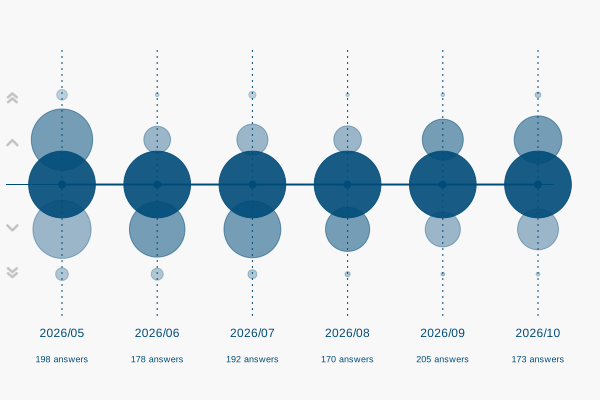
The assessment of current activity remains predominantly neutral in October, with the largest group of respondents reporting stable conditions.
Responses on either side of the neutral line indicate that market experiences remain mixed. Some participants report stronger activity, while others continue to face weaker conditions.
The overall picture is therefore one of continued stabilisation. Despite the more positive outlook for future activity, the October results do not yet indicate a widespread recovery in current business conditions.
Future Activity Forecast
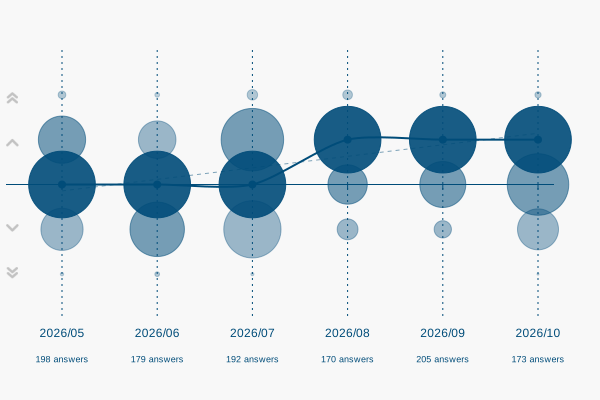
Expectations for activity over the next quarter remain positive in October.
The largest concentration of responses remains above the neutral line, maintaining the more constructive outlook visible since August. Stable activity also attracts a substantial share of responses, while fewer participants anticipate a decline.
The results suggest that respondents continue to see scope for improvement in the coming months. However, the significant neutral response underlines that confidence remains measured, with expectations pointing towards a gradual improvement rather than a sharp rebound.
Stock Position Outlook
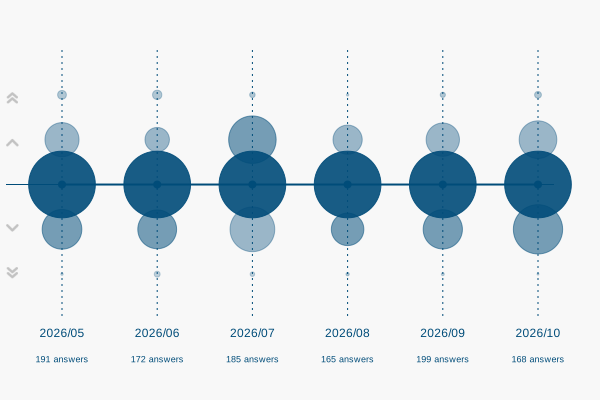
Stock expectations remain mainly stable, indicating that distributors continue to manage inventories cautiously.
The largest group of respondents expects stock volumes to remain broadly unchanged over the next three months. Among those anticipating a change, reductions carry somewhat more weight than increases.
This balance suggests that positive expectations for activity and prices are not prompting widespread restocking. Inventory plans remain restrained, consistent with the predominantly stable assessment of current market activity.
Price Development Expectations
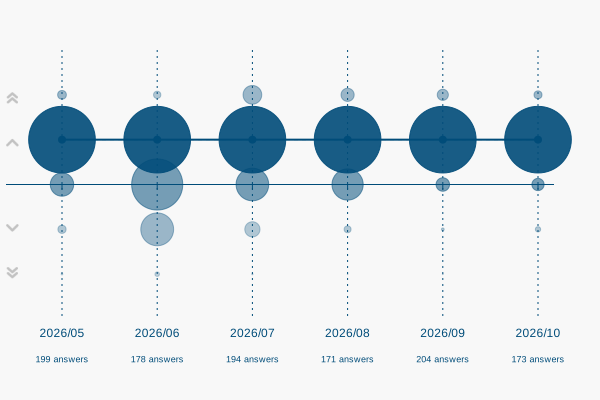
Price expectations remain strongly oriented towards increases in October.
The largest concentration of responses is above the neutral line, continuing the upward bias recorded in previous months. Comparatively few respondents anticipate stable or declining prices.
The results indicate a clear expectation of firmer prices over the next three months. This should nevertheless be distinguished from evidence of stronger demand: the survey records expectations for price direction, without identifying the factors behind them.
Outlook for the Coming Months
The October survey maintains the cautiously positive outlook seen in September.
Expectations for future activity remain constructive and price expectations continue to point upwards. Current activity, however, remains largely stable, while stock plans show continued restraint.
Taken together, these indicators suggest that the sector anticipates better conditions but remains cautious in its operational decisions. A broader improvement in actual activity would provide stronger evidence that the anticipated recovery is taking hold.
This analysis is based on the October 2026 EUROMETAL Market Sentiment Survey, with 173 responses to each of the activity questions, 168 responses to the stock question and 173 responses to the price question. EUROMETAL surveys the market monthly, offering results by sector, region and customer industry.
Interested in our Sentiment Tool? Contact us.