
UK steel producers are expected to pay substantially more for electricity than European and international competitors in 2026/27, placing further pressure on the sector’s competitiveness, industry body UK Steel said Oct. 19.
British steelmakers are forecast to face electricity costs of £91/MWh, compared with £61/MWh in France and £79/MWh in Germany, according to a UK Steel report. Prices are also expected to be 125% higher than in Alberta, Canada, 68% above Vietnam and 71% above Turkey, the report said.
The differential with France alone is expected to add £66 million to UK steelmakers’ costs in 2026/27. UK Steel estimates that the cumulative additional cost of the gap since 2017/18 has reached £917 million.
The industry body has proposed a wholesale electricity price rebalancing mechanism, based on independent modelling by consultancy Baringa. The scheme would compensate energy-intensive industries when UK wholesale prices exceed a European benchmark, while requiring payments back when domestic prices fall below that benchmark.
UK Steel estimates the mechanism would cost about £51 million annually between 2026 and 2030, equivalent to approximately 42 pence per UK household each year. It forecasts that the scheme could generate an average net return of £13 million annually between 2031 and 2035.
The proposal could be implemented within the existing regulatory framework while longer-term electricity market reforms progress, UK Steel said.
“British steelmakers are being asked to compete with one hand tied behind their backs,” Peter Brennan, director general of UK Steel, said, adding that high electricity costs were undermining investment and employment.
Electricity is becoming increasingly important as UK steelmakers shift towards lower-carbon production routes. UK Steel also called for changes to network charge compensation and broader access to electricity cost relief across the steel supply chain.
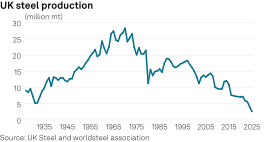
UK steelmaking has contracted in recent years, with production and capacity hit by weaker competitiveness with the high-energy prices that made it more expensive for domestic producers to operate, invest and compete for orders against overseas suppliers.
Author: Annalisa Villa