


European industry groups push to expand EU carbon border mechanism
EUROMETAL has joined 19 European industry associations and industriALL European Trade Union in calling for a broad extension of the EU’s Carbon Border Adjustment Mechanism to downstream products.
The joint statement, published on Oct. 19 on the EUROMETAL website, comes ahead of trilogue negotiations between the European Parliament, Council and Commission scheduled for Oct. 20. The signatories are urging EU policymakers to reach an ambitious agreement that protects European industrial value chains, investment and employment.
“Products covered by CBAM will benefit from a more level playing field, supporting their continued production in Europe,” the groups said. “Products left outside its scope will face growing risks of being replaced by imports or having their production relocated to third countries, where producers are not subject to equivalent carbon costs. This risk will become increasingly pronounced as free allowances under the EU Emissions Trading System are progressively phased out.”
Under the current framework, CBAM initially focuses on carbon-intensive products including steel and aluminum, while free allocations under the EU Emissions Trading System are being phased out. Industry groups warn that manufacturers using these materials could face rising carbon-related costs without equivalent coverage for competing finished and semi-finished imports from outside the EU.
The signatories said this could leave European producers at a competitive disadvantage and increase the risk of production being displaced by imports or relocated to countries with less stringent carbon-cost requirements. Such an outcome could also undermine investment in cleaner production within Europe, they said.
The sectors identified as being exposed include construction, mobility, machinery, energy, packaging, household appliances and clean technologies, as well as other metal-intensive industries.
For EUROMETAL, which represents European steel, tube and metal distribution companies, the competitiveness of downstream manufacturing is closely tied to the strength of the broader European steel value chain. The association has also been very vocal in the past about the importance of expanding CBAM to the downstream products.
The association said the joint initiative supports a coordinated approach to ensuring that European-made products are not disadvantaged by carbon costs imposed under EU legislation.
The signatories are calling for comprehensive downstream coverage in the final CBAM agreement, arguing that protecting European industrial production, investment and quality jobs is essential to the region’s economic security, prosperity and climate transition.W
Platts, part of S&P Global Energy, assessed on Oct. 16 domestic hot-rolled coil in Northern Europe at €740/mt ex-works Ruhr and in Southern Europe at €740/mt ex-works Italy, both stable day over day.
Platts assessed imported HRC in Northern Europe at €600/mt CIF Antwerp and in Southern Europe at €595/mt CIF Southern Europe, also both unchanged day over day.
Author: Annalisa Villa


UK steel industry faces higher power costs than European rivals
UK steel producers are expected to pay substantially more for electricity than European and international competitors in 2026/27, placing further pressure on the sector’s competitiveness, industry body UK Steel said Oct. 19.
British steelmakers are forecast to face electricity costs of £91/MWh, compared with £61/MWh in France and £79/MWh in Germany, according to a UK Steel report. Prices are also expected to be 125% higher than in Alberta, Canada, 68% above Vietnam and 71% above Turkey, the report said.
The differential with France alone is expected to add £66 million to UK steelmakers’ costs in 2026/27. UK Steel estimates that the cumulative additional cost of the gap since 2017/18 has reached £917 million.
The industry body has proposed a wholesale electricity price rebalancing mechanism, based on independent modelling by consultancy Baringa. The scheme would compensate energy-intensive industries when UK wholesale prices exceed a European benchmark, while requiring payments back when domestic prices fall below that benchmark.
UK Steel estimates the mechanism would cost about £51 million annually between 2026 and 2030, equivalent to approximately 42 pence per UK household each year. It forecasts that the scheme could generate an average net return of £13 million annually between 2031 and 2035.
The proposal could be implemented within the existing regulatory framework while longer-term electricity market reforms progress, UK Steel said.
“British steelmakers are being asked to compete with one hand tied behind their backs,” Peter Brennan, director general of UK Steel, said, adding that high electricity costs were undermining investment and employment.
Electricity is becoming increasingly important as UK steelmakers shift towards lower-carbon production routes. UK Steel also called for changes to network charge compensation and broader access to electricity cost relief across the steel supply chain.
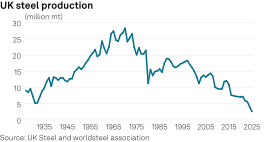
UK steelmaking has contracted in recent years, with production and capacity hit by weaker competitiveness with the high-energy prices that made it more expensive for domestic producers to operate, invest and compete for orders against overseas suppliers.
Author: Annalisa Villa

Federacciai: Italian steel output rebounds as new import measures support producers
Italian steel production returned to growth in September, ending a two-month declining streak, as output from domestic mills climbed 2.1% year over year to 1.9 million metric tons, according to data released Oct. 20 by the Italian steel federation, Federacciai.
The rebound pushed cumulative output for the first nine months of 2026 to 15.9 million mt, up 2.4% compared with the same period in 2025. This comes as the European Commission’s import measures on steel put in place in July have proven to help local producers at a time when European steel markets have grappled with weak demand, import pressure and elevated energy costs.
Meanwhile, the recovery in Italian steel output could signal a modest tightening of supply in the largest per-capita steel consumer and the second-largest steel-producing country after Germany.
Steel long products — which include rebar and wire rod used heavily in construction — held steady at 1.2 million mt in September, unchanged year over year, according to Federacciai data. For the January-September period, the longs segment posted cumulative output of 9.6 million mt, up 4.7% from the same period in 2025, reflecting relatively resilient demand from Italy’s construction and infrastructure sectors.
However, hot-rolled flat products told a very different story. September output fell sharply to 736,000 mt, declining 17% year over year, and further pressuring a segment that serves the automotive, white goods and mechanical engineering industries. Over the first nine months of 2026, flat product output totaled 6.5 million mt, down 4.2% from the same period in 2025.
The persistent weakness in flat steel production in Italy mirrors broader challenges facing European integrated steelmakers, who are confronting the softening in the automotive sector. Meanwhile, the resilience of Italian long products reflects the ongoing investment in Italian public infrastructure projects, in part supported by the six-year National Recovery and Resilience Plan (PNRR).
Platts, part of S&P Global Energy, assessed Oct. 19 domestic HRC in Southern Europe at €740/metric ton ex-works Italy, stable day over day and imported HRC in Southern Europe at €595/mt CIF Southern Europe, also unchanged day over day.
Author: Annalisa Villa
WV Stahl: German steel output falls in Sep as blast furnace production falters
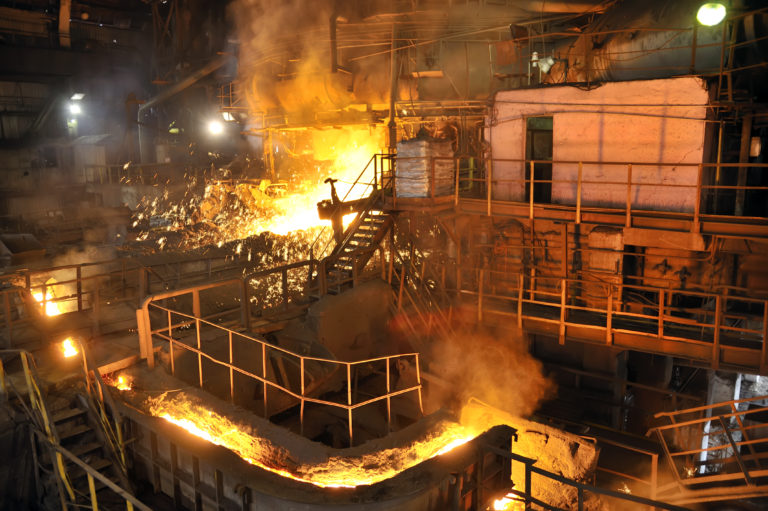
Crude steel production in Germany fell significantly in September, declining 13% year on year to 2.63 million metric tons, mainly due to the slump in blast furnace route production, according to realized data from the German steel federation, WV Stahl, published on Oct. 22.
The steep monthly decline has forced a significant downward revision to the country’s full-year production outlook, as the recovery in production has now cooled off noticeably.
Based on production figures from the first nine months of the year, the projected total for the full year now stands at 35.4 million mt, rising just 4% from the same period in 2025, according to the association’s extrapolation. That figure marks a sharp deterioration from the trajectory implied by first-half data, when the equivalent annualized projection stood at 37.3 million mt, 9% higher on the year.
Steel production using blast furnace and basic oxygen furnace technology in September fell 20.2% year on year to 1.7 million mt, while electric arc furnace output rose 4.3 % to 929,000 mt. From January to September, BF steel production increased 3.8% year on year to 18.16 million, and EAF output rose 4.3% to 8.37 million mt.
The figures underline the fragility of the recovery in Germany’s steel sector, a cornerstone of the country’s manufacturing economy and a critical supplier to its automotive, machinery and construction industries.
September pig iron production fell 19.9% year on year to 1.56 million mt, while output of hot-rolled steel products declined 10.6 % to 2.32 million mt. Both categories nevertheless recorded modest growth over the first nine months, rising 2.6% and 2.5% on the year, respectively.
Author: Annalisa Villa
Euroblech: European coil mills express optimism over annual contracts
European coil mills are confident that time is on their side during negotiations for annual supply contracts with OEMs and other large buyer companies this autumn.
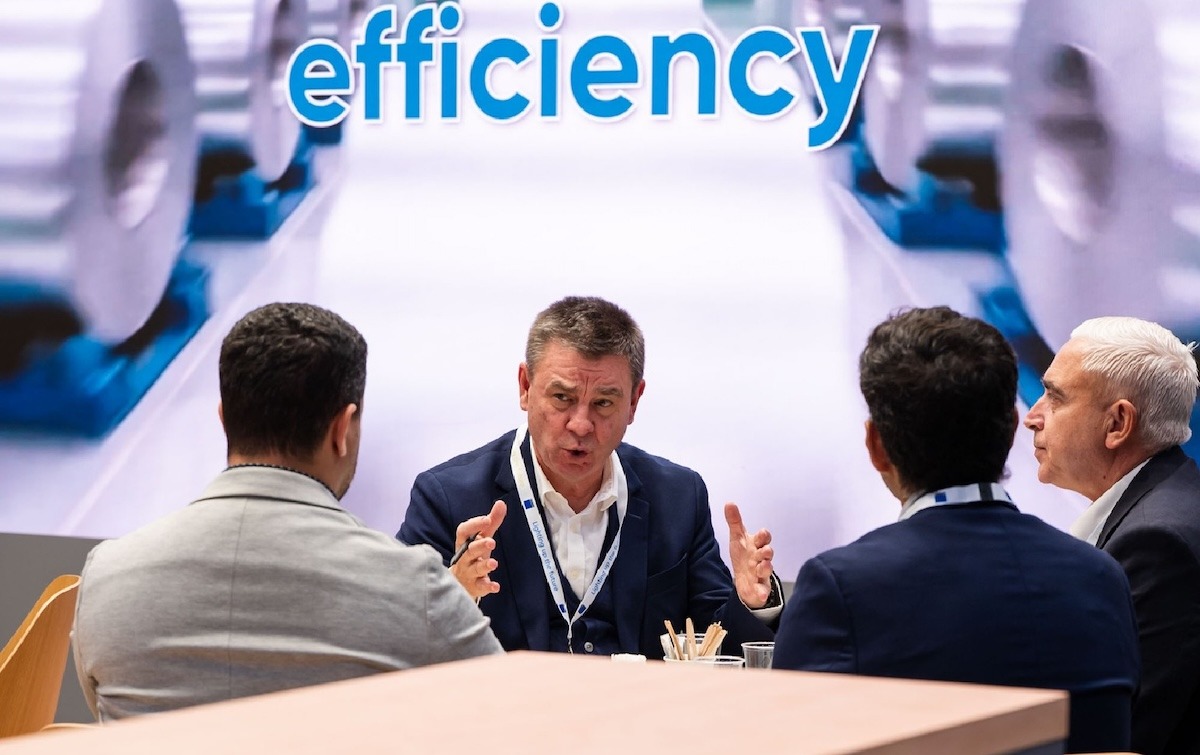
A customary starting point for price discovery are the German autumn sheet trade fairs Euroblech and Blechexpo. At this year’s Euroblech in in Hanover, taking place this week, some players have started their talks. Others dismiss the fair as too early in time, especially as several mills have declined to participate this year.
Those who obtained an early impression heard offers for contracts at roughly €100/tonne ($111) above current spot prices. This would mean €840-860/t for hot-rolled coil, and €940-960/t for hot-dip galvanized coil, mill and buyer sources confirm to Kallanish.
One mill manager cautions that extended rounds of talks will likely be accompanied by a trend of rising prices powered by a “QCC” factor, as he calls it. With this, he refers to the influence of import quotas, the Carbon Border Adjustment Mechanism (CBAM), and rising costs for production.
Such a gap between tabled offers and spot prices is not unusual, given that the long-term contracts warrant stable supply and quality over the term. However, one buyer of a re-roller’s manager finds that “a gap of €100 between spot and contract is clearly too big in the current market situation”.
He argues that quotas and CBAM influence the spot market, but not necessarily long-term contracts, which are the mainstay of European mills and their European customers who value a domestic supply base.
Still, the mill manager touches a painful point when looking three years back. Between October 2023 and February 2024, spot prices surged by more than €120, and the happiest buyers were those who had struck their deals by December.


Italian rebar prices under upward pressure as strikes in southern Italy threaten logistics
Deals and workable levels in northern Italy were heard at €730-760 ($820-853) per tonne ex-works, with one source expecting prices to reach €770 per tonne ex-works due to higher energy costs. This higher level, however, was not supported by transactional activity.
“There are attempts to move the Northern market towards €770/t, mainly supported by higher energy and production costs, but as far as I am aware there have not yet been significant transactions concluded at that level,” a buyer source told Fastmarkets.
“Ever-rising energy and transport costs are pushing a trend towards further increases for November,” a seller source told Fastmarkets.
“Producers’ intention is to go on in uptrend, because high energy and fuel costs keep pressure strong, but customers don’t have the same sentiment,” a trader source told Fastmarkets.
Demand, however, remained weak, limiting producers’ ability to achieve higher prices.
“Demand is currently very low and pretty much everyone is just relying on existing inventory and stocks,” another buyer source told Fastmarkets.
Meanwhile, in southern Italy, the latest deals and offers were reported at €750-780 per tonne ex-works during the week. Higher offers were also heard at €790-800 per tonne ex-works, but no transactions were reported at those levels.
Market participants said truck driver strikes were making transportation to southern Italy more difficult.
“In the South, recent protests and transport strikes linked to high fuel and energy costs, as well as the broader increase in the cost of living, have also caused significant disruption on the roads, with deliveries slowing considerably over the past few days,” a buyer source told Fastmarkets.
As a result, Fastmarkets’ weekly price assessment for steel reinforcing bar (rebar), domestic, exw Italy, was stable week on week at €730-780 per tonne on October 21.
Fastmarkets’ weekly price assessment for steel reinforcing bar (rebar), domestic, delivered Spain, remained unchanged at €750 per tonne on October 21.
In Northern Europe, the latest deals and offers were heard at €680-700 per tonne delivered, while market participants reported workable levels at €660-680 per tonne delivered.
One producer source also reported limited material availability in Germany.
Fastmarkets’ latest weekly price assessment for steel reinforcing bar (rebar), domestic, delivered Northern Europe, was therefore €660-700 per tonne on October 21, widening upward from €660-690 per tonne the previous week.
Sources indicated workable levels for wire rod in Southern Europe at €670-680 per tonne delivered, unchanged from previous levels.
Fastmarkets’ weekly price assessment for steel wire rod (mesh quality), domestic, delivered Southern Europe, was €670-680 per tonne on Wednesday, stable week on week.
In Northern Europe, wire rod was indicated at €705-715 per tonne delivered, also stable compared with previous prices heard in the market.
Fastmarkets’ weekly price assessment for steel wire rod (mesh quality), domestic, delivered Northern Europe, was therefore unchanged week on week at €705-715 per tonne on October 21.
European beams and sections
The latest deals and offers for domestic beams in Northern and Southern Europe were heard at €850-860 per tonne delivered, with workable levels reported by market participants at €840-860 per tonne delivered.
As a result, Fastmarkets’ monthly assessment for steel beams, domestic, delivered Northern Europe, narrowed upward to €840-860 per tonne, from €810-860 per tonne the previous month.
Workable levels for steel sections were reported at €850-870 per tonne delivered in both Northern and Southern Europe.
Fastmarkets’ monthly assessment for steel sections (medium), domestic, delivered Southern Europe, therefore narrowed upward to €850-870 per tonne, from €800-870 per tonne the previous month.
Author: Nia Radenkova

European domestic, import hot-rolled coil markets largely quiet, prices stable
In Northern Europe, tradable levels continued to hover within the range of €740-750 ($830-842) per tonne ex-works, versus offers at €750-760 per tonne ex-works.
While trading activity was muted, most offers reported were for December delivery, and some sources said some regional suppliers were already sold out until the end of the year.
However, other sources disagreed, saying customers’ stocks are high, some service centers have enough inventory not to restock heavily even in 2027, and mills are ready to sell HRC at €720 per tonne ex-works. This information was excluded from the October 22 index calculation as uncorroborated.
Fastmarkets’ daily steel hot-rolled coil index, domestic, exw Northern Europe, was calculated at €748.00 per tonne on October 22, up by €1.33 per tonne from €746.67 on October 21.
The index was up by €3 per tonne week on week and by €4.25 per tonne month on month.
The Italian market was also quiet, with indications of the tradable level at €730 per tonne ex-works during the day, while earlier in the week they were at €730-750 per tonne ex-works, with remarks that only limited tonnages were traded at the upper end of the range and €730 per tonne ex-works was called more realistic.
Fastmarkets’ daily steel hot-rolled coil index domestic, exw Italy was calculated at €738.75 per tonne on October 22, down by €3.75 per tonne day on day from €742.50 per tonne on October 21.
The index was down by €5 per tonne week on week but up by €3.50 per tonne month on month.
The supply situation in Italy should improve soon, as Arvedi reportedly restarted the hot-rolling line that was stopped at the end of September due to technical issues.
Meanwhile, the Italian government has allowed Acciaierie d’Italia to keep the hot-end facilities at its Taranto plant heated until no later than December 15 to prevent irreversible equipment damage, while the company challenges a court-ordered shutdown, but the measure does not authorize normal steel production.
Central Europe was the only region where suppliers tried to increase prices, but they still faced significant resistance. The absence of Ukrainian material, due to disruption of production caused by severe equipment damage from Russian attacks on Ukrainian mills, was one of the factors supporting a stronger position for European mills.
The market leader announced new offers at €790-800 per tonne CPT, equivalent to €770-785 per tonne ex-works, but these have not yet materialized in deals.
Another supplier in the region was heard to have achieved €765-775 per tonne CPT in recent transactions, netting back to €745-760 per tonne ex-works.
As a result, Fastmarkets weekly price assessment for steel hot-rolled coil domestic, Central Europe, was €745-760 per tonne ex-works on October 21, up from €740-750 per tonne ex-works a week earlier.
On the import side, the hot-rolled coil market in Europe was also largely quiet, with just a few deals heard during the week, as quotas for the current quarter from the key suppliers, Turkey and India, have already been exceeded.
Egyptian HRC was heard sold at $750 (€667) per tonne CFR, with the country’s fourth-quarter quota now said to be filled.
Turkish material was still heard available at €595 per tonne CFR, although the quota for this year was earlier said to have been exceeded by more than 100,000 tonnes.
Similarly, Indian coils continued to be offered at $740-760 (€659-667) per tonne CFR.
Fastmarkets weekly assessments for steel hot-rolled coil import, cfr main port Southern and Northern Europe, were €595-670 per tonne on October 21, narrowing upward from €590-670 per tonne on October 14.
On a DDP basis, offers were heard mainly from Asia, varying within the range of €760-790 per tonne.
A cargo of Chinese material was heard sold to Europe at €780 per tonne DDP.
Estimates of Turkish and Indian prices, including the duty payable for exceeding the quarterly quota, were at €720-740 per tonne DDP.
Author: Vlada Novokreshchenova

Dutch Staalfederatie raises concerns over uneven customs treatment of steel imports
The Koninklijke Staalfederatie has highlighted concerns that differences in the application of customs rules across EU Member States are creating an uneven playing field for stainless steel importers.
In a publication dated 22 October, the Dutch steel distribution federation reports that feedback from its members points to differences in the handling of import duties and quotas, including in Italy and Spain compared with the Netherlands. Importers in some Member States may have greater opportunities to access available quotas, potentially leaving Dutch companies facing higher import costs.
The federation warns that the consequences could extend beyond individual importers, affecting the wider steel supply chain, manufacturing businesses and the Netherlands’ position as an import hub.
The Staalfederatie has raised its members’ concerns with Dutch business organisations FME and VNO-NCW and submitted a complaint concerning differences in the application of import rules. It is also pursuing clarification through the Dutch customs–business consultation platform, Overleg Douane Bedrijfsleven (ODB).
Together with its members, the federation is compiling a dossier covering the products and metal types concerned, trade volumes and financial impacts. Around 26 product groups are expected to be examined.
For Europe’s steel distribution and trading sector, these concerns underline the importance of transparent procedures and consistent customs implementation throughout the EU. Common European rules must deliver fair and predictable conditions for businesses across the Single Market.
Read the original publication by the Koninklijke Staalfederatie (in Dutch).

Euro area construction output up 1.8% in August 2026 from July
According to first estimates released by Eurostat, the Statistical Office of the European Union, in August this year the seasonally-adjusted production of the construction sector in the European Union member states (EU-27) increased by two percent compared to July this year and rose by 2.6 percent compared to the same month of 2025. In July, production in the construction sector had moved down by 0.1 percent month on month.
In the euro area, the seasonally-adjusted production of the construction sector in August increased by 1.8 percent month on month and moved up by 1.4 percent year on year. In July, production had increased by 0.2 percent month on month.
Building construction in the EU-27 in August moved down by one percent month on month and down by 4.1 percent year on year, while civil engineering output in the region decreased by 0.2 percent month on month and increased by 2.8 percent year on year. In the euro area, building construction decreased by 0.4 percent month on month and was down by 3.7 percent year on year, while civil engineering output in the region fell by 2.1 percent both month on month and remained stable year on year.
As compared to July, construction output in August increased by 14.0 percent in Hungary, by 9.3 percent in Germany, and by 7.2 percent in Romania, while it decreased by 5.1 percent in Slovenia, by 4.9 percent in Slovakia, and by 2.9 percent in Italy.
As compared to August 2025, construction output in August this year increased by 39.0 percent in Romania, by 22.0 percent in Hungary and by 12.7 percent in Finland, while it decreased by 7.8 percent in France, by 4.9 percent in Slovakia and by 4.3 percent in Spain.


Local HRC prices edge higher in Italy on limited import options; Northern Europe stays quiet
Daily steel hot-rolled coil (HRC) prices rose slightly in Italy as the absence of cheaper imports supported domestic prices, sources told Fastmarkets on Wednesday October 21. The market was mostly quiet in Northern Europe, as many participants were attending an industry event.
In Italy, sources said imported material was no longer a main factor in domestic coil negotiations.
“It’s clear that it’s impossible to get import material significantly cheaper than domestic,” a producer source said on Wednesday.
The same source said workable prices for local HRC were in the range of €730-750 ($820-842) per tonne ex-works, adding that the upper end of the range was linked to very limited activity, while quoting €730 per tonne ex-works as a more realistic level.
The producer also said that it was harder to get higher prices for orders scheduled for delivery in December because “many customers minimize accepted deliveries due to year end accounting.”
A buyer source said on Wednesday that announced prices in the market were in the range of €740-750 per tonne ex-works, in line with previous indications reported by sources on Tuesday.
However, the same buyer said achievable levels for HRC were within €730-740 per tonne delivered, which nets back to €710-725 per tonne ex-works after deducting delivery costs of €15-20 per tonne.
This price range was discarded from the final index calculation due to a lack of corroboration from other sources and a lack of details about these levels.
As a result, Fastmarkets’ daily steel hot-rolled coil index domestic, exw Italy was calculated at €742.5 per tonne on October 21, up by €1.67 per tonne day on day from €740.83 per tonne on October 20.
The index was down by €2.50 per tonne week on week but up by €8.75 per tonne month on month.
While Acciaierie d’Italia and Ilva were challenging a Milan court order requiring the shutdown of the hot-end facilities at the Taranto steelworks, the Italian government issued Decree-Law 185/2026 on Friday October 16, allowing the producer to keep the hot-end area heated to avoid potentially irreversible damage from cooling.
The measure does not itself authorise normal steel production and is intended only to preserve the equipment. It applies until the reasons for the court’s ruling are published, or no later than December 15, 2026.
An official parliamentary dossier dated October 20 said the court had not yet ruled on the appeal. In the meantime, the producer should continue monitoring emissions into the atmosphere, according to the Italian government’s Decree-Law.
Northern Europe
In Northern Europe, market activity was very quiet on Wednesday, with many participants attending the Euroblech fair in Hanover on October 20-23, limiting the availability of pricing data.
One buyer provided an indication of workable levels within the range of €740-750 per tonne ex-works during the day.
A second buyer said trading activity was slow but could not provide workable market levels. No other price points were received during the day, linked to the industry event.
On Tuesday, market participants said producers in the region were under pressure due to high energy costs, citing this as a major problem in the industry. Buyer sources reported indications for HRC within €740-750 per tonne ex-works on the same day.
As a result, Fastmarkets’ daily steel hot-rolled coil index domestic, exw Northern Europe was calculated at €746.67 per tonne on October 21, down by €0.83 per tonne day on day from €747.5 per tonne on October 20.
The index was up by €0.67 per tonne week on week and by €1.67 per tonne month on month.
