

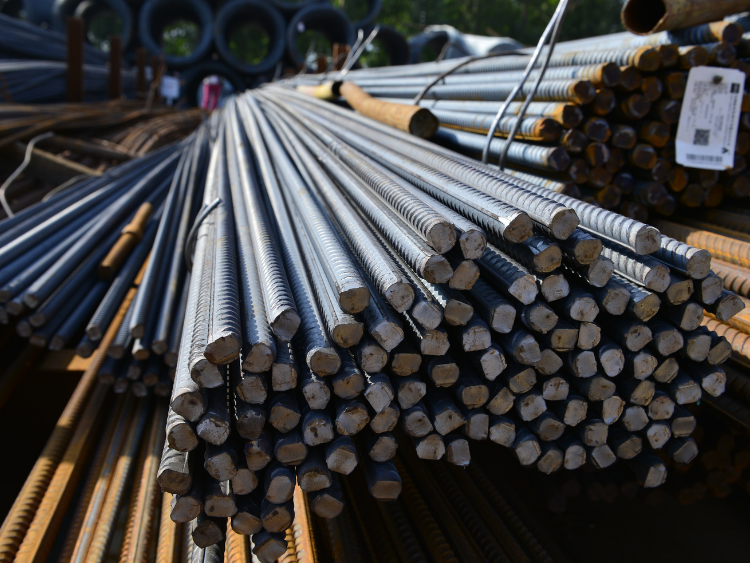
Slight deterioration in global longs market, demand stable but weak, scrap impacts rebar prices
Overall, the situation in the global long steel products market has worsened slightly. There has been a so-called stability in the global long steel products market for the last couple months as far as demand is concerned, though demand remains weak. However, some volatility is seen in rebar prices due to changes in scrap prices. Higher scrap prices have been resulting in increased demand for steel billets from the Far East. Governments worldwide may push for increased investments in infrastructure amid AI data centre construction and resulting increases in electricity needs. In the US, of course, this is already happening, but it is also expected to be seen in other parts of the world soon.
Chinese give signals of wanting to keep supply in check, but doubts persist
Excess production capacity continues to be a major concern. In terms of supply, it seems the Chinese government wants to keep supply in check. Of course, it is not clear that this will actually happen. There is still no sign of any improvement in demand or of a slowing down of Chinese exports for the time being. Market players are crossing their fingers that next year the Chinese will take similar actions to what they did back in 2016.
Uncertainty is the main risk facing all parties
Uncertainty is the main risk facing all parties and appears likely to remain so for the foreseeable future. Increased interest rates in the West are another concern affecting future demand expectations.
European steel producers face rapidly increasing costs, while demand remains weak
The European steel market remains challenging, with weak demand and strong competition between domestic producers. The reduced safeguard quotas and CBAM have so far provided limited support to steel prices, as European mills continue competing aggressively for volumes rather than protecting their margins. However, the situation is changing rapidly due to skyrocketing energy costs. Natural gas prices in the EU have increased by approximately 150 percent over the past three months, with Dutch TTF futures now trading above €100/MWh compared to less than €40/MWh three months ago. Electricity prices have also increased sharply. The increase in electricity and natural gas prices since August has so far added more than €110/mt to direct steelmaking and rolling costs, and there is a risk of further increases.
At current finished steel prices, the economics of European steel production are becoming increasingly difficult. Mills are facing a choice between passing these additional costs on to customers, accepting further deterioration in margins or reducing production. Meanwhile, reduced import quotas and CBAM are limiting alternative sources of supply. Although demand remains weak, the combination of rising production costs and restricted imports could significantly change the supply-demand balance in Europe.
The recent price increases have been primarily cost-driven rather than demand-driven. Higher logistical costs, including those caused by exceptionally low water levels on European rivers, have added further pressure without substantially disrupting supply chains.
The German construction industry is still awaiting the implementation of state-funded infrastructure projects, while private investment remains subdued due to continuing uncertainty.
Looking ahead to the first quarter of 2027, further increases in European steel prices appear likely if energy costs remain at current levels or continue rising. Any reductions in production would add further upward pressure, even without an improvement in demand.
The present situation has become unsustainable. It demands immediate action.
Some slight improvement in supply-demand balance in general
Mills in the rest of the world do not have the extremely high costs of European production, which are mainly the result of the EU’s CO2 policies, but it still seems oversupply is not a very big issue. So, the balance of supply and demand in general is probably a little better than before.
Demand in US relatively stable, but growth focused on select areas
In the US, demand is relatively stable, but high import tariffs and trade restrictions have significantly reduced opportunities for international suppliers, while domestic mills enjoy a more protected market. Margins for international traders in the US remain under significant pressure. AI data centre construction, energy, and selected infrastructure projects remain among the few major growth areas. Residential and commercial construction activity remains weak, partly due to high financing costs. Steel demand growth is uneven across different steel products and sectors. Overall, the global supply-demand imbalance continues to be a serious concern. It may soon be a US problem as well for certain products like rebar.
EAF-based producers see production costs rise continuously, integrated mills benefit
One interesting factor is that the production costs for EAF-based material are increasing continuously due to electricity shortages and the lack of adequate transmission lines. This is probably to the advantage of integrated producers who use coal.
India and parts of Southeast Asia remain relatively strong markets
Internationally, India and parts of Southeast Asia remain relatively strong markets. We also see some potential for improvement in Southeast Asia during 2027, although any recovery is likely to be gradual and uneven. Another positive factor is that there is no bombing in the Middle East.
Competition in global market remains very tough and very regional
Competition in the global market is, as always, very tough and very regional. Excess global capacity, particularly in Asia, combined with trade barriers and limited access to major importing markets, is forcing exporters to compete aggressively for fewer available opportunities. The first quarter of 2027 is expected to see further price increases in Europe. The North American market is still stable at 80 percent capacity utilization, but in the next two to three years domestic competition may
pick up due to oversupply and uncertain consumption forecasts.
Current status of the market stable in Europe for the moment, unstable in other areas
Under these circumstances, the current status of the market is stable in Europe at least for a few more weeks, but unstable in other areas.
Market outlook for next quarter very challenging, scrap to be scarcer as US and EU export less
The outlook of the market for the next quarter is very challenging and weak. It seems there will be higher prices due to higher energy costs and also scarcity of scrap, since the US, one of the two big scrap exporting regions, requires more and more scrap domestically. In addition, Europe, is increasing its consumption of scrap and less will be available for the export market, also leading to higher scrap prices. The outlook for demand is stable but unsatisfactory.