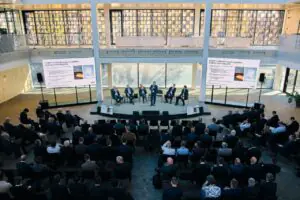

While the UK’s construction sector is increasingly incorporating sustainability criteria into its steel procurements, it is unlikely that consumers will engage with overly-sophisticated green steel standards, Dow Jones Energy heard at ACI’s Future of Green Steel event in London 28-29 October.
The conference had strong representation from the UK’s construction operators, giving their perspective on the UK’s emerging green steel market.
Overall, sentiments were positive: attendees reported increased consideration in public tenders for the sustainability of a project bid, with low-carbon steel presenting a relatively simple means of reducing carbon footprints due to the weight of emissions embedded in, for example, foundational steel structures.
Private sector interest is less evident, though London was repeatedly cited as an outlier, demonstrating increased preference for lower-carbon bids for new residential and commercial developments. Construction attendees expected this trend to expand beyond London and across the UK as local authorities are pushed to incorporate non-price criteria.
The trend is developing, but nascent, as engineering firms estimated that sustainability factors would only be workable below 2% cost premium. As soon as low-carbon sourcing pushes project costs beyond 2%, bids win on price, limiting what buyers will pay for green steel and creating a preference for established scrap-based electric arc furnace (EAF) producers. Construction firms stated that they were not aware of ever having lost a public tender on sustainability criteria.
Of course, this 2% margin is spread across the entire project bid, so whether firms pass on a green premium for using low-carbon steel is assessed on a case-by-case basis. A construction company said that on one recent bridge project bid currently under consideration, green EAF slab processed into low-carbon heavy plate on a tolling basis was incorporated at a 5-10% price premium, while previous bids did not attempt to charge additional costs for EAF-based steel.
For direct spot sourcing, distributors and consumers continue to see little interest in paying extra to hold green steel stocks, especially while markets lack a clear definition or standard for what actually constitutes lower carbon steel.
Sessions at the conference explored the difficulties in harmonizing a global – or even national – green steel standard in great detail, as global scrap supplies are insufficient to support an entire sector transition, and integrated blast furnace producers arguably need some access to premium low-carbon markets to ensure they can survive long enough to see their transformation projects to completion. Green standards like those of ResponsibleSteel, or LESS, thus grant cleaner classifications to steel products the lower the share of scrap in their production, to incentivise transformative low-carbon ironmaking developments such as green hydrogen-based direct-reduced-iron (H2-DRI).
This is particularly relevant to the construction sector – a frontrunner in creating real demand for lower-carbon steels – as construction operators are already subject to sustainability criteria via legislation like the EU’s Construction Products Regulation (CPR), project certification requirements, local authority permitting policies, and more. As an example, British Steel has criticised that Welsh procurement criteria restricts their steel from consumption in infrastructure projects, imposing a carbon footprint limit within the UK’s domestic market that British Steel’s output is currently unable to satisfy.
For construction attendees, how ‘green’ a steel is considered to be is entirely set by its EPD value, and there did not seem to be much appetite to widen that definition to accommodate the complexities of the steel sector’s transition. In the words of construction representatives, green steel procurement is “simply looking for the lowest number on the EPD” as that is what is required for the tender. While downstream operators were surprised by the degree of sophistication, and potential impacts, of defining green steel in different ways – for example with scrap content-based adjustments – there was evident sentiment that this was not really their problem to solve, especially when steelmakers themselves have such difficulty in reaching a compromise on standardisation.
For example, the EU steel lobby has only recently reached a form of compromise on its preferred green steel definition: scrap content-based adjustments to classification thresholds would be limited to carbon flat steels, and select carbon long steels, with most long steel, and stainless steel products assessed on a product carbon footprint approach without adjustments.
The EU’s green steel label was originally to be contained in the Commission’s Industrial Accelerator Act proposal, but was cut and postponed to delegated acts of the Ecodesign for Sustainable Products Regulation (ESPR), disagreements on scrap-content adjustments playing a primary role. This delegated act was due for publication before end of year, though sources now expect delivery in H1 2027.
As discussed across the conference sessions, much of the debate comes down to what extent a green steel definition should stimulate decarbonisation of the steel sector directly – requiring process emission reductions from blast furnace steel’s polluting ironmaking stages – versus individual company operations. Different interpretations of ‘decarbonisation’ entail different standards, but increasing scrap-EAF steelmaking alone arguably redistributes, as opposed to reducing, overall steel sector emissions.
Construction steel consumers may appreciate the need for green ironmaking, but “who pays” remains the main question, and if they already have low-carbon EAF steel available and compatible with their existing sustainability requirements, then they are unlikely to want to pay more, especially for higher carbon blast furnace material allowed into green classifications as a CAPEX incentive for integrated steelmakers. Construction companies also generally secure their steel supply via distributor intermediaries, and so while green steel premiums may often be negligible against the cost of an entire project, premiums seen in Europe of EUR100-300/t are certainly not offering distributors much of a margin, if at all.
Scrap-based adjustment standards could also force consumers to source higher priced DRI-EAF steel imports to meet requirements, and scrap-based EAF steels consumed independently of sustainability mandates could see prices follow higher. Changing the core role of EPD certifications in construction steel trade would also be a large administrative hurdle, and so decarbonisation incentives for primary ironmaking may be better placed directly in public procurement policies for e.g the automotive sector, which has a stronger consumption base for flat steels, predominantly produced via the BF-BOF route in Europe.
Author: Benjamin Steven