


Trump again raises Turkey’s steel import tariff to 50%
US President Donald Trump on Monday said he will double the Section 232 tariffs on Turkish steel from 25% to 50% as a result of the country’s military actions in Northeast Syria.
In a statement posted to Twitter Monday afternoon, Trump said he would soon be issuing an executive order increasing the steel tariffs and authorizing the imposition of sanctions against Turkey.
Trump previously raised Turkey’s steel tariff rate from 25% to 50% in August 2018 due to the devaluation of the Turkish lira and increased political tension between the countries due to the detention of US Pastor Brunson. Turkey’s tariff rate on steel was later dropped back to 25% in May 2019.
S&P Global Platts sent emails for comment to Turkish steel industry sources but could get only one comment, as President Trump’s tweet came near midnight in Turkey. “They have been playing cat and mouse with Turkey,” said the source.
The US government’s decision in mid-May to reduce the Section 232 tariff on Turkish steel back to 25% from 50%, has so far failed to meet Turkish producers’ expectations of a notable rise in export volumes, as Turkish mills’ steel offer prices remain uncompetitive in the US market, amid the decline seen in domestic prices in that country.
Turkish mills’ rebar shipments to the US fell to 38,300 mt in the first eight months of 2019, sharply lower than 304,300 mt exported in the same period of 2018, while mills’ HRC exports to that country declined to just 11,800 mt in the eight-month period, according to the Turkish Statistical Institute data.
Under Section 232 of the 1962 Trade Expansion Act, the US president is able to adjust the tariff level set for any country at any time he sees fit.
— Justine Coyne and Cenk Can
Worldsteel boosts 2019 demand outlook on China strength
The World Steel Association revised its 2019 short-range outlook (SRO) for steel demand higher on Monday on the back of resilient Chinese demand.
Worldsteel provided an updated SRO at its General Assembly in Monterrey, Mexico, and forecast global steel demand to grow by 3.9% to 1.775 billion mt, compared to an earlier forecast of 1.3% or 1.735 billion mt in April.
Global steel demand is expected to grow by another 1.7% in 2020 to 1.805 billion mt as emerging and developing economies, excluding China, increase contributions.
Global steel demand growth will be driven by China, forecast to see 7.8% growth to 900.1 million mt in 2019. The rest of the world is expected to record 0.2% growth to 874.9 million mt.
“The current SRO suggests that global steel demand will continue to grow in 2019, more than we expected in these challenging times, mainly due to China,” said Al Remeithi, chairman of the worldsteel Economics Committee.
The rest of the world was hampered by “uncertainty, trade tensions and geopolitical issues” which “weighed on investment and trade,” added Remeithi. “Manufacturing, particularly the auto industry, has performed poorly, contracting in many countries. However in construction, despite some slowing, a positive momentum has been maintained.”
Steel demand is expected to fall in five of eight regions in 2019. The sharpest year-on-year decline is forecast for Europe outside the European Union, including Turkey, where demand is expected to decline by 12.1% to 32.9 million mt in 2019. Steel demand in the EU is slated to decline by 1.2% to 166.8 million mt in 2019.
The NAFTA region is expected to be mostly flat in 2019 with 0.6% demand growth in 2019 to 141.5 million mt.
All major regions are forecast to show flat to positive steel demand growth in 2020 but face “significant downside risks if the current level of uncertainty prevails,” said Remeithi in the report.
— Michael Fitzgerald
Commissioner for Trade Cecilia Malmström visits the port of Rotterdam

The Commissioner is in Rotterdam today to meet with customs officials and food safety inspectors and take a closer look at the facilities at the EU’s largest port. The Netherlands is the entry point for 40% of goods entering the continent.
Cecilia Malmström, the EU’s Commissioner for Trade, said: “Everything we import has to abide by our strict food standards. Nothing in any trade agreement will change this. I am in Rotterdam today to learn more about how the port uses risk assessments and physical searches to keep our citizens safe from illegal and unsafe products.”
Following presentations by experts on customs, and food and consumer product safety, Commissioner Malmström made a tour of port facilities.
First, she visited the State Inspection Terminal, where customs authorities use the latest technology to scan the containers entering the port.
Secondly, the Commissioner was shown around the training centre for customs officials. The facility also has a specific dog-handling centre, where staff train the dogs to detect illegal substances.
In addition, yesterday the Commissioner announced that the EU was launching a formal dispute settlement procedure with Colombia at the World Trade Organization over the former’s imposition of anti-dumping duties on frozen fries from Belgium, Germany and the Netherlands.
Commissioner Malmström added: “Citizens need to have the confidence that the EU is standing up for their interests. That means striking trade deals across the world to open up new business opportunities and create jobs, but it also means ensuring that our trade partners stick to the rules.
This is why I am here in Rotterdam today, and this is why I instructed my department to launch a WTO dispute with Colombia as soon as possible. Since November last year they have been imposing unfair tariffs on frozen fries, causing unjustified damage to Belgian, Dutch and German companies.”
Background
On 9 November 2018, Colombia imposed definitive anti-dumping duties of between 3% and 8% on frozen fries from the Netherlands, Belgium and Germany for two years, following an anti-dumping investigation.

EU safeguards come under fire at EUROMETAL conference

The EU’s safeguard measures for steel products, and especially their latest upgrade, have created “… an additional layer of complication for doing business”, says Yuriy Rudyuk of law company Van Bael & Bellis.
Rudyuk was a participant in a panel discussing the EU safeguard measures at this week’s conference of trade association EUROMETAL in Rotterdam, attended by Kallanish. His law firm is contacted “… on a daily basis” these days, he said, to clarify questions such as the differentiation of coil product categories 4b (automotive) and 4a (non-automotive).

The “… additional layer of complication” comes at a time when the sector is already suffering from dwindling demand, Tayfun Isery from steel producer Colakoglu and Turkey’s YISAD noted. As Turkey figures among the ten largest steel importers as well as exporters in the world, “… we are very much for free trade,” he stressed.

Julian Verden of Stemcor drew a comparison with the Iron Curtain era, “… when the European Union and the Soviet Union had a functional dual trade system – you always knew what you would get,” he said. Today, with the unpredictability of EU quotas versus incoming volumes, “… you cannot know if you may have to pay 25% on top.” This exceeds the margins of any trader and it will massively reduce imports, he noted, and stated that “… safeguard measures are pretty punitive.”

Former EUROMETAL director general Georges Kirps pointed out that the authorities in many countries are becoming overstrained with fulfilling the EU’s requirement. The safeguards are a “… Mission Impossible,” Kirps said.

NLMK and partner to invest Eur200 million in NBH assets
Russian mining and steel company NLMK and Belgian investment fund SOGEPA have agreed to invest Eur100 million each in developing and modernizing NLMK Belgium Holdings (NBH), NLMK said Thursday.
The agreement also provides SOGEPA (Societe wallonne de Gestion et de Participations S.A.) with an option to sell 24% shares in the jointly owned group of assets to NLMK in 2023 thus reducing its stake to 25%. At present, NLMK and SOGEPA each hold a 49% equity stake in NBH.
NBH comprises NLMK Europe Strip Division (NLMK La Louviere and NLMK Manage Steel Center in Belgium and NLMK Strasbourg in France) and NLMK Europe Plate division (NLMK Clabecq in Belgium and NLMK Verona in Italy).
— Ekaterina Bouckley

EUROMETAL Steel Trade Day in Rotterdam highlighted the negative impact of trade protectionism on steel demand

On last 09 October, EUROMETAL had invited to its 8th International Steel Trade Day having Paradigm Change in Global Steel Supply Chains as a main conference theme.
This major event, hosted by Port of Rotterdam Authority, noted a large success with professionals from the steel community attending the conference from all over Europe and Turkey.
The EUROMETAL International Steel Trade Day in Rotterdam started with a visit of the Broekman Logistics modern warehouse inside of the Port of Rotterdam. Visitors could assist to automated cranes unloading and warehousing at the company’s break bulk terminal.
In the evening a boat tour of the Port of Rotterdam was offered by the Port of Rotterdam Authority in the Catamaran Nieuwe Maze.
On conference day, Fernando Espada, President of EUROMETAL opened the Steel Trade Day while an outstanding speakers list was introduced by Daniel Guinabert, EUROMETAL Director General, and included Danny Levenswaard, Director Breakbulk at Port of Rotterdam Authority that welcomed all participants to the EUROMETAL event in the World Port Center Rotterdam; Matt Watkins, consultant and principal analyst of CRU; Georges Kirps, former EUROMETAL Director General, Colin Richardson, editor at Argus Media; Hugo Du Mez, Advisor Business Intelligence – Dry Bulk at Port of Rotterdam; Remco Bol, Sales Manager at Broekman Logistics; Yuriy Rudyuk, Partner and International Trade Law specialist at Van Bael & Bellis; Ruslan Kharlamov, chief executive officer at SteelHedge and Tayfun Iseri, Director of business development and foreign subsidiaries.

The conference was concluded by an open forum animated by Daniel Guinabert. Besides speakers the panel was completed by the participation of Julian Verden, Managing Director at Stemcor Distribution and EUROMETAL Presidency member.
Speakers and panelists outlined some of the challenges, threats and chances for Steel Trading in a changing world.
Here are some key quotes from speakers or panelists:
Trade protectionism is in progress on a worldwide level endangering economic growth in many parts of the globe with negative impact on steel demand.
The ever growing range of trade measures affecting steel means havoc for global steel supply chains.
At first glance, steel safeguards, recently modified by EU Commission, seem to adequate present demand patterns of EU steel demand.
But on the other hand, the decided safeguard measures represent such an expanding administrative effort, almost impossible to tackle by small and medium sized market players.
Under this consideration, the latest steel safeguards modifications, represent a sensitive de facto restriction of import flows.
Finally it was underlined, that after expiry of this measures in mid-2021, there is a quite a probability that they may be re-conducted eventually for further years, be it with a smaller product scope.
In the view of US sector 232 measures prevailing in a longer perspective, speakers at the meeting concluded that EU steel safeguards are there to stay and will continue for years their impact on EU steel supply chains, even if latest
EU import statistics seem to indicate that a re-direction towards EU of former US steel imports presently remains more an assumption than a reality.
We would like to thank again our gold sponsors Port of Rotterdam Authority and Broekman Logistics and our partner Baurom for hosting us and their confidence in our work and event.
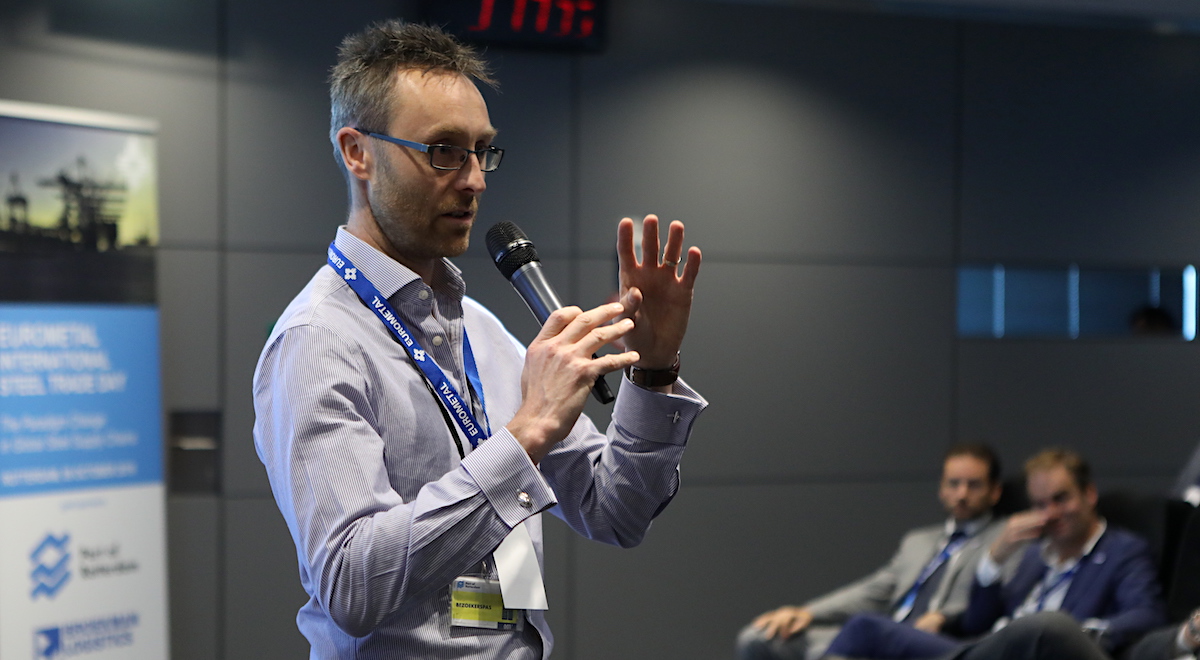
Global trade measures may cause local steel overcapacity
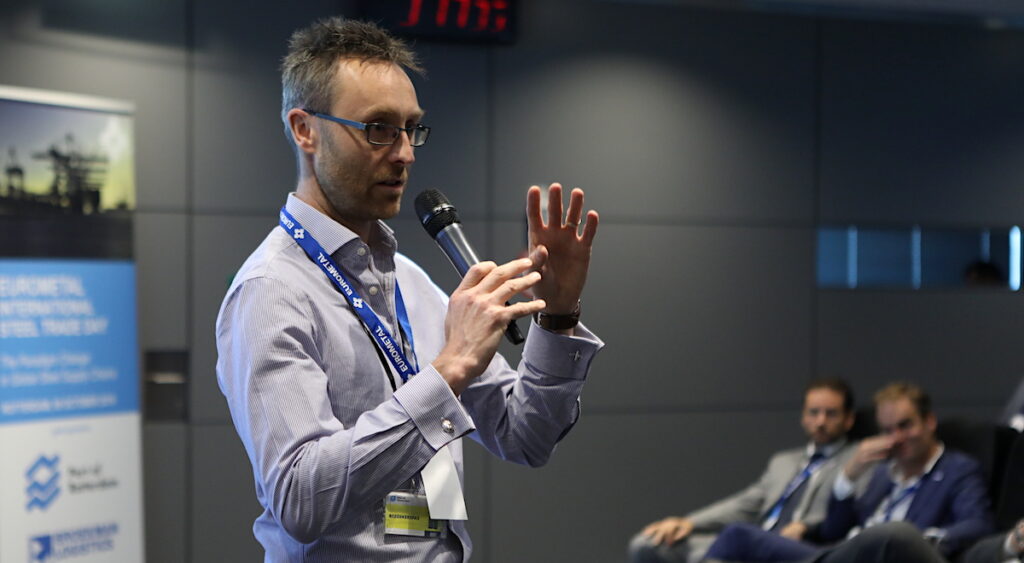
The wave of global safeguard measures is likely to cause a shift from a globalised market to more localised markets, analyst Matt Watkins said at Eurometal’s Steel Trade Day in Rotterdam attended by Kallanish.
Regarding the immediate trade war between China and the USA, he believes that the two powers will find a deal to clarify the situation sooner or later. In the longer run however, steel sellers will not be looking for international opportunities as much as they used to. And this will lead to overcapacities as people have to rely on their local mills, he said at the meeting entitled ‘The Paradigm Change in the Global Steel Supply Chain’.
In detail, he observed that cheap steel for the EU is not coming so much from Turkey these days as it is originating from India. “We have seen many Indian imports, partly for seasonal reasons: high inventories in India plus the monsoon period, which is slowing down local activity, therefore more imports,” he said. And there may be a change ahead. “Recently, it was mostly hot-rolled coil because these new capacities built up faster than for cold-rolled. So, we may see less import of HRC next year, but more CRC,” Watkins continued.
Also, the possibility of a carbon border adjustment in which the EU is imposing CO₂ costs on exporting countries may hit nearby suppliers of slab. “Much of European steel is based on a re-rolling model, and that could affect the main slab suppliers Russia and Ukraine,” he added.
thyssenkrupp and partners study ‘blue’ hydrogen for steelmaking
thyssenkrupp Steel Europe has joined up with Norwegian-based energy company Equinor and natural gas transmission system operator Open Grid Europe to explore the decarbonised production and supply of ‘blue’ hydrogen.
The study’s premise will be the production of hydrogen from natural gas and permanent offshore storage of carbon dioxide accrued in the process, Kallanish hears from the steelmaker. The gas is meant to be stored potentially in the Equinor-operated “Northern Lights” storage facility project on the Norwegian shelf, and then sent to tk’s steel plant in Duisburg.
Equinor is Europe’s second largest gas supplier and the largest operator of offshore gas and oil production facilities. Open Grid Europe will add its knowledge in transmitting and transporting gases to the study.
tk is currently pursuing two routes for fossil-free steelmaking. One is the avoidance of carbon dioxide emissions by injecting hydrogen instead of coal into its blast furnaces. The other, Carbon2Chem, is based
Dansteel to make 5% of sales via its new service center
Danish plate mill Dansteel, part of Russian mining and steel group NLMK, aims to initially pass through 5% of its annual sales volume to its newly created steel service center, a spokesman for NLMK told S&P Global Platts Wednesday.
The Frederiksvaerk-based mill has just inaugurated its steel service center, which specializes in custom plate cutting and edge beveling. It is capable of processing up to 32 meter long plates with 8 mm-150 mm thicknesses and up to 4 meters wide.
Dansteel is seeing good demand for the added services from makers of wind turbines, pressure vessels, bridge builders and other heavy industry end-users, according to NLMK.
Previously, Dansteel outsourced these services to a third party but decided to invest in in-house expertise and develop its own steel service business. With this in view, NLMK made a minor investment in upgrading an old cutting machine installed at the plant and in skills and training of a new team.
Dansteel sold 290,000 mt of steel plate in the first half. Its sales grew 9% last year to 520,000 mt.
— Ekaterina Bouckley

Turkey nearly exhausts EU rebar quota
Turkey has almost exhausted its rebar quota into the EU after 1,410t cleared customs in the past 24 hours, leaving only 79t of its allowance remaining.
CIS countries are also reaching critical stages in rebar exports to the EU. Ukraine has only 45,251t remaining, with 336t awaiting allocation — only 28pc of its original allowance of 160,848t. While slightly more restrained, Russia has only 40pc remaining on the 241,998t allowance it was given on 1 July. This is expected to change over the next month or so with the arrival of winter in Russia and CIS mills needing to redirect rebar sales to the export market.
Turkish wire rod exports into the EU are also close to critical, with just over 30pc currently available. The original quota was 312,081t but as of today, 100,528t are remaining with 991t awaiting allocation.
As Turkish rebar prices remain relatively flat, it may be more viable for producers to sell wire rod on export to the EU while the quotas last, especially given the high demand in the market. Over the past six months, the Argus fob Turkey rebar assessment has lost almost $80/t, going from $480/t on 10 April to $401.30/t yesterday.
Turkey was previously the largest exporter of wire rod into the EU, with 929,150t in 2018. The quota system has raised concerns from EU integrated wire rod processor association Eunirpa that its members will be unable to source the material to meet their requirements, given that the quantities they require are generally unavailable within the EU.
“There is a well-documented shortage of wire rod on the EU market due to an increase in consumption and captive use,” Eunirpa said in July. “EU producers are simply not able (or willing) to supply us with the volumes of wire rod we need to operate under normal business conditions.”
Turkish wire rod exports to the EU totalled just 360,222t in the first seven months of 2019, trade data show. This will also decrease sharply as Turkey uses up its remaining 100,000t for the second half of the year and the first half of 2020.
China, Turkey and Russia’s export pace for merchant bars looks likely to leave their quotas exhausted before the end of the period. Although not yet near the critical level, with just 26pc of the quota period elapsed, China has used 32pc of its 427,536t allowance, Turkey has used 42.4pc of its 295,302t allowance and Russia has exhausted 34pc of its original 243,820t allowance.
In the rebar market, Moldova is outstripping the quota period with 38pc of its 72,752t quota exhausted within 26pc of the elapsed time. At current speeds, having used only 25pc of its allowance, Bosnia and Herzegovina looks to be the only country with an individual quota that will not have to tap into the “other countries” quota for rebar when it opens on 1 April.
Similarly, Ukraine and Switzerland will likely be able to benefit from the wire rod quota at the end of the period, having used only 11pc and 17pc, respectively. Russia has used 32pc of its original 316,074t, Belarus 40pc of its 250,620t and Moldova 30pc of its original 187,848t.
Flats
Turkey’s organic sheet quota is also critical, with only 575t remaining of an initial 56,161t. South Korea and Taiwan have been more restrained in exporting organic sheets but they both look set to exhaust their quotas before the end of the period. Currently, South Korea has 140,021t left of its 265,842t original allowance while Taiwan has 47,202t of an 82,246t allowance remaining.
China exhausted its 527,164t allowance of automotive-gauge galvanised steel on the same day the quotas opened. Taiwan’s auto-grade galvanised steel is also nearing a critical stage, with 50,698t of 126,675t left. South Korea has also used just under half of its auto-grade galv allowance, with only 331,764t remaining, meaning it looks like the “other countries” quota of around 80,000t per quarter will be tapped into.
It seems several countries will run out of their allowances for various products before the end of the period, should exports continue at the same pace. For example, Ukraine has exhausted 33.79pc of its 263,197t allowance for cold-rolled coils (CRC) and 33.71pc of its 873,702t plate allowance.
As its domestic steel market flatlines, Turkey is increasing its market share of CRC exports into the EU, going from just 92,839t in 2015 to 336,951t in the first seven months of 2019 alone. This seems to be at the expense of the CIS region. Russia exported just 2,543t of CRC to the EU in 2018 compared with 903,098t in 2015.
The Argus Black Sea steel CRC and plate fob assessments have tumbled in the past six months. On 10 April, CRC stood at $550/t fob, while today it is down $90/t at $460/t fob. Similarly, plate is at $505/t fob today, down $75/t on $580/t fob on 10 April.
The entire hot rolled coil (HRC) allowance renews each quarter at just over 2mn t but weak automotive demand means around 770,000t were available at the end of last period. Since 1 October, several shipments have arrived. But unless there is a significant uptick in the EU automotive industry, the quota looks unlikely to be exhausted before the end of the period, with 1,989,063t remaining and 679t awaiting allocation.