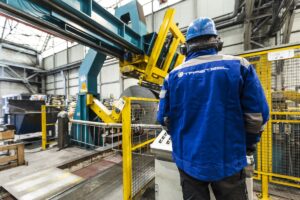


The big hype seen around digitalisation last decade has gone, but digital processes will be critical in supporting the steel industry’s transition to electric arc furnace-based steelmaking, as well as ensuring scrap quality and closed loop systems. Transparency in the sharing of data will be crucial. Artificial intelligence will meanwhile play an increasing role in process automation, but the human component will remain indispensable.
So said Primetals Technologies head of industrial digitalisation Kurt Herzog during an exclusive interview with Kallanish at the technology supplier’s flagship location in Linz.
Europe an old hand at digitalisation
There was a time when people believed big data would solve many problems in manufacturing, but how to utilise this data is the critical next step to ensuring improved industry performance.
European steelmakers have been integrating digital processes in production for decades, but their often tailor made software is ageing and the people who developed it are retiring. “So, maintenance of the software is a huge issue,” Herzog said.
Compared to China, whose approach is build huge data infrastructure, collect data and then “start thinking about what to do with the data”, Europe says: “There is already a lot [of data available]. How can we expand that, and how can we generate the quick benefit of everything we are doing?” he asked.
Digital processes support competitiveness but software investment hesitant
In the current low-margin steel industry climate, digitalisation can support steelmaker competitiveness and reduce cost per tonne.
“How often is a slab produced with a defect which is not detected or considered, but it’s still going through the rest of the production process, and at the end, the final product needs to be scrapped? There is a huge amount of energy and other costs to finalise this product, although I know the slab is not good,” Herzog noted.
Digital tools can be used to implement counter actions, to, for example, repair the product, reassign the slab to another customer, or scrap the slab if it is deemed unusable.
Intralogistics are another important digitalisation lever. This may “sound rather boring” but digital processes can help navigate the “trade off” between mills wanting to offer short delivery times but therefore needing to have sizeable material in stock, “which comes with a lot of money, bound capital”, he continued.
However, while mills are spending big sums on the equipment, they hesitate to spend relatively smaller sums, amounting to a low one digit percentage of the asset cost, on the right software solution to ensure the best use of the hardware and return on investment, he noted. “There is a KPI when equipment is bought, which is, what’s the cost per tonne of equipment? It’s a KPI that’s hardly applicable to software, and that’s the traditional thinking in the steel industry,” Herzog said.
Production route transition neutralises human knowhow
Digitalisation will also support the process of steelmaking decarbonisation in two ways, directly and indirectly, as an enabler. Directly, it can optimise the production process to, for example, reduce fuel consumption, or increase the yield by better steering the product quality along the production chain – these result in a reduction in carbon footprint.
“If I have to cut off pieces, because the quality is bad, the CO2 footprint of these cut off pieces is projected to the sellable [steel] pieces,” he noted. Quality control can ensure the amount of sellable products “stays high or gets higher by early identification of quality issues and recommending counter actions”.
These measures provide a quick return on investment but their scope for emissions reduction is limited. The indirect support provided by digital processes enables production route transition, which yields the biggest emissions reductions.
“Is an operator of a blast furnace capable to operate the direct reduction plant? No. Is a BOF operator capable to operate an electric arc furnace? No. So all the experience collected in the past, the value is zero. I mean, they are still operating those aggregates in the transition phase. But for the electric arc furnace, the value is not there. So what digitalisation can do is support operations in operating these new plants by providing a high degree of automation, digital assistant systems, that the high level of skills to operate these aggregates is not that necessary,” Herzog noted.
Moreover, it can provide training simulators to prepare teams to operate new plants, he added.
Hybrid BF-EAF operation presents a challenge
The combined operation of BOFs and EAFs on the same steelmaking site, a scenario envisaged at some European mills, including voestalpine, in the coming years, will require heavy support from digitalisation due to the challenges of planning and scheduling in this hybrid model.
“You cannot produce – if it’s a scrap based electric arc furnace – all the steel grades you can produce on the BOF … What is produced on the electric arc furnace, what is produced on the BOF? How not to break casting sequences, how to manage transitions, product transitions … If a steel grade can be produced on a BOF and the electric arc furnace, where is the lowest price of production? Is it on the arc furnace or on the BOF?” Herzog pointed out.
“Scheduling this hybrid production, managing this hybrid production from a timing point of view and the quality point of view is something where, I think, if you want to have a certain flexibility, it is not manageable by humans. This cannot be done by Excel. You need some very elaborate digital tools to manage this production,” he added.
AI will drive automation but human element remains
Artificial intelligence will not have complete autonomy over the production process because it cannot be trusted to avoid making a critical mistake. “Generative AI is something that will be implemented or used in support functions. When it comes to production, I still believe that data analytics will be the major lever to better understand the processes, and based on this analysed data, consistent decision making will support, or will happen in the production,” Herzog said.
Individual decisions made today by operators or process engineers every 30 minutes regarding, for example, needing to increase or decrease the coke rate in the blast furnace, can be defined by humans and then automated.
“If you digitise the knowhow of your best operator, in this way, your best operator defines how decisions are made. And this is automated. This means your best operator is on duty, 24/7, and by analysing the results of these decisions with AI tools, you can even improve this decision-making, and that’s where I see that the benefit will be generated in the next decade,” he noted.
“But when it comes to really steering, controlling the production, I think that there will always be this, call it intermediate step, which is still understandable by humans. Otherwise, I think it will not be acceptable,” he continued.
Scrap treatment, closed loop systems gain importance
A lot of research & development is already being done in Europe into solutions that ensure the removal of residuals from scrap so that the material is the right quality, but that costs are kept down. This involves metallurgical models on EAFs that make pre-calculations. “So I need to … simulate before I start to charge the furnace. Okay, what does this input material mean for the quality of the final product and optimise them? This is definitely something that will be necessary,” Herzog suggested.
One way to support this is ensuring data travels with the steel product all along its life cycle, from producer to end user. If 50 metres of a 200-metre coil have quality issues, the provision of the data to the buyer means he can cut off the defective section, not pay for it, and use the rest.
“The scrap would be sent back, which has the beauty that the scrap is well defined – if data travels back with the scrap. So if the steel producer knows exactly what the composition of the scrap is, it’s good to be used in the electric arc furnace,” he said.
Supplying transparent data does have its challenges, however. “Steel producer and car producer could jointly optimise the production process or the product specification. There would be huge potential, but sharing too much data risks intellectual property. So there are challenges; if these can be solved in an elegant way, in a feasible way, in the sense that both parties can live with it, I think that there will be huge potential,” Herzog concluded.