

The European Commission has initiated a safeguard investigation into imports of grain-orientated flat-rolled products of silicon-electrical steel (GOES), perceiving sufficient evidence to assess the necessity of new trade protections.
The investigation, launched on 27 March, will also cover steel laminations and cores (SLC), whether or not stacked or wound, for transformers and inductors.
Imports of GOES are not under the scope of the EU’s existing steel safeguard, nor its July replacement. The Commission notice cites an increase of 109% and 82% for GOES and SLC imports, respectively, in the year to 30 June 2025, stating that the “increase in imports appears to be the result of unforeseen developments such as increased production capacity in third countries and the ensuing risk of further increased imports on the Union market.”
Excess global capacity for GOES is said to exceed EU consumption by 64%, leading the Commission to conclude that further injury to domestic industry is likely “even if only part [of the excess] is redirected to the Union market.” The Commission also highlights the imposition of trade barriers to GOES imports in other jurisdictions in compounding the threat to the EU market.
Interested parties have 21 days from today’s publication of the safeguard notice in the Official Journal to submit issued questionnaires, written views, and supporting evidence. Market participants or other relevant parties should notify the Commission, ideally within 15 days, to register their interest.
The investigation will cover CN codes 72251100 and 72261100 for GOES, and 85049013 for SLCs.
GOES steels from China, Japan, South Korea, Russia, and the United States are currently subject to anti-dumping duties composing of minimum import prices, and maximum ad-valorem rates.
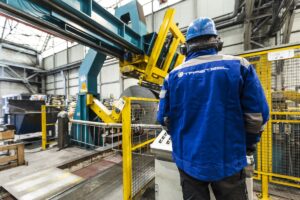
European steelmaker Thyssenkrupp announced this week that it would extend shutdowns of its GOES production in Isbergues, France to September 2026 due to import pressures, stating 1,200 jobs across Germany and France were at risk from non-competitiveness in the EU market.
According to McCloskey’s sources, relevant steelmakers have been pushing hard for an inclusion of GOES and SLC-related products in the downstream extension proposal for the CBAM, potentially offering double-shielding from import pressures if both the safeguard investigation and CBAM extension result in new barriers to GOES or SLC accessibility.
“The Commission’s announcement shows that Brussels is not finished with its efforts to shield the EU steel market,” said Yuriy Rudyuk, Partner at trade-specialist law firm Van Bael & Bellis. “In fact, the decision reflects a broader policy direction: safeguards remain a relevant instrument, and we may well see more safeguard actions across additional product sectors in the near future.”
Rudyuk’s comments are particularly relevant as the EU labours to replace its current safeguard system – necessarily expiring in June under WTO maximum 8-year term rules – with a new permanent framework, pursued under Article 28 of the WTO’s General Agreement on Tariffs and Trade and requiring extensive negotiations with trading partners. Safeguards, on the other hand, offer a unilateral solution to ‘short-term’ import pressures – and as demonstrated by efforts on the wider steel framework, these temporary solutions may well become permanent once term limits are reached.
Author: Benjamin Steven