

Restrictions on the export of scrap metal from the European Union to certain countries outside of the Organisation for Economic Co-operation and Development (OECD) from next year are expected to realign supply chains for secondary ferrous materials, sources told Fastmarkets on Tuesday September 22.
A draft published by the European Commission on Friday September 18 showed a proposed list of countries outside of the OECD which would be allowed to continue importing EU-origin scrap metal classified as “waste” from May 21, 2027 under the revamped Waste Shipment Regulation (WSR).
Twenty-four nations outside of the OECD submitted applications to continue receiving non-hazardous EU waste in compliance with the revamped WSR back in February 2025. The revamped WSR came into force within the EU in May 2026, with the export restrictions to non-OECD nations delayed for a further year.
Although applications from some European countries outside of the EU were approved for imports of metal scrap including Ukraine, Moldova and North Macedonia, the vast majority of applicant countries were rejected, the list shows.
Applicants had to demonstrate that imported waste would be managed in an “environmentally sound manner,” the Commission stated without elaborating. The proposed list is open for feedback until October 16, with adoption still planned for the fourth quarter of 2026.
Market panic
The draft has raised panic in key ferrous scrap importer markets over recent days, sources said, because if there were no major amendments, it could lead to European steel scrap being locked out of several major buyer markets like India, Pakistan and Egypt.
One way for recyclers to avoid their scrap metal being restricted by the WSR rules is to ensure that their material is not classified as a waste product by obtaining end of waste (EOW) status from an EU-accredited auditor if their material is of high purity, Fastmarkets understands.
But it is not known how many EU recyclers have obtained EOW status and for how much of their scrap metal output.
“Export restrictions on recycled metals are the wrong way to go. Introducing them via waste law does not make it any better,” Murat Bayram, president of the Germany-based Circular Metal Association (CMA), said on Tuesday. “Those who close international markets do not create additional demand or more competitiveness in Europe.”
“If European metal producers do not buy the available quantities, sales markets will disappear, material values will come under pressure and surpluses will grow,” he added.
Sebastian Will, deputy chairman of German metals recycling trade association BVSE, called for “open markets and real demand instead of new export barriers.”
Realignment in trade
The EU is the world’s largest ferrous scrap exporting bloc, exporting 13.76 million tonnes under harmonized system (HS) code in January-June 2026, according to Eurostat data, up by 10.3% year-on-year.
Its largest single buyer, Turkey, is not affected by the proposed restrictions because it is a member of the OECD, but there is potential trouble for importers in Egypt, Pakistan and Morocco – which make up positions two to five on the list.
“I think it could cause quite a significant realignment rather than simply removing tonnage from the international market,” a major exporter source said this week. “Turkey is OECD so EU exporters can continue selling there, and I would expect more European scrap to be pushed towards Turkey and the EU domestic market.”
“The bigger impact could be in India, Pakistan and Bangladesh – those markets would have to replace EU supply from origins such as the UK, US, Japan, Australia and other Asian or Middle Eastern exporters,” he said. “That should increase competition for available scrap from those origins and potentially support higher CFR premiums in South Asia.”
“Egypt and Morocco will be most affected in terms of European steel scrap,” a second major scrap exporter source said.
There is still time for an appeal, so “there is not too much panic in the market yet, but for exporters, [this could be] very bad,” he said.
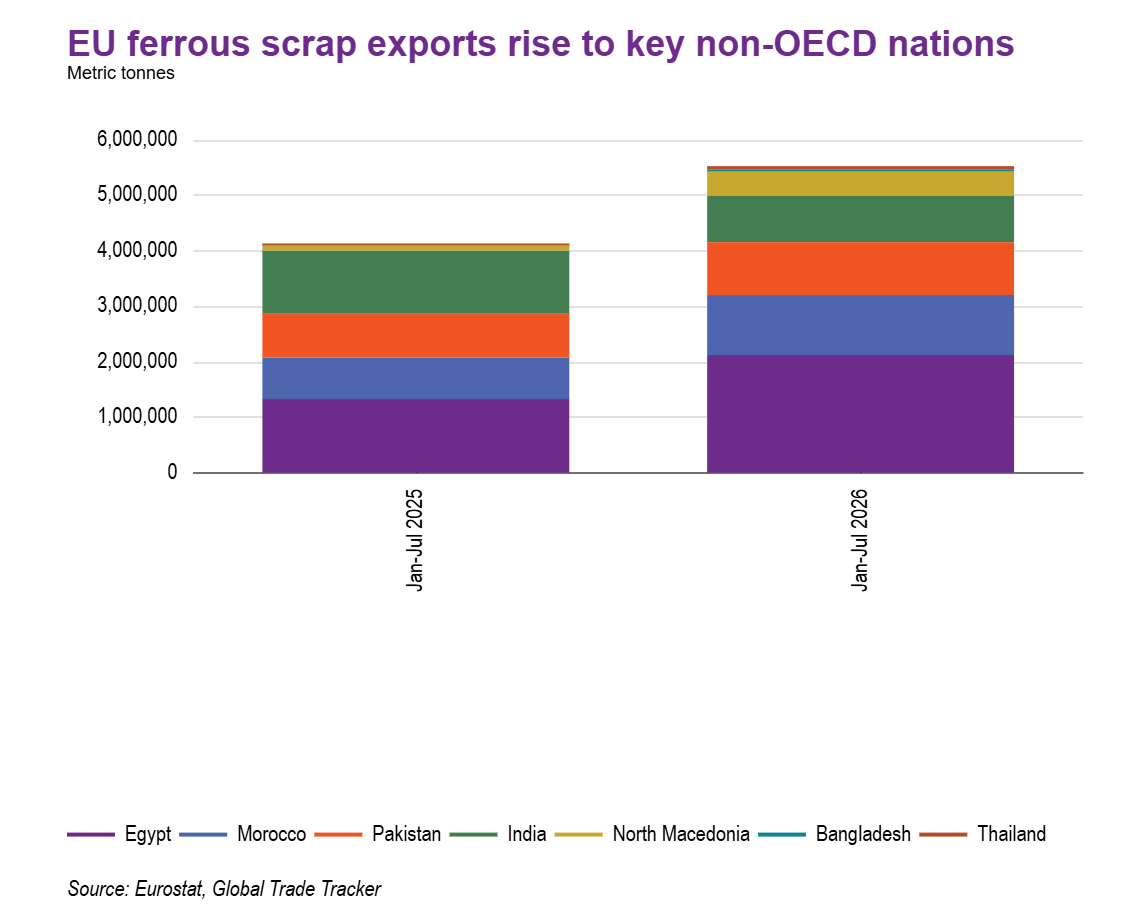
Egypt imported 2.12 million tonnes of steel scrap from the EU in the first six months of 2026, up by 59.7% year-on-year, according to the Eurostat data, while Morocco imported 1.08 million tonnes in the same period of time, up by 44.9%.
Both countries are raising ferrous scrap use due to rising local melting capacities for production of materials like rebar, and Egypt’s continued import safeguards of steel billet, according to market sources.
Knock-on effect in South Asia
Should key consumer markets in Asia such as India and Pakistan not receive approval to import EU waste materials under the final determination, demand for scrap in alternative East Asian export markets is expected to rise further, sources said.
This will have “an indirect but powerful impact” because importers from India and Pakistan relying on EU scrap will shift their focus to nations that export larger volumes to Bangladesh, such as Singapore, Malaysia and Australia, a Bangladeshi source said on Friday. “This will ultimately impact prices in South Asia.”
Asian ferrous scrap traders in East Asia said that although there is still time given this is a draft decision, demand from South Asian importers which currently buy from the EU may be redirected to Japan, Australia or New Zealand.
“If not from them, then where would they get their scrap from?” a Singapore-based trader said, highlighting that Bangladesh is especially vulnerable given its scrap import dependency.
The source, however, also cautioned that there might not be sufficient scrap to go around, adding that a good portion of scrap exported by Australia and Japan is already headed to Bangladesh.
Pakistan was the largest South Asian buyer of European steel scrap in the first half of 2026, with 952,110 tonnes – up by 18.5% year-on-year – while India purchased 832,375 tonnes – down 26.2%, according to the Eurostat data.
Fastmarkets’ calculation of the steel scrap shredded, index, import, cfr Port Qasim, Pakistan was $418.68 per tonne on Friday September 18, up from $365.19 per tonne on September 23, 2025.
Bangladesh imported just 40,154 tonnes from the EU over the same period, but imported major volumes from Asian and Oceania origins this year.
This includes 906,910 tonnes of imports from Japan, 499,707 tonnes from Australia and 462,887 tonnes from Singapore, according to Bangladeshi customs data.
UK position
One major exporter country in Europe not directly affected by the WSR rules is the United Kingdom, given the UK left the EU following a referendum in 2016.
Sources said they did not expect the UK to replicate the EU’s WSR rules at this time, which would allow UK-based scrap exporters unfettered access to non-OECD export markets.
“From a UK perspective it could actually create quite a sizeable opportunity,” the first exporter source said. “If UK material remains freely exportable while equivalent EU material is restricted, UK container exporters potentially become more strategically important to India, Pakistan and Bangladesh.”
“Given the volumes involved, I could certainly see buyers becoming much more focused on locking in UK supply,” he said, adding that he hasn’t “seen anything at this stage suggesting the UK will automatically follow the EU” given its waste shipment regime is now separate after the UK left the EU.
The second exporter source agreed, noting that he doesn’t think the UK will adopt similar WSR rules, and regards this as a benefit of the UK leaving the EU.
The UK is a pivotal exporter of ferrous scrap, and – like EU exporters – sells large volumes into key non-OECD markets including Egypt, Morocco and Pakistan.
UK exports of steel scrap were 4.92 million tonnes in January-July 2026, up by 7.5%, according to UK customs data.


