
“Do we want to leave European defense, research and development, the future of our kids, the green transformation – in the hands of non-European countries?” – Alexander Julius, President of European steel trade and distribution association, EUROMETAL.
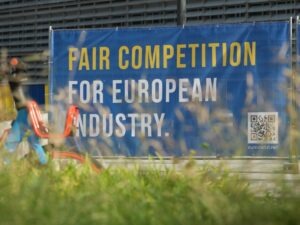
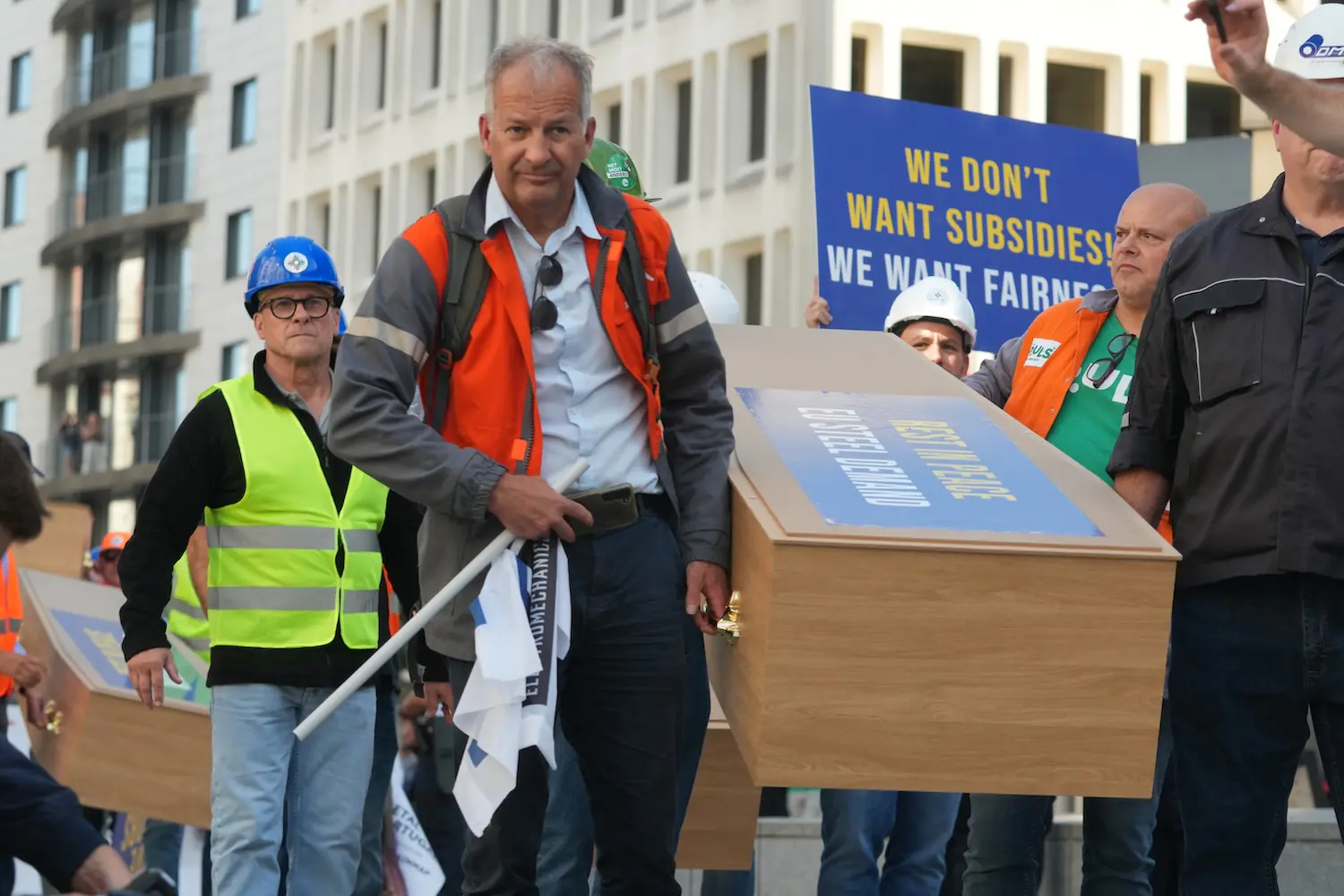
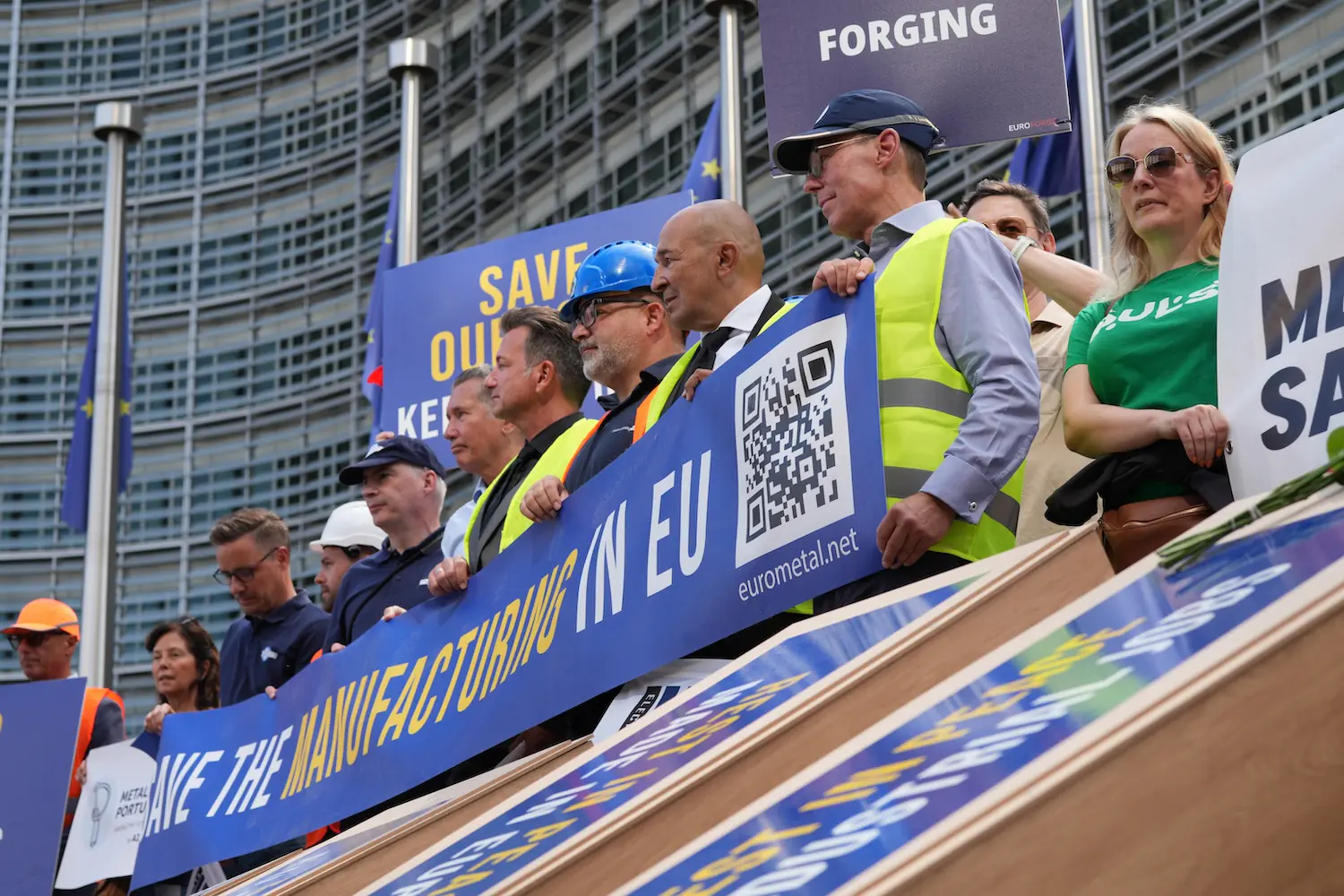
Representatives from across the EU’s steel sector held a symbolic funeral for European industry in Brussels on 7 September, laying ten coffins at the European Commission’s doorstep as part of EUROMETAL’s European Convoy for Industrial Competitiveness.
Reminiscent of similar efforts by Europe’s agricultural sector, the steel sector demonstrators were joined in their procession by a convoy of trucks, sounding their horns in concert as the coffins were laid in front of the Berlaymont, headquarters of the European Commission.
Conveying a symbolic death, the coffins were displayed with individual banners of “Industrial Jobs;” “Made in Europe;” “EU competitiveness;” “EU supply chains;” “Green Deal;” “Fair Competition;” “European Defence”; “European Factories;” “Industrial Independence;” and “EU Steel Demand” – commonly featuring a foreboding “Rest in Peace.”
McCloskey was on the ground in Brussels for the demonstration, well-attended by senior executives from companies across Europe’s steel value chain, and its representing associations.
The problem
Few would disagree that Europe’s industries are being put to the test: competitiveness concerns have grown to existential levels for European manufacturing, as domestic production costs are increasingly undercut by international exporters with cost advantages unavailable to European operators.
For industries such as steel, the potential loss of these capacities is likely to have real consequences: how can Europe retain global influence and attract competitive advantages in an increasingly fraught geopolitical context, if dependent on potentially volatile trading partners to facilitate its industrial survival, military capacity, and low-carbon transformation?
Seeing the danger, the European Commission has moved in the last year to mitigate some of these competitiveness pressures for its domestic steelmakers, attempting to ensure a future for steel production in the bloc to preserve its industrial backbone.
Two primary protective policy pillars have been constructed to hold the steel sector above water, on climate and trade grounds. Firstly, the Carbon Border Adjustment Mechanism (CBAM) entered into its ‘definitive’ stage in January 2026, mirroring domestic carbon costs to equivalent imports at the border; followed by reform of the EU’s long-standing steel safeguard system in July, doubling the EU’s steel tariff rate to 50%, while halving accessible duty-free volumes.
The effect on domestic steel prices has been significant, with European hot-rolled coil prices seeing a year-on-year gain of nearly 30% (EUR170/t) leading into September (McCloskey’s Northwest European hot-rolled coil price marker), with current prices 20% higher than when CBAM liabilities activated in January.
Additionally, as these protective pillars are intended to not only ensure the survival of the EU’s steel sector, but also facilitate its low-carbon transformation, the addition of a low-carbon premium to traditional steel pricing dynamics is likely to see end-consumers paying even more for their steel-containing inputs – especially if the EU forces low-carbon demand via green procurement mandates, already under legislative consideration.
The issue – with sirens now blaring broadly across Europe’s steel value chain, from steelmakers to manufacturers – lies downstream, as domestic manufacturing has not been afforded the same treatment in the European Commission’s protective efforts, and remains as of yet unshielded by both CBAM and the EU’s core steel tariff-rate quota (TRQ) trade measure.
As described by EUROMETAL President Alexander Julius, addressing the demonstrators, while upstream steelmaking enjoys new these protections, manufacturers downstream are being left to fight for global competitiveness “only on price,” despite many of its cost burdens coming from its own jurisdiction’s regulatory efforts – old and new – and the historical lack of effective EU-level movement to mitigate the bloc’s sky-high energy costs. Comparatively, the most aggressive international exporters have received subsidisations in their own jurisdictions, creating a significant policy cost gap that EU manufacturers are struggling to survive.
This creates a real risk that further cost inflation in upstream manufacturing inputs – and the consequent attempts of manufacturers to pass on these costs – sees buyers of the EU’s manufactured goods look abroad to lower-cost substitutive imports, resorting to skipping the European steel value chain entirely to preserve competitiveness in their own markets, or deliver maximum returns to shareholders.
EUROMETAL have already outlined the scale of the danger in their policy briefing “Steel Derivatives: The hidden threat driving Europe’s deindustrialisation”, finding that “Europe’s core industrial sectors – those most dependent on steel inputs – have been losing ground for over a decade” resulting in “a stealth mechanism of deindustrialisation, undermining Europe’s ability to retain value creation, climate responsibility, and strategic autonomy.”
How then to reverse this injury, or at least prevent its worsening, without overly abandoning core EU principles or values? In the absence of dealing with energy cost fundamentals, attendees at the Industrial Convoy for European Competitiveness would suggest politicians start with what they already have.
The solution?
There were scarce few demonstrators calling for the total abandonment of the EU’s climate ambition, or even for the individual scrapping of CBAM or upstream steel TRQ protections, despite the headache these developing regulations (often at last-minute) have caused European steel market participants over the last year. Be it faith in the importance of the EU’s climate leadership and trade protectionism, or political pragmatism, no demonstrators expected any significant reversals in the EU’s developing steel regulatory framework.
Instead, steel sector representatives across the value chain were near-unanimous in calling for a rapid extension of these new steel trade and climate protections to their downstream partners, seeing little point in protecting vital domestic supply, or distribution outlets, without also ensuring that European steel goods actually have a place to go.
While the European Commission is actively legislating to extend CBAM downstream, and has a similar consultation running for a limited first-step extension of the steel TRQs, there is still no decision from Brussels as to how far this extension should go, with different committee positions on CBAM’s extension alone still representing a lack of agreement on hundreds of downstream CN codes, and more substantive scope extensions to steel TRQs not scheduled for consideration until mid-2027.
Speaking to representatives at the demonstration, part of the solution may be to acknowledge that no best-fit extension strategy exists, instead implementing wide-ranging protections as a first step, then potentially weakening them, or exempting certain products where protections are deemed unnecessary, or ultimately do more harm than good (via a lack of EU supply availability, or export competitiveness factors).
“Shotgun-style”, “protectionist”, “Trumpian” – however demonstrators described their desired protections, the goal was a common one: to convince the European Commission of the urgent need to forgo its slower-paced administrative tendencies and prioritise rapid industrial protections, less the EU’s industrial capacities face irreversible injury.
Producers in the EU steel value chain – while not overly represented at the distribution and manufacturing-focused demonstration – have separately voiced support for EUROMETAL’s efforts, including steelmaking association Eurofer, ferroalloy producers’ association Euroalliages, forging association Euroforge, as well as other producing associations like those for the EU’s copper and aluminium segments.
“Once European industrial capacity and good jobs disappear, rebuilding it is far harder than preserving it,” European steel association, Eurofer, stated in a press release relating to the demonstration.
However, end-consumers that require a range of steel-containing manufactured goods, such as the automotive sector, have largely resisted further regulatory cost drivers in their supply chains, fearing for their own competitiveness should they have to sustain competitiveness in markets at home and abroad amid compounding inflationary pressures from the extension of upstream policy protections.
The risk is real: German automaker Volkswagen announced an additional 50,000 job cuts across its global operations earlier this week, citing excess capacities in Europe, as well as poor demand, and competition burdens as factors.
Earlier this year, industrial resistance downstream contributed to the Commission’s delay of the EU’s first official low-carbon steel label under the Industrial Accelerator Act to the Ecodesign for Sustainable Products Regulation, after member states were unable to reach a compromise between “Made in EU” and low-carbon content specifics in a demonstration of how regulatory ambitions can be tempered by competing national industry interests.
But for participants in the European Convoy for Industrial Competitiveness, their own industrial reality is telling them that time is up, and that the EU must move now if it wants its newly protected steel industry to have anyone left to sell to.
Author: Benjamin Steven